Tag Archives: armed violence

Two Truths: A 9/11 Reflection, Dr. Robert Zuber

12 Sep
See the source image

The hole that swallowed so much of ourselves.

Those who do not weep, do not see.  Victor Hugo

Chase away sorrow by living. Melissa Marr

Twenty years ago we were credulous and blundering. Now we’re sour, suspicious and lacking in discernible ideals. Michelle Goldberg

Half the night I waste in sighs. Alfred Tennyson

Every angel is terrifyingRainer Maria Rilke

Are we to spend the rest of our lives in this state of high alert with guns pointed at each other’s heads and fingers trembling on the trigger?  Arundhati Roy

Terror had them all for a moment, and it ravaged them, and when it was finished, shock had its way with them, and left them cold and helpless.  Dean Wilson

As these years of weekly posts begin to wind down towards a culmination of sorts later this year in Advent, the question of what is left to say looms large for me.  Our global community is literally drowning now in opinion and commentary of all stripes and conclusions, opinions more or less attentive to circumstances around their owners, more or less grounded in reality, more or less helpful in moving the needle towards healthier, more peaceful futures.

Commentary for us has never been a competition.  We don’t make money from it.  We don’t brand it.  We also don’t believe that ours is the only way for the policy community to proceed.  Instead, we’ve looked for fertile entry points for ideas that are surely not always our own but that deserve to be considered as policy is crafted and implemented.   Amidst a cacophony of “interested” opinions, we have never had an interest beyond creating cultures of policy more conducive to honoring promises to those who have felt the blunt end of armed conflict and other ills for far too long.

As this interest unfolds, it is sometimes valuable to find a platform a bit outside the fray.   We have ideas to promote, but we are not salespeople engaged in zero sum activities – my product or yours in the basket on its way to checkout.  The point of sharing ideas in policy settings is to make better ideas, more responsive ideas, more accountable ideas.  The exercise is – or should be – complementary not predatory.  We don’t “win” in this business.  The only question of relevance in this work is whether or not our constituencies win.

Apologies for the digression, but it is important as background to what will be attempted here – a modest contribution to a seemingly endless stream of commentary on the 20th anniversary of the 9/11 attacks.  I’ve been reading quite a bit of other people’s ideas this week – mostly emanating from a grief in some ways larger than the twin towers, a grief motivated by the reality that, 20 years on, the bombs are still falling, the ethnic violence persists, the famines rage, the vaccines are yet to be distributed, the conspiracies and stiff-necked perspectives continue to multiply, the children still search for comfort in a world which, in some key ways, is simply not fit for them.

My own grief is only one grief among millions and perhaps among the more self-indulgent of them.  Like many of you, I have my own 9/11 stories, but these pale among the stories of that “first truth,” those whose loved ones went to work that day and never returned; the firefighters and police ascending stairs in the towers that were about to collapse around them; their colleagues sifting through rubble that would jeopardize their mental and physical well-being for the rest of their earthly lives; the passengers struggling with kidnappers to divert a deadly flight over Pennsylvania knowing that their own fates were largely sealed; the people from a distance who watched helplessly as the last vestiges of their “national security” came unraveled, a security which, whatever its merits, would never feel quite the same as the towers fell and victims jumped to their deaths.

This is the always the first truth of armed conflict, whether conducted by gunships or commercial aircraft, whether taking place in Lower Manhattan or in central Kabul.  The human toll of conflict is as ubiquitous as it is persistent.  We pause to remember, even to shed tears, because a generation later there are still many holes to fill, holes as large as those at the center of the 9/11 Memorial; places at the family table still being held for those who will never again occupy them, but also the struggles of responders and others whose lungs have still not expelled the toxins in the rubble, have still not fully come to terms with what they saw and heard as they sifted through a gnarly aftermath that produced numerous corpses and poisonous exposures.

This is the first and most important truth of 9/11 but it is not the only one.  For the misery we experience is tied inextricably, in this instance and others, to the misery we inflict in turn.  9/11 was not the alpha moment of global conflict, but was one point in a long chain of violence, retribution, righteous indignation, nationalistic fervor and self-justifying aggression that, in the case of the US and other major powers, had long taken a consequential toll greater than the conflicts to which it was pegged, violence  which was often alleged to be “preventive” in nature but which we have come to realize has bred more of the threat our sophisticated weaponry was allegedly intended to mitigate.

This second truth is the truth about us, about what we did in response to 9/11, what we have justified in the name of those collapsed buildings, and what that justification has uncovered and unleashed in ourselves.  We remain grateful to those who have helped ensure that, over 20 years, it has been safe to fly in airplanes and take long elevator rides to the top of our ever-larger office towers. We should also be grateful for those at the UN who pursue elements of counter-terror policy – promoting border controls and aviation safety, ensuring accountability for terror crimes and addressing the uneasy status of Foreign Terror Fighters – all with the understanding that basic human rights must always be protected, that we cannot remove a blight on the global commons by adding to the volume of abuse ourselves.

At the same time, we have become a people, certainly often in the US, who more and more seem intent on “eating its young,” a people suspicious to the core of everything but our own motives, a people whose movements are constantly scrutinized in the name of “security” but whose freedom “red line” is not the powers that manipulate our tastes and violate our privacy but those who insist on basic hygiene to ward off a deadly pandemic; a people who routinely tolerate deadly violence undertaken in their name so long as it doesn’t screw up Sunday church or karaoke night; a people at war with ourselves in a manner that can be every bit as vicious and self-serving as the force we inflict –and mis-inflict on those of other nations.

This second truth of 9/11 is wrapped around a reminder that we have not gotten over this, have not gotten over the need to lash out in retributive and even ethno-centric violence, have not yet shed the tears that actually promise some relief and closure, that allow us to move forward and release the better of our “terrifying” angels rather than those mostly ready to lash out in anger and revenge in response to the “shock” of circumstances we share in common with others more than we allow ourselves to realize.

The justifiable tears we have collectively shed during this 20th anniversary of the 9/11 attacks have not, it would appear, made us see more clearly, feel better about ourselves, or risk more closeness with others. They have not cleared our hearts of malice, our lungs of toxins, or our brains of conspiracy.  They have not made us rethink our role in the world as a superpower fading in too many aspects save for our technology and military hardware. They have not made us less sour in our affluence and entitlements, less suspicious of everything and everyone but ourselves, less confused about our role and responsibilities in the world, less able to own up to our mistakes as a nation as a way of rebuilding trust and becoming what we still have it within ourselves – somewhere, somehow – to become.

The legacy of 9/11 is in large part about the losses we’ve suffered, but perhaps more about the impacts of those losses we’ve ingested and then tolerated for too long, losses that much too often, we have then chosen to inflict on others.  It is about what we have allowed an attack to do to ourselves, the spread of our self-justifying and reality-challenged views about our own people let alone about those in the world around us, views which continue to stunt our emotional growth, impair the pursuit of our ideals, widen our divides, keep us sighing and fretting at night rather than sleeping, and too often leave us feeling “cold and helpless.”

Much as we ask of individual clients in counselling, how long do we want the events of the past to maintain control of our current lives, to impede our zest for living and our capacity for closeness and care? This is a question for us all, one that holds the key to lives who can never forget, who will always need spaces for mourning and tears, but who can also refuse to renounce their responsibility to families and communities across this country and around this troubled world, including duties of solidarity towards those many millions who barely know a single day free from hunger, disease and “fingers trembling on the trigger” of guns that may well have originated in our own factories.  

The two realms of 9/11 truth are not mutually-exclusive; we can honor them both if only we would.

Internal Medicine: The Progress on Peace We Make and Need, Dr. Robert Zuber

4 Jul

Follow and improve the light before the darkness overtakes you.  John Fox

Knowing is not enough; we must apply.   Leonardo da Vinci

Your new life will be tinged with urgency, as though you’re digging out the victims of an avalanche. Douglas Coupland

Get it right today, for today will never come again.  Seyi Ayoola

You cannot prove your worth by bylines and busyness.  Katelyn S. Irons

Don’t forget that people are dying in hundreds every day, hurry up, don’t take time. Abraham Guesh

The last quote from Abraham Guesh was one of dozens of comments posted on our twitter feed to our reporting on Friday’s Security Council discussion on the complex situation which has long been unfolding in Tigray.  At this meeting, called by the US and hosted by France, UN Secretariat briefers highlighted the multi-polar politics and dire, violence-inflamed humanitarian needs experienced by many people living in this northernmost part of Ethiopia. For us, but much more for our commenters, it was largely a discouraging session.

In the Chamber, sharp differences on how the Council should proceed on Tigray, indeed even if the Council should proceed at all, were major takeaways from this session.  The Ambassadors of Russia and China were insistent that, with due recognition of the need for humanitarian assistance and “political dialogue, Tigray was essentially an “internal matter” for the government of Ethiopia and its self-selected African and global partners to work out. China specifically expressed the concern that a failure of the Council to carefully “calibrate” response would run the risk of “making matters worse” in a place where “worse” is, quite frankly, a bit challenging to fathom.

For others on the Council, the impacts on the people of Tigray from eight long months of violent clashes, climate change, locust plagues and other threats of existential proportions were of primary concern.   Led by the delegations of Ireland and Kenya, a focus was on urgently addressing what is now a longstanding humanitarian catastrophe as well as on the “tools” both within and outside the African continent that can be utilized to promote an end to the conflict and then, once peace is restored, more effectively help that region “heal from violence and deprivation.”

But as is the case with many sessions in this genre, it was not at all clear how or if the full Council was prepared to “hurry up” and do its part to open those pathways to healing.  The US Ambassador, hosting a press briefing prior to the formal Council meeting, alleged value in letting conflict parties in Tigray know that “they are being watched.”  Fair enough, but since when does “watching” in and of itself deter the violent abuses which are the precursor to humanitarian disaster?  The Council is ostensibly “watching” abuses unfold in Syria, in Yemen, in Myanmar, in Palestine, in Libya, even in Cameroon.  Is there reason to contend that Council “watchfulness” causes abusers to pull back, to reconsider, even to modulate their aggressions?   And if not, are there other internal measures that we might be overlooking (or misusing) that can address violence at earlier stages without, as China noted, “making matters worse?”

Following this Council meeting on Tigray, our twitter account literally exploded with commentary from Africans that in some ways mirrored the Council discussion itself.  Some were highly supportive of Ethiopian government actions and expressly thanked the Russians for having their back and affirming the “internal” nature of the conflict.  Others pointed to what they (and not without reason) interpret as a full-on genocide to which the international community has, at best, been slow to respond.   Still others focused attention on the access needed to more quickly and effectively alleviate humanitarian miseries which have festered and intensified over many weeks while also creating waves of human displacement, mostly into the Sudan.  Some even raised the prospect of political independence for Tigray.

Amidst this cacophony of political and humanitarian concerns and remedial options, the common threads of response were on the need for peace and the urgency of global action.  Even those touting the “internal” nature of this dispute understood that recovery and reconstruction will require assistance from beyond national borders.  The politics of conflict may often be internal, but the consequences of conflict are not, including in the form of displaced lives and ruined infrastructure. Moreover, what does “urgency” mean to a conflict which is 8 months old and many more months in the making?  If peace is the condition for effective humanitarian response, and speaker after speaker at this Council meeting (and on our twitter feed) affirmed as much, how can we better overcome the Council’s internal political divisions in order to respond more effectively and rapidly to escalating political conflicts within member states that continue to set off fires with deadly consequences across the world?

More and more, it seems, there are two factors at work which are in parallel creating unfathomable heartbreak for communities and credibility issues for the UN.  One, as already noted, is the tendency to see conflicts as “internal matters” that Council decisions cannot resolve but can make worse.  The other matter is related to existing levels of trust, trust that members of the Council are able and willing to put their own national political interests aside to do what is best for states on the verge (or in the midst) of conflict, that they are as committed to delivering on peace as they seem to be on ensuring humanitarian assistance when the peace, yet again and for a variety of reasons, fails to hold. It is also important to note in this context that Ethiopia is only one of many African states tiring of seemingly endless Council deliberations on African peace and security which to some smacks of a fresh and unwelcome iteration of colonial interference, despite claims by former colonial powers and other intervention-minded states that they are now “honest brokers” on peace which they surely have not always been in prior times.

Earlier on Friday, at the Integration Segment of the Economic and Social Council,  the Vice-President of ECOSOC, Ambassador Sandoval of Mexico, delivered some kind and hopeful remarks seeking to remind his UN colleagues that our policy “must have a human face,” and that we must commit in practical terms to whatever changes we need to make in order to deliver on our promises to sustainable development, promises which are not only focused on poverty reduction, water access and food security, but on forms of governance (including at the UN) that can deliver on the protection of human rights, the provision of justice, and the promotion of peace, and to do so with proper levels of thoughtfulness and urgency,  We are not always digging out bodies under avalanches, metaphorically-speaking, but there is much misery in our world, most all of it existing beyond our policy bubbles, and we must ensure that our delivery architecture at national and global levels remains ready and able to prevent crises or at least address them in the shortest possible time-frames, certainly shorter than the 8 months the people of Tigray have been crying for relief.  

But the membership of ECOSOC knows, as indeed we all should recognize, the extent to which the silencing of guns is indispensable to the fulfilling of other commitments to sustainable development and successful humanitarian access.  Members equally recognize that given current levels of armed threat, stoked in part by what appears to be growing levels of global distrust in the motives of our institutional system of security maintenance, it is no small matter to enable conflict hotspots to be allowed to cool, and to ensure that the coals of conflict are thoroughly raked such that a recurrence of armed violence is no longer an option.  But this is our job. This is how we have chosen to earn our keep.

To my mind, such tasks are largely internal affairs, not in the jurisdictional sense but in the cultural one.  As we push states (and offer them capacity support) to honor Charter commitments including to the protection of their citizens, our multilateral system and especially its Security Council must discern how to “prove its worth” to an increasingly incredulous global community, including to a growing number of states within the body of the UN.  It must also discern how to engage states on their protection responsibilities in ways that do not undermine national and regional efforts nor pour flammable liquid on already raging fires.  And it must be able to demonstrate, as a matter of its own internal growth, that the faces of conflict victims, the sounds of despair as lives and communities are ravaged, are essential to policy progress in ways that national politics and personal careers simply are not.

Indeed, as a matter of principle and accountability, we must all work in our various contexts to “improve the light” such that the darkness of violence afflicting too many in our world can finally be lifted. This is why we’re here.  This is why we have made the choices we’re made.  This is what we have given threatened constituencies a right to expect of us, that despite our own internal limitations we are determined to get peace “right” and that we are determined to get it right today, the only day that really matters to children and families, in Tigray and elsewhere, attempting to survive under a dark cloud of armed threat.

Smoldering Embers: The Fire of Violence we Fail to Extinguish, Dr. Robert Zuber

16 May
See the source image

Every day the community faces the possibility of breakdown — not from the forces of nature but from sheer human unpredictability.  Robert Heilbroner

The fundamental idea is not that of removing disturbing elements and letting things settle down, but that of introducing a peace-power among the disputants.  Vilhelm Grønbech

Endless numbers of speeches, publications, political debates do not have the function of getting at the root of important questions of life but of drowning them in verbiage.  Wilhelm Reich

A late justice is a lame justice.  Amit Kalantri

We protect ourselves to excess because we learned abruptly and painfully that no one else would.  Sarah Olson

There are innumerable ways to murder a person, but the most subtle and pernicious of these is to mutilate the soul of the innocent by denying or downgrading their uniqueness and their beauty.  Gerry Spence

Is not most talking a crazed defense of a crumbling fort?  Hafiz

Like others of my ilk, I am poised in front of a computer screen early on a Sunday morning waiting for the start of the Security Council emergency session following another long week of deadly violence in a conflict between Israel and Palestine that is as old as the UN itself.

The images from this recent, relentless exchange of hostilities have been heaped on top of so many others over many years, the fires we have addressed when they rage but which we never bother to completely extinguish, the embers of incitement and occupation, of intimidation and brutality that are one brisk wind away from igniting yet again, forcing the Council and other UN member states to public affirm their client interests or shrink into the background hoping that the red glow beneath the ashes from the last rounds of hatred and violence will somehow spare us all from what has almost become inevitable — more misery for the people, more trauma for the children, more narrow, nationalist justifications for occupation, more incitement to violence, more talking unattached to remedial response.

Amidst the disturbing images of buildings reduced to rubble with little warning for the civilians and media professionals who occupied them, the “iron dome” patterns in the night sky in response to missile attacks emanating from Gaza, the brutal measures adopted by Israeli defense forces on worshippers in Al-Aqsa Mosque at the end of Ramadan, the ecstatic jumping for joy of a group of Israelis as that same mosque was seen engulfed in flames, the young boy rushing to the head of a funeral line to say a final goodbye to his muirdered father. There is no shortage of heartbreak in these images of conflict allowed to rage, allowed to recur over and over. There never is.

Perhaps the most heart-tugging image of all was courtesy of a video widely circulated of a young girl surveying the wreckage from one of many air attacks on Gaza this week. As she held back tears, she remarked while pointing at the rubble “You see this? What am I supposed to do? Fix it? I’m only 10.”

She’s only 10, living in what some have called an “open air prison,” wanting to “help my people” but for now having to live with rubble both physical and psychological as she awaits her turn to serve and to lead, a turn which unless we cease this recurring cycle of misery might never come.

Sadly, as we know, hers is not the only story of childhood-denying misery, misery that will likely require herculean efforts to heal, misery which will turn a few children into heroic adults while leaving many others angry and despondent over years of having their beauty and potential denigrated, leaving scars that won’t easily disappear. Such scars represent a future in grave jeopardy for us all, a future for which we all bear some responsibility but certainly for the nations and institutions which continue to cover up abuses and other crimes, which continue to advocate for client states, simultaneously selling them weapons and undermining any timely prospect of accountability.

The UN earlier in the week gave good attention to another tragedy not as long on its watch, the genocidal violence committed beginning in 2014 by ISIL terrorists against the Yazidi people of northern Iraq, including mass executions of men and young women forced into conditions of sexual slavery.

There are differences between the situation facing the Yazidi and that now faces Gaza. While it may turn out to be the case that some UN member states have enabled ISIL violence through some nefarious back-channel means, ISIL itself has no visible state protectors. The violence which was inflicted against the Yazidi has been widely encouraged by the international community to be thoroughly investigated by UNITAD though this has so far not resulted in tangible prosecutions seven years after the occurrence of these abuses. Such investigations have only recently enabled the conditions for Nadia Murad and many other Yazidi to properly bury their murdered loved ones amidst a cloud of revisited sorrow, one piece of a relatively uncomplicated (if deferred) promise of some genuine closure, some eventual justice for perpetrators, some final resting place for the unimaginable pain inflicted over many months. Gaza currently experiences few such tangible promises.

And yet, there are several lessons from Iraq that could be applied to the violence in and around Gaza which as of this writing shows little prospect of abating: the importance of thorough investigation of abuses and competent justice mechanisms; the need for transparency regarding the political alliances and backroom deals that undermine the peace and justice we claim to want; the firm resolve to cease all arms sales and transfers into conflict zones; the importance of investigating and then sharing not only the specific consequences of armed violence but exposing the reticence of those tasked with ending violence to uphold their full responsibility to ensure that violence once constrained is not allowed to recur. In addition there is the lesson, largely unheeded, to put an end to a Council practice which enables the major powers to shield clients (Israel, Syria, Myanmar and more) from the legal consequences of the most horrific of their actions.

As the emergency Security Council meeting on the Israel-Gaza violence earlier this morning draws to a close, it is not at all apparent that we have learned the lessons which are now required of us. Despite some passionate and eloquent statements by Palestine’s Minister of Foreign Affairs and his counterparts from Ireland, Jordan and Norway, it is unclear that the US will loosen the most toxic connections to its support for Israel; it is unclear that the “back channel” efforts to resolve the violence claimed by some states will ever see the light of public scrutiny; it is unclear that arms trade restraint will soon become the norm rather than the exception; it is unclear that states are uniformly willing to help the International Criminal Court and other legal entities apply the lens of justice now becoming operational in Iraq to bring closure to so many Gaza children and others in the region terrorized and victimized over so many years by a range of violent acts; it is unclear if states understand beyond their own rhetoric that putting out the Gaza fire is not the same thing as suppressing the immediate flames, but requires more attention, more hands-on action, more responsibility to address all aspects of our current cycles of violence.

And part of this responsibility requires a commitment to discernment that is often hard to come by in diplomatic settings, discernment regarding our failure, metaphorically speaking, to ensure that the “campfire” of violence is completely snuffed out, that those embers of future destruction which continue to smolder long after we have damped down the most damaging and obvious flames are no longer allowed to flare up again and engulf entities and citizens with what in our current circumstance seems like an otherwise inevitable renewal of their searing heat.

We have the capacity to turn current political impediments into peace power, a “power” that demands of us a determination to ensure that the fire of mass conflict has been fully and utterly extinguished. So long as the embers of our once-raging violence continue to glow, so long as they continue to threaten, we in the peace and security community simply cannot claim to have done our proper jobs.

Community Foundation: The UN Slowly Localizes its Conflict Responses, Dr. Robert Zuber

23 Jun

Violence and

Any intelligent fool can make things bigger, more complex, and more violent. It takes a touch of genius- and a lot of courage – to move in the opposite direction. E.F. Schumacher

Extreme violence has a way of preventing us from seeing the interests it serves. Naomi Klein

Evil turned out not to be a grand thing…It was selfishness and carelessness and waste. It was bad luck, incompetence, and stupidity. It was violence divorced from conscience or consequence. It was high ideals and low methods.  Joe Abercrombie

Our age not only does not have a very sharp eye for the almost imperceptible intrusions of grace, it no longer has much feeling for the nature of the violences which precede and follow them. Flannery O’Connor

The tales of death were in their homes, their playgrounds, their schools; they were in the newspapers that they read; it was a part of the common frenzy — what was a life? It was nothing. It was the least sacred thing in existence and these boys were trained to this cruelty.  Clarence Darrow

During what seemed to be a particularly gloomy week in New York and a particularly hectic week inside the UN, I found myself reflecting on some of the logistical and personal complexities and distractions of life that have consumed so many of the people I know and know about: The people forced to confront their own mortality or caring for others forced to confront the same.  The family livelihoods hanging by a thread, drowning in paperwork and regulations that only the well-off can effectively manage.  The endless drone of advertisers and others attempting to seduce us into purchases and activities we’ve forgotten we can neither handle nor afford.

And these are just some of the problems and stresses facing those of us who are relatively “well-off” in this increasingly unequal world.

More and more, our brains seem victimized by a conspiracy of sorts, a conspiracy too often “divorced from conscience or consequence,” a conspiracy to make our economic and social contexts seem more powerful, more complex and more violent than they need to be. In the name of some combination of status, comfort, thrill-seeking and self-interest, we continue to burden our own lives and make it harder on those who will come after us. We create messes that that we have been resigned in the past to merely mopping up after the fact, but which now gush rather than trickle, “spills” that now threaten to overwhelm both our increasingly distracted brains and the standard institutional capacities we’ve authorized to mitigate unwanted impacts.

The UN this week took up a myriad of mostly-familiar, conflict-related messes from the Gaza and Afghanistan to Idlib (Syria) and the Central African Republic.  All of these conflicts have “spilled over” for some time and represent places where UN and regional efforts to quell the violence have so far been only minimally successful.  In sitting through these sessions and their seemingly endless “speechifying” (to quote the Dominican Republic), our thoughts extended to the people who have known little but conflict and violence in their lives, including the children who may not have experienced life on a consistent basis other than with homes, schools and medical facilities reduced to rubble, and with burials and explosions more prevalent than play dates.  How have all these conflict-related stresses affected their brains? How have they impeded their collective capacity to contribute one day to building that elusive “sustainable peace” that we talk about endlessly in UN settings?  How do we ramp up urgency to meet current security challenges given the diminished capacity that our violence, our distractions, our damaged politics and economics have inflicted on so many, young and old alike, worldwide?

Perhaps the best response to these problems in our recent hearing was articulated this week by the South Sudanese monitor and activist, Merekaje Lorna Nanjia, one of the speakers at an event on Security Sector Reform (SSR): Local Participation and Ownership of Reform Efforts, organized by South Africa on behalf of the Security Council Working Group on Conflict Prevention and Resolution in Africa.  Nanjia urged the designers of SSR programs to “learn from their mistakes,” including their frequent insistence that Reform is only focused on “hard” security matters involving combatants and not also about the skills and capacities that more directly impact that ability of communities to cope with the threats and consequences of violence.  She was one of several voices this week advocating for more attention to how violence diminishes human health and social possibility in myriad local settings.  She reminded the audience that in promoting security, the value of social “inclusiveness” can hardly be overemphasized.  And perhaps most important, she called for “demilitarization” that is in part about disarming those who create conditions of violence, but also in part about healing the minds of those for whom militarism has become the default standard for organizing daily life.

Slowly, thankfully, the UN is coming around to recognize that the damage inflicted on communities from armed violence is both pervasive and deep-rooted, and that effective SSR must accommodate the “mindset of citizens who have already had too much contact with militarized communities and instances of armed violence,” persons who have already had their capacities diminished and perhaps even their brains rewired through habitual trauma inflicted largely through the instruments of human conflict.

Ms. Nanjia was perhaps the most engaging speaker this week to raise the need for inclusive community involvement in security sector reform and conflict prevention initiatives.   But there were other recent clues that we are becoming more systemically successful at carving spaces in our own brains for more thoughtful and people-centered responses to our security-related responsibilities.  From the UN’s Rule of Law Unit urging both public dissemination of “basic information” about security and peace processes and more local agreements that can improve security in the shorter term, to the Former Ambassador of Fiji’s statement in the Treaty Body on the Law of the Sea advocating for greater attention to the “precautionary principle” in policy, there is a growing consensus regarding what one speaker noted at an African Refugees event this week, that we must learn to more effectively “tap into what makes us human.”

From discussions by force commanders on reshaping (and gender-mainstreaming) UN peacekeeping priorities to reflections on a Security Council resolution highlighting the needs of persons with disabilities in conflict situations, the UN this week demonstrated that it is slowly coming on board with the notion that the negative impacts of armed violence do not end when the guns are silenced; and that many of the assets to prevent violence, address its cerebral inflexibilities, and restore genuine hope for communities, are embedded in large measure within communities themselves.  As Poland explained in the session on the Council resolution which it co-sponsored, “persons with disabilities are often forgotten in times of peace and are even more likely to be ignored during times of conflict.” Given this resolution there is now a framework for change on a human scale, as Poland noted, change that local communities and stakeholders are generally best suited to make.

This represents an important insight and the pace of its acceptance must accelerate.  We simply cannot afford more security policy that ignores community, more security sector “reforms” that impede local participation, more violence that blocks out hope and possibility in local settings for the many who suffer its consequences.  In this “frenzied” moment of our collective history when human cruelty seems to be finding its new level,  we need the courage to take a collective deep breath, examine the “low methods” that too often accompany our high ideals, assess the interests that this current age largely services, and find new impetus for change within the communities that know best both their own people and what can most effectively heal their physical and emotional wounds.

Sounds of Silence: The Security Council Endorses Ambitious Disarming, Dr. Robert Zuber

3 Mar

Guns at Rest

Does not everything depend on our interpretation of the silence around us?  Lawrence Durrell

And at last you’ll know with surpassing certainty that only one thing is more frightening than speaking your truth. And that is not speaking.  Audre Lorde

People never expect silence. They expect words, motion, defense, offense, back and forth. They expect to leap into the fray. They are ready, fists up, words hanging, leaping from their mouths.  Silence? No. Alison McGhee

Talk, talk, talk: the utter and heartbreaking stupidity of words.  William Faulkner

The UN this week, much like the world at large, was replete with motion and “talk” on a variety of related fronts.  From dueling Security Council resolutions on Venezuela with acrimony to match, to renewed resolve (under the Kimberley Process) to turn remaining pockets of “conflict diamonds” into “peace diamonds” (as Romania and others insisted), the UN and those seeking to cover its many events had our collective hands full.

We of course welcomed all of this week’s interest by diplomats in security in all its diverse manifestations.   From a Norway-sponsored event to honor the 20th anniversary of the highly effective Mine Ban Treaty to a Japan-led event to commemorate the 25th anniversary of “human security” –an integrative concept beyond “hard security” preoccupations with weapons and alliances — we support (as most of you already know) holistic initiatives that seek to impact both over-produced weapons and under-inclusive governance; initiatives that seek to reduce weapons-related threats in part by addressing complementary challenges related to state corruption, climate-induced disasters and the persistent rights abuses and social inequities that provide too-easy rationales for so many to acquire and use weapons in the first place.

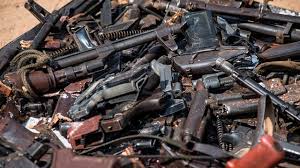
We urge states to address, as Poland mentioned this week in the Security Council, the “destabilizing acquisition” of weapons by states which cannot easily control their movements nor guarantee that weapons replaced by such acquisitions will not fall into the hands of non-state actors.  But we also urge action on the “destabilizing production” of weapons, the shiny new toys that are unlikely to provide any more “human security” than the toys states have already grown tired of.  To these ends, we have doubled down on support for efforts such as the Peace Angel’s “USA Weapons Destruction Campaign,” an initiative which seeks to repurpose weapons used to kill into works of art that can both inspire more peaceful communities and help identify ways to address the “triggers” of conflict that lead too many in these unsettled times to believe in the power of weapons more than in the power of the human spirit.

From the standpoint of a more secure world, this week’s main event was Wednesday in the Security Council where many delegations and a few civil society voices addressed the successes and gaps of the “Silencing the Guns in Africa by 2020” initiative.  Under the leadership of the Foreign Minister of Equatorial Guinea, the Council session was noteworthy for its verbal and active support of an aspiration that has proven to be more ambitious and complex than was perhaps originally envisioned, but which has inspired actions likely to accrue lasting benefits for more secure African societies going forward.

As 2019 reaches the “quarter pole” it would be foolish to suggest that gun-related “silence” across this large continent is likely to occur in nine months’ time.   Armed violence in many forms continues to impact African states from Burundi and Cameroon to Libya and Somalia. Al-Shabaab and Boko Haram insurgents are among the non-state actors indulging regularly in armed threats against civilians and government forces, and governments themselves have been responsible for armed attacks in South Sudan and elsewhere.  Moreover, the Security Council has authorized responses to insurgent threats, including the G5 Sahel Force, which have resulted in the importation of yet more weapons into theaters of conflict, albeit weapons lodged in the hands of “legitimate” authorities.  Whatever the merits of such supplemental and robust coercive measures – whether in Mali, South Sudan or DR Congo – at the end of the day these guns must also eventually go silent if the goals of this African initiative are to be fulfilled.

And yet, despite some notable setbacks, we have seen over these past few years an awakening of cross-regional capacity and resolve among Africans and their leadership which, together with UN and other supporters, have shifted at least part of the playing field regarding our responses to threats of armed conflict.  As evidenced by Wednesday’s Security Council meeting, the African Union and regionally-focused organizations such as ECOWAS and IGAD have undertaken a series of important measures to help ensure fair elections, mediate disputes within and between states, promote inclusive sustainable development, uphold the rule of law, and provide incentives for state leaders reluctant to share or relinquish power to rethink their alleged “indispensability.”

In Liberia, Eritrea, Guinea and elsewhere, threats of armed violence and rights abuses have given way to a welcome “silence” of sorts that must be fully utilized to consolidate gains and ensure that such abuses once renounced are not allowed to return.  These and other successes, perhaps even now in the Central African Republic as well, are in part a function of rapidly-evolving security architecture across Africa that will increasingly be able to “flag” emerging conflicts, mediate active conflicts, protect those displaced by conflict, and call attention to the many development and “human security” benefits that could well accrue in societies that have succeeded in finally silencing the guns.

Noteworthy for us in Wednesday’s Council debate were the pointed warnings from ACCORD’s Gounden and even a few diplomats about the need for vigilance in defusing the “time bombs” that tick loudly when guns proliferate in environments characterized by limited employment, governance challenges, unplanned urban growth and criminality.  The Council must, Gounden insisted, remain strongly engaged on the causes of armed violence in Africa.  The danger, he rightly noted, is that the guns will not be silenced but only the active and supportive voices of Council members.

And yet across seven “talkative” hours, it was apparent to most diplomats that “silencing of the guns” must continue and in concert with other “silencings” – of rights abuses and neglect of the rule of law (Belgium); of  discriminatory practices affecting the safety and access of women and cultural minorities (Ireland); of the constant march of development-desperate persons displaced by drought, flooding and conflict threats (Equatorial Guinea); of economic inequalities and illegal efforts to exploit natural resources for criminal gain (European Union); of the failure to include youth in policy decisionmaking, especially on conflict and employment (Botswana and Kenya); of impediments to education and health access (Angola), and much more.   Silencing the guns remains the essential condition that makes these other “silencing” tasks more likely to succeed.  Thus the key, as noted by South Africa, is to ensure that “that countries exiting conflict do not return to conflict conditions,” that guns once silenced are not permitted to roar again.

As the Foreign Minister of Equatorial Guinea noted during his opening remarks, “a conflict-free Africa will likely remain a utopia unless we promote inclusive development and put to use all available conflict prevention and resolution tools.”   This is, of course, sound advice, especially as the year 2020 inches closer.  Through this commitment to “silencing,” African states have sought to move mountains, and in fact have moved a few.  But as Namibia’s Ambassador reminded the Council, “if we want to continue moving mountains” on armed violence in Africa, we must begin by “lifting stones,” by engaging any number of smaller actions that set aside the “stupidity” of too many policy words and set about to build societies that can fulfill more conflict-related promises, end more social inequities, promote more trustworthy governance, and allow the displaced a safe and dignified return home.

As we sit here in March 2019, Africans are unlikely to meet their 2020 “silencing” goals at face value, but they have surely embarked on a path (albeit uneven at times) that offers hope both to their own peoples and to others watching across continental borders.  As this new peace and security architecture for Africa continues its evolution, we must all pledge to stay engaged.  This is simply not the time for the rest of us to withhold our own practical contributions or silence our own supportive voices.

What about Us?: The Children We Need, the Children We’ve Ignored, Dr. Robert Zuber

15 Oct

Puerto Rico

Those who have virtue always in their mouths, and neglect it in practice, are like a harp, which emits a sound pleasing to others, while itself is insensible of the music. Diogenes

When the human race neglects its weaker members, when the family neglects its weakest one – it’s the first blow in a suicidal movement. Maya Angelou

Last evening, I sat in a Harlem church, in a row filled with former members of my now-closed parish, and listened to the wonderful East Coast Inspirational Singers led by the equally remarkable (and former music director at my parish) John Stanley.

The music was both deafening and completely on key.   The audience was active and engaged, soaking in the music and the message, waving and shouting both their approval and their conviction that something continues to go terribly wrong in our world, something that they have at least a bit of resources and the will-power to help fix.

The “something” in this particular instance is the slow pace of response to the hurricane-related needs of the people of Puerto Rico (and other Caribbean communities).   This concert was meant to inspire donations to augment what many felt has been a pattern of government neglect, leaders taking credit for responses that have left most families still in the dark, children without schools to attend, health deficits made worse as residents consume contaminated water in the absence of any cleaner alternatives.

Some of these Harlem folks brought their children along, in some cases to fortify the impression that people still care about others down on their luck and that the plight of children living within and far beyond Harlem is deserving of more attention by others.  The concert raised almost $3000 out of pockets that I know in some cases to be mostly empty.  No one imagined that this gesture would be sufficient, would substitute for the oft-lacking determination by government agencies to fulfill their commitments to their own people.  But they had to do something.  And they did.

And they also painfully understood that if the message to the children brought to that concert was one of agency and concern, what message must the children of Puerto Rico take away from a crisis that has both profoundly disrupted their lives and possibly also confirmed their worst fears about how much (or little) they are valued by others?

Such questions gnawed at much of the UN all week as well. The “Third Committee” of the General Assembly heard from special rapporteurs about the often-heartbreaking circumstances endured by children in diverse global regions, especially the children displaced by violence, storms or drought, children on the move with or without their families, sometimes falling victim to traffickers eager to sell them off to sexual predators or even to harvest their organs.

At the same time, the rapporteurs also reminded states of their near-universal commitments to preserve the rights and dignity of children, to do everything in their power to ensure that next generations are capable and enabled to manage complex future challenges, including doing a better job of preventing the conflicts that continue to ravage prospects for future generations.

Beyond the 3rd Committee, the UN honored the International Day of the Girl Child with a quite upbeat Wednesday afternoon event featuring UN Deputy Secretary-General Amina Mohammed.    The theme of the event, “Empowering girls—before, during, and after crises,” was an important reminder of both the many skills of girls and the responsibilities of states. And yet, as with so many UN events, this one was also of no particular comfort to Caribbean children struggling with their families and communities to adjust to circumstances that they could not foresee and with no insurance agents standing ready to offer assistance like the ones they (when the power was still on) have seen on TV.  Nor is it of comfort to the girls who have reportedly been sold into marriage by Yemeni parents who see no other way to get their children away from the bombing and cholera to which they have daily been subjected.

The Security Council had its own engagements with the often-unsettling circumstances of the world’s children.   On Friday afternoon, the Council in an Arria Formula format welcomed back former SG Kofi Annan to discuss recommendations for addressing violence and discrimination against Myanmar’s Rohingya minority still to be found streaming into neighboring Bangladesh.   Calls by Council members to end violence committed by the Myanmar military, to address documentation and citizenship concerns of the Rohingya, and to conduct an official mission to Rakhine state (as suggested by Ukraine) were all most welcome, but again were surely of no comfort to the children fearfully separated from families, desperate for food and shelter, and struggling to shake off the horrific effects of the traumatic violence to which they have already been witness.

Earlier that day, with logistical and program support from Jo Becker of Human Rights Watch and others, the Council held still another Arria Formula event, this time focused on the grave (and seemingly growing) problem of attacks on schools by state and non-state military forces, including the forced dislodging of students and teachers such that schools might become “zones of occupation” for armed combatants.

The highlight of this event for many in the room was the address by Joy Bishara, one of the Chibok Girls who managed to leap to safety after Boko Haram attacked the school and herded girls on to a get-away truck.  Joy is now a student in Florida (thanks to the intervention of a US Congresswoman) and shared her story in a clear and determined manner, evoking some emotional responses from Council members who lauded her courage and pledged to do more to keep this from happening to others.  One concrete outcome from all this “pledging” (we hope) is for more Council members to formally endorse the Safe Schools Declaration to prevent armed violence from compromising educational facilities and impeding student access to those facilities.

This was my second time listening to Joy (with her Chibok friend Lydia) and, while her talks were meant to share a story rather than critique a process, I was struck by the trust deficits that permeated much of that story — at least between the lines.  Where were the school guards on the night of the attack?  Where was the government security sector as the girls were being carted away?  Where was the international community as the rest of Joy’s classmates remained in a dismal captivity month after month?  Joy spoke of running for help after jumping from the truck and then “not trusting” those who offered it.   I’m guessing that her deficits of trust will turn out to be more pervasive than those directed at a Nigerian boy with a motor scooter in the middle of that night.

Returning to Saturday’s Harlem concert, one highlight of the event was a Gospel selection familiar to me and others, the key line being “what about us?”  What about those promises, those commitments?  What about those international resolutions and treaties, those constitutional protections and national implementing agencies? What about those state services missing in action? What about all that?

There might be no determination quite like that displayed by people of modest means and solid values who know the consequences first hand of our collective failure to ensure safe and productive passage for children.  Many of the older folks at this concert had lived through the ravages of crack cocaine and broken down schools, of sub-standard health care options and a hands-off attitude by police and other public servants.  They had shielded children not their own from bullies and bullets, but mostly from the creeping fear that they might not be worthy of empowerment, of a chance to have a voice and make a difference, even of the possibility of trusting the public institutions that rhetorically purport to have their best interests at heart.

This damage to the physical and emotional well-being of children has the potential to undermine our common future every bit as much as “competing” existential threats, including those related to weapons and climate.   We can and must do more at community and policy levels to reverse the “slow suicidal movement” wherein we pass on our unresolved crises to a new generation, too many of whom have already had their hopes and dreams senselessly impaired.

What about us?

Traffic Circles:  Addressing the Loops that Fuel Conflict and Undermine Dignity, Dr. Robert Zuber

19 Mar

Enslave the liberty of but one human being and the liberties of the world are put in peril. William Lloyd Garrison

Do something wonderful; people may imitate it.  Albert Schweitzer

This week at the UN was a bit of an “odd coupling” with legions of blue Smurfs showing up to promote the Sustainable Development Goals while Washington added to the UN’s funding anxieties and Pyongyang created new nuclear proliferation headaches.

It was also the first week of the annual Commission on the Status of Women (CSW), a massive (and in our view too often un-strategic) gathering that, in its best iterations, reminds us of the still-unfinished work of gender justice as well as of the many areas of policy and practice which are yet to become “women’s business.”

One area that has long been “women’s business” – as both advocates for change and tragically more often as victims of abuse — is that of trafficking.   This week, both in the context of a CSW side-event and in the Security Council under the UK’s leadership, the UN attempted to steer a more hopeful path that promises genuine forward momentum on this stubborn scourge beyond our conventional cycles of response.

The “complexities” of trafficking – so described by one inspiring Somali activist — were very much on display this week.   Diplomats and NGOs called attention to the multiple (and as Egypt and others noted) mutually-reinforcing networks that traffic in weapons, narcotics, cultural heritage and, worst of all, in persons themselves.   For his part, UN Secretary-General Guterres made additional reference to the “shine of some skyscrapers” in our cities that were dependent on “forced labor.”

What all these violations have in common of course is their assault on human dignity, putting persons in what many of us would deem impossible situations and then offering options going forward that are likely to accomplish little other than snuff out the last vestiges of self-respect.   This creates a pattern all too familiar and all too insidious – people risking (and too often finding) unacceptable vulnerability in an attempt to escape conditions of unacceptable vulnerability.

At CSW, it was noted again and again the degree to which trafficking and the “modern slavery” that so often follows in its wake constitute “money making machines” for transnational criminal networks, terrorist groups, unscrupulous government officials, and others simultaneously skilled in exploitation and dismissive of human value (and especially the value of women and girls) beyond their own limited circles of malfeasance.

The complexities of modern trafficking have contributed to responses that seem more like endless circles of frustration than pathways to progress.   This week at the UN, diplomats and NGOs alike commented on the degree to which armed violence creates breeding grounds s for trafficking in all its dimensions.   In the Security Council, Panama made linkages between armed violence and child marriage.  Nigeria noted the conflict-related misuse of captured girls as “baby making machines.”  In more general terms, the European Union cited the “spillovers of insecurity” that are caused by armed conflict and which very much include the enabling of hard-to-address trafficking networks.

At the same time, others in the Council made clear that the inequalities and vulnerabilities of societies create conditions ripe for human slavery and trafficking, but also for the perpetuation of armed conflict itself.  As Greece explained, trafficking in all its aspects remains a major factor in sustaining the “economy of war.”  And Bolivia was (as they have been since they joined the Council in January) insistent that the pervasiveness of inequalities is symptomatic of a larger systemic problem — that our economics and politics privilege competition over dignity, acquisition over equity.  We humans have spent too much of our collective history “taking what we want” even if it means (as it often has) lowering the threshold of our common humanity in the process.

Around and around we go – conflict fueling trafficking networks which exacerbates existing inequalities and discriminations which creates (as Morocco noted this week) new breeding grounds for conflict.  It is a cycle that frustrates, a loop we cannot easily escape, a ride from which we cannot seem to dismount.

But there are strategies afoot to help us fortify what Pakistan this week referred to as our “spasmodic” responses to the violence and criminality of trafficking. The UN Office of Drugs and Crime is doing its part to help strengthen domestic law enforcement and border controls.  Ireland and other states are actively exploring ways to improve legal accountability at national and international levels as one means to prevent future abuses.   UN Women and many of the participants of CSW are holding up the gender dimensions of abuse and insisting that policy accommodates each and every one of them. The Security Council’s Counter-Terrorism Committee is helping to disrupt the financial incentives for trafficking networks and undermine their internet-based recruiting.  At the same time, at least some of those Council members understand that trafficking response must involve all relevant UN stakeholders; that one UN organ cannot presume responsibility for an issue that takes so many forms, impacts so many development and security processes, traumatizes so many global citizens.  All are initiatives and insights worthy of “imitation.”

But the Council (together with the Peacebuilding Commission and other stakeholders) can take welcome leadership in one additional area. This week, UK Ambassador and current SC president Rycroft cited our collective duty to end the “instability” in which trafficking thrives.  Much of this instability, we would argue again, is a function of the armed violence that flares up and drags on in so many global regions.  With threats to UN funding looming, with assaults on human dignity seemingly as pervasive as ever, with so many illicit arms fueling so much unaccountable criminal violence, the Council must become smarter and especially more proactive in its security responses.   As Indonesia noted well this week during the debate, fresh efforts directed towards a more upstream “de-escalation” of conflict threats would be the ideal next step.