
Tag Archives: dignity

Ballot Blunders: Election Influence in a Partisan Age, Dr. Robert Zuber

18 Oct
Oregon's vote-by-mail gets scrutiny from inside, outside state

To win the people, always cook them something savory that pleases them.  Aristophanes

Numbers by themselves cannot produce wisdom and may give the best favors of office to the grossest flatterers. Will Durant

Good governance in a democracy is impossible without fostering in our communities and the electorate, an appetite for leaders who are committed to respectful conduct. Diane Kalen-Sukra

The wish to be elected cannot be more important than the wish to do the right thing.  Victor Bello Accioly

An election must be more than a search for honesty in a snake pit.  Stewart Stafford

Apparently, a democracy is a place where numerous elections are held at great cost without issues and with interchangeable candidates.  Alfred E. Smith

This is likely to be news to none of you, but the US is holding an election for president in a bit over two weeks.

And while national elections are frequently held with greater and lesser degrees of integrity – voting results New Zealand and Bolivia have recently attracted a fair amount of attention in the global press – the US presidential race has become something of an obsession (if not a circus), especially for policymakers and poll watchers in many global regions.

Despite (or perhaps due to) our commitment to weigh in on national issues only to the extent that they impact multilateral effectiveness, we have shared more of this obsession than would normally be the case.  It is a temptation at the ready to spend endless ink critiquing one’s own country under the guise of interrogating multilateral processes.  It is a temptation we have largely avoided over the past 20 years, though challenges to multilateral cooperation on pandemics, food insecurity and climate change have never seemed as daunting – and untimely – as they do at present.

Some of this recent obsession has a “bull in a china shop” feel to it.  Even after the past few years of attempting to roll-back US engagements in the world, my country retains an outsized influence in economic, military and even to some extent in diplomatic circles such as the UN Security Council.   And as citizens and leadership gawk in amazement (at times even pity) at the acrimony and disinformation that has infected our political life – or at least forced it out into the open – many fear the implications for small states and vulnerable peoples when rich and powerful states see their often sub-optimal checks and balances heading completely off the rails. 

When the largest animals scuffle, the smaller ones have the sense to move away.  But in a world that is as interconnected as this one now is, there is simply nowhere to run.  Many smaller states – in Latin America certainly but also in other global regions – have had to adjust with alarming frequency to the political and economic whims of their northern neighbor.  But in this time of pandemic and security unpredictability, when that neighbor seems to have less and less interest in honoring agreements and championing core norms and values meant to bind states in collaborative action, the chills felt across multiple global regions are no trifling matter.

And so this US election does matter to many beyond national borders as well – a referendum not on our hegemony so much as our sanity, not on our irascibility so much as our reliability.   Despite our laundry list of hypocrisies and self-exemptions based on some perverse notion of exceptionalism, there has been some sense at least that the values we say we admire – and that infuse most of the multi-lateral charters that we once sponsored and from which we now seek our distance – were deemed ours to uphold as well to champion for others.  There was some sense, albeit one now largely relegated to our rearview mirror, that to whom much is given, much is expected; that blessings are to be shared more than hoarded and that others have a right to judge us as we often judge others — by our deeds and not by our carefully and often self-righteously crafted brands.

As elections draw near and anxiety levels rise within and across borders, a couple of points on where we currently stand.  First a reminder that Article 25 of the International Covenant on Civil and Political Rights – to which the US accedes — conveys to all people “universal and equal suffrage,” which pertains not only to the right to vote, but to participate in civic life and have access to public services.    These are rights which the US has steadfastly – if imperfectly – sought to encourage in other states. 

Thus the shock from many global quarters as measures to disenfranchise domestically have been as numerous and shameless as the disinformation that accompanies them.  Thus the shock as our pre-electoral discourse lays out political competition among erstwhile domestic enemies seeking each others’ ruin rather than among citizens who share a franchise and a constitution.   Thus the shock as domestic gun sales go through the roof as though we were preparing not for a peaceful transition of power but for a violence-prone showdown among people whose differences – real and provoked — can no longer be reconciled.

As the agencies of the UN know full well, elections, are a pre-condition for good governance, not its guarantor.  But elections matter most when they are conducted with proper regard for rights of access, and when they are free of fraud and intimidation, as they can then contribute to elevating the legitimacy and authority of the duly elected government.  To those ends, many millions in the US are now determined to cast their ballots, even if it takes a full day to exercise their right to do so, and even if it is often with fingers crossed that their ballots will not arbitrarily be discarded or “harvested;” fingers crossed that the local heroes who have committed to deliver massive numbers of ballots by mail, who will count and certify ballot totals, and who strive to minimize illegal impediments to the legal exercise of a franchise, can somehow help produce a result that we can, quite literally, all live with.

In this context, the campaign season for this election is as troubling as any potential outcome itself, for it reminds us once again of how far we have fallen from the grace that our founders sought to bestow on those who would follow, a grace that we have sullied through selfishness and willful ignorance, through self-justifying lenses of partisanship and a corrupted nationalism which, as lamented this week in the General Assembly’s Third Committee by UN Special Rapporteur Okafor, “obscures multilateral benefits.”  Added to this is our propensity for short-termism that soils our own bed and risks a world for our progeny bereft of any bed at all.

Though we are hardly alone in this, we in the US have slowly chipped away at the effectiveness and credibility of our structures of governance.  We seem more willing than ever in my lifetime to gouge and humiliate each other in order to “win” and, if victory eludes us, to then deliberately and systematically undermine those who prevail even before they are formally inaugurated.  As the Washington Post wondered this week, can any election promise a viable path out of the extreme partisanship that has marooned us on ever-distant islands of opinion and practice?

We’re about to find out.  If you are in the US and legally able to do so, please vote.  If you are not so authorized, help us prepare for the possibility of fresh assaults on the integrity and legitimacy of multilateral processes that we and so many others have strived to uphold.   In either case, we would do well to prepare as best we can for choppy seas that will take all our wisdom and patience to calm and will leave more than a few immobilized with some incarnation of post-electoral nausea.  This election might actually result in a path that takes health disparities and climate threats more seriously, that honors more of our international commitments and shares governance-related information more transparently.  But an election alone will not be enough to rebuild trust in each other, to restore credibility within and across borders where it has been discarded, or to heal domestic divisions that have in some instances been festering for years.  

A commitment from elected leadership to “respectful conduct” would surely be one desirable electoral outcome, as would leadership more interested in “doing the right thing” than in consolidating political power. But these outcomes require common undertakings by the rest of us as well:  a pledge to respect each other across differences and to uphold rights and dignity of those beyond the boundaries of our tribe better than we have done to date.  Whether we recognize it or not, we’ve mostly all been swallowing pills of partisanship and self-interest. If upcoming elections are to achieve the larger result we need them to achieve, it’s past time for us to toss away that bottle.

Identity Theft: Restoring Access and Dignity for Millions, Dr. Robert Zuber

8 Mar

Without dignity, identity is erased. Laura Hillenbrand
Most people are other people. Their thoughts are someone else’s opinions, their lives a mimicry, their passions a quotation.  Oscar Wilde
Living a lie will reduce you to one.  Ashly Lorenzana
We experience ourselves our thoughts and feelings as something separate from the rest. A kind of optical delusion of consciousness. Albert Einstein
I find I am constantly being encouraged to pluck out some one aspect of myself and present this as the meaningful whole, eclipsing or denying the other parts of self. Audre Lorde
You are a thousand things, but everyone chooses to see the million things you are not. m.k.
One of the most interesting aspects of life inside UN headquarters these days is the diversity of conversations and events focused on what the Secretary-General has designated as the “Decade of Action” regarding fulfillment of our responsibilities to the Sustainable Development Goals (SDGs).  This decade seeks to make clear that while the SDGs require us to “stop doing things” such as polluting our oceans and discriminating against migrants, it also requires us to raise the bar to ensure food security, promote the rule of law,, create decent employment opportunities and much more.
From alleviating the impacts of violence on children to the statisticians charged with monitoring progress on goals from gender to environment, the UN is indeed making a good faith effort — and must continue to demonstrate even more — to honor its unprecedented promises to bring sustainable dividends to those for whom such dividends in the past have largely been a mirage.
And yet, sitting through these UN discussions of varying levels of interest and passion, there are several trends that we frequently notice.  First, there tends to be more problem sharing than problem solving. This “Decade of Action” is admittedly still in its infancy but it has not yet sufficiently permeated the “culture” of UN conference rooms.  Parallel reforms to the UN’s resident coordinator system offer the promise of development that is more tailored to circumstance and better coordinated with national development priorities.  But at headquarters the talk is still much about the logistics of forthcoming meetings or policy guidance on actions still to be taken rather than on states inspiring other states to do more for those genuinely in danger of being left behind.
The second thing we notice is a failure to clearly articulate the ways in which parts of the UN system are still “in the way” when it comes to fulfilling our common SDG commitments.  The primary culprit here might well be the Security Council, whose half-successes on preventing and resolving conflict (see Iraq or Yemen) contribute to enormous pressure being place on UN agencies responsible for humanitarian and development assistance.  Of the looming threats in the world that have the potential to wipe away development progress and drive humanitarian need to the breaking point, the persistence of armed conflict and the trafficking and excess weapons production which provide its oxygen remain as major culprits.  Indeed it seems as though more sustained policy reflection is in order regarding the “drag” on sustainable development coming from within the system responsible for ensuring such development.
And finally we notice that so much of the policy discourse focused on SDGs comes from the mouths of persons, like myself, who surely live under threats from climate change, ocean degradation and weapons of mass destruction, but for whom the bulk of needs and access issues associated with SDG commitments do not directly apply.  Indeed, even a cursory review of the 2019 Sustainable Goals Report reveals this often gross disparity between those in danger of being left behind yet again and those, like me, who are virtually never left behind.
For instance, according to the UN report, food insecurity is on the rise in many global regions, yet my own food access is both abundant and stable.  Access to fresh water is under threat in many places, but the quality of New York City drinking water is virtually unmatched among major global cities.  There have seemingly been some significant health-related improvements in recent years — notably with regard to tuberculosis, HIV infection and under 5 mortality rates — but health care access for many millions, especially those homeless or displaced, bears little or no resemblance to the doctors to whom I have access and who find ways to keep this now-aching shell of a body intact. Millions of children lack access to schooling and adults to literacy training, but my own educational profile is unassailable.
One can go up and down the line, across all SDGs and indicators to reveal a truth that those who make development policy live in very different realities than those who seek development assistance; that we in the policy community inadvertently put on display some of the very inequalities we profess to address. This is, at least in my own context and surely for others as well, a manifestation of privilege largely undeserved, a function of skill that surely exists, but skill that has also found its points of access to opportunity and resources far beyond its portion.
One such “portion” especially caught our eye this past week during a side event hosted by the UN Statistical Commission focused on a manifestation of inequality that is largely off our collective radar but which creates uncertainties and threatens dignity at depths that most of us could scarcely contemplate — and that is the matter of identity.
Identity is something we think about often in “developed” societies, though not in the same way that its deficit implies for the quality of life of too many in our world.  In our islands of privilege, we tend to see identity largely in terms of access and attention.  On the one hand, we generally possess multiple indicators of identify — birth certificates, marriage licenses, school diplomas, drivers licenses, credit cards, passports, social security cards, home and business addresses.  On and on it goes, pieces of paper that allow us to board airplanes, cross borders, access loans and medical attention, keep our increasingly complex lives in order, and  lay the groundwork for the next levels of success and privilege.
On top of this abundance is our other identity-related obsession, the “identity” that helps us to build a brand, get noticed, make sure “people are watching” both in the sense of earned recognition and in the sense of attention more akin to celebrity than substance, attention that “eclipses” as much of the self as it reveals.  In such instances we are more likely to exercise those “muscles” of separation and distinction than of complementarity and respect. The enormous personal benefit of being identified in this world as a diplomat, teacher, designer, farmer, nurse or even an NGO, is both a manifestation of our professional success and a privilege tethered to our worldly status, in response to which we now tend too often to skew the balance between the “optical delusion” of personal pride and the larger truths of gratitude and service.
But beyond the bloated contents of our wallets and egos, let the reader reflect for a moment what it would be like to survive in a world of constant uncertainty or even displacement, without anything like a proper paper trail to help establish who you are, where you came from, who you are connected to, who (if anyone) is watching your back.  No birth records or credit cards, no forwarding addresses for your personal effects, no national documentation that might be recognized as such by another state’s officials, no way for others to “know” who you are aside from whatever words you are able to successfully exchange with strangers. And, to say the least, no equivalents of the  little “blue badges” that allow those of us privileged to have one to access UN Headquarters and its many material and identity benefits.
In the Christian tradition this is the season of Lent, a time to do more for others but also to stop doing things which cause harm to the dignity and well-being of others — all in recognition of the gifts that accrue from a sojourn of faith, gifts that we did not earn, could not earn, gifts that have been lavishly bestowed  but in response to which much is also expected. It would be especially appropriate in this season to recall the many contributions from those who have made us who we are, the unearned identity conferred on us which underpins our own dignity and which, in our view at least, should inspire a more humble and just response to the identity and dignity needs of others.
That we in our “advanced” societies and our policy bubbles are literally “saturated” with identity opportunities and resources in a world where millions literally have little or nothing to “show” for themselves is one of the more profound and cross-cutting aspects of global inequality.  During the aforementioned Statistical Commission side event, reference was made to the launch of the UN Legal Identity Agenda. As we contribute as we are able within and beyond this UN policy space to identifying and reducing poverty, food insecurity, employment discrimination and other global scourges, we pledge as well to devote a bit of extra energy to ending the identity deficits which place both service access and human dignity in perpetual danger.

Justice Matters:  The UN Explores Multiple Pathways to Human Dignity, Dr. Robert Zuber

17 Jul

Roman

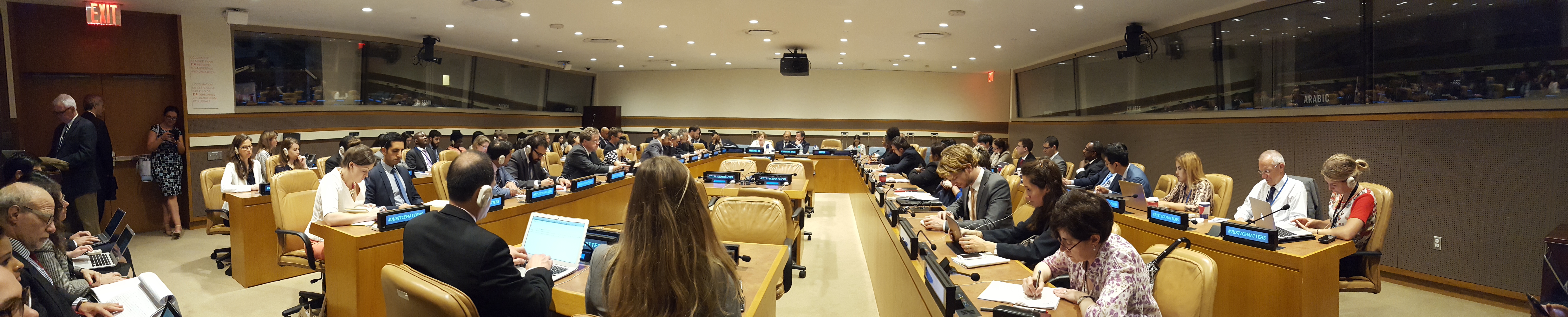
On July 14, Judge Silvia Fernandez de Gurmendi, president of the International Criminal Court (ICC), spoke to a packed conference room at UN Headquarters.  The event was chaired by Italy’s Ambassador Cardi and was intended as part of the UN’s acknowledgment of the International Day of Criminal Justice which falls each year on July 17.

The president hit many important notes during her address, including reminding the audience that the ICC is a court of “last resort” for the “crimes against humanity” under its jurisdiction, including the use of child soldiers, sexual violence as a tactic of war, the wanton destruction of cultural property, and soon the crime of aggression.  It is up to member states, she rightly noted, to help the ICC establish a “consistent pattern of accountability” for international crimes, in part by taking greater national responsibility for the investigation and prosecution of such crimes and in part through efforts to deter and punish those who seek to undermine the administration of justice through the ICC, including the interference with/harassment of witnesses.

The president did not take up several questions that some of us might otherwise have expected.  The ICC’s relationship to the Security Council, for instance, has been a contentious one that has included untimely referrals, massive security restrictions on investigations, significant budgetary limitations, and the Council’s refusal to sanction states that fail in their responsibilities to arrest indicted criminals.  Moreover, the president chose not to ‘call out’ states parties which have hosted – rather than captured – those very same criminals.

But what she did suggest was important: that credible international justice is essential to the restoration of rule of law, to human development, indeed to the dignity of victims.   She recognized that a “global system of justice” has many facets that are tied to the activities of courts, certainly to the vigorous promotion of internationally recognized human rights but also to a development and conflict prevention system that can uphold dignity and help ensure that the worst of crimes can be addressed in their potential before they unfold in grotesque practice.

As the president also recognized, other UN events during this past week touched on key elements of a global system of justice.   In the General Assembly, PGA Lykketoft convened a high level event to assess the human rights performance of the UN as it concludes its 70th year.   Fittingly, states used the occasion to promote the need to, as New Zealand and others noted, examine the implications of human rights across the three UN “pillars.” States from Panama and Chile to France and Estonia noted the many rights dimensions that affect people in overt conflict situations, but also highlighted those suffering from torture, discrimination, incarceration-related abuses and many other violations.   And while Liechtenstein rightly lamented that disregard of the ‘rules of war’ seems now to be reaching epidemic proportions, there was broad agreement with the Netherlands and others that we can do more  — and must do more — to ensure that people can finally live in a world “free from armed conflict.”

Last Wednesday in another small conference room, an “A” list of UN officials was brought together by Uruguay and Portugal to discuss the economic and social rights implications of the 2030 Sustainable Development Goals (SDGs).  ASG Šimonović set a collaborative tone, urging all of us “to bring human rights to the core of our development work.”  ASG Gass went ever farther, noting that the SDGs represent a “new social contract,” while lamenting a “shortage of tools” with which we can hold states (and others) accountable to their SDG promises.   Happily, Gass rightly suggested that the integration of human rights into the SDGs would help make accessible the more fully developed capacities within the human rights community which are already doing much to hold states accountable to rights-based obligations.  As it turns out, tools for SDG accountability need not be created.  They can be borrowed.

As for the convening states, there was enthusiasm for SDG-rights linkages but also cautious tones.  Uruguay’s Ambassador responded to those who see economic and social rights as “vague,” noting that genuinely sustainable development requires ‘dignity work’ in the form of ending gross social and economic inequalities.  Portugal’s Ambassador urged member states to show more leadership on core Charter values while simultaneously urging NGOs to help ensure that values espoused are values enacted.  But he also painfully referenced the many millions of persons in our world for whom rights and dignity remain only “a mirage.”

During his report on Friday in the UN Security Council, Special Representative Jan Kubiš made reference to the upcoming efforts by Iraq and its military partners to liberate the city of Mosul from ISIL control.   While clearly supportive of reducing all manner of ISIL’s influence, Kubiš also predicted that such liberation would likely trigger a humanitarian crisis that could dwarf the already horrific stories of deprivation and rights abuses (including by Iraqi forces) now emanating from Fallujah.  In many instances, it seems, “liberation” bears the potential to create and magnify trauma and deprivation in the name of eliminating them.  The Council, the government of Iraq and the entire UN community must leverage additional capacity to address the psychological and physical dimensions of victim’s assistance in all their aspects.

And of course to do more to ensure that the “pipelines” of trauma are effectively sealed, that relief is more than a fleeting mirage.

As the week’s events underscored, the struggle for sustainable human dignity is a long road, easier to claim than to protect.  As the ICC president noted, we live in a world in which “many perpetrators continue to be untouched.”  Sadly, there are millions more victims in our conflict zones who also remain “untouched.”   Our commitment – on sustainable development and international justice, on poverty reduction and trauma response – is to find the means and the will to touch them all.