Tag Archives: disabilities

Normal Range: Honoring a World of Difference, Dr. Robert Zuber

6 Dec
Image

If you are different from the rest of the flock, they bite you.  Vincent O’Sullivan

Everyone’s on the cliff edge of normal. Holly Bourne

In a society so governed by superficiality, appearances, and petty economics, dreams are more real than anything in the “real world.” Dominic Owen Mallary

Everything was perfectly healthy and normal here in Denial Land.  Jim Butcher

I claim to crave a bit of normalcy but now that I have some, it’s like I don’t know what to do with it. Gayle Forman

The normal world has no room for exceptions and always quietly eliminates foreign objects. Sayaka Murata

Though they may not (yet) have influenced your own life in ways that are tangible to you, the UN managed a quite remarkable week, albeit mostly in virtual formats, holding events on issues from aviation security and Africa security sector reform to transforming rural food systems and addressing the distinctive aspirations and circumstances of people of African descent.

Amidst this cacophony of policy deliberations and interests, two significant events grabbed headlines while another didn’t generate the interest it should have.  On Wednesday, the UN Secretary-General presented his “State of the Planet” address (at Columbia University) in which he detailed our “assault on nature” which continues largely unabated into the present, an assault that requires an environmental equivalent to “silencing the guns.” The SG passionately reminded us of the many “suicidal” climate impacts that we have done too-little to mitigate and which threaten us with both political instability and biological collapse. As he so often does, he ended his “world on fire” remarks by reminding us that we now have the skills and technology needed to right this ship, but both now require the most urgent application.

One of those aforementioned (what Peru referred to as “slow motion”) climate impact is directed related to human health, specifically the frequency of deadly pandemics or which COVID-19 could eventually prove to be merely a warm-up.  Thus, it was with great anticipation that we greeted this week’s General Assembly special session on COVID-19 response which focused on ensuring that approved vaccines are understood by states and stakeholders as a “global public good.” The other priority (with leadership from Latvia) was on reversing course with regard to the current “Infodemic,” the preponderance of misinformation and disinformation – some perversely intentional – which has complicated vaccine rollout and disappointed the researchers who spoke to the GA in humble (and sometimes frustrated) tones about their aspirations for the vaccines they helped develop, test and authorize for use at a remarkable, unprecedented pace.

These two were the highest of a series of high impact events, and rightfully so.  Both climate change and the current pandemic (and their overlapping “Infodemics”) are creating havoc in communities urban and rural, jeopardizing both our food security and our mental health, making life uncomfortable for the most privileged and literally unthinkable for the least privileged with more sliding into the latter category each and every day.

Such was the context for the annual meeting of the treaty body on the Rights of Persons with Disabilities that we look forward to every year, a time when the hallways of the UN are usually filled with people who are “disabled” in mostly physical ways but who have often struggled mightily and successfully in an attempt to overcome for themselves and others what are generally recognized as the primary barriers associated with disability – activity limitations and participation restrictions. 

The pandemic spread made it impossible to gather on site as we are often honored to do, to be in the presence of persons who come to the UN with their walking sticks and wheelchairs, with their hearing assistance and seeing-eye dogs to make the case that their “normal” is as entitled to rights, respect and recognition as that of any of the rest of us; that participation in social and political life is not a privilege to be bestowed but a right to be recognized; that the “soft bigotry” that Australia highlighted this week is related not only to the codification of a more conventional “normal,” but also to an arrogant ascription of low expectations for persons who can’t “do what we do” as though they might not also be able “to do what we can’t.” 

These misplaced codifications and expectations exacerbate struggles within communities of disability, mighty ones in fact.  Persons with physical disabilities must navigate a world designed largely to reinforce the comforts and conveniences of the conventionally abled, and we have heard story after agonizing story over many years as their largely inaccessible homes and communities makes timely relocation from bombing and flooding, from famine and insurgencies, particularly treacherous for both themselves and those accompanying them.  Moreover, especially in this time of pandemic, we recognize that “disability” in many global regions is taking some precarious and unwelcome turns towards higher levels of poverty, epidemics of narcotics dependency and mental illness, and other factors making it harder and harder to thrive amidst a host of still-potent accessibility and participation-challenged contexts.

This “soft bigotry” takes other forms, from our increasing reliance on the “normal” within our families and other social bubbles to the functional denial of the rights and skills of those billion + persons in our world who struggle to find their way within societies which seem to be designed and crafted around the abilities they don’t have and not the ones they do have.  

Some of this seems not so “soft.” The tendency to shrink “room for exceptions,” or even to insist that others hold their places on a “cliffs edge” of our own sense of what is normal, is sadly not unusual throughout our life cycles.  Parents of young children can experience high and sometimes even competitive levels of anxiety as they assess whether their children are following a “normal” development path.   Older children can certainly be prone to “biting” or otherwise intimidating classmates who for one reason or another fail to conform to “normal” social expectations, especially those of the “cool kids.”  Later in life, those sufficiently privileged can create domiciled havens in communities which virtually guarantee that the only people seen and heard on a regular basis are those who look and act “like us.”

While some of this is understandable, especially regarding the development of young children, the general pattern here is conducive to another sort of “Infodemic” – the (mis) communication that what is different is to be deemed alien or even threatening until proven otherwise, such “proof” being hard to come by.  In this time of pandemic and economic uncertainty the tendency to roll up the metaphorical rug of our lives; to restrict the circle of concern to a more “manageable” size; to let others worry about the access, participation and other rights of persons with whom we are rarely in contact; to restrict our experiences in the real world and then allow others to fill in reality gaps with conspiracies and other “information” designed to push people further into dens of grievance and retreat; all if this creates an unwelcome context for difference, including of ability/disability, one that reflects yet another, albeit largely unseen, barrier to rights and respect.

The irony here is that, as the pandemic and its economic consequences spread and deepen, as the impacts of a warming climate accelerate displacement and exacerbate insecurity and political tensions, the numbers of the “not normal,” the people who now find it harder and harder to cope in societies which seem habitually distracted at best and hostile to their needs and interests at worst, these numbers are certain to grow.  And as those who gathered around a largely virtual UN this week to assess the treaty guaranteeing the rights of persons with disabilities recognize, our responsibility is only deepening to ensure that those growing numbers of persons in all their aspects and circumstances, with all their levels and types of ability, are not also forced to cope with life challenges in some lonely, inaccessible, insecure isolation.  

Whether we like to admit it or not, we live in a world of “exceptions” beyond range of our ascriptions of normalcy, people whose diverse talents and abilities, whose broad and even uncommunicated aspirations and longings, are still not in sufficient balance with our “normal,” our taken-for-granted, than our fragile social, security and environmental networks can likely tolerate.  We need to honor these billion + life forces better than we do at present, to watch and listen to them, to consider more of what they have to teach the rest of us, even if they don’t realize they’re teaching! Moreover, we would do well to regain some of our misplaced sensitivity to the access and participation needs of others, protecting them as jealously as we guard our own. And we need to do this as though our lives depend on it.

More than many recognize, they do.

Home Depot: Reliable Spaces to and From Familiar Places, Dr. Robert Zuber

9 Dec

A person is, among all else, a material thing, easily torn and not easily mended. Ian McEwan

He showed me his scars, and in return he let me pretend that I had none. Madeline Miller

One of the most important things you can do on this earth is to let people know they are not alone. Shannon Alder

There can be few situations more fearful than breaking down in darkness on the highway leading to Casablanca. I have rarely felt quite so vulnerable or alone. Tahir Shah

The UN spent the week meeting in far-flung corners on issues that in some key ways would have fit nicely together.  In New York, a special event called to mind the special needs and special potentials of persons with disabilities.  Despite the fact that as many as 1 billion of our species has a recognized (if not always recognizable) disability, we continue to organize the world around those who can demonstrate more than a modicum of mobility, emotional restraint or sensory normalcy.   Even more insidious, we still look upon persons with disability through the lens of that disability, as though they could somehow be reduced to the “thing they don’t have,” as if “normal” was the objective to be aspired to rather than placing the unique set of skills one does possess – sometimes in abundance – into productive use in the world.

The failure to accommodate persons who don’t, through no fault of their own, conform to some arbitrary notion of “normalcy” has implications beyond access to education, employment or social services.   Indeed at two major events “off campus,” the reluctance to factor difference into our planning was on display, specifically our reticence to recognize that our current, severe and common vulnerabilities provide distinct opportunities and challenges for persons who perhaps “can’t keep up” in one sense but can contribute much in another.

These major events – one in Poland (on climate change) and the other in Morocco (on migration) could well have been organized in tandem as the failure to satisfactorily address one crisis directly exacerbates the other.  While there was some attempt to address issue linkages, especially in some of the Poland side events, it isn’t clear that the international community completely grasps the degree to which severe storms and unprecedented drought (not to mention bombs and landmines) drive often dangerous and chaotic migration flows of persons who can no longer make a go of it in the places they call home.  The Global Compact on Migration, which is scheduled to be signed by many high officials as this essay is being posted, is not completely silent on climate and disability challenges, but neither does it recognize the degree to which our planet has become a starting gate of sorts for all kinds of persons racing (if they can) towards borders and makeshift ports in the hope of escaping the effects of lakes turned to sand, schools and hospitals reduced to rubble.

If they can: There is no wheelchair access at the embarkation points.   There is no foam to brace the falls from clumsy ascents of border walls on legs that simply cannot hold the weight.   There is no security for those forced to run from border guards but who cannot see the flimsy trails to freedom or safety.  In every respect the desperate path to the possibility of a better life is made more difficult, more treacherous, more frustrating, more dangerous by “difference.”

And while the Global Compact’s concern is with establishing consensus principles of migration governance (which it does well by the way), it is less focused on persons for whom migration is essentially coerced, driven by circumstance at least as much as by voluntary will.   On one afternoon during an exposure in Marrakesh with Churches Witnessing With Migrants (CWWM), an event on the margins of the Global Compact signing, we sat with a courtyard full of (mostly men) who had fled from violence and economic uncertainty in several African countries, but primarily from the Anglophone regions of Cameroon where I have spent some good time in the past.  The circumstances in the courtyard were dire, but the people themselves were not.   While they waited for blankets and basic provisions with a stoicism that occasionally leaked anger and frustration we talked about the places they had come from, the places they hoped to go, the skills they sought to share, and the myriad of obstacles that seemed to block every point of potential access.

The mood in the courtyard, despite the remarkable efforts of the local church staff, was subdued, even resigned.  Were it not for the few children running around, making up their games, the life energy of these people would have suggested that they were at an impasse – unable to go further and yet unwilling for now to go back.  They all shared scars from violence endured and family support forfeited but the blind and the lame were not among their numbers.  This was not a journey for them to make.  They have little choice but to remain behind with hopefully enough of a safety net to keep them afloat until the political crises abate and the soils regain their fertility.

The people who made it to the courtyard were described as alternately angry and frustrated, in part because they were persons of some honor before their world caved in, persons who likely never imagined they would find themselves in an alleyway waiting for someone to distribute a few provisions so they could make it through another cold Marrakesh night. Even if these people had not been torn from their communities by a state and security establishment that couldn’t leave well enough alone, it is still disconcerting to discover that doors are more often closed than ajar – doors to basic necessities but also to the jobs and dignity they left behind many miles ago.

While some of us in Marrakesh tried to think through our responsibilities to a world increasingly pushed out of homes and livelihoods, the news coming from Poland was little short of grim.  We are not making our collective climate targets.  Indeed, due in part to influential climate skeptics and the millions who continue to live as though massive storms and mass extinctions are mere anomalies, this past year set a dubious and dangerous record for emissions.  Despite all the warnings, despite weather maps that resemble Hollywood-produced alien invasions, we mostly continue on our merry way, keeping our credit lines open and our borders closed.

Our CWWM event had moments of good policy insight though such were sometimes buried in the clear and present responsibility to meet the needs that manifested themselves (in this instance) at the church door, to feed and cover and comfort and refer, and even to make the stories of those on almost unimaginable journeys speak to the unconvinced or merely indifferent, journeys in this age of climate shocks, state-sanctioned violence and discrimination that are only likely to increase in number and dimensions of difficulty.

What most of these journeys have in common is that those making them exhibit limited trust levels, occasionally of the churches and other caregivers, certainly of governments and their multilateral Compacts.  To be fair, this Compact certainly has some wise referrals, including to fulfill our 2030 Development responsibilities so as to minimize the incentives for people to leave their homes as well as an injunction to do more to make a public case that, as with those in the Marrakesh courtyard, most migrants have skills that can contribute much to sustainable development whether in transit, at their intended destination, or back in their preferred communities.

But in this current matrix of mistrust, NGOs and churches are left to do what they so often try to do – fix the broken, bandage the wounded, satisfy some of the empty stomachs and even emptier souls, doing just enough to address the miseries and fill the voids such that government officials and their five-star entourages don’t have to feel too badly about migrant-related agreements that are largely government driven, government negotiated and –when it suits their purposes– government neglected.

Many at our CWWM event have often been in this difficult place, with needs staring us in the face while the responsibilities to make good policy that can impact the many beyond the courtyard also beckon.  We are not so callous that we can step over and around those facing acute need, even with the consequence of enabling governments to care less in the process. But neither can we leave policy entirely to the governments, the same governments who claim a sovereign right to keep internally displaced persons out of the Compact’s protections, the same governments that hesitated to meaningfully integrate special accountability for migrants with disabilities and others facing acute vulnerabilities, the same governments which relegate churches and NGOs to meeting the needs of those in their gaze while state officials grant themselves de facto permission to turn their own gaze towards other “pressing” matters.

The lessons for me this past week are clear:  We must provide care as best we can but not enable other persons and entities to withhold their own.  We must protect the right of movement but also do more to ensure that those wishing to stay in their homes can do so.  We who are able must contribute more to policies of protection and accompaniment for displaced persons remaining within national borders and not only people crossing over.  And we must ensure that persons with disabilities and others facing multiple vulnerabilities are given special attention, that their “right to migrate” is also honored.

We all have our scars; we have all faced metaphorical abandonments on dark and lonely roads.  Moreover all have contributed in some way to a violent, over-heated world where so many need “mending,” need accompaniment, need tangible reminders that they are more than the provisions periodically extended to them. These messes we’ve made; these vulnerabilities we’ve ignored; these will become the tests of our collective character, our collective attentiveness, our collective promise to heal as best we can the wounds of the legion of persons from many cultures and walks of life now on the move.

Highlighting the Gender-Disability Nexus, Felix Balzer

13 Apr


Editor’s Note:  The following is from Felix Balzer, a graduate student in the Global and European Studies Institute at the University of Leipzig in Germany.  He spent the month of March at Global Action’s office (courtesy of FIACAT) with lots of time spent across the street at UN Headquarters. Felix came to us with a passion for disabilities rights, and here he reflects on a relationship that deserves higher-profile policy attention from both the gender and human rights communities. 

Womenanddisability

You can not be strong at the expense of the weak. Hanan Ashrawi

And those who were seen dancing were thought to be insane by those who could not hear the music.  Friedrich Nietzsche

The difficulty of formulating policies of universal validity within the United Nations can at times be considerable. Finding common ground between actors is often complicated by the need to vindicate national or personal interest in ways that impede the creation of synergies between parties. When this is the case, clear and honest discourse can take a back seat to statements that prove of too-little value in inciting dialogue, but rather concretize the status quo when a larger and more connected vision is urgently needed.

Given this need, the present contribution seeks to raise attention towards a synergy that could prove crucial for the implementation of future strategies for sustaining peace. The example to be cited here was vividly discussed at a recent UN side event and shows in my view a viable approach towards a vital discourse within the UN that is capable of revitalizing a crucial linkage for the UN’s broader human rights and sustainable development agenda.

The event, “Working to improve our own future,“ took place on the sidelines of last month’s 61st session of the Commission on the Status of Women (CSW). The event stressed the need to strengthen networks of women with disabilities through the promotion of their human rights and economic empowerment, with the larger aim of fostering their participation and independence. This attempt included assessments of the responsibilities of governments, international agencies, and civil society that are involved with one or more of the stakeholders in this important but generally neglected relationship.

The current president and CEO of World Learning, Donald Steinberg, who was also past Deputy Administrator to USAID and a former US Ambassador, moderated the side event. He initiated the discussion by rendering a slogan pertinent to the movement for the political rights and participation of people with disabilities, a movement that seeks to alter often prejudicial views on disability: “Nothing about them without them“ or as the original slogan goes: “Nothing about us, without us.“

The first speaker on the panel was Ms. Sarah Costa, Executive Director of the Women’s Refugee Commission. She emphasized that the largest problem migrants with disabilities face is the stigmas they experience from others, especially but not only in “destination communities.“  At the same time, she criticized the lack of funding for institutions that can research needs and issues affecting women with disabilities, urging creation of more robust advocacy and service institutions and agencies that can “walk the talk” for people (and especially for women) with disabilities.

The next speaker on the panel was Stephanie Ortoleva from the Women Enabled initiative. Her group promotes advocacy strategies and legal advice to enhance women’s rights and disability rights globally. Stephanie stressed that 19.2% of women in the world are also persons with disabilities; thus complementary efforts to improve the social acceptance and general status under the law for these women are urgently needed. Further, she identified one of the key problems hindering the implementation of effective social policies in this area: the pervasive “siloing” of gender and disability rights communities rather than their mutually-supportive engagement. .

As the presentations came to an end, the panel stood in agreement that holding together the concerns of gender and disability can assist communities in bridging the development – humanitarian divide in the particularly challenging situations that often befall migrants; and even help to strengthen community resilience during times of unusual stresses and “shocks.“ People with disabilities are often in danger of being overlooked in our development and humanitarian assistance planning, despite the many contributions they are capable of making to more just and sustainable societies. This “overlooking“ appears to be even more pervasive when those persons with disabilities are women.

The event also demonstrated the need to “de-silo“ as much as possible all research and advocacy related to the rights and freedoms of persons. In the case of women with disabilities, the hope is that mutual engagement of their needs and rights could serve as a model motivating advocates to seek and find common ground in other emancipatory struggles for equality and human rights. Further research and policy deliberation focused on this gender-disability nexus is therefore needed to build knowledge and insight capable of informing human rights and development policy from a yet under-developed, but certainly rich perspective.

Through the Convention on the Rights of Persons with Disabilities, the  Convention on the Elimination of All Forms of Discrimination against Women, and political gatherings such as the CSW, the UN is determined to do everything possible to guarantee the human rights of women and persons with disabilities.  The side event described above was a call to the communities surrounding those conventions to pool their considerable energies and talents for the common good.

Disabling Inequality:  Establishing Conditions for a Healthier, Less-Conflicted World, Dr. Robert Zuber

6 Dec

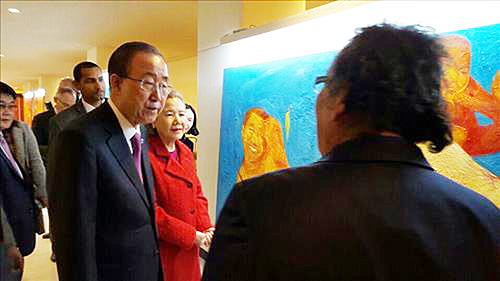
Korean Artist

On December 3, the UN commemorated the International Day of Persons with Disabilities with day long displays of art and film along with some stirring and inspirational panel discussions led by senior UN officials, influential diplomats and leaders of disabilities-focused organizations.

No fewer than seven Ambassadors followed presentations by the Secretary-General, ASG Bas and NGO leaders on disabilities, affirming their “commitment to action” in relation to the day’s theme, “Inclusion Matters:  Access and Empowerment for People of all Abilities.”   Among the highlights of those presentations was Kenya Amb. Kamau’s call for “inclusive education” to increase options and empowerment for persons with disabilities while also highlighting the degree to which such persons are disproportionately victimized by armed violence. Spain’s Amb. Oyarzun noted that it has been a decade since persons with disabilities “were no longer ignored in policy,” but also cited the long road ahead until equality of access is assured.  Amb. Yoshikawa of Japan and Amb. Bird of Australia highlighted the high mortality rates of persons with disabilities affected by humanitarian disasters and called for greater sensitivity in disaster risk planning.  And the current president of ECOSOC, Amb. Oh Joon of Korea, cited disabilities as a “cross-cutting” theme, the recognition of which by the UN has allowed it to better “lead by example.”

In a week when diplomats and activists in Paris were trying to stave off a climate disaster, the Security Council was trying to make sense of escalating violence in Burundi, other diplomats were wrestling with ways to make the Council’s sanctions system more fair and effective, and officials in the US were attempting to draw lessons from our latest mass murder rampage, it might seem that there are far more important things to focus on than the plight of persons with disabilities.

I think not.

One of the things that policymakers need to do more, and often fail to do, is to look beyond current crises to the societies left in their wake.   If we are somehow able to disarm our weapons and clean our waterways; if we are able to restore the ice caps and reverse species extinctions; if we are able to end mass atrocities and settle restless populations, then what?   How do we best lay the ground for societies that have some chance of consolidating the gains from crisis resolution in ways that minimize the risk of new crises taking their place?

The uncomfortable truth is that, sometimes, the burdens of our current crises often shield us from exercising this larger policy responsibility.  Discrimination against persons with disabilities surely seems less “existential” than climate and mass atrocity violence until we recognize the degree to which inequalities foment such threats and, indeed, impede their successful resolution.

This recognition is similar to comments made by Guatemala’s Ambassador Rosenthal during his review of the Secretary-General’s recent Peacebuilding report.   Echoing comments from others, Rosenthal noted that peacebuilding has been largely restricted to post-conflict settings.  And while the goal of eliminating recidivist violence is noble, the best way to ensure this is to work more creatively and “further upstream,” to breathe fresh air into our policy structures so to prevent the inequalities and discriminations that are the “first principles” of a dangerous planet.

The presence of wheelchairs, walking sticks and sign-language interpreters in spaces normally filled by persons lacking visible limitations reminds us of how carefully scripted and stubbornly “fashioned” life in our corridors tends to be.   We speak when protocol determines our right to speak.  We dress according to “western” business models even though many of us are not “western.”  And we mostly walk independently from one meeting to the next.   We see with two eyes, hear with two ears.  Our brains have been schooled to grasp the intricacies (and tolerate the tedium) of our policy discussions.  At the same time, we outwardly show little joy, share little of the emotional space that houses our own hidden “disabilities.”

And we have established social structures defined too much by competition and too little by kindness and respect: competition that is based largely on criteria that is both school-driven and limited in scope, with “winners” largely confined to persons with multiple formal credentials, conventional incarnations of beauty, aggressive ambitions, or well-sculpted physiques.  In most every instance, these are persons without recognizable “flaws,” such being determined by the very same people who have managed to avoid having, or at least showing them to the rest of us.

But of course there are manifold skills, talents and contributions beyond our socially-sanctioned ambitions, ones which we need both to solve our greatest challenges and to create those “peaceful, inclusive societies” to which we so often point, hoping that such societies can be successfully crafted such that they can somehow ward off another generation of existential threats.

Nowhere during this day of events was this any more clear than in the art exhibit “Like Wildflowers, Like Stars,” from the Korean artist Kim Geun-tae.  The faces he renders – children living with disabilities – show a range of emotions from confusion to joy.   Some faces appear remote while others are delightfully engaging.  Some of the children appear sick, others are physically incomplete, but few could walk this UN corridor and conclude that these renditions do not represent a veritable cornucopia of potential contributions to the societies that we need and want.

The lessons in the paintings are both simple and numerous, but two stayed with me.   One of the panels asks, “Does this child have cerebral palsy or polio?”  The answer comes:  “I am Min-june.  I am not palsy or polio,”  reminding that none should be defined by our limitations, the visible nor the hidden.  And the second lesson may have greater poignancy.  In a panel that depicts children with disabilities in obvious distress, the artist proclaims, “The harder we feel our lives are, the more firmly we have to grasp each other’s hands.”

Indeed, the more important it is for hands to be extended.

In reflecting on the beauty of the artist’s panels, on the often-wise content panels earlier in the day, as well as on the many grave responsibilities found daily on our policy plates, I cannot but wonder about my own “disabilities” — out of sight for the most part, but not without consequence for others.  For many of these “others” worldwide including persons with disabilities, life is hard now, and our collective response is not with hearts and hands fully extended.  Our crisis reactions are overly militarized; we are too dismissive of each other’s talents and contributions; we are inattentively sending species to extinction and threatening to do the same to ourselves; we do not “step up” often enough with understanding and welcoming hospitality; we allow ourselves to be distracted too often by so many things that just don’t matter.

Thankfully, these are all things we can do more about, some primarily in the realm of policy, others within our private dwellings and local communities.  In the end, as we were reminded this week, one of our best, most sustainable antidotes to social and political crises is to humanize the cultures of discrimination and inequality that now lie at their roots.