
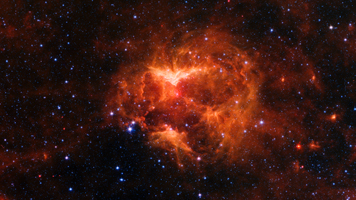
The Jack-o-Lantern Nebula Courtesy of NASA
All you have to do is write one true sentence. Write the truest sentence that you know. Ernest Hemingway
Much of what was said did not matter, and that much of what mattered could not be said. Katherine Boo
No persons are more frequently wrong, than those who will not admit they are wrong. François de La Rochefoucauld
Better a cruel truth than a comfortable delusion. Edward Abbey
The truth is rarely pure and never simple. Oscar Wilde
The truth isn’t always beauty, but the hunger for it is. Nadine Gordimer
It is far better to grasp the universe as it really is than to persist in delusion, however satisfying and reassuring. Carl Sagan
In a week when UN diplomats struggled, as they often do, to speak words that truly matter, that can truly inspire and clarify – on climate change, on international justice, on the latest iteration of longstanding struggles for peace in the Sudan and Mali, on the need to protect educational opportunity from threats of conflict, on the role of technology (including in space) in enhancing our lagging sustainable development priorities – it was a series of compelling images that captured more of my own imagination, more of my own bandwidth as I try in my own small way to help guide our troubled path.
Among the many ways in which I seem to be no longer “fit for purpose,” is my own preoccupation with words, their meaning and impact. I have tried over several years to “write the truest sentences I know,” not confusing “truest” with “true,” but also not reducing words to their instrumental value, as a means to some unconfessed end or as a mere tool for building a personal brand, staking out political turf or inflaming constituent grievance. I have always believed in the value of what is becoming more and more of a dead art – the careful selection and arrangement of words can help both to clarify and inspire, that can remind people of the proper contexts for the “facts” we toss around with reckless abandon, but also provide the takeaways that leave a “taste” that lingers long after the initial presentation has concluded.
The UN, as most of you know, often drowns in words uttered by speakers whose need to “present” often far outstrips the pedagogical value of their presentations. Speakers are assembled, and often over-assembled based on position and entitlement. Those who are authorized to speak are given every opportunity to do so, regardless of how familiar,predictable or even uninspiring their words are likely to be. A few speakers do thankfully say things which linger, which clarify, which remind listeners that predictable statements of policy or token gestures of deference to academics or civil society leaders are not the same thing as thoughtful, mindful reflections on issues which are generally speaking more urgent and complex than our presentations imply.
The UN, like many other institutions, routinely struggles to “get its message out,” to connect with people in diverse circumstances who need more than provisions and peacekeepers. More than we often recognize in this multilateral space, people also need a clearer sense that leadership “gets it,” gets the urgency of things, gets that “we” spend too much time speaking to funding sources and “excellencies” and too little to constituents, gets that “we” waste too much time and energy honoring protocol, including by expressing endless gratitude to speakers for episodically-inspiring remarks that “we” actually didn’t pay any attention to, remarks that often sound more like the political version of “nagging” than like a serious exploration of fresh options for resolving conflict and solving stubborn global problems to replace our largely stale ones.
Surely we recognize that our endless parades of “speakers” is more about protocol than substance, more about ticking the boxes of national or institutional interest than of exercising a pedagogical responsibility beyond institutional walls. Surely we recognize that the worst way to influence anything is through endless speeches largely devoid of metaphor or of genuine invitations to co-create a better future. Surely we recognize that much of what is said within UN confines does not matter enough in pratical terms and that much of what could matter cannot easily or readily be said, in part because no one is “authorized” to speak those words.
This week as in times past, the UN has struggled with the still-growing problem of disinformation and misinformation, largely focused on a pandemic that some still deny but also with regard to climate change that may or may not move beyond the pious words of global leaders who will soon convene in Glasgow and who continue to hedge their political bets regarding actions that might actually galvanize response at the levels now required. On Friday, the UN held a side-event entitled “Empowering Civil Society in Strengthening Media and Information Literacy,” during which attention was given to the current “infodemic” wherein what were descreibed as “established facts” were being systematically ignored if not outright rejected. A panel of journalists from different global regions made helpful, if sobering points, including highlighting the dangers facing journalists in this disinformation age, as well as the mass quantities of energy required to debunk errors and misconceptions, especially as those errors move from elements of cognition to lynchpins of identity.
As one of many who has abundant respect for the statistical and other expertise which the UN has gathered around itself; as one of many who deem the protection of journalists and other info-contributors to be of the highest priority; I still wonder if what heads of state referred to in the Security Council this week as “toxic narratives” (Kenya) and “demons” (Tunisia) reference a larger problem, one characterized by convenient condemnations of the narratives of others coupled with an over-confidence that our own narratives are somehow beyond reproach or even self-executing.
I have deep confidence in science, but also understand its essentially evolving nature based on fresh evidence. I believe in facts, but also understand that facts have a context, and that both require attention if “truth” is ever to become a less elusive goal. I have deep confidence in the UN’s expertise, but do not assume the value of that expertise to every situation where it seeks to be applicable. I have a “hunger” to see the core values of the UN Charter enacted worldwide, including its “rule of law” aspects, but also understand the degree to which those values have been tread under foot by people, including people like me, who have misplaced at least part of the responsibility to narrow gaps between what we espouse and how we live.
The narrative that too many of us now seem to adopt, deliberately or not, regarding some alleged chasm between “truth tellers” and “liars,” is itself unempirical, even dangerous. It appears that, more and more, we are witnessing a struggle in part about the nature of truth itself but even more about those who authorize and promote it. In such a scenario, the hill we need to climb seem to be less about facts themselves and more about cultivating minds open and receptive to their full complexity, minds attached to people able to demonstrate attentiveness to context, curiosity, courage, even (can we actually propose this) humility.
How do we enable these traits of character in a time when ideas are more about social identity than attempts to understand our place in the universe, more about comforting delusions than about the courage to face up to the reality of things as they are and our collective responsibility to fix what is broken, to more deeply examine the complexities of the truths we espouse but incompletely understand, to embrace the contexts of the truths we promote without slipping into some careless relativism?
Maybe words are now becoming, in and of themselves insufficient to these tasks. I mentioned at the beginning the “compelling images” from this week, and I am so very grateful to the contributions of some of our twitter followers who continue to send thoughtful and at times powerful images of art that can help us to see more deeply than we might be inclined to otherwise. I equally honor those who share extraordinary images from space – not the space that some now pay millions to visit for an hour-long joyride, but the origin of extraordinary images supplied by sources from Hubble to backyard astronomers, images of galaxies pulling each other apart or being slowly consumed by black holes, images of gaseous clouds allegedly containing enough alcohol to make 400 trillion pints of beer, images that stretch our hearts and minds beyond the moment, beyond the conventional, beyond the petty and familiar, images that remind us of just how much can go wrong in this vast universe and how very fortunate we are on this relatively isolated blue ball for the opportunity to push back hard against the life-threatening damage we have clearly been doing to ourselves.
This bit of the truth of our times was underscored by an enormously clever video produced by the UN Development Program (click here for the video), one which depicts a dinosaur making its way down the center aisle to the UN rostrum to remind diplomats of the obvious — that “extinction is not a good thing” — referencing both our habitual climate stupidity and the asteroids that created the extinction event for those large lizards. The video does a fine job of reminding we humans that this particular extinction moment is something we are doing to ourselves. There is no space rock that we can credibly blame for our current climate predicament. As such it is past time, as the dinosaur-speaker notes, for we humans, especially those in positions of authority, to swiftly agree to stop making “excuses and start making changes,” to stare our complex realities in the face with firm and flexible resolve no matter how unsatisfying and unreassuring those realities are now likely to be.
There are times when I am so “old school” I’ve altogether forgotten where the school was in the first place. But I can still recognize the genius of this video – its blending of jarring and unforgettable images with words (not gratuitious speeches) to match. Clearly the changes we need to make, and urgently, are about correcting the mistakes we are currently disinclined to acknowledge, about changing habits of behavior we continue to justify instead. But it is also about recalibrating the false dichotomies that allow us the indulgence of positing a world constituted by truth-tellers (ourselves) and liars (those others).
It is ironic that the light from those those birthing and exploding stars, those galaxies expanding and contracting, those nebula which we can anthropomorphize from a vast difference, that light left some of those celestial bodies during the era of the last major extinction event on earth. We don’t know with any certainty what has happened to those bodies since light was released from them so long ago. But we do have a good sense of where we are headed if we don’t put our petty political ambitions, gratuitious narratives and lifeless speech making behind us, if we do not take the risks we need to right this planetary ship before it finally tips over, ensuring at a minimum that all aboard will drown.
As one who has trafficked in words for most of his life, I am aware of how impotent words can be, especially when they fail to represent the “truest” that I know. We do need to identify and counter the “toxic narratives” and other disinformation with the best truth at our disposal, but we need to do so by ensuring “truth” that is rigorous, humble, attentive to context and pedagogically sound, truth that can help us make a more reliable, more inclusive, less-polarizing case for the world we can still have.


 gapwblog
Leave a comment