
Tag Archives: United Nations

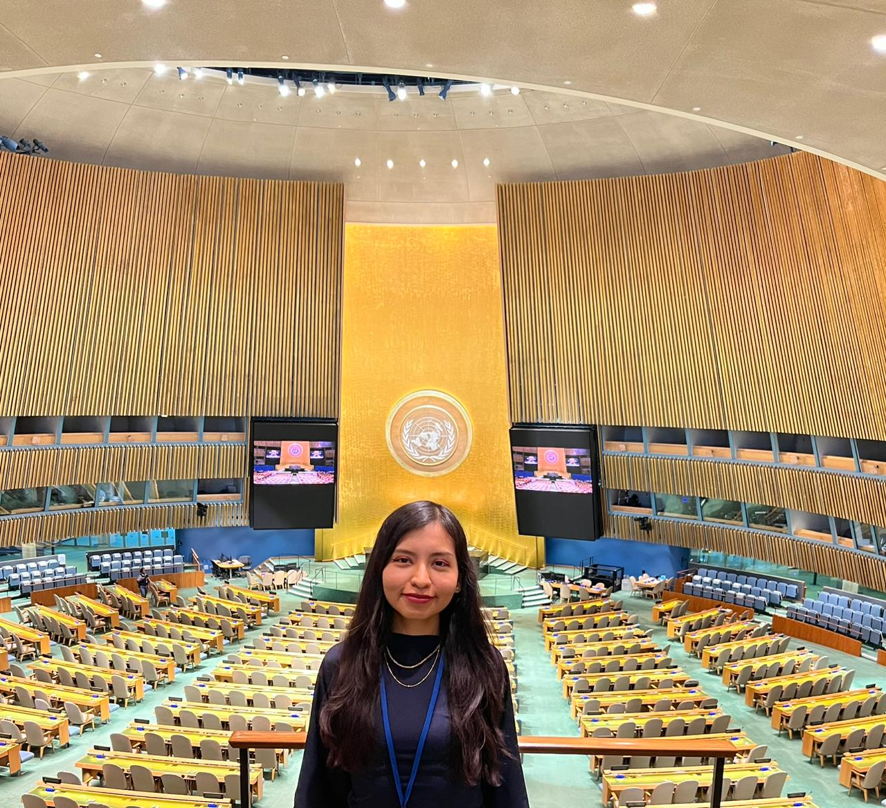
From Inside the UN: What You Gain, What You Learn, and What Still Needs to Be Heard by Andrea Viviana Araujo Muñoa (Political Scientist)

20 Sep

Editor’s Note. It is important to us that interns take the tine to reflect on their experience at the UN before their lives get busy with other commitments. In the end, some take this responsibility seriously and others don’t. Andrea’s effort here is most appreciated.

For a month I had the opportunity to be selected as a fellow for Global Action to Prevent War at the United Nations, which allowed me to experience the High-Level Political Forum (HLPF) 2026, the General Assembly, and in a rare opportunity sessions of the Security Council, the UN’s most restricted body when it comes to peace and international security. I also had access to dozens of side events, including ones organized by the diplomatic missions of Switzerland, Canada, the United Kingdom, South Korea, Germany, Spain, and the Netherlands, as well as international organizations. All of this happened in an international context marked by the highest number of active conflicts since 1946 (65 active conflicts in 35 countries in 2025), and growing pressure on development financing (Peace Research Institute Oslo, 2026).

The HLPF 2026 and the critical cycle of the 2030 Agenda

The HLPF 2026 took place from July 7 to 15 and deeply reviewed SDGs 6 (water and sanitation), 7 (affordable energy), 9 (industry and innovation), 11 (sustainable cities), and 17 (partnerships for the goals). Being consistently present at the Security Council, the General Assembly, and the HLPF meant experiencing the same critical cycle of 2026: the penultimate one before the SDG Summit 2027, with only a third of the 2030 Agenda targets on track in Latin America and the Caribbean, and, according to the United Nations Inter-agency Task Force on Financing for Development (2026), a financing gap that now exceeds 4 trillion dollars annually.

This cycle also coincides with a time of strong pressure on international cooperation: according to the OECD (2026), global Official Development Assistance (ODA) fell by 23% in 2025 — the largest annual contraction on record — following an 8.5% reduction in 2024, with a further 6.9% decline projected for 2026. This would bring ODA to its lowest level since 2014 and mark a third consecutive annual decline, something that has only happened once before in history (1992–1995). In this context, the Sevilla Commitment on financing gained prominence as the reference framework to support the implementation of the 2030 Agenda.

The Security Council: reading power from the inside

In July 2026, under the presidency of the Democratic Republic of the Congo, high-impact topics were discussed such as sexual violence in conflicts, natural resource governance as a basis for peace, the Middle East, Ukraine, Haiti, Sudan, and the peace process in Colombia. Being there right when the multilateral system is discussing how to sustain itself with fewer resources gave me an early view of where international cooperation is heading, and how geopolitics are increasingly intersecting directly with access to capital, regulatory risks, and new public-private partnerships. What you see from the inside, day by day, is how three layers that the private sector and high-level diplomacy need to read precisely are either articulated—or blocked: power and veto dynamics in the Security Council, position and coalition negotiations in the General Assembly, and the translation of those balances.

A recurring pattern in side events

In side events, important and balanced panels are usually convened. There is openness to dialogue, as indicated by the official schedule, but in practice, many of these spaces end up being just a place to listen to the panelists’ presentations. Requests to speak from attendees — such as civil society representatives, young people, or smaller delegations attending with their own resources or as scholarship recipients — are not always prioritized. Sometimes, it is simply omitted.

This matters because these forums are not just one among thousands of international events. They are some of the most important spaces the world has for bringing together those who make decisions and those who experience them, and not just from the panel, but from the other side of the seat.

Why is this more urgent now 

This pattern becomes especially relevant at a time marked by at least three intersecting forces: the historic cut in international cooperation mentioned earlier, a growing distrust of multilateralism and democratic institutions, particularly among younger people, and a climate crisis that has already crossed thresholds that once seemed distant. 

Data from the Americas Barometer (LAPOP, 2023) show that support for democracy declined sharply after 2016 and remained low for nearly a decade. Younger generations, moreover, consistently expressed less support than older ones. However, the most recent survey, the 2026 Pulse of Democracy, found the first broad regional upturn in a generation: support for democracy in Latin America rose to 65%, six points higher than in 2023, with gains recorded across nearly every country, age group, and education level.

Even so, this recovery appears fragile and paradoxical. It coincides with serious institutional erosion across the region, ranging from the suspension of elections in Nicaragua to the removal of presidential term limits in El Salvador; this suggests that the renewed support for democracy does not necessarily reflect a deeper commitment to its liberal norms, that is, to the checks that limit those in power, such as the separation of powers, an independent judiciary, respect for political opposition, and the protection of minority rights.

According to the report itself, many citizens in the region associate democracy more with satisfaction with government performance than with institutional commitment. In other words, they value above all whether the government in power addresses their concrete everyday needs, such as security, the economy, and public services, without this necessarily implying support for or respect for institutional checks and balances.

On the climate front, the Global Tipping Points Report 2025 (University of Exeter et al., 2025), authored by 160 scientists from 87 institutions in 23 countries, documents the first climate tipping point that humanity has already crossed, namely the massive and unprecedented die-off of coral reefs due to ocean warming, an ecological collapse that threatens the livelihoods of nearly a billion people and a quarter of all marine life. On top of that, the World Meteorological Organization (WMO, 2026) estimates a 91% chance that at least one year between 2026 and 2030 will temporarily exceed 1.5°C above pre-industrial levels, with an 86% chance that one of those years will surpass 2024 as the warmest year on record.

Cuts in funding, institutional distrust, and the climate crisis are not three parallel problems: they feed into each other. And those who are going to live with the consequences the longest, and largely those who are already organizing to face it, are the younger generations.

Who is going to solve this? 

The question is not rhetorical: who is going to fix these overlapping problems? Generation Z is already part of the present and the future. They are a generation that has built its own social awareness movement, in the middle of the digital age and, at the same time, a widespread mental exhaustion. Without their involvement, it’s hard to imagine that the upcoming leaders, those who will inherit these same crises, can solve them on their own. 

That’s why it’s crucial that the UN doesn’t just invite them. It’s about giving them, in a strong way, a real opportunity so that the return of trust in multilateralism also falls on them. They are one of the most decisive age groups for the future of these institutions. We also must not forget the youth organizations that, for years, have been promoting democracy and peace in their own countries and regions, often without the recognition or the speaking space their work deserves.

The pending challenge

If the UN seeks to regain legitimacy in a moment of global distrust, the challenge is not just to bring more diverse voices to its side events. It’s truly listening to those who are already in the room.


Referencias bibliográficas

Global Tipping Points. (2025). Global Tipping Points Report 2025. University of Exeter / Stockholm Resilience Centre. https://www.stockholmresilience.org/research/research-stories/2025-10-13-world-reaches-first-climate-tipping-point—widespread-mortality-of-coral-reefs.html

Organization for Economic Co-operation and Development. (2026). ODA projections for 2026 and the near-term: Implications for vulnerable countries and sectors. OECD Policy Briefs, No. 59, OECD Publishing, Paris. https://www.oecd.org/en/publications/oda-projections-for-2026-and-the-near-term_d7c74fa2-en/full-report.html

Peace Research Institute Oslo. (2026). Conflict Trends: A Global Overview, 1946–2025. Based on data from the Uppsala Conflict Data Program (UCDP), Uppsala University.

United Nations, Inter-agency Task Force on Financing for Development. (2026). Financing for Sustainable Development Report 2026: Implementing the Sevilla Commitment. United Nations. https://financing.desa.un.org/iatf/report/financing-sustainable-development-report-2026-implementing-sevilla-commitment

Vanderbilt University, LAPOP Lab. (2023). Support for democracy in the Americas remains low, opening door for politicians with undemocratic plans, Vanderbilt survey finds. https://news.vanderbilt.edu/2023/11/29/support-for-democracy-in-the-americas-remains-low-opening-door-for-politicians-with-undemocratic-plans-vanderbilt-survey-finds/

Vanderbilt University Center for Global Democracy & University of Notre Dame Kellogg Institute. (2026). 2026 Pulse of Democracy. https://news.nd.edu/news/new-americasbarometer-report-finds-modest-but-widespread-recovery-in-support-for-democracy-across-the-americas/

World Meteorological Organization. (2026). Global Annual to Decadal Climate Update: Target years 2026–2030. https://wmo.int/publication-series/wmo-global-annual-decadal-climate-update
Annalena Baerbock: It’s the tone that defines the crisis, by Lia Petridis Maiello

11 Sep

Editor’s Note: Lia formerly served as our media specialist before moving to Germany and taking on media-related positions of greater prominence. She has always demonstrated a fine eye for both “things unsaid” and “things which should never have been said,” which made her a particularly valuable colleague in New York. While supporting what appears below from Lia, and despite having my own concerns about her candidacy from the start, I found her to be a better PGA than I had feared. There were some reckless moments to be sure, and I had expected a stronger response to the end of her presidency, on protocol grounds if nothing else. She did, after all, champion women’s issues from a dais which has seen few women predecessors. And she did come to a more balanced, nuanced place of support for Gazans and Palestinian West Bank residents. But there was something else about her, something not quite right. Lia as she often has done, has put her finger on what some of that might have been.

Some positions, by the very nature of their job description, are an invitation to elegant understatement and calculated invisibility. The presidency of the UN General Assembly has, by definition, always been one such role: a year of chairing meetings, organising consensus, smiling for the record, and above all, under no circumstances becoming the news itself. Annalena Baerbock has distilled something quite different from this role description: namely, a one-woman show with her sights set on the Security Council.

Her term of office expired on 8 September 2026, and rarely has an outgoing office-holder demonstrated so loudly that, for her, ‘diplomacy’ was more of an attitude than a professional craft. Generally speaking, social contexts and gatherings of people from a wide variety of backgrounds in the US always and under all circumstances require the ability to ‘read the room’, to engage in rhetorical indirection, and to make subtle innuendos. In such settings, the German ‘assertiveness’ – well known in the US and often met with derision – can quickly come across as vulgar. What applies to the cultural context of the US, particularly in New York City, applies to the UN context many times over – and it is something that has to be learnt.

Baerbock’s career, by contrast, is a case study in how to squander what little diplomatic leeway one has through excessive rhetoric. Even as Foreign Minister, in 2023 she spoke before the Council of Europe of a “war with Russia” – a statement that triggered crisis meetings in Berlin and provoked outrage in Moscow, and which, moreover, was quite simply diplomatically incorrect. She referred to Xi Jinping on television as a “dictator”, a phrase that even well-meaning foreign policy experts deemed unnecessarily escalatory. Anyone elected as president of the most courteous body in global politics with such a track record must either possess remarkable self-confidence or a remarkably short memory. Baerbock has proved that it is possible to possess both simultaneously. The former German UN ambassador, Christoph Heusgen, summed it up even before her election, calling her nomination an “outrage”. A politician who had made a name for herself more through pithy press statements than through persistent “grunt work”. One might suspect Heusgen of malice; after all, his preferred candidate, Helga Schmid, was sacrificed in favour of her more prominent party colleague. A year on, however, his warning reads less like resentment and more like a prophecy with an expiry date.

The real moment of reckoning came at the end of her term of office. Unsurprisingly, it was on the very issue that would have demanded the greatest restraint: the succession of the UN Secretary-General António Guterres. Organising public hearings with the eight candidates has been standard practice for years. So far, so unremarkable. However, at a dialogue event in late July, Baerbock had the audience assess the candidates live, without giving them or official observers any prior warning. She subsequently wrote to the Security Council, stating that it should not even consider candidates who had not taken part in her events. So far, so embarrassing.

As a result, the US and Russia – who are otherwise on opposite sides of the fence on virtually every UN issue – found themselves in rare agreement – united against Baerbock. The US representative to the UN, Jennifer Locetta, accused her in the Security Council of “overstepping her remit” and “irresponsible actions”, describing the audience poll as “unfair, non-transparent and unprecedented”. Her most scathing barb, however, was aimed at Baerbock’s self-image: she was portraying herself as a “diplomatic superstar”. A “hypocrisy” which, taken as a whole, casts a bad light on the work of the General Assembly. The Russian ambassador, Vasily Nebenzia, echoed this by warning against the President overstepping her authority. When Washington and Moscow agree on an issue within the UN context, it usually raises questions. Nevertheless, this pattern of overreach has run through Baerbock’s entire term in office. Even her nomination was criticised as a party-political ploy to secure a post. Heusgen smugly referred to ‘Operation Abendrot’ in support of a ‘has-been’. Of course, within this context, mean spirited remains mean spirited, no matter who verbalises it. Baerbock’s inaugural mission then sounded correspondingly grandiose: she wanted to “show 8 billion people why this organisation remains important”, as if no one had done so before. Moreover, it was a phrase that sounded less like chairing a meeting and more like personal brand-building.

In her dealings with African states, too, the pattern of using a rhetorical cleaver rather than a graceful foil was repeated. A former president accused Germany of “condescending and disrespectful behaviour” after invitations had gone unanswered for months, whilst CDU politician Gitta Connemann spoke of a “foreign policy underpinned and driven by moralising” which had been perceived as overbearing in the Global South. And Baerbock’s staunchly pro-Israeli stance during the Gaza offensive – she described South Africa’s genocide case before the International Court of Justice as “baseless” and refused to support key ceasefire resolutions – sparked protests from human rights groups barely after she had taken office. As if German national interests (Staatsräson) and objective criticism were suddenly incompatible. As is well known, the irony comes at the end: Baerbock is not returning to Berlin, but is moving to New York City’s prestigious Columbia University to take up a ‘practice-oriented’ professorship in feminist foreign policy. Her successor as President of the General Assembly, Khalilur Rahman, a 72-year-old veteran diplomat from Bangladesh, was elected by 99 of the 193 member states and is likely to lead the office exactly as intended: unobtrusively.

The criticism that can be levelled at Baerbock in all seriousness after twelve months at the helm of the General Assembly is not incompetence in the traditional sense. It is something more subtle: a chronic inability to hold office without overstepping its bounds. Diplomacy thrives on allowing one’s own importance to fade into the background in favour of the cause. In New York, Baerbock proved the opposite, and for that she deserves precisely the title that American diplomacy smugly bestowed upon her: ‘diplomatic superstar’. It was not meant as a compliment. And yet it captures the essence of the matter with astonishing precision.

More Reflections from the UN High Level Political Forum (HLPF): A Next-Gen Voice from Peru.

14 Jul

Editor’s Note: This is the second piece we have run from Andrea Viviana Araujo Muñoa who is now with us at the HLPF in New York. As we know and as Andrea has learned, many affiliated events are taking place outside of UN headquarters. Our July 9 event was also a hybrid event outside the UN building, designed in part to hear Andrea’s remarks: From Ayacucho to the United Nations A First-Generation Perspective on Identity, Resilience, and Youth-Led Community Transformation. But it was also to bring together a talented and professionally diverse group to relaunch the New York chapter of Women in International Security (WIIS) which had been run out of the Global Action office for several years pre-Covid. The hope is that events like this one and contributions like Andrea’s will help us maintain commitments to young women in all facets of the security sector.

The High-Level Political Forum (HLPF) is far more than just another United Nations event. It is a meeting point where changemakers come together, bringing their experiences, hopes, and shared aspirations. In an increasingly interconnected world, partnerships and collaboration are more essential than ever, because what affects one country ultimately affects us all. International cooperation must place greater focus on young people from marginalized and underserved communities—those who continue to transform their neighborhoods through resilience and self-organization despite persistent inequalities. They deserve not only to be heard, but also to serve as representatives in global decision-making spaces within the United Nations.

  1. Roots and Resilience: The Journey from Ayacucho
    Sometimes, people forget where they come from and where they are going. For me, family history is essential because it shapes the way first-generation young people take action and create change. My parents are Quechua speakers from Ayacucho, the region where terrorism began in my country. As children, they were among the thousands who were forced to leave their homes and migrate to the capital. They never finished high school, had to learn Spanish at a very young age, and grew up facing systemic discrimination.
  2. The First-Generation Responsibility
    I am now 27 years old. Although my parents had very limited educational opportunities, my two triplet sisters and I all graduated from a public university. Being a first-generation university graduate has given me a deep sense of responsibility to give back to my community and create opportunities for others who face similar barriers. For me, taking action is not simply a choice—it is a responsibility. It is not easy to face uncertainty or to defend diverse voices and cultural diversity, but these are precisely the values that make us human. My story is my starting point because I believe that everyone has a purpose in life. In times of uncertainty, that purpose provides clarity and direction. “Taking action is not simply a choice—it is a responsibility. It is not easy to face uncertainty or to defend diverse voices and cultural diversity, but these are precisely
    the values that make us human.”
  3. Voices from the Margins: Youth-Led Action in Lima
    Through a youth-led organization born in the outskirts of Lima—the often-overlooked side of a deeply unequal capital—you can witness how young people from vulnerable communities promote and defend meaningful civic participation within their own neighborhoods. You can see that they do care about politics, not as partisan competition, but as a way to improve their communities. Despite having very limited financial resources, they design and implement free social initiatives for those around them. Self-management keeps these initiatives alive, but it also comes at a cost. I do not want to romanticize resilience or suggest that community organizing alone can overcome structural challenges. Young people need resources, opportunities, and institutional support so that their commitment is not what limits their future. Many volunteer despite lacking formal employment or financial stability. Each of them carries a unique story, yet they all share a remarkable determination to build stronger and more inclusive communities.
  4. A Call for Global Partnerships & the HLPF
    The High-Level Political Forum (HLPF) is far more than just another United Nations event. It is a meeting point where changemakers come together, bringing their experiences, hopes, and shared aspirations. In an increasingly interconnected world, partnerships and collaboration are more essential than ever, because what affects one country ultimately affects us all.
    International cooperation must place greater focus on young people from marginalized and underserved communities—those who continue to transform their neighborhoods through resilience and self-organization despite persistent inequalities. They deserve not only to be heard, but also to serve as representatives in global decision-making spaces within the United Nations.
  5. Reimagining Trust and Governance
    Today, there is growing discussion about the perceived decline of the United Nations, the urgent need for reform, and the frustration felt by many around the world. In this context, one question becomes unavoidable: isn’t this precisely the time to place our trust in those who continue to create real impact in their own communities? The High-Level Political Forum offers a unique opportunity for young people to move beyond simply being heard and to become active partners in shaping concrete, genuine, and transformative action.

More Reflections from the UN High Level Political Forum: Liberato Bautista on “Communities of Hope.”

12 Jul


Editor’s Note: Our Good friend and colleague, Rev. Dr. Liberato Bautista, made this excellent presentation at a recent HLPF side event on “Communities of Hope: Advancing Human Dignity and Development for Sustainable Futures.” “Levi” as he is known, is of Filipino ancestry and has long served in New York as Assistant General Secretary for United Nations and International Affairs, General Board of Church and Society of The United Methodist Church. He is also immediate past president of the Committee on NGOs. Levi is a familiar figure around the UN and this fine talk is what we have come to expect from him.


Excellencies, distinguished colleagues, friends, partners in civil society and faith communities: Thank you to the organizers for convening this timely parallel event to this year’s High-Level Political Forum, titled “Communities of Hope: Advancing Human Dignity and Development for Sustainable Futures.”

At a time when much of our public discourse seems saturated with anxiety, uncertainty, and division, I am grateful that you have chosen to organize a conversation about hope. Some may even accuse us of being hopeless romantics for injecting hope into an anxious world. I confess that I am happy to join that company. So, allow me to invite you, for the next few minutes, to imagine with me a future in the present tense. That may sound like a contradiction. Yet much of our work in the United Nations, in civil
society, and in communities of faith depends precisely on this capacity.

We live amid the present tensions of our time—war and displacement, widening inequalities, lingering historical injustices, ecological degradation, technological uncertainty, and growing fragmentation. Yet we are called at the same time to orient our vision toward futures that are both visible and viable—futures shaped by human dignity, sustainable development, and shared flourishing.

I am especially drawn to the title of this event and its use of the word futures in the plural. Not future, but futures. That choice matters. Because no individual, no nation, no institution, and no tradition possesses a monopoly on what the future should look like. None has a franchise on hope. The future is not something handed down by the powerful. It is something imagined, negotiated, and built together. The language of hope and the language of futures, therefore, share a common invitation. They call us into a collective exercise of moral imagination about what makes for a more just, peaceable, and sustainable world.


Communities of hope help us hold these realities together. The timing of this event is especially meaningful. In just two days, on July 12, the international community will observe the International Day of Hope. By establishing this observance, the United Nations reminds us that hope is not merely a private sentiment but a force that advances dignity, peace, social stability, and sustainable development. Indeed, the United Nations has described itself as “the product of hope.” Hope, therefore, is not peripheral to the multilateral project. It lies close to its heart. The United Nations emerged from humanity’s determination that war, devastation, and fear should not define the future. Hope is among its animating purposes.

And it is in that spirit that I would like to begin with a lesson I continue to learn from people experiencing forced migration. Part of my work has involved creating platforms for migrants, refugees, displaced persons, and communities uprooted by conflict, persecution, environmental degradation, and economic necessity to speak about their own fears and hopes. One quickly discovers that hope, for people in forced movement, is rarely an abstraction. Hope does not recover the passport left behind. Hope does not reunite a parent with a child separated by war. Hope does not erase trauma. Hope does not instantly provide protection, livelihood, housing, or belonging.

And yet they continue to hope. What amazes me is not simply their resilience. What amazes me is their moral orientation. It is their determination to anchor their breath, their being, and their future to hope even when circumstances seem determined to deny their dignity. One of the lessons forced migration teaches us is that human dignity often survives long before development arrives. People continue to imagine futures for themselves and their children even when the path ahead remains uncertain. They continue to seek community amid displacement, dispersal, and dislocation. For some, the hope is a return. For others, it is the possibility of rebuilding life in countries of transit and destination. Development worthy of the name begins there. It begins with the recognition and protection of human dignity.

Communities of hope emerge wherever people refuse to surrender their dignity to conditions that deny it. That experience has led me to a conviction: Hope cannot merely be the ceiling we seek to reach. Hope must also be the floor from which we begin. Too often, we speak of hope as a distant horizon. But when hope is permanently deferred, its very unreachability can become a source of fear. Hope must be accessible. Hope must be tangible. Hope must be lived.

In the Wesleyan understanding of grace, God’s action is not merely a destination awaiting humanity at the end of the journey. Grace is already at work, preparing the way and opening possibilities where none previously seemed to exist. Hope functions in much the same way. It is not only the horizon that beckons us forward. It is also the ground beneath our feet that enables us to move at all.

Perhaps this is one of the lessons we must learn again regarding sustainable development. The Sustainable Development Goals were never intended to be merely a collection of targets and indicators. They were intended to advance human dignity through development and thereby create the conditions for sustainable futures. This year, as the High-Level Political Forum reviews Sustainable Cities and Communities and Partnerships for the Goals, I am reminded that both are, at their heart, questions of hope.

Communities cannot be sustainable if people are denied dignity, participation, belonging, and opportunity. And partnerships cannot flourish where fear, fragmentation, and exclusion prevail. One reason implementation gaps persist is that we have learned to count the goals while becoming less adept at encountering the people they represent. When goals become detached from lived realities, they risk becoming fossilized. Sustainable development is ultimately about creating conditions in which human dignity can flourish. Yet dignity, while inherent in every human person, does not protect itself. It requires protection through institutions, laws, norms, and regimes of human rights.

Hope, therefore, is not sustained by aspiration alone. It also requires institutions capable of safeguarding dignity and advancing rights. It is precisely because the SDGs are ultimately about people that I have come to believe that we live in a world in deficit of hope and in excess of fear. Fear generated by poverty and inequality. Fear generated by conflict and displacement. Fear generated by lingering historical injustices of slavery, colonialism, and racism. Fear generated by ecological degradation. Fear generated by technological change whose ethical consequences remain uncertain.

Yet fear today is more than an emotion. It is increasingly becoming a governing narrative. But we must not allow the present tensions of our day to determine the future. Hope begins with a refusal to make that concession. Hope is humanity’s insistence that another future remains possible.


This is why I increasingly refer to Agenda 2030 and the Pact for the Future as elements of the United Nations’ agenda of hope. They express not only hope for a better world but also hope for a United Nations transformed and fit for purpose—faithful to its foundational responsibilities to advance human dignity and human rights, promote peace and security, and foster sustainable development for people and planet.

For many years, I have argued that civil society must have access to the United Nations’ premises, promises, and processes. Today, I would add a fourth imperative: Civil society must also have access to the agenda of hope. Because hope belongs not only to governments but to peoples. Yet aspirations do not advance themselves. Norms do not implement themselves. Hope does not
institutionalize itself. Every agenda of hope requires institutions capable of shepherding it. The multilateral infrastructure entrusted with this task—the United Nations—is under strain. Ultimately, humanity’s collective capacity to imagine and pursue a common future is under pressure.

This is why I continue to advocate for a people-centered, ethical, and transformative multilateralism. Ethical multilateralism is not merely cooperation among governments. It is the encounter between the community of nations and the community of peoples. Human beings flourish not in isolation but through mutual responsibility, solidarity, compassion, and participation in the common good. As Minjung theologians in South Korea reminded us, ordinary people are not objects of history but its makers. When people become subjects rather than objects, the horizon of hope becomes clearer, and the space for collaboration widens rather than shrinks.


My friend and colleague, Christian social ethicist Dr. Lester Edwin Ruiz, has challenged us to distinguish between what is fundamentally new and what is fundamentally better. This question is especially important in the age of artificial intelligence. The issue is not whether AI is fundamentally new. It clearly is. The deeper question is whether it fosters fundamentally better relationships. In this regard, I find resonance with Pope Leo XIV’s insistence that: People must come before technology. Human dignity must come before efficiency. Ethics must come before capability.

For many of us who work in and around the United Nations, no passage from sacred scripture has captured the moral imagination of the international community more profoundly than Prophet Isaiah’s vision that nations shall beat their swords into plowshares and their spears into pruning hooks. Yet eighty years later, we must acknowledge that the world has not yet beaten all its swords into plowshares. The answer, however, is not to abandon Isaiah’s vision. The answer is to deepen it. This is where I find Prophet Micah’s injunction indispensable. While Isaiah calls us to transform the implements of war, Micah calls us to transform ourselves: to do justice, to love kindness, and to walk humbly.


Here, I also hear an echo of John Wesley’s first general rule: Do no harm. Between the present tensions of our day and the future we aspire to build lies a profound moral responsibility. Do no harm. Do not compromise the future of generations to come with our own follies. Do not diminish tomorrow through the choices we make today. Do not sacrifice the dignity of others for immediate gain.


In a world marked by conflict, displacement, dispersal, dislocation, ecological degradation, widening inequality, and technological disruption, this remains a profoundly relevant public ethic. The world does not need less imagination. It needs imagination disciplined by justice, tempered by mercy, and guided by humility. Perhaps this is what communities of hope are called to offer in our time: not merely a vision of a future without swords and spears, but the moral capacities to build and sustain it.

Finally, these traditions remind us that the future is not merely something we await, inherit, or discover; it is something we create. As the musical Rent reminds us, the opposite of war isn’t peace. It is creation. War destroys. Creation builds. War wounds. Creation heals. War closes horizons. Creation opens possibilities. Therefore, communities of hope become communities of creation. They participate in the ongoing work of creating a world where human dignity is protected, human rights are respected, communities flourish, and sustainable futures become possible. And because destruction is ultimately aligned with death, creation remains one of humanity’s deepest affirmations of life itself.

In a world in deficit of hope and in excess of fear, communities of hope remind us that hope must be more than a destination. It must become a lived reality. They remind us that human dignity is not a consequence of development but its foundation. They remind us that sustainable futures are built when peoples and nations work together to move our world from fear toward hope, from fragmentation toward solidarity, and from what is merely fundamentally new toward relationships that are fundamentally better.

That, I believe, is the promise and calling of communities of hope: advancing human dignity through development for sustainable futures. Thank you for your indulgence.

Reflections from the UN High Level Political Forum: Rebecca Irby Highlights the Dignity Foundations of Development

11 Jul

Editor’s Note: Rebecca Irby’s investments related to her leadership of PEAC (www.peacinstitute.org), investments in sustainable development, youth and women’s engagement, nuclear disarmament and NGO-focused media are becoming legendary in UN spaces. Here she kicks off what will surely be a fruitful, longer-term engagement, one which has already attracted the attention of other parts of the UN system, including from the leadership of the UN mission of the Republic of Korea. Her comments in relation to the newly-formed NGO Committee for Dignity were very well received and I am pleased to be able to share them here.

Opening Statement + Introduction of the Committee for Dignity

Good morning, everyone.

Welcome, and thank you for joining us for Dignity and the SDG Implementation Gap: Structural Discrimination, Community Evidence, Nature, and Meaningful Participation.

It is an honor to gather here during HLPF, in this space so close to the United Nations, and in the company of civil society leaders, advocates, community partners, researchers, and people who continue to believe that sustainable development must be more than a promise on paper.

At the heart of today’s conversation is a simple but urgent idea:

Dignity is not an ornament added to development after the fact. Dignity is the measure of whether development is happening at all.

When a community lacks safe water, it is not only a service gap. It is a dignity gap.

When people are denied clean energy, housing, infrastructure, health, education, or safety because of who they are, their race, caste, gender, disability, migration status, Indigenous identity, poverty, or political exclusion, that is not only a policy failure. It is a dignity failure.

And when communities are studied, counted, consulted, and photographed, but not trusted to shape the decisions that affect their lives, that is not participation. That is performance.

The United Nations begins with the words “We the Peoples.” Those words matter. They remind us that the UN was not created only for states, systems, or institutions. It was created to serve humanity.

And at this particular moment, the role of civil society has never been more important. Around the world, too many people live under systems where their voices are restricted, dismissed, or unheard. NGOs, grassroots movements, Indigenous leaders, youth organizers, disability advocates, faith communities, women’s groups, peacebuilders, journalists, educators, and community institutions help ensure that the lived experiences of people remain part of the global conversation.

That is why the NGO Committee for Dignity exists.

This Committee was created to bring organizations together around a shared commitment to dignity, justice, inclusion, peace, and meaningful participation.

But I want to say something plainly: a committee is not meaningful simply because it exists. A coalition is not powerful simply because names appear on a list. An organization becomes meaningful when it becomes a place of commitment.

Commitment to one another.

Commitment to the communities whose lives are shaped by these decisions.

Commitment to the difficult, patient, disciplined work of moving from concern to action, from action to accountability, and from accountability to transformation.

Our purpose is not to speak for people.

Our purpose is to create spaces for people to speak for themselves, and to help make sure that when they do, institutions are prepared to listen, respond, and change.

We are here to help ensure that all peoples, including stateless peoples, Indigenous communities, vulnerable populations, marginalized groups, and communities facing structural discrimination, are not treated as afterthoughts in global policy conversations.

These communities are not footnotes.

They are not simply beneficiaries waiting at the end of a system.

They are the authors of evidence. They are the holders of wisdom. They are the builders of solutions.

Dignity is inseparable from the dignity of life itself: the dignity of nature, the dignity of water, the dignity of land, the dignity of future generations.

Protecting dignity and protecting the planet are not competing responsibilities. They are deeply connected.

As Wangari Maathai, a Kenyan social, environmental, and political activist who founded the Green Belt Movement, reminded us, when we help the Earth heal, we also help heal ourselves.

And that brings us to the core question of today:

What is the SDG implementation gap really telling us?

It tells us that promises are not enough when the structures that deliver them still exclude people.

It is telling us that technical solutions are not enough when the people closest to the problem are kept farthest from power.

It is telling us that participation without influence is not participation. It is choreography.

And it is telling us that the people closest to the harm must be central to defining the repair.

This week, as the United States reflects on 250 years since the Declaration of Independence, we are reminded that every nation, every institution, and every global framework is tested not by the beauty of its ideals, but by the honesty of its implementation.

The question is not only whether we can repeat our founding promises.

The question is: Who is still waiting to be included in them?

That is true for the American story. It is true for the United Nations. It is true for the Sustainable Development Goals.

Our task is not simply to celebrate the promise.

Our task is to close the distance between the promise and people’s lives.

So today, we gather not only to talk about dignity, but to ask what dignity requires of us.

Dignity requires memory, because communities know the histories that institutions often ‘forget’.

Dignity requires truth, because we cannot repair what we refuse to name.

Dignity requires evidence, because lived experience must be treated as knowledge, not anecdote.

Dignity requires humility, because institutions must be willing to learn from the people they were designed to serve.

And dignity requires communities at the center, not as symbols of inclusion, but as partners in shaping what comes next.

Most of all, dignity requires us to move from symbolic inclusion to meaningful participation. These are not abstract values. They are the conditions that determine whether communities are treated as partners in implementation or as evidence after the fact.

Thank you all for being here. I am so grateful for the wisdom in this room, and I look forward to the conversation we are about to build together.

Accountability, Compromise and the Future of the UN: A Reflection by Tazia Marie Mohammad.

14 Aug

Editor’s Note:  This reflection is courtesy of one of the more insightful interns/associates we have had at Global Action in my 23+ years.  Tazia did what we want all of our colleagues to do – throw themselves into many areas of UN policy and practice and then assess the current relevance of the UN as convener and problem-solver on an increasingly volatile planet. This task was made easier during July’s High-Level Political Forum when so many UN issues and concerns come to the fore.  But the HLPF also magnified opportunities for frustration, especially for younger people worried about their future and the capacities of existing global institutions to shape a more compassionate, just and sustainable world.

The day after my internship with Global Action ended, I took a 6:00 AM connecting flight from JFK to Tokyo-Haneda. Since then, I have been working as an English tutor in multiple prefectures across Japan, a welcome respite from the bustle and grit of life in New York City. The curriculum I work with, more content-based than instructional, focuses on multicultural communication and attainment of the UN Sustainable Development Goals—noticeably reminiscent of the Japanese mission’s own interventions on the General Assembly floor.

It feels a bit hypocritical to be getting these kids excited about our grand plans to change the world only days after walking out of a circle that blatantly disregards them. America, the country I effectively represent to my students, has rejected the SDGs and withdrawn from the Financing for Development conference—a culmination of decades of unwillingness to commit to its climate promises. Simultaneously, it funds the killings of over 60,000 Palestinian men, women, and children, while strong-arming sovereign bystanders into complicity in the Security Council and beyond.

The UN, over its near-eighty-year tenure, seems to have refashioned itself in America’s image: swift and adept at bullying the weak, but slow and inefficient at aiding those in need. This has long since graduated from mere unfairness: with 2030 just around the corner, only 17% of the SDGs are on track, and each state’s unwillingness to shape up digs us deeper into a grave that seems less escapable each day. If we cannot face ourselves and implement a hard narrative reset, we may well not survive.

Perhaps the greatest hindrance to SDG attainment is the UN’s inability to hold member states accountable. In the Security Council, this dearth of responsibility can be attributed to an irreconcilable truth: every resolution, stance, and condemnation issued is overshadowed by each nation’s own military exploits and casual brutality. Every law-breaker seemingly feels emboldened by the tacit understanding that they will face no substantial punishments for violating international laws, for the states responsible for upholding these laws are often the most infamous violators themselves. This is evident in Israel and America’s noncompliance with the Geneva Convention despite near-universal condemnations, and in Russia’s stubborn continuation of its invasion in Ukraine despite its pariah status in Europe. Until more rigid and autonomous frameworks for unlawful intervention are implemented, the UN cannot in good faith claim to protect the sovereignty of its members or the safety of their citizens.

This accountability crisis also stems from the Western hegemony’s open use of reality-bending narration as a shroud for its own failings. Iran, for instance, engages in a more rigorous nuclear reporting process than any other UN member, yet its compliant status with the IAEA was revoked immediately preceding Israel’s unprovoked terror attacks on its IAEA-protected nuclear plants on June 13th. Iran, which has never been recorded to possess nuclear arms, was declared a volatile adversary seemingly overnight to justify Israel’s warfare. Statements by nearly every Security Council member focused more on urging that Iran—a known non-nuclear entity—must never obtain nuclear weapons than on addressing any details relevant to the matter at hand. This air of favoritism is accentuated by the fact that Israel itself is estimated to possess 90 nuclear warheads yet refuses to sign any non-proliferation treaty or register its arsenal with the IAEA.

One must also look to Palestine, where the plight of Israeli hostages—prolonged solely by Israel’s ceasefire violations and rejection of negotiations with Hamas—is measured at equal, if not greater weight, than the deaths of over sixty thousand Palestinians. Moreover, Israel’s core arguments about the hostages are never challenged despite the obvious question: how can one protect Hamas’s prisoners while simultaneously bombing them? Even factual realities are pushed aside to make room for Israel’s excuses: some member states still push the debunked claim that Palestine’s aid blockages are caused by Hamas’s banditry and not Israel’s denial of humanitarian entry. This utter obedience to the flawed, dehumanizing logic of uncompromisingly self-interested tyrants degrades the credibility of the United Nations, and if there is to be a future for international cooperation, such atrocities cannot continue.

At the same time, efforts at achieving SDG 13 and other climate goals are undercut by the naivete of many member states, who support climate efforts only if they are cost-effective, complementary to their development ideas, and inoffensive to corporate sponsors. To illustrate this, I recall a panel I attended during the early days of the High-Level Political Forum on AI integration into bureaucratic institutions. While charismatic and well-spoken, the presenter painted a future in which AI technology is so ubiquitous that it will become inseparable from our logistical frameworks—a beautiful idea, but without any word on where the energy for such technology would come from, or how environmental implications might be reconciled. When I pressed him on this point, the answer I received was certainly optimistic: “AI will solve for AI.” Though it would be lovely to see this clever catchphrase prove true, it is irresponsible for any diplomat or lawmaker to operate with this notion in mind. The “do no harm” principle dictates that it is the innovator’s responsibility to prove her creation isn’t harmful, and there is no alternative that makes it viable to create and then market problems in hopes of fixing them later.

Yet, it seems the consensus for most wealthy and middle-income nations is to have your cake and eat it too. Climate conversations throughout the HLPF were lathered with appeals for understanding: while states want to try their best for our planet, they refuse to hinder their own economic development. This unwillingness to accept the inherent limitations of sustainability on growth sets us on a dangerous path: climate protection will always require sacrifice, and member states must compromise on growth expectations if they hope to meaningfully contribute to SDG 13 or any of the other goals.

It is easy to be swept up by the pomp and circumstance of the UN Headquarters: diplomats are ushered from their limousines by entourages at every hour, and there is constant pressure to cave to the status quo of self-aggrandizing optimism and verbose inertia. However, we cannot forget the main purpose of its existence: to protect and care for our fellow human beings. Integrity can no longer remain an afterthought on the General Assembly floor; we must be diligent in our moral convictions, and honest in our efforts at carving out a better world. Only then can we look our children in the eye and tell them sincerely that the SDGs are worth being excited about.

Staying Engaged, Dr. Robert Zuber

29 Jun

Dear All, I wrote this short piece for another list, but thought it might be useful to some to post it here as well.

This will be a short message to all of you.  I’ve been asked on several recent occasions why I am not posting as many weekend messages as in the past.  It is a good question which requires me to “fess up” to what has been going on with me and with Global Action amidst the searing heat and personal health issues which have defined the summer so far. 

I want to remind all of you that I have never written for mass consumption, in large measure because in my case there is no “mass” to consume.  What there are is friends and colleagues, diplomats and even occasional adversaries, people who once thought we were crazy and have come around to see the benefit of what we do, people who once sided with us and now think we’re crazy.  Or worse. 

 I am grateful for all of you, more than you know. The fact is I have always written to people I know, at least in some measure, sharing challenge and hope and, if desired, a pathway to policy communities at times impactful and at times delusional.   We have written and contributed to a number of books over the years but the impact has mostly been modest as they weren’t really directed anywhere — perhaps towards some “community” of practice in disarmament or peacekeeping or human rights, but those communities are fractured at best and are sometimes resistant to the sympathetic critique which lies at the heart of our work.  

We all need critique, and I have surely benefited from yours.  We continue to bite off a lot especially inside the UN, reminiscent of the pelican whose “mouth can hold more than its Belly-can.”  And with all that is going on in the world now, there is a need to bite off even larger portions and chew them harder. This summer has been a test of endurance, dodging dramatic storms record heat and the impatience it breeds to get in front of policy actors and remind them of the consequences of the paths they have chosen and seemingly refuse to adjust.  There is a stubbornness about our sector,   a refusal to rethink the value of unimplemented resolutions, performative rhetoric and values which adorn the ice cream cone but don’t materially affect the ice cream. There is, as I reminded a group of NGOs a few days ago, a danger in sacrificing our dignity for the sake of access and acceptance in increasingly restricted UN spaces, a danger in forgetting that when our dignity suffers so does that of the constituents we are connected to, constituents who are often and already poorly placed on the lower end of the dignity scale.  

My wonderful summer intern, Tazia Mohammad, has quickly grasped the “tangibility gap” which characterizes much of what we witness and try in our own small way to amend.  As a gift to me and to others, her reaction to this “gap” has been less cynicism and more about trying to discern how Security Council members and other people with considerable authority in the world could invest that authority so timidly, as though there were no institutional values to uphold and as though previous practical investments — on climate, on weapons, on women, on conflict prevention, on the health of ocean and forests — had gotten us over even one future-challenging hump.   The numerous younger people who have passed through our program have felt the weight of a future which seems murky at best and frightening at worst.  Many have retreated into a world that politics can’t easily reach, including various cyber spaces where the world might actually seem more manageable.  Others want to know clearly and concretely what they and their future are up against.  Tazia is one of those. 

There were others like her this past week in a large auditorium at the New School where I joined Professor Peter Hoffman and two senior officials with the UN Department of Political and Peacebuilding Affairs to talk about the future of peacekeeping and related matters.  I always enjoy helping to explain to younger audiences the extraordinary complexity which accompanies the mandates, planning, discharge and eventual drawdown of such missions.  As with many things in life, relevant complexities are often hidden from view rendering the criticisms which inevitably follow lacking in both sympathy and context.  Indeed, one of my concerns about modern society is that we don’t know much about how things work — including how the things we rely on for our comfort, safety and general well-being actually come to pass..  We don’t know what it takes to get vegetables into our kitchens or water into our sinks.  We certainly don’t know what it takes to protect civilians in a conflict zone let alone protect an entire country from hostile attack.  I could fill pages with those things which are essential to our well-being which we merely take for granted, to which we are entitled but not cognizant.  In a complex and at times frightening world, the logistics of things need to remain fully in our sphere of appreciation and support. 

Beyond complexities, we New School speakers all took turns describing threats to peacekeeping from terrorism and budgetary limitations to the deliberate spreading of hate speech and disinformation and the concerns of more and more UN member states that peacekeeping must do more itself to blend its mandates with national priorities.  My own contribution to this part of the program (surprise, surprise) was a bit different, seeing the main threat in the form of a UN (and especially a Security Council) which refuses to uphold its own values, its own Charter, its own reason for being.  More and more, the Charter and international law violations of states are serving as cover for violations and abuses by other states.  If there is only impunity for breaking the most fundamental of organizational principles, then more states will cross those lines.  If there is only impunity for breaking those principles, then the UN’s reputation is sure to continue taking the “hits” with implications for how peacekeepers and their mandated tasks are perceived and trusted in the field. 

While we are well down the list of concerned parties, these reputational issues affect our sector as well.  Many of us have gotten the message in recent years (from inside and outside UNHQ) that our input is neither necessary nor particularly valuable, that our presence is more annoyance than appreciated, that our role is merely tolerated rather than cultivated.  But we also don’t have “thin skin” and we have no right to thin skin as we are duty bound to make the most of our place at the table even if at times we seem to have been relegated to the kiddie table.  People worldwide need to know what is going on in that large complex at Turtle Bay.  They also need to know how they can meaningfully connect to that daunting space.  These things we know how to do, and it is important in these times that we keep doing them without whining and with whatever tools and resources are at our disposal.  

While we continue, we offer to all of you our heartfelt thanks as well as access to our platform to get your best ideas and deepest concerns in front of global policymakers.  Certainly, we don’t have the best platform around, not by a long shot.  But we have penetrated the system deeply through many thousands of hours of listening and reflection.  We know what works and what doesn’t, and we know where to go with ideas and concerns even if we can’t always go there ourselves. 

We’ll report back again at the conclusion of the High-Level Political Forum in July.  Fingers crossed for bold policies and even bolder practices to help reverse some of our current slide.

Blessings, 

Bob

Earth Year: A Call to Clarity of Hands and Hearts, Dr. Robert Zuber

2 Apr
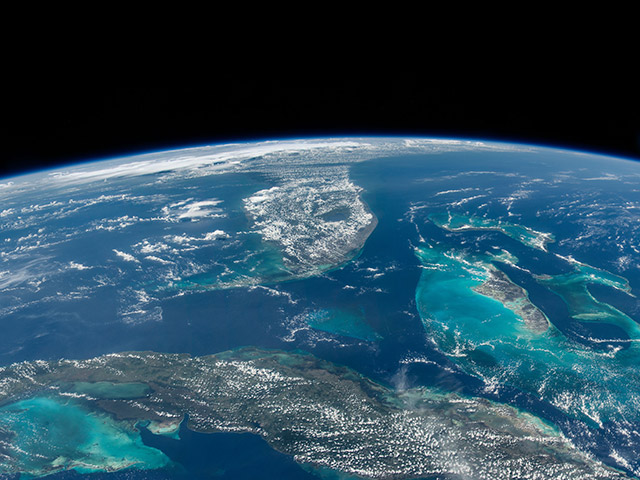
Florida, the Bahamas and Cuba as seen by the International Space Station.

From NASA

The holy men say we are entering a period of clarity. Rigoberta Menchu

The greatest privilege is to live well in flourishing lands. Hamza Yusuf

Virtue can only flourish among equals.  Mary Wollstonecraft

For millions of years, this world has been a great gift to nearly everything living on it. Rebecca Solnit

If beautiful lilies bloom in ugly waters, you too can blossom in ugly situations. Matshona Dhliwayo

Peace is the creation of an environment where all can flourish regardless of race, color, creed, religion, gender, class, caste or any other social markers of difference. Nelson Mandela

Around the globe, people from all walks of life are holding their breath in the hope that a flurry of activity at all levels of policy and human community will be sufficient to reverse what is commonly known at the UN as the “triple” planetary threats from climate change, biodiversity loss and pollution (especially plastics pollution).  

The UN has seen its own frenetic activity as leaderships tries to both make up for precious lost time while encouraging member states to take more political risks and step-up ambitions to find more robust and cooperative measures to address threats which clearly are not inclined to wait for us to make the change we need to make in order to secure a future for our children, especially those children residing in the most climate-vulnerable regions.

The UN has certainly created numerous spaces for member state deliberations on virtually all aspects and dimensions related to the “triple threat,” including implications for human health (mental, physical and nutritional), for international peace and security, and for more inclusive processes which not only heed the voices of women, youth and indigenous people but which actually seek to incorporate their learning and insights into policy decision making.    

Some of these processes, as many of you recognize, take the form of large, carbon-intensive events which create some consensus-driven movement but generally lacking in practical implementation of pledges which fully mirror their rhetorical origins.   Case in point is the fund for “loss and damage” agreed to at COP 27 in Egypt, an important step which has yet to generate the remedial funding which the most climate affected states had anticipated (and still anticipate).  Diplomats also agreed recently on elements of a treaty to impose structures of governance on ocean areas beyond national jurisdiction (BBNJ), a theoretically important framework to mitigate at least some of the “wild west” mentality which has encouraged massive ocean dumping and deep-sea mining and has also precipitated a decline in ocean species as waters warm and the remains of our collective overconsumption now reach the furthest ocean depths. The recently concluded UN Water Conference resulted in over 600 pledges (albeit voluntary) to strengthen “trans-boundary water cooperation, promote universal sanitation and explore security and other implications of severe access challenges regarding this most precious of resources.  The General Assembly for its part passed a unanimous resolution (sponsored by Vanuatu and others) seeking clarity from the International Court of Justice regarding the legal obligations of states whose production and consumption patterns, as noted during the week by UNEP director Inger Andersen, now serve to threaten the very existence of other states.   Even the Security Council got into the act recently as Mozambique chaired an Arria Formula discussion on protecting water-related infrastructure.  But despite what (to us at least) seems like an obvious linkage between a dangerously warming climate and prospects for armed conflict, several Council members past and present remain unconvinced that climate concerns should be folded into the Council’s peace and security mandate.

This bevy of activity (we didn’t even mention the biodiversity conference in Montreal or the Forum on Forests) is welcome but can also obscure the fact that most of these commitments are voluntary, are unenforceable or constitute some subtle form of “greenwashing” which leads people beyond UN confines to think that more is happening to forestall disaster than is actually the case. Having been around the UN for what seems like forever, we understand well that in large multi-lateral spaces facilitated by the UN, spaces filled with diplomats representing national positions and increasingly insisting on elusive consensus, progress is likely to be slow, perhaps too slow given crises weighing down human community like a bad case of COPD.  It certainly seems as such to the growing number of youth environmental activists who, despite their energies and practical commitments across the globe, still struggle for their place at the policy table to help ensure progress that is more than textual and rhetorical.  Indeed, as one youth activist noted during the days of the UN Water Conference, holding these large eco-events in expensive UN cities literally ensures that many of the people who wish to present testimony regarding the effects of and responses to climate change, pollution and biodiversity loss in their communities – testimony unmediated by diplomats and NGOs like me – will continue to experience great difficulty in doing so.

While some turn red at the suggestion that the UN isn’t doing enough on a range of environmental challenges, the troubling consensus of senior UN leadership (and many of the rest of us) reveals a serious disconnect between what is needed, what is being proposed in response, and the risks that member states – including some of the world’s largest polluters – are willing to take in order to preserve healthy options for succeeding generations.  And because states in the main are not doing enough despite some claims to the contrary in UN conference rooms, the rest of us are thereby encouraged to not do enough also.  Indeed, to our minds at least, the mass of discouragement experienced about the state of the world by many is another unfortunate consequence of rhetoric that is not matched by concrete policy support for the actions at community level, actions which ultimately have the most to do with whether or not the current “triple threat” becomes what Costa Rica referred to recently as a full-on “death sentence.”

Thankfully, there are many communities and individuals from all walks of life who have refused to have the potential for abundant living by their families and communities sidetracked by misleading policy utterances including those from senior officials which are insufficiently hopeful or mindful  of the vast and increasing web of environmentally healing measures proliferating worldwide.  From habitat restoration and community composting to organic agriculture, bee-keeping and tree planting on a massive scale in countries like Pakistan and across the Sahel, people of all ages and cultures are seeking a new clarity, refusing to be distracted by either doom and gloom or passive indifference.  They have not given up on prospects for a world which can genuinely flourish for many more people, a world which remains plausible despite the circulating metrics from competent researchers associated with insects decline, plastics inundation and sea level rise.  

The UN, for all its contributions and deliberations, is not really in the “flourishing business;” indeed it is at its best a place which provides a policy platform to support and enable work which needs to take place elsewhere. But we know how easy it is to get distracted by the glamour of UN conferences or discouraged by the sometimes-dismal reports emanating from UN sources which such conferences often do too little to address.  We must remind ourselves that what both glamour and doom have in common is that they are poor recruiters for hopeful, virtuous, collaborative activity at community level which can do much to rebalance our world of sometimes gross inequalities, a world which we have been told much too often has reached or even exceeded survival “tipping points.”   

In this momentous year for the earth and our presence within it, we must not allow ourselves to be deterred by the eminence and capacity of our large institutional frameworks and spokespersons nor allow ourselves to retreat into smaller circles of life in an attempt to protect what is closest to us from the “ugly” storms looming over an uncertain horizon. We cannot survive the storms by ourselves, but the truth is that neither can they be survived without us.  In this Earth Year, we all need to urgently recalibrate the sustainability of our own lives; but perhaps even more importantly we need to help ensure that millions more people now situated firmly on the sidelines of climate action are encouraged and supported to lend hands and hearts to prospects for planetary abundance, such that more and more of us and other life forms might “live well in flourishing lands” on a planet we are running out of time to truly love. 

On Caring and Enabling: Navigating Crisis Response on a Post-Twitter Planet, Dr. Robert Zuber

19 Nov

The goal is not to get something said but to get something heard.  Fred Craddock

We cannot feel good about an imaginary future when we are busy feeling bad about an actual present.  Daniel Gilbert

It is our daily lament that we cannot love enough.  Charles H. Spurgeon

We want our leaders to inspire us because we’ve been inspiring them for so long.

This last quotation from Vanessa Nakate, one of the leading youth representatives at COP 27 in Egypt, hit me in ways that most of the oft-compromised, policy speechmaking emanating from this climate COP (and previous COPs for that matter) has not. 

While preparing yet another Advent Letter and while assessing the value of our work and how it needs to change going forward given the possible end of twitter and some predictable disappointments from the latest (and now extended) UN climate change event in Egypt, the words of a compelling young advocate seeking from “leaders” what they should be providing to our youth as a matter of course is, to my mind at least, both jarring and dispiriting.   

For over 20 years, we at Global Action have chosen to tether ourselves to institutions which tend towards being long on activity and short on progress and the inspiration which progress engenders, institutions (and their talented people) which largely mean well but which fail to communicate the limits of their own efficacy; institutions which urge people to have confidence in state capacities which have proven largely insufficient given the magnitude of threats and challenges which now dominate our social and political landscape. In process and rhetoric, the emphasis seems to be on maintaining control of issues and their response narratives much more than most officials of these institutions would ever acknowledge.

Many of us know what it feels like to “mean well,” to grant ourselves some form of emotional participation trophy for efforts – good faith and not – to honor our promises and commitments to others.  In our own modest line of activity at the UN and beyond, such honoring has taken the form of both careful scrutiny and feedback which has attempted to be harsh when needed, complimentary when deserved, and mindful that the insight and skills of our policy competitors and even our adversaries are likely to be as indispensable to a healthy, secure, peaceful future as our own.

After years of engagement, we continue to believe that our own small-scale energies are mostly on the hopeful side of issues from climate change and capital punishment to weapons spending and the well-being of persons with disabilities.  And while we may have over-rated a bit the capacities of we humans to rise to difficult occasions, especially in cases where our status and income might be called into question, we have seen enough change over the years – much of it welcome — to know that the fact of change – if not its general direction – is inevitable.  Painful to navigate at times, raw material for a barrage of grievances often, but also potential never to be dismissed. 

Still, we who spend time in the endless gabfests of international policy have forgotten things which are perhaps not in our remit but are indispensable to the success of our efforts to address problems beyond operative paragraphs in resolutions that all governments (and even some civil society organizations) can accept in theory if subsequently ignore in practice. We especially forget that beyond the range of our policy bubbles, resolutions represent promises.  People anticipate, and have the right to anticipate, that our erstwhile “leaders” are fully committed to global well-being, and that the skilled diplomats who carry their messages and incarnate them in agreements are as committed to honoring public expectations in a timely manner as they are to honoring “political realities” or diplomatic consensus.  

We also seem to forget that the messes we have made in the world are unlikely to resolve themselves, that the sickening mold on our walls will only expand unless we take firm measures to remove it and then impede it from returning.  Such firmness in the policy realm requires commitments to both boldness and fairness, ensuring that crises are met with actions that can bring us back from the brink and can do so to the best of their ability without inflaming further the tensions currently tearing our grossly unequal world apart. 

Such a scenario is not outside the realm of possibility, even in this time of shrinking response options. But we need more – much more – from the people who hog the podium, negotiate tepid agreements beyond public view, accept outcomes which they know will not solve the problems to which they point, and dare to get inspiration from talented, energized youth advocates rather than providing more of it themselves. 

No, the ones who gobble up the speaking slots and then stand and accept the applause for their “leadership” should also be providing a larger share of the inspiration, encouraging the rest of us to do more, care more, and take more risks while promising to watch our collective back.  It should not be left to a group of diverse and determined teens to inspire leaders to do more to mitigate climate and other global threats, to take more tangible responsibility for the health and well-being of this next generation as they would take for those of that generation in their own households.

Nor is it unreasonable for me to wonder if after all these years of monitoring and organizing, of creating spaces of hospitality and access for people who could otherwise not afford to have their voices heard in UN policy spaces, if we haven’t also, at times inadvertently, enabled the perpetuation of some of what we say needs to be fixed. Enabled by showing up every day and tacitly (and at times explicitly) equating what the UN does with what the world now needs; emabled by sharing critiques that are little more than feathery blows against a system which has amply fortified itself against much stronger winds; enabled by failing at times to communicate the best of what we see at the UN in anticipation of its potential recurrence, or to hold up the worst of what we see in the hope that repairs can commence at the earliest possible moment.

I don’t want to be that sort of enabler any longer.  To the extent that I and my colleagues have been so, we should have had the sense to divert from that path long ago.  Of course, enabling itself can be (and often is) an act of love, one which commits to attentiveness beyond our comforts, which seeks to magnify the voices, capacities and skills of others, to help more and more people find places in the world where they can not only speak but be heard, and where possible, even be heeded.  This is the sort of enabling we wish to do, what we have long sought (and sometimes failed) to do, the sort of enabling which helps create and inspire more in the world of what we seek beyond the limits of our own mandates, energies and capacities for care.

The possible demise of twitter has sent many users, including within our own community of some 6800 followers, into a state of alarm. Some have already found an alternative platform in an effort to preserve a modicum of community engagement which an otherwise-flawed resource has for some time allowed them.  If twitter dissolves, a large portion of our own monitoring work will likely dissolve with it.  But we will continue to write, continue to engage our lists, continue to create spaces for hospitality and presence in and around multilateral settings, continue to enable others to take up their hopeful tasks in the world as our frustratingly constrained capacity for loving this planet and its diverse inhabitants permits. 

Reports this morning suggest that COP 27 might actually have endorsed creation of a fund for “loss and damage” directed towards the states and peoples suffering disproportionate impacts from climate threats. We greatly honor those who have advocated for this breakthrough while we wait to see if this fund can be sufficiently capitalized to address the fossil fuel-influenced loss and damage which continues to slowly, inexorably engulf our world and which too many of our policy compromises — including at COP 27 –seem as likely to inflame as to abate. Given this and going forward, twitter or no twitter, we all must do more and better to enable life-preserving outcomes.

Opportunity Beyond Uncertainty and Action Beyond Words: Reflections of an Afghan Student, Jamshid Mohammadi

27 Mar

Editor’s Note: Jamshid came to us this spring via Kandahar, Kabul and the Bard Globalization and International Affairs Program. While Jamshid is not the first Afghan intern we have had over the years, he is most likely the first intern from any source to have escaped from his home country prior to his tenure with us. As the UN continues to open up after two years of COVID restrictions, he is already experiencing the richness and frustration of UN policy environments. Jamshid is not the last young person to experience grave uncertainty due to conflict and political turmoil. We need to do more to accompany their difficult journeys.

One global trend today is a mismatch between what fragile governments can provide and what the citizens expect or rather need. Take the de facto state in Afghanistan as an example, where the cause of a growing mismatch is well beyond the ability of the state to resolve due to wide-ranging factors including but not limited to a lack of political will. As in other regions, a void has been created in Afghanistan and subsequently filled mostly with uncertainty which could ultimately be either disruptive or constructive depending on the models we adopt and the frameworks we construct around this uncertainty.

I grapple with a similar uncertainty on an individual level. I experience a growing mismatch between what I envisioned 2022 would look like what it is like today. I had assumed, as a Fulbright Semi-Finalist and a U.S. Embassy in Kabul alumnus, that my higher education was destined to be in the United States. I also assumed that I would go back to Afghanistan and tell the tales of Central Park to my friends who are obsessed with the “Friends” series, an American TV Show popular among young Afghan adults.

My country and I are facing many of the same questions: what lies beyond uncertainty and what lies beyond words (or beyond “work” as in meetings at the UN and elsewhere to discuss Afghanistan compared to taking actions that can make larger and more lasting differences)? As is the case with Afghanistan, my own growing mismatch is at some level caused by myself and our own people, and at some level caused by outsiders.

As a kid who went to high school in Kandahar, Afghanistan, I had to work so hard to be able to debate global issues with my fellow exchange students who came from Europe, the Americas and Eastern Asia to join the Bard Globalization and International Affairs Program where I now study. My country had gone through so much in order to rise from having almost no functioning institutions to having a recognized state apparatus, albeit corrupt and largely ineffective. For my own part, I admit that I could do better and work harder, and my country also acknowledges that some elite Afghans could do better and do more to finally end the longstanding suffering of the Afghan people. Surely I should not have missed my classes to sometimes join soccer matches to satisfy my personal desires. Corrupt elites (often with dual citizenship) do as I did but on a much larger scale, prioritizing personal gains over the national interest.

I want to ask those who are reading this personal post alongside Dr. Zuber’s thoughtful pieces: is it now unfair of my country or myself for that matter to seek a more stable, less uncertain life?

As I unpack my things here in New York and plan for my future, I still see commonalities between my country and me. I see opportunity beyond uncertainty, but to make that happen I need to go beyond planning. Some perhaps disagree, but I believe that there is also opportunity beyond uncertainty for Afghanistan. But to grasp that opportunity, we must go beyond meetings and discussions of issues affecting Afghanistan and risk more specific, tangible actions on the ground.

As a sovereign actor, the burden of my future falls solely on me. However, there are obvious impediments to realizing opportunity in the case of Afghanistan, including an international structure designed and based largely on neoliberal ideals that can compromise and even undermine the sovereignty of fragile states by large global powers or even by supra-national organizations such as the UN, IMF and World Bank.  For Afghanistan the involvement of large states and institutions has been a mixed blessing, a source of assistance but also a collective burden.

We must remind ourselves that the quantity of assistance to Afghanistan is not as important as effective aid management.  We must also do more for ourselves, to open educational opportunity for all and ensure that our economy and politics are fully inclusive.  In this regard, the recent reversal by the Taliban of a decision to allow girls in school is a major setback for the future of Afghanistan.  And yet there is hope that the recent, welcome renewal of the UNAMA mandate, including its human rights monitoring, will help ensure that the Taliban will keep its promises and meet its international obligations.

Rightly focused now on the situation in Ukraine, the international community must also strive to maintain its practical attention on other conflict settings. When it fails to do so, this implies that ending such conflicts is merely a means for protecting strategic interests rather than ending human suffering. My internship at Global Action to Prevent War and Armed conflict, providing me the opportunity to write and reflect alongside Dr. Robert Zuber, has given me a chance to scrutinize UN meetings on Afghanistan but also to keep appraised of other conflict settings in global regions where opportunity is being compromised.  

To keep Afghan opportunity in focus, the United Nations ought to reform much of its policies toward Afghanistan. For me, beyond uncertainty is the opportunity to go to a decent graduate school and use this time to prepare to contribute to a more stable and inclusive Afghanistan. For UN and other international partners, the goal must be to enable a viable pathway towards a self-sustaining Afghanistan: The opportunity to put modern labor forces together with the agricultural base of Afghan communities to gradually develop a self-sustaining economy.  The opportunity to democratize Afghanistan by integrating inclusive governance models which already exist which align with the realities of Afghanistan. The opportunity to pressure the de facto authorities to, among other things, respect the promise of general amnesty, uphold the rights of all, open schools to girls, and end corrupt practices, trafficking and threats from terror groups. 

There is so much more to be done.  I am grateful for this opportunity to prepare to help my country turn the current period of uncertainty into a longer period of opportunity.