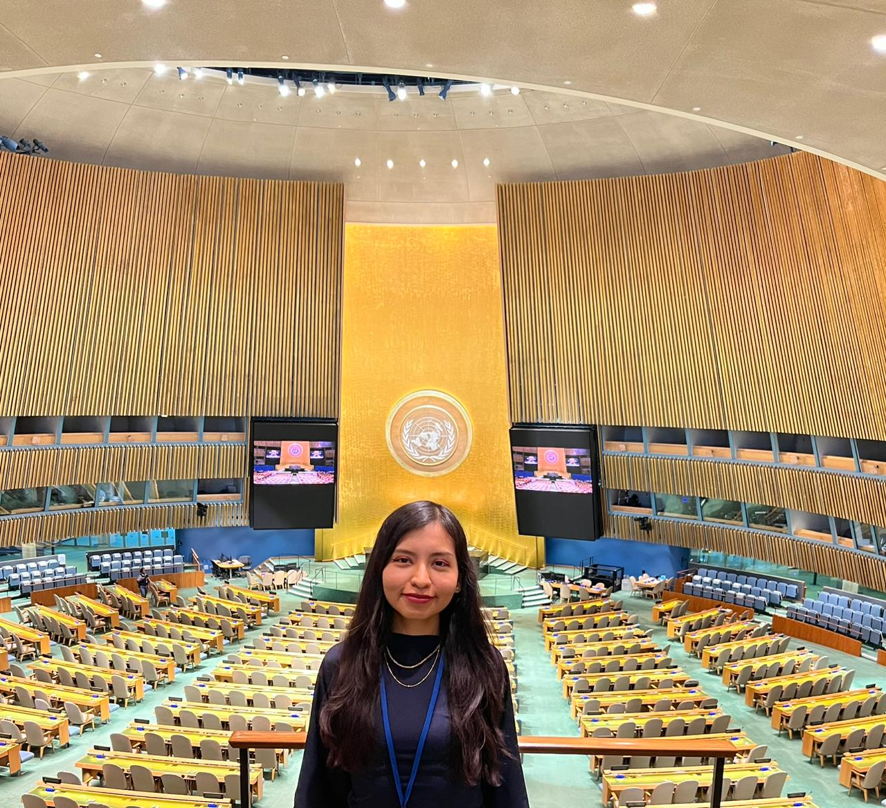
Editor’s Note: This is the second piece we have run from Andrea Viviana Araujo Muñoa who is now with us at the HLPF in New York. As we know and as Andrea has learned, many affiliated events are taking place outside of UN headquarters. Our July 9 event was also a hybrid event outside the UN building, designed in part to hear Andrea’s remarks: From Ayacucho to the United Nations A First-Generation Perspective on Identity, Resilience, and Youth-Led Community Transformation. But it was also to bring together a talented and professionally diverse group to relaunch the New York chapter of Women in International Security (WIIS) which had been run out of the Global Action office for several years pre-Covid. The hope is that events like this one and contributions like Andrea’s will help us maintain commitments to young women in all facets of the security sector.
The High-Level Political Forum (HLPF) is far more than just another United Nations event. It is a meeting point where changemakers come together, bringing their experiences, hopes, and shared aspirations. In an increasingly interconnected world, partnerships and collaboration are more essential than ever, because what affects one country ultimately affects us all. International cooperation must place greater focus on young people from marginalized and underserved communities—those who continue to transform their neighborhoods through resilience and self-organization despite persistent inequalities. They deserve not only to be heard, but also to serve as representatives in global decision-making spaces within the United Nations.
Roots and Resilience: The Journey from Ayacucho Sometimes, people forget where they come from and where they are going. For me, family history is essential because it shapes the way first-generation young people take action and create change. My parents are Quechua speakers from Ayacucho, the region where terrorism began in my country. As children, they were among the thousands who were forced to leave their homes and migrate to the capital. They never finished high school, had to learn Spanish at a very young age, and grew up facing systemic discrimination.
The First-Generation Responsibility I am now 27 years old. Although my parents had very limited educational opportunities, my two triplet sisters and I all graduated from a public university. Being a first-generation university graduate has given me a deep sense of responsibility to give back to my community and create opportunities for others who face similar barriers. For me, taking action is not simply a choice—it is a responsibility. It is not easy to face uncertainty or to defend diverse voices and cultural diversity, but these are precisely the values that make us human. My story is my starting point because I believe that everyone has a purpose in life. In times of uncertainty, that purpose provides clarity and direction. “Taking action is not simply a choice—it is a responsibility. It is not easy to face uncertainty or to defend diverse voices and cultural diversity, but these are precisely the values that make us human.”
Voices from the Margins: Youth-Led Action in Lima Through a youth-led organization born in the outskirts of Lima—the often-overlooked side of a deeply unequal capital—you can witness how young people from vulnerable communities promote and defend meaningful civic participation within their own neighborhoods. You can see that they do care about politics, not as partisan competition, but as a way to improve their communities. Despite having very limited financial resources, they design and implement free social initiatives for those around them. Self-management keeps these initiatives alive, but it also comes at a cost. I do not want to romanticize resilience or suggest that community organizing alone can overcome structural challenges. Young people need resources, opportunities, and institutional support so that their commitment is not what limits their future. Many volunteer despite lacking formal employment or financial stability. Each of them carries a unique story, yet they all share a remarkable determination to build stronger and more inclusive communities.
A Call for Global Partnerships & the HLPF The High-Level Political Forum (HLPF) is far more than just another United Nations event. It is a meeting point where changemakers come together, bringing their experiences, hopes, and shared aspirations. In an increasingly interconnected world, partnerships and collaboration are more essential than ever, because what affects one country ultimately affects us all. International cooperation must place greater focus on young people from marginalized and underserved communities—those who continue to transform their neighborhoods through resilience and self-organization despite persistent inequalities. They deserve not only to be heard, but also to serve as representatives in global decision-making spaces within the United Nations.
Reimagining Trust and Governance Today, there is growing discussion about the perceived decline of the United Nations, the urgent need for reform, and the frustration felt by many around the world. In this context, one question becomes unavoidable: isn’t this precisely the time to place our trust in those who continue to create real impact in their own communities? The High-Level Political Forum offers a unique opportunity for young people to move beyond simply being heard and to become active partners in shaping concrete, genuine, and transformative action.
Editor’s Note: Our Good friend and colleague, Rev. Dr. Liberato Bautista, made this excellent presentation at a recent HLPF side event on “Communities of Hope: Advancing Human Dignity and Development for Sustainable Futures.” “Levi” as he is known, is of Filipino ancestry and has long served in New York as Assistant General Secretary for United Nations and International Affairs, General Board of Church and Society of The United Methodist Church. He is also immediate past president of the Committee on NGOs. Levi is a familiar figure around the UN and this fine talk is what we have come to expect from him.
Excellencies, distinguished colleagues, friends, partners in civil society and faith communities: Thank you to the organizers for convening this timely parallel event to this year’s High-Level Political Forum, titled “Communities of Hope: Advancing Human Dignity and Development for Sustainable Futures.”
At a time when much of our public discourse seems saturated with anxiety, uncertainty, and division, I am grateful that you have chosen to organize a conversation about hope. Some may even accuse us of being hopeless romantics for injecting hope into an anxious world. I confess that I am happy to join that company. So, allow me to invite you, for the next few minutes, to imagine with me a future in the present tense. That may sound like a contradiction. Yet much of our work in the United Nations, in civil society, and in communities of faith depends precisely on this capacity.
We live amid the present tensions of our time—war and displacement, widening inequalities, lingering historical injustices, ecological degradation, technological uncertainty, and growing fragmentation. Yet we are called at the same time to orient our vision toward futures that are both visible and viable—futures shaped by human dignity, sustainable development, and shared flourishing.
I am especially drawn to the title of this event and its use of the word futures in the plural. Not future, but futures. That choice matters. Because no individual, no nation, no institution, and no tradition possesses a monopoly on what the future should look like. None has a franchise on hope. The future is not something handed down by the powerful. It is something imagined, negotiated, and built together. The language of hope and the language of futures, therefore, share a common invitation. They call us into a collective exercise of moral imagination about what makes for a more just, peaceable, and sustainable world.
Communities of hope help us hold these realities together. The timing of this event is especially meaningful. In just two days, on July 12, the international community will observe the International Day of Hope. By establishing this observance, the United Nations reminds us that hope is not merely a private sentiment but a force that advances dignity, peace, social stability, and sustainable development. Indeed, the United Nations has described itself as “the product of hope.” Hope, therefore, is not peripheral to the multilateral project. It lies close to its heart. The United Nations emerged from humanity’s determination that war, devastation, and fear should not define the future. Hope is among its animating purposes.
And it is in that spirit that I would like to begin with a lesson I continue to learn from people experiencing forced migration. Part of my work has involved creating platforms for migrants, refugees, displaced persons, and communities uprooted by conflict, persecution, environmental degradation, and economic necessity to speak about their own fears and hopes. One quickly discovers that hope, for people in forced movement, is rarely an abstraction. Hope does not recover the passport left behind. Hope does not reunite a parent with a child separated by war. Hope does not erase trauma. Hope does not instantly provide protection, livelihood, housing, or belonging.
And yet they continue to hope. What amazes me is not simply their resilience. What amazes me is their moral orientation. It is their determination to anchor their breath, their being, and their future to hope even when circumstances seem determined to deny their dignity. One of the lessons forced migration teaches us is that human dignity often survives long before development arrives. People continue to imagine futures for themselves and their children even when the path ahead remains uncertain. They continue to seek community amid displacement, dispersal, and dislocation. For some, the hope is a return. For others, it is the possibility of rebuilding life in countries of transit and destination. Development worthy of the name begins there. It begins with the recognition and protection of human dignity.
Communities of hope emerge wherever people refuse to surrender their dignity to conditions that deny it. That experience has led me to a conviction: Hope cannot merely be the ceiling we seek to reach. Hope must also be the floor from which we begin. Too often, we speak of hope as a distant horizon. But when hope is permanently deferred, its very unreachability can become a source of fear. Hope must be accessible. Hope must be tangible. Hope must be lived.
In the Wesleyan understanding of grace, God’s action is not merely a destination awaiting humanity at the end of the journey. Grace is already at work, preparing the way and opening possibilities where none previously seemed to exist. Hope functions in much the same way. It is not only the horizon that beckons us forward. It is also the ground beneath our feet that enables us to move at all.
Perhaps this is one of the lessons we must learn again regarding sustainable development. The Sustainable Development Goals were never intended to be merely a collection of targets and indicators. They were intended to advance human dignity through development and thereby create the conditions for sustainable futures. This year, as the High-Level Political Forum reviews Sustainable Cities and Communities and Partnerships for the Goals, I am reminded that both are, at their heart, questions of hope.
Communities cannot be sustainable if people are denied dignity, participation, belonging, and opportunity. And partnerships cannot flourish where fear, fragmentation, and exclusion prevail. One reason implementation gaps persist is that we have learned to count the goals while becoming less adept at encountering the people they represent. When goals become detached from lived realities, they risk becoming fossilized. Sustainable development is ultimately about creating conditions in which human dignity can flourish. Yet dignity, while inherent in every human person, does not protect itself. It requires protection through institutions, laws, norms, and regimes of human rights.
Hope, therefore, is not sustained by aspiration alone. It also requires institutions capable of safeguarding dignity and advancing rights. It is precisely because the SDGs are ultimately about people that I have come to believe that we live in a world in deficit of hope and in excess of fear. Fear generated by poverty and inequality. Fear generated by conflict and displacement. Fear generated by lingering historical injustices of slavery, colonialism, and racism. Fear generated by ecological degradation. Fear generated by technological change whose ethical consequences remain uncertain.
Yet fear today is more than an emotion. It is increasingly becoming a governing narrative. But we must not allow the present tensions of our day to determine the future. Hope begins with a refusal to make that concession. Hope is humanity’s insistence that another future remains possible.
This is why I increasingly refer to Agenda 2030 and the Pact for the Future as elements of the United Nations’ agenda of hope. They express not only hope for a better world but also hope for a United Nations transformed and fit for purpose—faithful to its foundational responsibilities to advance human dignity and human rights, promote peace and security, and foster sustainable development for people and planet.
For many years, I have argued that civil society must have access to the United Nations’ premises, promises, and processes. Today, I would add a fourth imperative: Civil society must also have access to the agenda of hope. Because hope belongs not only to governments but to peoples. Yet aspirations do not advance themselves. Norms do not implement themselves. Hope does not institutionalize itself. Every agenda of hope requires institutions capable of shepherding it. The multilateral infrastructure entrusted with this task—the United Nations—is under strain. Ultimately, humanity’s collective capacity to imagine and pursue a common future is under pressure.
This is why I continue to advocate for a people-centered, ethical, and transformative multilateralism. Ethical multilateralism is not merely cooperation among governments. It is the encounter between the community of nations and the community of peoples. Human beings flourish not in isolation but through mutual responsibility, solidarity, compassion, and participation in the common good. As Minjung theologians in South Korea reminded us, ordinary people are not objects of history but its makers. When people become subjects rather than objects, the horizon of hope becomes clearer, and the space for collaboration widens rather than shrinks.
My friend and colleague, Christian social ethicist Dr. Lester Edwin Ruiz, has challenged us to distinguish between what is fundamentally new and what is fundamentally better. This question is especially important in the age of artificial intelligence. The issue is not whether AI is fundamentally new. It clearly is. The deeper question is whether it fosters fundamentally better relationships. In this regard, I find resonance with Pope Leo XIV’s insistence that: People must come before technology. Human dignity must come before efficiency. Ethics must come before capability.
For many of us who work in and around the United Nations, no passage from sacred scripture has captured the moral imagination of the international community more profoundly than Prophet Isaiah’s vision that nations shall beat their swords into plowshares and their spears into pruning hooks. Yet eighty years later, we must acknowledge that the world has not yet beaten all its swords into plowshares. The answer, however, is not to abandon Isaiah’s vision. The answer is to deepen it. This is where I find Prophet Micah’s injunction indispensable. While Isaiah calls us to transform the implements of war, Micah calls us to transform ourselves: to do justice, to love kindness, and to walk humbly.
Here, I also hear an echo of John Wesley’s first general rule: Do no harm. Between the present tensions of our day and the future we aspire to build lies a profound moral responsibility. Do no harm. Do not compromise the future of generations to come with our own follies. Do not diminish tomorrow through the choices we make today. Do not sacrifice the dignity of others for immediate gain.
In a world marked by conflict, displacement, dispersal, dislocation, ecological degradation, widening inequality, and technological disruption, this remains a profoundly relevant public ethic. The world does not need less imagination. It needs imagination disciplined by justice, tempered by mercy, and guided by humility. Perhaps this is what communities of hope are called to offer in our time: not merely a vision of a future without swords and spears, but the moral capacities to build and sustain it.
Finally, these traditions remind us that the future is not merely something we await, inherit, or discover; it is something we create. As the musical Rent reminds us, the opposite of war isn’t peace. It is creation. War destroys. Creation builds. War wounds. Creation heals. War closes horizons. Creation opens possibilities. Therefore, communities of hope become communities of creation. They participate in the ongoing work of creating a world where human dignity is protected, human rights are respected, communities flourish, and sustainable futures become possible. And because destruction is ultimately aligned with death, creation remains one of humanity’s deepest affirmations of life itself.
In a world in deficit of hope and in excess of fear, communities of hope remind us that hope must be more than a destination. It must become a lived reality. They remind us that human dignity is not a consequence of development but its foundation. They remind us that sustainable futures are built when peoples and nations work together to move our world from fear toward hope, from fragmentation toward solidarity, and from what is merely fundamentally new toward relationships that are fundamentally better.
That, I believe, is the promise and calling of communities of hope: advancing human dignity through development for sustainable futures. Thank you for your indulgence.
Editor’s Note: Rebecca Irby’s investments related to her leadership of PEAC (www.peacinstitute.org), investments in sustainable development, youth and women’s engagement, nuclear disarmament and NGO-focused media are becoming legendary in UN spaces. Here she kicks off what will surely be a fruitful, longer-term engagement, one which has already attracted the attention of other parts of the UN system, including from the leadership of the UN mission of the Republic of Korea. Her comments in relation to the newly-formed NGO Committee for Dignity were very well received and I am pleased to be able to share them here.
Opening Statement + Introduction of the Committee for Dignity
Good morning, everyone.
Welcome, and thank you for joining us for Dignity and the SDG Implementation Gap: Structural Discrimination, Community Evidence, Nature, and Meaningful Participation.
It is an honor to gather here during HLPF, in this space so close to the United Nations, and in the company of civil society leaders, advocates, community partners, researchers, and people who continue to believe that sustainable development must be more than a promise on paper.
At the heart of today’s conversation is a simple but urgent idea:
Dignity is not an ornament added to development after the fact. Dignity is the measure of whether development is happening at all.
When a community lacks safe water, it is not only a service gap. It is a dignity gap.
When people are denied clean energy, housing, infrastructure, health, education, or safety because of who they are, their race, caste, gender, disability, migration status, Indigenous identity, poverty, or political exclusion, that is not only a policy failure. It is a dignity failure.
And when communities are studied, counted, consulted, and photographed, but not trusted to shape the decisions that affect their lives, that is not participation. That is performance.
The United Nations begins with the words “We the Peoples.” Those words matter. They remind us that the UN was not created only for states, systems, or institutions. It was created to serve humanity.
And at this particular moment, the role of civil society has never been more important. Around the world, too many people live under systems where their voices are restricted, dismissed, or unheard. NGOs, grassroots movements, Indigenous leaders, youth organizers, disability advocates, faith communities, women’s groups, peacebuilders, journalists, educators, and community institutions help ensure that the lived experiences of people remain part of the global conversation.
That is why the NGO Committee for Dignity exists.
This Committee was created to bring organizations together around a shared commitment to dignity, justice, inclusion, peace, and meaningful participation.
But I want to say something plainly: a committee is not meaningful simply because it exists. A coalition is not powerful simply because names appear on a list. An organization becomes meaningful when it becomes a place of commitment.
Commitment to one another.
Commitment to the communities whose lives are shaped by these decisions.
Commitment to the difficult, patient, disciplined work of moving from concern to action, from action to accountability, and from accountability to transformation.
Our purpose is not to speak for people.
Our purpose is to create spaces for people to speak for themselves, and to help make sure that when they do, institutions are prepared to listen, respond, and change.
We are here to help ensure that all peoples, including stateless peoples, Indigenous communities, vulnerable populations, marginalized groups, and communities facing structural discrimination, are not treated as afterthoughts in global policy conversations.
These communities are not footnotes.
They are not simply beneficiaries waiting at the end of a system.
They are the authors of evidence. They are the holders of wisdom. They are the builders of solutions.
Dignity is inseparable from the dignity of life itself: the dignity of nature, the dignity of water, the dignity of land, the dignity of future generations.
Protecting dignity and protecting the planet are not competing responsibilities. They are deeply connected.
As Wangari Maathai, a Kenyan social, environmental, and political activist who founded the Green Belt Movement, reminded us, when we help the Earth heal, we also help heal ourselves.
And that brings us to the core question of today:
What is the SDG implementation gap really telling us?
It tells us that promises are not enough when the structures that deliver them still exclude people.
It is telling us that technical solutions are not enough when the people closest to the problem are kept farthest from power.
It is telling us that participation without influence is not participation. It is choreography.
And it is telling us that the people closest to the harm must be central to defining the repair.
This week, as the United States reflects on 250 years since the Declaration of Independence, we are reminded that every nation, every institution, and every global framework is tested not by the beauty of its ideals, but by the honesty of its implementation.
The question is not only whether we can repeat our founding promises.
The question is: Who is still waiting to be included in them?
That is true for the American story. It is true for the United Nations. It is true for the Sustainable Development Goals.
Our task is not simply to celebrate the promise.
Our task is to close the distance between the promise and people’s lives.
So today, we gather not only to talk about dignity, but to ask what dignity requires of us.
Dignity requires memory, because communities know the histories that institutions often ‘forget’.
Dignity requires truth, because we cannot repair what we refuse to name.
Dignity requires evidence, because lived experience must be treated as knowledge, not anecdote.
Dignity requires humility, because institutions must be willing to learn from the people they were designed to serve.
And dignity requires communities at the center, not as symbols of inclusion, but as partners in shaping what comes next.
Most of all, dignity requires us to move from symbolic inclusion to meaningful participation. These are not abstract values. They are the conditions that determine whether communities are treated as partners in implementation or as evidence after the fact.
Thank you all for being here. I am so grateful for the wisdom in this room, and I look forward to the conversation we are about to build together.
There exists no more difficult art than living. Seneca
Our planet is the mental institution of the universe. Johann Wolfgang von Goethe
Insanity is relative. It depends on who has who locked in what cage. Ray Bradbury
Neither a man nor a crowd nor a nation can be trusted to act humanely or to think sanely under the influence of a great fear. Bertrand Russell
Madness is something rare in individuals — but in groups, parties, peoples, and ages, it is the rule. Friedrich Nietzsche
Where to look if you’ve lost your mind? Bernard Malamud
Was insanity just a matter of dropping the act? Susanna Kaysen
Eventually you learn to exist on the precipice of insanity. R.F. Kuang
It is perhaps an oddity (even by my standards) to write about madness as a tribute to Fathers’ Day. But madness now accompanies a broad swath of our personal, family, economic and governance domains and it is reasonable to ask if there are particular responsibilities that parents — that fathers — can exercise to help ensure that the music accompanying the sanity-deficient dance we now collectively perform, thereby giving expression to a range of social and personal pathologies, can be toned way down.
The motivation for this post is a book which I recently read again and which had a good bit to do with my own social psychology awakening, “The Sane Society” by Erich Fromm. The book is certainly dated in some aspects, still wrestling with outdated Freudian assumptions and advocating mostly conventional therapeutic options. But it also makes an important contribution to the creeping anxiety and “great fear” which characterize this moment, indeed has characterized many of our “civilized” societies and their institutions well before the inception of Fromm’s work (and my own earthly existence) back in the 1950s.
Most of us don’t need to be convinced about the collective insanity which punctuates our present. We experience the carnage of epidemic levels of predation, sexual and economic. We endure a system which stacks the deck against workers and in favor of oligarchs and corrupt officials, a system which has left many of us desperate for health care and other services all while we literally starve for connection beyond transaction. We daily witness the unleashing of bias and violence against people, even citizens, whose skin color and language preference is exploited by out-of-control enforcement agents. We recoil from seemingly endless armed conflict and rumors of more, as well as from faith traditions which are now as likely to justify the madness as demand the repentance for our most toxic actions and aspirations.
There is more, of course, both life affirming and life challenging. What interests me is that, 70+ years on, none of our current levels of insanity would be news to Fromm. Even then, he lamented the “lengthening shadows” over societies which have increasingly made human beings an alienated “appendix” to societies rather than being central to the creation of their meaning and value. Indeed, Fromm lamented traits of personality which made people “acceptable” in his time and ours – humans who “fit” without friction, who obsess over recognition and affirmation, who refuse to “stick their necks out no matter the provocation, people who are “well adjusted” in a way that reminds of the robots and AI which, despite the benefits, now seem to be pushing us further towards “the precipice of insanity” and further away from the human agency which remains our primary antidote to alienated living.
Fromm was explicit in his concern that, unless societies can transform material interests into respect for what he called “the fundamental facts of human existence,” such as our need for transcendence, relatedness and rootedness, that decay and barbarism were likely outcomes and that “blood and soil” concerns would crowd out solidarity and the quest for genuine security in a world which is literally ruled by (largely outmoded) economic indicators and priorities. Even back then, Fromm lamented the gaps increasingly separating knowledge and reason (let alone wisdom), the willingness of too many to sit back and let the world simply take its course, to reinforce and amplify passivity as a lifestyle in which “taking care of your own” is the only care you are ever expected to take.
Many of the fathers I know see these recurring warning lights and understand the threats they pose to the children they are trying to raise. They recognize that, quoting Fromm again, “ the aim of life is to live it, to be fully born, to be fully awake.” But these fathers also see the pressures emanating from an increasingly sanity-challenged society which deifies the economic, which reinforces the passive, which mocks the humble, and which sustains mighty divides of race and economic opportunity, religion and gender – divides which ultimately magnify insecurity rather than promote its resolution.
Fromm worried in his time about the idolatrous “blood and soil” concerns upheld by too many men, concerns which have only served to make prescient his “decay and barbarism” warning in our own, more immediate contexts. But he also worried about fathers who were seemingly, in his words, “along for the ride” of rearing children in this current time of creeping madness. Thankfully, however, many of the fathers I know largely recognize the need to model and promote a certain kind of courage and resilience in their children, helping them along the road to more effectively tolerating insecurity and to do so free of panic, free of pretense , and free of the life-denying consequences of the “great fear” which currently grips much of our individual and institutional expressions.
In these times, such is the opening portal to a very high calling, one which models a life engaged robustly, a life which eschews the paralysis of boredom, which upholds the ethical even while sailing across seas of corruption, which allows us space to find rest without resignation, which insists on agency to help mold a world fit for more — much more — than our borderline-insane pursuits and distractions focused largely on human consumption.
Fromm urged all parents, especially all fathers, to commit to raising children able and willing to use their skills and commitments in the service of life and not of destruction, alienation or even death. From my seat in the policy world, I believe that these contrasting ends remain fully relevant if we are ever to move our planet beyond its “mental institution of the universe” status. And from my even better seat in the human community, I deeply honor those fathers who help their children master “the difficult art of living” in all its aspects, in part by choosing life themselves.
In this sanity-challenged world of ours, this mastery might be the highest calling of all. Grateful to all the fathers who heed the call on this Father’s Day.
Don’t let the rain drive you to the wrong shelter. Michael Bassey Johnson
The greatest protection any of us can have is faith in ourselves. Maya Angelou
Your silence will not protect you. Audre Lorde
If we want to embrace life, we also have to embrace chaos. Susan Elizabeth Phillips
The best lightning rod for your protection is your own spine. Ralph Waldo Emerson
By allowing your mother to protect you, you gave her a gift. Kristin Cashore
So you don’t think three protection dogs, a room filled with weapons, a panic room and house that eats people isn’t just a little overkill? Christine Feehan
The measure of strength is how gently it can hold the fragile. Lawrence Nault
It’s easy to have ethics when what you love is not in danger. Mariana Enríquez
I realized protecting my children meant speaking truths I had buried for decades. Denika Fercho
The phrase in the title of this post comes from the representative of Liechtenstein speaking at a Security Council debate on civilian protection. Last week was “protection of civilians” week, an opportunity for the UN to examine generally mandated tasks to protect civilians endangered by armed conflict, but also to examine measures to, as was noted in a side event, “protect the protectors.” Liechtenstein has been among the most important UN members in calling attention to deficits in civilian protection but also in atrocity crime prevention and in upholding international law.
There are, indeed, expectations for protection, expectations of our military and police contingents, expectations of our UN peacekeeping forces and first responders, expectations of our political and community leaders, expectations of our families and neighbors, expectations that these and others are committed to a degree of protection from threats which so often seem to be beyond local capacity to respond, and which may indeed, at least in some instances, be beyond our capacity to grasp.
Like some of our readers, my relatives saw their military commitments largely as acts of protection of the places and people they loved. They entered such service willingly but not vindictively, understanding the potential horrors of armed conflict while hoping and praying that horrors would end quickly and impact as few communities as possible.
While these sentiments may have been self-deluding in some measure, they derived from the idea that protection in itself had noble aspects, that threats were real and that, while all had a responsibility to protect, that burden was higher for some. They were prepared to respond to a crisis as it unfolds, to run towards danger rather than from it, to take on risks so that others could have their own risks reduced. While protection is incumbent upon all who are capable of protecting, some in our dangerous world are certainly more fragile than others, as some are better equipped (in military hardware if not necessarily in temperament) to meet threats and challenges than others.
What emerged from the UN’s “protection of civilians” week was a tapestry defined by increasing state and non-state brutality, a willingness to disregard international law and the UN’s own Charter, and a liquidity crisis which has exacerbated the UN’s own reputational concerns. In the Security Council, delegation after delegation implored the Council to take their protective responsibilities more seriously and to do so in accordance with the values that led to the founding of the UN in the first instance. These delegations understood (as did those of us witnessing the discussion) the degree to which our global economic and security systems have become partisan entities which benefit the few and increase pressures on the many. They understood that the UN’s liquidity crisis impedes the ability of the UN system to properly fund protective operations, but that the need for protection is now more acute than in the past, not less.
Not all of the UN’s shrinking roster of peacekeeping operations have protection mandates. But all have protection expectations of people living in countries where physical insecurity is as much a factor of daily life as economic, food and health insecurity. These people need “blue helmets” to respond even as response is compromised by combinations of funding shortfalls, increasingly mistrustful host governments and troop contributing countries concerned about the ability of their troops to protect themselves in increasingly hostile contexts let alone to protect others.
During the Council debate, it was Panama who highlighted the irony that over a dozen civilians will have lost their lives “while we sit here and debate how to protect them.” Indeed, it is a failure to either manage or meet protection expectations which generates irony such as Panama’s, which in turn generates a sense that the UN’s protective architecture now falls well short of what is needed given our current laundry list of vulnerabilities.
And the gap is likely to increase as threats from a world increasingly indifferent to international law or climate change, a world in which the US and others are turning their backs on (and closing their wallets to) multilateral solutions, a world (to cite the ICRC this week) which is literally drowning in language used to justify our own brutality, language which includes what Somalia referred to as the “exceptionalism” which justifies any and all IHL violations, language easier employed when we simply choose to stop seeing adversaries as human beings.
It is, indeed, harder to uphold ethics when the things you love are under threat. But threat is a common factor not a partisan one and those commonalities are becoming more severe not less (as Pakistan, Denmark and others noted last week) due to the disinformation and misinformation increasingly generated by artificial intelligence tools. Indeed, one of the major threats now to UN protection measures is the AI-generated lies which seek to pit communities against each other and undermine confidence in authorities and their protective responses. We now see the results of that mistrust play out in communities worldwide, people who have given up on any assistance from outside and have turned that mistrust into emotional and physical barricades which, of course, cannot viably protect themselves and their loved ones from the crossfire of either weapons or weaponized “information.”
Thankfully, mistrust of authorities and their entities does not automatically remand into privatized “overkill.” One of the takeaways of “protection of civilians” week is the role that communities can and must play in their own protection rather than simply huddling together in expectation of an external force which might never arrive, which might make matters worse, or which otherwise might be insufficient to task if it does arrive.
As with many other issues, the discourse at UN headquarters struggles to properly acknowledge local expertise and capacity to address a range of threats which have defied multilateral solution. But the event on “protecting the protectors,” dominated by civil society voices, had no such struggle. Nonviolent Peace Force is perhaps the most notable of a global movement which invests in the community dimensions of protection, helping to build bonds of trust and active good neighborliness which can help create protective agency when and where external protective forces are delayed or absent.
While this approach does, as was noted at the session, transfer some risk from external protectors to frontline actors, it also acknowledges the skill that frontline actors have to protect themselves and the communities with which they are aligned. At a time when the UN admits to “unprecedented” numbers of victims, often at the hands of state actors with full impunity, the UN’s ability to provide external protection to civilians on a wide scale is clearly compromised. More and more, such peacekeepers are the targets of violence as they also seek to be a prompt and trusted response to violence.
So this is where we are now. Peacekeepers facing threat from drones and other state and non-state weapons which also threaten those they seek to protect. Government forces applying their own protective measures selectively, more consistent with political rather than humanitarian objectives. Peacekeepers lacking dependable funding and host country respect for status-of-forces agreements, including an increasing willingness to suspend adherence to international law for often poorly defined national interests. Communities also are facing increased protection-related risks without the skills or training in too many instances to build local trust and cultivate local protection expertise.
As with so much else in our world, we have done this to ourselves. We have created this moment with corruption embedded in virtually every economic transaction, with abuse normalized and agreements purely instrumentalized, with nations doing more or less what they please because there are fewer and fewer persons and institutions committed to diverting their more nefarious intentions.
Until we can get these circumstances turned around, the need for protection remains acute – from families and neighbors, from properly trained soldiers, officers and agents, from people of many backgrounds who recognize the absolute imperative of meeting the protection expectation and doing so in ways which honor and uphold the law, not trample on it.
On this day and all days, may those who protect teach the rest of us how to choose or even build more effective shelters from the storms which so often surround us. And may they all survive the gauntlet they have so bravely chosen to traverse.
So how on earth can I bring a child into the world, knowing that such sorrow lies ahead, that it is such a large part of what it means to be human? I’m not sure. That’s my answer: I’m not sure. Anne Lamott
Through the blur, I wondered if I was alone or if other parents felt the same way I did – that everything involving our children was painful in some way. Debra Ginsberg
She has changed in this way that motherhood changes you, so that you forget you ever had time for small things like despising the color pink. Barbara Kingsolver
Mothers are all slightly insane. J. D. Salinger
The best way to keep children at home is to make the home atmosphere pleasant and let the air out of the tires. Dorothy Parker
(24/7) once you sign on to be a mother, that’s the only shift they offer. Jodi Picoult
What fabrications they are, mothers. Scarecrows, wax dolls for us to stick pins into, crude diagrams. Margaret Atwood
Women, who struggle and suffer pain to ensure the continuation of the human race, make much tougher and more courageous soldiers than all those big-mouthed freedom-fighting heroes put together. Anne Frank
Have you any idea how many children it takes to turn off one light in the kitchen? Three. It takes one to say “what light” and two more to say “I didn’t turn it on.” Erma Bombeck
Guilt to motherhood is like grapes to wine. Fay Weldon
Taking care of myself doesn’t mean ‘me first.’ It means ‘me, too.’ L.R. Knost
If they would all sleep all the time she wouldn’t mind being their mother. Kate Atkinson
I spent part of Thursday at the Post Office where I was on a line behind two men with Mother’s Day cards trying desperately to get some commitment from the postal workers that a 78-cent stamp would ensure delivery two days hence.
Such a small and untimely investment wouldn’t ensure any such thing of course and you have to wonder about folks who felt that they had to do SOMETHING for Mother’s Day but didn’t have the resourcefulness to mail on time nor were they apparently inclined to resort to the fancy bouquets, jeweled necklaces and other material indulgences which literally dominate the airwaves during this season.
The quotations above are intended to serve as a partial antidote to the excessive rituals which often punctuate this “holiday,” a day when “remembering” mom is incarnated, not enough in thoughtful questions and familial solidarity but in gifts which often show as much care and recognition as those tardy Mother’s Day card holders in the postal line. Some of the quotations will be familiar. Some offer humor and a bit of insight into the worry and uncertainty experienced by so many mothers I know, the knowledge that we have collectively made a world too dangerous for humans and other life forms, including the life forms better known as human children. We have indulged and normalized behavior that need not be so and that we do not need to be so. We have misused the inheritance of our children – grown and not – inheritance less about trust funds and more about a world which is running out of trust more generically, a world in which we don’t honor promises and then create conditions where promises can barely be met even if we were inclined to do so.
And yet, despite all, so many women, so many mothers in waiting have decided to bring new life into the world anyway.
It is this cloud of global uncertainty affecting motherhood, even influencing the decision to be a mother, in the first instance which I want to briefly explore here.
I have articles on my feed daily outlining some of the internal pressures on mothers – from partners inattentive to child rearing responsibilities and children addicted to screens and their messaging, to struggles with access to health care, child care and formal schooling which might actually prepare children to take on an increasingly challenging world.
At the same time, mothers face a climate increasingly hostile to women’s full and equal (as we say at the UN) participation in civic and political life. The rollback of women’s rights and freedoms, including the disrespect of their professional skills and accomplishments, unimaginable threats to their political franchise and the apparent re-normalization of sexual predation, all this and more has a dramatic impact on mothers hoping to raise respectful sons and empowered daughters. It is painful for some I know to watch as children struggle to adjust to a world which, in several significant aspects, we older folks dared to think we had left behind.
On top of this, as many mothers I know recognize, threats and challenges to children extend much further afield – to rising sea levels and biodiversity losses, to wars of choice and the inevitable displacements and deprivations they cause, to pandemics and other medical emergencies which we don’t seem to have any timely plan to recognize or address, to the pervasiveness of criminality on a massive scale which literally opens spaces for traffickers and corrupt officials as it closes spaces for those seeking to hold criminal elements to account.
You who have indulged these posts over several years have also shared our window into an international order which seems to be fraying at the edges and which the growth of artificial intelligence is most likely to accelerate. From climate change to nuclear weapons, the institutions where we do our work are increasingly unable to ensure that we will not eventually perish at our own foolish hands. “Bombs, blockades and bluster” are terms which represent too much of our current policy discourse and practice, speeches and actions much more likely, it seems, to turn up the heat rather than tone it down.
For mothers, this is yet another dimension of a painfully recognized inability to shield children from the worst of adult follies. Long before these posts were launched, I was part of a UNICEF Committee on the Rights of the Child, committed to “making the world fit for children.” I have worked over the years alongside many women – many mothers – who have contributed much of themselves towards this same end, a goal as essential to the continuation of our human family as it has been elusive. And it has remained very much elusive over the course of my adult life.
And yet, knowing what they know, feeling as they feel, worrying as they might, women choose to have and raise children anyway. They take a stand for lives that they can nurture if not always protect, extending the hope and potential that every child brought into this world embodies, at least in part. As Anne Frank noted above, amidst her own era of war and holocaust, there is courage at the center of this choice, the courage which we should honor this day and all days, the courage which binds so many mothers amidst the joys and travails of motherhood, even those for whom having children remains simply the only natural life path.
We see you and your courage. We see what you have chosen to do, have chosen to embrace, to bring children and the possibility they represent into this world. We have no cards or jewels to offer, but you have our deep respect. Take a bow.
Editor’s Note: The lengthy excursion below is also an excellent introduction to the work of a young Peruvian woman who has become an important colleague for us. Andrea was introduced to us by our longtime friend Dr. Toh Swee-Hin, and we had quickly become enamored of her community activities and her energetic spirit that we wanted to both support that work and draw her more into our international orbit. Andrea recently was issued a visa by the US government and we expect to have her at the UN this summer for the High Level Political Forum and related activities. Hopefully she will make abundant contacts which will help shape her future community work in Peru. We, on the other hand, stand to learn much from her presence here. The text below will help explain why we are so pleased to welcome her.
No one told me that founding a youth organization engaged in community volunteer work on democracy and citizen participation while belonging to a vulnerable population (a young woman, premature seven-month triplet, first-generation university student, and coming from an emerging district) would be highly complex; but no one told me either that I would lead with such passion, even on the most uncertain days.
I GREW UP ON THE PERIPHERY OF DEMOCRACY: I BECAME NATIONAL NEWS WHEN I WAS BORN ALONGSIDE MY SISTERS.
Who could have imagined that the girl whose birth was exposed as a media event in the era before social networks — at a time when digital platforms did not exist to communicate and public visibility depended almost entirely on traditional media — would later be instrumentalized within a phenomenon that drew in a political candidate willing to extract political capital from family vulnerability, would end up leading her community. Yes, a politician came to promise help, posed for the photo as part of his unfulfilled social assistance, and never returned. That is how I was named Andrea, in honor of an authority of the time who promised support to my family in front of cameras and whose name I ended up carrying in its feminine version.
My parents settled in an emerging district — the other face of Lima — where many people build their lives from scratch in search of the opportunities their hometown, 18 hours from the capital, could not offer them: education, healthcare, and stability. They were uprooted from their families at ages 11 and 14 respectively and arrived in a city marked by discrimination, structural racism, and stigmatization. In those years, coming from Ayacucho — a region deeply affected by the internal armed conflict — meant bearing prejudice, suspicion, and exclusion. I am the daughter of those migrants who fled not only from precariousness, but also from the weight of stigmatization and lack of opportunity.
Both arrived while still almost children. They had no formal education or role models along the way, yet guided by their Catholic faith, they leaned on one another and on work to provide their daughters with basic goods and services. I grew up with faith and dignity. Perhaps it was there that I understood how each act shaped who I am. I chose to study Political Science as an act of “rebellion”: to understand power in order to transform it, because politics shapes our lives from birth.
In my veins, in my Indigenous Ayacuchan roots, runs the blood of generations who did not have the privilege of education, of understanding, or of acting to alter that reality. It is a struggle that is not easy to embody, yet it became my life’s passion: to assume collective challenges from the periphery.
I, too, would have liked to be born into a cradle of opportunity, but the cradle of resilience into which I was born shaped me from my very first minute of life. Here I am, here I remain, and I endure, because I firmly believe, as Mujica once said, that my strength lies precisely in having been born where opportunities are scarce but dignity abounds. We do not choose the cradle into which we are born, but we do choose what we do with the life we are given. In the trench of scarcity also lives the courage of struggle and rebellion transformed into love for others. For that reason, politics is an instrument of service, even when the path becomes more arduous for those who remain faithful to their ethical principles. What gives strength is not what is lacking, but what overflows in conviction, because the cause is always to live with meaning.
I ENTERED THE MOST PRESTIGIOUS PUBLIC UNIVERSITY IN MY COUNTRY, ON SCHOLARSHIP, AND SINCE THEN I HAVE WORKED TO TRAIN WITH EXCELLENCE
I have always pursued challenging goals. I understood early on that living means precisely that: moving forward even when uncertainty weighs more than certainty.
I never imagined entering the “Dean of the Americas.” Not because I doubted my abilities — I was always disciplined and deeply committed to my studies in my community’s public school, where I ranked second overall throughout all my school years (first place was achieved by my triplet sister) — but because I often heard that such a path “was not designed for someone like me.” The narrative was familiar: accept reality, resign yourself to economic limitations, study only if my parents could afford a few months of preparatory academy; otherwise, give up the dream.
But I earned admission. I won a national scholarship. I graduated with excellent grades. I participated in an international exchange, also on scholarship. Later, I went through months of unemployment until an opportunity arrived that transformed my trajectory: a paid internship at USAID, an institution that believed in my potential, revitalized my vocation, and allowed me to work alongside highly qualified professionals, engage in technical dialogue, and operate in a language other than my own. It was not that I romanticized the agency. It was that every second of the experience was difficult to describe. I learned enormously and deeply valued having been selected among thousands of applicants. I did not only learn from my office, but from all of them. Absorbing knowledge was, without exaggeration, one of the most enriching professional experiences of my life.
I received significant recognition within the institution, yet everything ended. My stipend was rescinded in February due to the broader context. I carried with me learning, networks, and professional validation. Outside, however, another reality awaited me: that of my country. Months later came the enactment of Law No. 32301, modifying the framework of the Peruvian Agency for International Cooperation (APCI). One of the main criticisms points to its imprecise wording. By generically prohibiting projects that may imply “intervention in internal politics” or actions that “affect public order, citizen security, or national defense,” the regulation could inhibit virtually any form of citizen criticism. The potential impact on independent media and organizations reliant on international cooperation is particularly concerning, especially in fields such as human rights, governance, and the environment. An inevitable tension arises: How can the State validate investigations that may question it?
The Inter-American Commission on Human Rights (IACHR) expressed grave concern regarding these changes, warning that prior authorization requirements and new administrative obligations could create disproportionate obstacles to civic space and freedom of association. All of this unfolds amid a national context marked by organized crime, expanding extortion, and the proximity of general elections in a highly fragmented landscape with more than 36 political parties.
For a political scientist who refuses to normalize complacency toward corruption, navigating this reality is already complex. Doing so from unemployment is even more so. In contemporary Peru, engaging in advocacy or volunteer initiatives related to democracy and citizen participation can paradoxically become a professional risk factor — not due to lack of merit, but because certain institutional environments view such experiences with suspicion. In a climate where the current government maintains a restrictive posture toward various forms of collective action, the tension between ethical coherence and job stability ceases to be theoretical and becomes a daily decision.
FROM RESILIENCE TO COLLECTIVE ACTION: ORGANIZING FROM BELOW TO SUSTAIN DEMOCRACY
I founded Empodérate Vecino(a) in 2022. I did so while working as a junior research assistant at the National Police of Peru and simultaneously directing the research workshop “Ciudad Crítica” at my university. This initiative emerged after researching the territorial governance of the Lima 2019 Pan American Games, particularly in my district. For the first time, high-level sports infrastructure arrived in my community. This transformed not only the urban landscape, but also my understanding of territory, inequality, and citizenship.
I chose to lead the organization through a quiet yet close approach. I wanted to build a space that did not merely appear active, but truly executed; that did not only speak about participation, but practiced it effectively. Since then, Empodérate Vecino(a) has become my principal space and refuge for civic engagement. I deeply believe in self-organization and self-management as forms of democratic resilience. Grassroots movements like ours embody concrete practices of deliberative democracy: inclusion of diverse voices, public reasoning grounded in arguments and evidence, respect, active listening, and the search for shared foundations connecting deliberation with legitimacy.
However, the path is not easy. Structural barriers persist: distrust toward young women’s leadership, cohesion within community-based grassroots organizations, high criminality in historically excluded territories, and the constant fear of raising one’s voice in the face of social injustices. Added to this is the reduction of funding for democratic strengthening, which generates emotional exhaustion among those who sustain initiatives amid scarcity.
Young people who choose to speak up also face demotivation stemming from precarious conditions and, more recently, the threat hanging over their social and professional capital. In many cases, activism — far from being recognized as valuable civic experience — can become a source of vulnerability, stigmatization, or professional risk.
Despite this, the organization has consolidated itself as a space where young people from peripheral neighborhoods learn to lead, participate, and create change through everyday action. Not through rhetoric, but through practice: civic labs, civic games, workshops for young mothers, and creative participation methodologies. After my experience at the development agency within the U.S. Embassy, I decided to apply for international funding. We secured support from Global Changemakers, which allowed us to implement the project “Qhapaq Ñan Cívico.”
This electoral education and empowerment initiative was aimed at internally displaced migrant women from the other side of Lima — my community, emergent yet resilient. Many of them face triple exclusion based on gender, age, and migratory trajectory, along with limited access to safe spaces for participation.
We worked to change that reality through participatory workshops, intergenerational mentorship, and intercultural content. As part of the pedagogical design, I developed a mascot: an animated version of the Andean Cock-of-the-rock, Peru’s national bird. This character accompanies participants along the “civic pathway,” blending humor, warmth, and cultural symbolism.
In this way, the concept of Qhapaq Ñan — a Quechua term associated with the Inca road system — is reimagined as a metaphor of connection: civic pathways that cross territories where institutional democracy often arrives late or incompletely. Because it is precisely there — in the margins — where decentralized democracy must be strengthened: where the State, technology, academic opportunities, and international connection rarely converge.
This initiative is deeply personal. It represents a living expression of the principles that guide my work: that transformative education can build bridges between local realities and global aspirations for justice, sustainability, and inclusive democracy. And because, ultimately, change is driven by ordinary people, by the nobodies, the anonymous, those who rarely appear in the newspapers.
DELIBERATIVE DEMOCRACY FROM THE MARGINS: GRASSROOTS ORGANIZATIONS MATTER MORE THAN EVER
Community-based youth organizations are not born from offices nor under paternalistic, assistentialist logics. They emerge from lived experience, from territorial urgency, and from the need to solve concrete problems where the State arrives late, precariously, or simply does not arrive. However, the ecosystem of social and financial support often privileges models more comfortable for traditional cooperation: initiatives aimed “at” vulnerable populations, but not necessarily built “with” them. Projects designed from above, framed by savior narratives, backed by secured resources and prior institutional validation.
This tension reveals a structural contradiction: while the importance of empowering underrepresented populations is proclaimed, their organizational autonomy, technical capacity, and political leadership are frequently met with distrust. Youth organized within their own territories are not assistentialist projects nor symbolic extensions of traditional activism. Yet they often face a silent delegitimization when they attempt to articulate networks, mobilize communities, or generate advocacy, as they are frequently not taken seriously.
A problematic logic persists within certain social support and funding ecosystems: narratives, representation, and even the “marketing of the cause” are expected to be led by external actors with greater economic capital. Collective action appears to require the mediation of a savior figure — someone with resources, status, or symbolic authority — who designs initiatives from a desk and speaks on behalf of those who experience inequality firsthand.
Grassroots youth organizations face a persistent paradox. They must demonstrate professionalism, impact, and sustainability while operating under conditions of high precariousness, constant self-management, and emotional exhaustion. Added to this is another challenge: the suspicion cast upon youth activism, especially when it addresses democracy, citizen participation, or institutional oversight. Today, in an international landscape where funding for democracy and civic strengthening is shrinking, the pressure is even greater. Defenders of democracy — particularly those who work within and belong to excluded territories — face not only budgetary constraints, but also symbolic and material risks.
In countries such as Peru, this tension acquires complex issues. Advocacy on democracy and electoral education, far from always being recognized as a contribution to democratic development, can become a source of professional vulnerability. For many young people, active engagement in these spaces entails real costs in employability, job stability, and even personal safety. All of this unfolds within a context marked by low electoral trust, party fragmentation, the expansion of organized crime in peripheral territories, the normalization of extortion in public spaces, and the weakening of civic space.
In the face of this panorama, grassroots organizations do not represent a romantic gesture nor a naïve wager. Rather, they constitute living democratic infrastructures: spaces where deliberation is practiced, citizenship is built, and social bonds essential to democratic stability are sustained. Transforming concerns into collective action is not easy — even less so when dealing with agendas that rarely appear “attractive” to funding mechanisms despite their structural urgency.
And yet, I remain convinced: Peru needs more than ever spaces for civic education, electoral literacy, and democratic leadership, particularly as the country moves toward general elections described by many analysts as among the most complex in its history, in a landscape with 38 political parties and a citizenry increasingly disconnected from institutional politics.
CONCLUSION: DEMOCRACY IS DEFENDED WHERE LEAST ATTENTION IS PAID — THE MARGINS.
Democracy is not sustained solely by institutions, norms, or electoral processes. It rests above all on everyday practices, on social bonds, and on people’s capacity to organize, deliberate, and construct collective solutions. A truly living democracy is not merely administered from above: it is built from below. This demands an urgent ethical and political call: to recognize that democracy is also a territorial experience, one that must be lived, contested, and strengthened precisely where it has historically been most fragile — the margins.
It requires rethinking public policy through a territorial lens and listening to those who for decades have been considered social, political, or economic peripheries — not as a symbolic gesture, but as a structural condition for democratic legitimacy. Because citizen participation is not a complement to democracy. It is its invisible infrastructure.
Sometimes it rains. Sometimes exhaustion outweighs optimism. Yet even on those days, I wake up motivated when I see tangible results in Empodérate Vecino(a) — a space that has become my refuge for civic engagement and living proof that another way of practicing citizenship is possible. I continue applying. I continue studying. I continue preparing myself technically and professionally. And I aspire to find work where I can keep reimagining, from within, how the State, public policy, and democracy can better dialogue with people’s lived realities.
This article is not a success story. It is a story still under construction. Because I am still striving for stability, for professional growth, for new opportunities. But I also know I am not alone. There are thousands of us, across different territories, weaving another way of doing politics — grounded in collective purpose.
Democracy will survive if it learns to look where it has never truly looked. If it recognizes that its defense does not occur only in grand national debates, but also in neighborhoods and grassroots organizations that sustain the public sphere through fragility and hope.
Because, ultimately, democracy reinvents itself precisely where it is least observed.
They want us to practice aggression and perfect antagonism. Kamand Kojouri
What do nations care about the cost of war, if by spending a few hundred millions in steel and gunpowder they can gain a thousand millions in diamonds and cocoa? W.E.B. DuBois
We are only just beginning to understand the power of love because we are just beginning to understand the weakness of force and aggression. B.F. Skinner
The greater the gap between self-perception and reality, the more aggression is unleashed on those who point out the discrepancy. Stefan Molyneux
There are no humane methods of warfare, there is no such thing as civilized warfare; all warfare is inhuman, all warfare is barbaric; the first blast of the bugles of war ever sounds for the time being the funeral knell of human progress. James Connolly
Likewise the proud do not have mercy because they despise others and look upon them as evil, taking it for granted that these people deserve to suffer whatever they have to suffer. Thomas Aquinas
The evidence of history is that no advance which can be applied to the killing of other human beings goes unused. Malcolm Potts
Venom doesn’t always declare itself in aggressions; sometimes it’s hidden in the calm of indifference, in the choices we justify, in the harm we cause without raising our voice. Renuka Goria
As of this writing, the presidency of the UN Security Council transitions from the US to Bahrain, a stark shift in appearance more than in fact as Bahrain in the early stages of its Council tenure has proven itself to be a consistent (if not always enthusiastic) ally of US positions, including with regard to the war in Iran.
The US presidency in March got off to an auspicious beginning with Russia and China refusing to initially endorse the US program of work for March (over the JCPOA) and the US beginning its presidency not with a discussion on Iran but with a Melania Trump-led discussion on “Children, technology and education in conflict.”
To some of us, it seemed a bit convenient that the aggression against Iran was held more or less at the same time the US assumed the presidency of the Council. Without plunging into conspiracies, it was apparent that the March presidency gave the US leverage over how meetings on Iran were to be conducted, including the briefers and the designated slots when the US Ambassador or DC Secretaries would deliver their remarks.
What was stunning to me, though not entirely surprising, is how much of March’s Iran-focused discussions were about Iran’s transgressions not those related to the war-of-choice waged by Israel and the US. Evidence of this took the form of Resolution 2817 submitted by Bahrain under the US presidency (https://docs.un.org/en/s/res/2817(2026) and focused on the illegality of attacks by Iran on Jordan and Gulf Coast States.
This is fair enough on its face. Iran has launched attacks on its neighbors and apparently not always with precision. But even a cursory reading of the resolution text calls its exclusions into account, leaving the reader to wonder if Bahrain and some other Council members actually believe that this particular iteration of needless warfare was initiated by Iran itself.
Indeed, there is no mention in the resolution of US or Israeli aggression, no mention of the massive aggression now being perpetrated against Lebanon by Israel, no acknowledgement of the perpetually dubious claims that Iran is on the verge of acquiring a nuclear weapon, no mention of Iran’s right of self-defense, a right which is invoked over and over to justify Israeli abuses against Palestinians, Lebanese and others. Moreover, there is no mention of the US bases which have for some time formed a “ring” around Iran, bases which are threatening enough in peacetime but which are manifestly more threatening once aggression from the administrator of those bases commences.
Some have claimed that not all of these bases were being utilized in the Iran attacks and thus should be exempt from being targeted. Again fair enough to a point. But questioning Iran’s targeting strategy while also (by words or silence) defending the war-of-choice waged by the US and Israel is, for me, a bar far too high, as is the constant reshuffling of the cards hoping to the find the one which can explain with any validity the justification for this particular incarnation of aggressive intent.
I am no fan of Iran’s government as I am not a fan of many others. But the juxtaposition of a Security Council which, on the one hand, denies Iran’s right to self-defense while granting plenary indulgence to Israel to commit whatever crimes it feels the need to commit against both Gazans and the sovereign territories of other states is more than I am able to accept. It is also more than the credibility of the UN can bear. at this pivotal moment in its history. An institution which refuses to uphold its own core principles has endangered and possibly even forfeited more of its authority and credibility than it might currently be able to recognize.
It is not as though the current crop of Council members is unable to muster up indignation at violations of IHL and the UN Charter. During discussions on Ukraine, Council members take Russia to task in a manner markedly at variance with the more “kid gloves” treatment given to Israel and/or the US. I have no issue with such treatment of Russia though much of the rhetoric often seems more political than principled, par for the course in a Chamber where diplomats are conferring positions crafted elsewhere. But the tonal gaps between Ukraine and Gaza (and now Iran) are startling for at least some of us who frequent the Council chamber. That the US ensures such a chasm where Israel is concerned is both apparent and emblematic of the UN’s decline in the eyes of much of the global public.
When the Trump Administration started sending its own people to New York over a year ago, it was clear that the UN was headed into rougher waters. Part of this was of the UN’s making but part of it was the need to respond to threats by the “host country” to restrict payment of dues and diplomatic visas while seeking to reduce the footprint of the UN in multiple contexts, as part of a move to “return the UN to its core mission” which is to stop war and armed conflict.
There was and still is a kernel of truth to this. The UN has engaged in seemingly endless policy meetings and pledging conferences geared towards funding the humanitarian and development consequences of un-prevented and/or unresolved armed conflicts. The US is right to point out this linkage and insist that a more robust conflict prevention capacity would yield financial and credibility benefits across the UN system and, even more, offer relief to millions of long-suffering conflict victims.
The US, however, is wrong for not owning up to its own fingerprints on some of the gravest, conflict-related horrors facing nations and peoples around the globe. This isn’t the place to explore how a national psyche absolves national leaders of self-reflection, let alone responsibility. But this is the place to remind the US (and certainly not only the US) that its vast military expenditures and protective vetoes, its bullying and disinformation campaigns often behind the scenes, its predisposition at times to blatant “wolf in sheep’s clothing” sabotage has not made the world safer or more trustworthy. At times such actions merely reinforce the view that international law is a luxury that the well-armed and well-financed nations of the world need only invoke when it serves their narrow purposes.
Even in this time of often inept and tone-deaf governance, there is much that still emanates from my country which serves a human interest more than a national one and which can still elicit pride in the actions of a range of national stakeholders. But it is also the case that we are living through a time where trust across nations and cultures is low and aggression itself is increasingly normalized – in our foreign policy, in our use of language, in our willingness to see others as competitors to neutralize rather than as partners in positive, cooperative endeavors, even in swaths of our religious life seemingly unaffected by the devotional profundities of Ramadan, Passover and Christian Holy Week. And despite the collaborative rhetoric routinely emanating from UN sources, we have largely allowed the same to fester within our own structures, enabling states to attempt to justify what ought to be unjustifiable, acts of aggression leveled against nations and peoples with little or no accountability or remorse.
Bahrain began its formal presidency on Thursday with events exploring ways of enhancing relations between the UN and both the Gulf Cooperation Council and League of Arab States. Here’s hoping that any fresh collaborative commitments extend to some of the other items on the Council agenda for April including the event on the 27th devoted to “maritime security.” The status of the Strait of Hormuz will no doubt dominate that session regardless of how aggression against and by Iran over the next three weeks evolves. The stake here are clearly high and continuing to rise.
I have been asked by a couple of people to convey some thoughts regarding the recent US decision to, once again, do Israel’s bidding and launch fresh attacks on Iran which, as of this writing, have resulted in the deaths of the Ayatollah, other Iranian leaders, perhaps hundreds of of Iranian school children and other civilians, with more to come, perhaps much more.
The response to this latest war of choice has been interesting; positive responses from the Iranian community on the streets of Los Angeles and from some members of the US Congress, along with endless prevarications from a White House which has long-ago stopped talking forthrightly to US citizens while promoting the view that US aggression constitutes some form of providential redemption and that what Israel wants is more important than what any of what remains of our multilateral frameworks can assimilate.
There has been tepid global response in support of the US-Israeli operation, response which recognizes, as we all probably should, that the Trump Administration has no interest in what any of us thinks about any of this. “Getting behind” the operation seems to be the only viable option even for sovereign governments which have seen for themselves the relentlessness of current US military operations, the single mindedness of this administration in advancing the joint US-Israeli agenda and, of course, the burning desire to keep the Epstein Files out of the headlines.
The relative success with which the US is currently achieving its objectives in Iran while mobilizing the “holy warriors” narrative should remind us that this trend has not run its course. The speed, surprise and violence characteristic of “Epic Fury” will not be limited to Iran which, despite some claims to the contrary, did not attack the US in the first instance.
Many expect Cuba to be next in line for a “righteous” assault. Whether or not, there will most assuredly be a “next.” The righteousness attached to this US will to “project force on a global scale” is rightly questioned, but the ability of the US to “sustain one fight after another” is not completely apparent, regardless of whether that fight has been provoked or merely chosen.
The US goal here is to remind the global community that while international law and multilateral cooperation may be crumbling, the law of force in the form of US-Israeli collaboration is locked and ready, more so than we have seen a military alliance in some time. This alliance is powerful, relentless, amoral, deceptive, abusive and largely non-negotiable.
The US will surely continue to “play act” its concern for Security Council resolutions and other manifestations of multilateralism. But this sustained attack on Iran and the growing number of sycophantic leaders who condemn not the US-Israeli aggression but only the Iranian response leads one to presume that, behind the veil of statecraft, concessions have been made which are only likely to accelerate the “nationalizing” of international law and its incumbent responsibilities.
For us, this is a tragic erosion that we will do all within our very limited powers to reverse. I have certainly had many concerns about the Iranian government in its current incarnation. But in the larger picture, it is aggression and war itself which are the greatest of all current threats to the human race. No amount of deceptive policy bravado or high- tech weaponry changes that equation. Those of us who witness this erosion must commit ourselves anew to shifting the arc of our current, dangerous narrative as best we are able.
One should try to be honest with oneself almost as a daily devotion. Ian Brady
Never try to discourage thinking, for you are sure to succeed. Bertrand Russell
The world was to me a secret which I desired to divine. Mary Shelly
It is an illusion of idealistic children of light to imagine that we can destroy evil merely by avowing ideals. Reinhold Niebuhr
An hour of innocence builds more trust than years of diplomacy. Abhijit Naskar
History does not care about intention. It records outcomes. Leo Croft
When a philosopher happens to read some of his older texts, and most of the time he shakes his head in disapproval, he can be sure that he is on the right path. For this is an infallible sign that his thought has evolved and that he possesses the capacity to learn, to unlearn, to adapt. Giannis Delimitsos
Why do we call all our generous ideas illusions, and the mean ones truths? Edith Wharton
I have been writing and advocating in the peace and security space for many long years, trying to maintain poise and principle amidst updrafts of needless violence and now the crumbling of an international order that, though far from perfect, has helped hold together some semblance of security and dignity amidst the oppression and greed to which too many of us succumb.
Relative to many people I am privileged to know in this world, I have had a relatively drama-free life. But I must acknowledge, albeit with some hesitation, that my engagement with an increasingly unruly world, and even with some of the people and organizations with whom we ostensibly share goals and principles, have taken an increasingly heavy toll.
I have attempted over many years to keep my own counsel in part as a service to those with whom I interact, especially the younger people for whom bursts of cynicism or other careless emotional reactions only serve to push them away from the very work I would wish for them to undertake. And though I’m clearly losing more and more miles off my proverbial fast ball as time progresses, I do my best to maintain a posture of hopefulness and competence amidst the current chaos.
After all, in a world of sometimes grave suffering, my own drama has been, and remains, more self-inflicted than due to any objective influence.
All this said, I’m not going to keep my own counsel here, which means that some of you who still read these posts might wish to close this file and move on to more productive endeavors. For those who remain, which likely includes several folks also struggling with the current weight of bewildering, unwelcome change, perhaps they and others will relate to what is coming below and, if only for a short while, swap out their own masks of rationality and competency for a few additional moments of honesty.
As some of you know, I’ve been re-reading some of my graduate school texts and my earlier writings. In both of these instances, my main take-away has been some iteration of “what were you thinking?” Why did you underline that paragraph while missing the more salient insights down the same page? Why did you allow yourself to think that articles of yours which were for some unknown reason accepted into journals or magazines might actually be breaking some new ground? And why did you not run more confidently with insights that you knew to be true but which lacked the courage to pursue? And, finally, why have you been so slow to unlearn and adapt?
These questions seemed especially pertinent as I re-read “The Children of Light and the Children of Darkness” by Reinhold Niebuhr, a book now 80 + years old which had a stunning impact on me at the time of first reading even if its influence on my subsequent writing and activities would remain uneven.
Niebuhr’s Christian realism (not nationalism) spoke to me as one who took the violence and discrimination of the world seriously but felt that many of the responses to such ills were more sentimental than impactful. By “sentimental” I mean (and Niebuhr mostly meant) the largely unexamined belief that the breakthroughs of history are inevitable; that institutions in which we have spent years such as the UN are grounded in fundamental principles which ensure their survival and even their prosperity; that the hard-won achievements of humanity are assured to persist even absent the hard work, dedication and self-analysis required to weed out the hypocrisies that make most of us unworthy stewards of our most profound ideas and values; that we can confront and nullify threats and evils merely by spouting rhetorical condemnations and avowing abstract ideals.
For Niebuhr, history is creative but not redemptive. This is how I had come to see it also. A space where we can participate in and offer correctives as needed regarding the complexities of the world and ourselves, the successes and inadequacies of our policies, practices and aspirations. To the extent that we can escape our own limitations, our knee-jerk forgiveness of mixed motives and unimplemented ideals, our “rooting interests” which cause pain to those who “root” differently, then history holds possibilities for maximizing dignity, empathy and care.
Possibilities not inevitabilities.
We now find ourselves at a particularly discouraging moment not only because institutions are crumbling and violence and cynicism are wildly on the loose, but because we humans have not proven ourselves up to current challenges. Indeed, this current, oppressive moment seems utterly beyond our remit. Too many people in shoes similar to mine have allowed ourselves to be blinded by a light of virtuous aspiration which is largely self-manufactured. Such light remains possible in our age as it was in others, and yet our sentimental attachments to what is good, but not yet good enough, have resulted in more fog than illumination, more abstracted diagnoses about the status of institutions and fewer concrete diagnoses about the status of ourselves and our promises to others..
For me, this has long been a double discouragement; in the outsized malevolence of riches and power politics, to be sure, but also in our failure to seize the creative opportunities of the present without turning what works for us into what works for all. We know we can do better, but too many people like me who should also know better as we choose to push our chips into the center of an unstable table that we forget we must vigorously maintain if the table itself is to remain functional.
I am blessed with places to go and friends and loved ones in many of them. I am also someone who has tamed his wants such that he infrequently wants for more of anything. But as with other friends and colleagues I know, I am veering too close to a tipping point of emotional insolvency. I have become the person who watches sports instead of movies and documentaries because sports don’t break any of my emotional bubbles. I have become the person who can’t even sing Christmas songs in private without shedding tears. I have become the person who bonds with cats more easily than with many humans, someone whose faith tradition is now in the hands of largely unfathomable forces whose theology offers no truth or comfort, someone who harbors too many secrets even from himself.
I am not alone in any of this even if the peculiar sources of my discouragement are not always in alignment with others. Many rightly wonder, even despair over what might still be salvageable in our world, wonder how we can best save what is left of structures that promised much of value but also promised considerably more than they have delivered. Such persons wonder how to adjust to the dismantling of rights and institutions that we have dedicated our lives to improve but too often have also idealized and even taken for granted.
Niebuhr spent much of his writing highlighting the power of self-interest not only in those promoting the darkness of tyranny and injustice, but in the rest of us as well. Our serial inability to remove the logs in our own eyes such that we can better see the specks in the eyes of others was a cardinal sin of my early years and a deep sadness of my later ones. As I have come to learn, the moment we disregard our own willful blindness, the moment that we replace honest critique of personal motives with behavior now known as “virtue signaling,” we open the door to violence and worse by those content to heap scorn on our self-congratulatory claims of virtue as they seek to consign such virtue to the scrap heap of history.
When you sit in UN conference rooms day after day over many years as we have done, it is easy to point out the cynicism which infects the practices of many nations, especially but not exclusively the large and powerful ones. Nations which come to places like the UN to put their best faces on often abusive policies. Nations which turn their backs on treaties and international law obligations whenever such suits their interests. Nations which create convoluted rationalizations for behaviors which are clearly contrary to the commitments which led them into the UN in the first instance.
But I have also fudged things when it served some need of mine. I have also indulged rationalizations for choices that clearly should have taken a different direction. I have also created invitations to cynicism by not saying what needed to be said, by not betting sufficiently on the value of our own critical lens, by not insisting firmly enough that the institutions we say we care about are ultimately not going to improve in any sustainable way until we improve ourselves as well.
Niebuhr understood well this dilemma of how to confront cynicism in the powerful and malevolent without becoming cynical ourselves. He maintained, rightly I think, that “the children of light must be armed with the wisdom of the children of darkness but remain free from their malice.” This is a high bar, even for folks in my circles of commitment, as we are persons battered in ways that we can only begin to understand, persons in diverse global settings whose emotional bank accounts have suffered from too many withdrawals and too few deposits.
Of course these wounds are all relative in volume and impact, but all offer important lessons. For instance, I have long maintained the view that there is sanity in agency, that the ability to address and resolve (or at least attempt to do so) personal and even global crises is ultimately less taxing on the emotions than feeling trapped in impotence and its oft-accompanying despair. But agency for myself and others is, indeed must be, more than defending values and ideals, more than rhetorical arguments and clarifications, more than sentimental attachments to institutions and their rules which have proven less effective than advertised and which we have ultimately done too little to energize. My own life used to be more practical, more personal, more about enabling the agency of others than about brandishing a second-tier policy lens. For the sake of our still-numerous, still-inspirational global connections and my own, now-teetering emotional health, I need to find that missing piece of agency once again.
May you who have read this to the end find it also.