
Archive | September, 2026

From Inside the UN: What You Gain, What You Learn, and What Still Needs to Be Heard by Andrea Viviana Araujo Muñoa (Political Scientist)

20 Sep

Editor’s Note. It is important to us that interns take the tine to reflect on their experience at the UN before their lives get busy with other commitments. In the end, some take this responsibility seriously and others don’t. Andrea’s effort here is most appreciated.

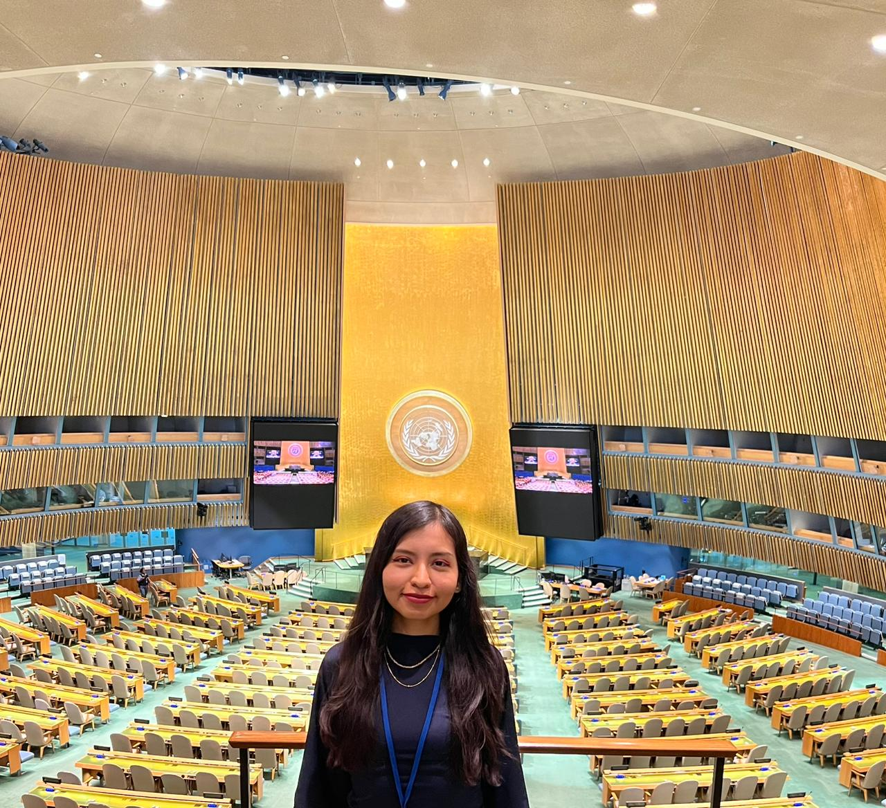
For a month I had the opportunity to be selected as a fellow for Global Action to Prevent War at the United Nations, which allowed me to experience the High-Level Political Forum (HLPF) 2026, the General Assembly, and in a rare opportunity sessions of the Security Council, the UN’s most restricted body when it comes to peace and international security. I also had access to dozens of side events, including ones organized by the diplomatic missions of Switzerland, Canada, the United Kingdom, South Korea, Germany, Spain, and the Netherlands, as well as international organizations. All of this happened in an international context marked by the highest number of active conflicts since 1946 (65 active conflicts in 35 countries in 2025), and growing pressure on development financing (Peace Research Institute Oslo, 2026).

The HLPF 2026 and the critical cycle of the 2030 Agenda

The HLPF 2026 took place from July 7 to 15 and deeply reviewed SDGs 6 (water and sanitation), 7 (affordable energy), 9 (industry and innovation), 11 (sustainable cities), and 17 (partnerships for the goals). Being consistently present at the Security Council, the General Assembly, and the HLPF meant experiencing the same critical cycle of 2026: the penultimate one before the SDG Summit 2027, with only a third of the 2030 Agenda targets on track in Latin America and the Caribbean, and, according to the United Nations Inter-agency Task Force on Financing for Development (2026), a financing gap that now exceeds 4 trillion dollars annually.

This cycle also coincides with a time of strong pressure on international cooperation: according to the OECD (2026), global Official Development Assistance (ODA) fell by 23% in 2025 — the largest annual contraction on record — following an 8.5% reduction in 2024, with a further 6.9% decline projected for 2026. This would bring ODA to its lowest level since 2014 and mark a third consecutive annual decline, something that has only happened once before in history (1992–1995). In this context, the Sevilla Commitment on financing gained prominence as the reference framework to support the implementation of the 2030 Agenda.

The Security Council: reading power from the inside

In July 2026, under the presidency of the Democratic Republic of the Congo, high-impact topics were discussed such as sexual violence in conflicts, natural resource governance as a basis for peace, the Middle East, Ukraine, Haiti, Sudan, and the peace process in Colombia. Being there right when the multilateral system is discussing how to sustain itself with fewer resources gave me an early view of where international cooperation is heading, and how geopolitics are increasingly intersecting directly with access to capital, regulatory risks, and new public-private partnerships. What you see from the inside, day by day, is how three layers that the private sector and high-level diplomacy need to read precisely are either articulated—or blocked: power and veto dynamics in the Security Council, position and coalition negotiations in the General Assembly, and the translation of those balances.

A recurring pattern in side events

In side events, important and balanced panels are usually convened. There is openness to dialogue, as indicated by the official schedule, but in practice, many of these spaces end up being just a place to listen to the panelists’ presentations. Requests to speak from attendees — such as civil society representatives, young people, or smaller delegations attending with their own resources or as scholarship recipients — are not always prioritized. Sometimes, it is simply omitted.

This matters because these forums are not just one among thousands of international events. They are some of the most important spaces the world has for bringing together those who make decisions and those who experience them, and not just from the panel, but from the other side of the seat.

Why is this more urgent now 

This pattern becomes especially relevant at a time marked by at least three intersecting forces: the historic cut in international cooperation mentioned earlier, a growing distrust of multilateralism and democratic institutions, particularly among younger people, and a climate crisis that has already crossed thresholds that once seemed distant. 

Data from the Americas Barometer (LAPOP, 2023) show that support for democracy declined sharply after 2016 and remained low for nearly a decade. Younger generations, moreover, consistently expressed less support than older ones. However, the most recent survey, the 2026 Pulse of Democracy, found the first broad regional upturn in a generation: support for democracy in Latin America rose to 65%, six points higher than in 2023, with gains recorded across nearly every country, age group, and education level.

Even so, this recovery appears fragile and paradoxical. It coincides with serious institutional erosion across the region, ranging from the suspension of elections in Nicaragua to the removal of presidential term limits in El Salvador; this suggests that the renewed support for democracy does not necessarily reflect a deeper commitment to its liberal norms, that is, to the checks that limit those in power, such as the separation of powers, an independent judiciary, respect for political opposition, and the protection of minority rights.

According to the report itself, many citizens in the region associate democracy more with satisfaction with government performance than with institutional commitment. In other words, they value above all whether the government in power addresses their concrete everyday needs, such as security, the economy, and public services, without this necessarily implying support for or respect for institutional checks and balances.

On the climate front, the Global Tipping Points Report 2025 (University of Exeter et al., 2025), authored by 160 scientists from 87 institutions in 23 countries, documents the first climate tipping point that humanity has already crossed, namely the massive and unprecedented die-off of coral reefs due to ocean warming, an ecological collapse that threatens the livelihoods of nearly a billion people and a quarter of all marine life. On top of that, the World Meteorological Organization (WMO, 2026) estimates a 91% chance that at least one year between 2026 and 2030 will temporarily exceed 1.5°C above pre-industrial levels, with an 86% chance that one of those years will surpass 2024 as the warmest year on record.

Cuts in funding, institutional distrust, and the climate crisis are not three parallel problems: they feed into each other. And those who are going to live with the consequences the longest, and largely those who are already organizing to face it, are the younger generations.

Who is going to solve this? 

The question is not rhetorical: who is going to fix these overlapping problems? Generation Z is already part of the present and the future. They are a generation that has built its own social awareness movement, in the middle of the digital age and, at the same time, a widespread mental exhaustion. Without their involvement, it’s hard to imagine that the upcoming leaders, those who will inherit these same crises, can solve them on their own. 

That’s why it’s crucial that the UN doesn’t just invite them. It’s about giving them, in a strong way, a real opportunity so that the return of trust in multilateralism also falls on them. They are one of the most decisive age groups for the future of these institutions. We also must not forget the youth organizations that, for years, have been promoting democracy and peace in their own countries and regions, often without the recognition or the speaking space their work deserves.

The pending challenge

If the UN seeks to regain legitimacy in a moment of global distrust, the challenge is not just to bring more diverse voices to its side events. It’s truly listening to those who are already in the room.


Referencias bibliográficas

Global Tipping Points. (2025). Global Tipping Points Report 2025. University of Exeter / Stockholm Resilience Centre. https://www.stockholmresilience.org/research/research-stories/2025-10-13-world-reaches-first-climate-tipping-point—widespread-mortality-of-coral-reefs.html

Organization for Economic Co-operation and Development. (2026). ODA projections for 2026 and the near-term: Implications for vulnerable countries and sectors. OECD Policy Briefs, No. 59, OECD Publishing, Paris. https://www.oecd.org/en/publications/oda-projections-for-2026-and-the-near-term_d7c74fa2-en/full-report.html

Peace Research Institute Oslo. (2026). Conflict Trends: A Global Overview, 1946–2025. Based on data from the Uppsala Conflict Data Program (UCDP), Uppsala University.

United Nations, Inter-agency Task Force on Financing for Development. (2026). Financing for Sustainable Development Report 2026: Implementing the Sevilla Commitment. United Nations. https://financing.desa.un.org/iatf/report/financing-sustainable-development-report-2026-implementing-sevilla-commitment

Vanderbilt University, LAPOP Lab. (2023). Support for democracy in the Americas remains low, opening door for politicians with undemocratic plans, Vanderbilt survey finds. https://news.vanderbilt.edu/2023/11/29/support-for-democracy-in-the-americas-remains-low-opening-door-for-politicians-with-undemocratic-plans-vanderbilt-survey-finds/

Vanderbilt University Center for Global Democracy & University of Notre Dame Kellogg Institute. (2026). 2026 Pulse of Democracy. https://news.nd.edu/news/new-americasbarometer-report-finds-modest-but-widespread-recovery-in-support-for-democracy-across-the-americas/

World Meteorological Organization. (2026). Global Annual to Decadal Climate Update: Target years 2026–2030. https://wmo.int/publication-series/wmo-global-annual-decadal-climate-update

Annalena Baerbock: It’s the tone that defines the crisis, by Lia Petridis Maiello

11 Sep

Editor’s Note: Lia formerly served as our media specialist before moving to Germany and taking on media-related positions of greater prominence. She has always demonstrated a fine eye for both “things unsaid” and “things which should never have been said,” which made her a particularly valuable colleague in New York. While supporting what appears below from Lia, and despite having my own concerns about her candidacy from the start, I found her to be a better PGA than I had feared. There were some reckless moments to be sure, and I had expected a stronger response to the end of her presidency, on protocol grounds if nothing else. She did, after all, champion women’s issues from a dais which has seen few women predecessors. And she did come to a more balanced, nuanced place of support for Gazans and Palestinian West Bank residents. But there was something else about her, something not quite right. Lia as she often has done, has put her finger on what some of that might have been.

Some positions, by the very nature of their job description, are an invitation to elegant understatement and calculated invisibility. The presidency of the UN General Assembly has, by definition, always been one such role: a year of chairing meetings, organising consensus, smiling for the record, and above all, under no circumstances becoming the news itself. Annalena Baerbock has distilled something quite different from this role description: namely, a one-woman show with her sights set on the Security Council.

Her term of office expired on 8 September 2026, and rarely has an outgoing office-holder demonstrated so loudly that, for her, ‘diplomacy’ was more of an attitude than a professional craft. Generally speaking, social contexts and gatherings of people from a wide variety of backgrounds in the US always and under all circumstances require the ability to ‘read the room’, to engage in rhetorical indirection, and to make subtle innuendos. In such settings, the German ‘assertiveness’ – well known in the US and often met with derision – can quickly come across as vulgar. What applies to the cultural context of the US, particularly in New York City, applies to the UN context many times over – and it is something that has to be learnt.

Baerbock’s career, by contrast, is a case study in how to squander what little diplomatic leeway one has through excessive rhetoric. Even as Foreign Minister, in 2023 she spoke before the Council of Europe of a “war with Russia” – a statement that triggered crisis meetings in Berlin and provoked outrage in Moscow, and which, moreover, was quite simply diplomatically incorrect. She referred to Xi Jinping on television as a “dictator”, a phrase that even well-meaning foreign policy experts deemed unnecessarily escalatory. Anyone elected as president of the most courteous body in global politics with such a track record must either possess remarkable self-confidence or a remarkably short memory. Baerbock has proved that it is possible to possess both simultaneously. The former German UN ambassador, Christoph Heusgen, summed it up even before her election, calling her nomination an “outrage”. A politician who had made a name for herself more through pithy press statements than through persistent “grunt work”. One might suspect Heusgen of malice; after all, his preferred candidate, Helga Schmid, was sacrificed in favour of her more prominent party colleague. A year on, however, his warning reads less like resentment and more like a prophecy with an expiry date.

The real moment of reckoning came at the end of her term of office. Unsurprisingly, it was on the very issue that would have demanded the greatest restraint: the succession of the UN Secretary-General António Guterres. Organising public hearings with the eight candidates has been standard practice for years. So far, so unremarkable. However, at a dialogue event in late July, Baerbock had the audience assess the candidates live, without giving them or official observers any prior warning. She subsequently wrote to the Security Council, stating that it should not even consider candidates who had not taken part in her events. So far, so embarrassing.

As a result, the US and Russia – who are otherwise on opposite sides of the fence on virtually every UN issue – found themselves in rare agreement – united against Baerbock. The US representative to the UN, Jennifer Locetta, accused her in the Security Council of “overstepping her remit” and “irresponsible actions”, describing the audience poll as “unfair, non-transparent and unprecedented”. Her most scathing barb, however, was aimed at Baerbock’s self-image: she was portraying herself as a “diplomatic superstar”. A “hypocrisy” which, taken as a whole, casts a bad light on the work of the General Assembly. The Russian ambassador, Vasily Nebenzia, echoed this by warning against the President overstepping her authority. When Washington and Moscow agree on an issue within the UN context, it usually raises questions. Nevertheless, this pattern of overreach has run through Baerbock’s entire term in office. Even her nomination was criticised as a party-political ploy to secure a post. Heusgen smugly referred to ‘Operation Abendrot’ in support of a ‘has-been’. Of course, within this context, mean spirited remains mean spirited, no matter who verbalises it. Baerbock’s inaugural mission then sounded correspondingly grandiose: she wanted to “show 8 billion people why this organisation remains important”, as if no one had done so before. Moreover, it was a phrase that sounded less like chairing a meeting and more like personal brand-building.

In her dealings with African states, too, the pattern of using a rhetorical cleaver rather than a graceful foil was repeated. A former president accused Germany of “condescending and disrespectful behaviour” after invitations had gone unanswered for months, whilst CDU politician Gitta Connemann spoke of a “foreign policy underpinned and driven by moralising” which had been perceived as overbearing in the Global South. And Baerbock’s staunchly pro-Israeli stance during the Gaza offensive – she described South Africa’s genocide case before the International Court of Justice as “baseless” and refused to support key ceasefire resolutions – sparked protests from human rights groups barely after she had taken office. As if German national interests (Staatsräson) and objective criticism were suddenly incompatible. As is well known, the irony comes at the end: Baerbock is not returning to Berlin, but is moving to New York City’s prestigious Columbia University to take up a ‘practice-oriented’ professorship in feminist foreign policy. Her successor as President of the General Assembly, Khalilur Rahman, a 72-year-old veteran diplomat from Bangladesh, was elected by 99 of the 193 member states and is likely to lead the office exactly as intended: unobtrusively.

The criticism that can be levelled at Baerbock in all seriousness after twelve months at the helm of the General Assembly is not incompetence in the traditional sense. It is something more subtle: a chronic inability to hold office without overstepping its bounds. Diplomacy thrives on allowing one’s own importance to fade into the background in favour of the cause. In New York, Baerbock proved the opposite, and for that she deserves precisely the title that American diplomacy smugly bestowed upon her: ‘diplomatic superstar’. It was not meant as a compliment. And yet it captures the essence of the matter with astonishing precision.

Our World Beyond Work: A Labor Day Reflection, Dr. Robert Zuber

7 Sep

Every day I remind myself that my inner and outer life are based on the labors of others, living and dead, and that I must exert myself in order to give in the same measure as I have received and am still receiving. Albert Einstein

We are being “saved” from work, then for what?  Wendell Berry

If you care about farmers, let the potatoes stay home. Barbara Kingsolver

Writing is a labor of love and also an act of defiance, a way to light a candle in a gale wind. Alice Childress

This world in arms is not spending money alone. It is spending the sweat of its laborers, the genius of its scientists, the hopes of its children. Dwight D. Eisenhower

Thou, of God, dost sell us all good things at the price of labor. Leonardo da Vinci

Those of you who have followed these posts over the years know of my personal fondness for holidays and other events that call attention to our current “crisis of labor.”

Though not without caveats, Global Action has long supported the call of the UN for “decent work,” a specificity-challenged notion which nevertheless underscores the chronic need for work which allows individuals to have dignity, families to have security, and communities which have at the very least the prospect of greater prosperity. 

It also calls attention to that which undermines decency, including radical and growing economic inequalities, oligarchies which have much,  control much, and have secured the means to ensure that acquisition, predation and control are unassailable features of our current economic landscape.  It even calls attention to labor issues specifically affecting immigrants, such as those farmers who thought they were being clever by subscribing to the MAGA brand and sending away migrant workers to return home or otherwise be deported by ICE, farmers who now cannot attract enough workers to harvest crops while their fearless leader sells out their ranches to import inferior foreign beef.

I won’t take up your time with too much of this, but a few images have consumed a good bit of my conscious life over this last period, all of which have implications for the incessant and even desperate scramble which is modern labor. 

The first takes the form of the proliferation of data centers, critical for artificial intelligence but also for surveillance technologies which seem to incarnate the most dystopian features of our increasingly “big brother” world.  Like prisons, slaughterhouses and other entities we would prefer to keep out of public view, these data centers are generally placed in communities far from the mainstream, certainly far from the domiciles of the billionaire classes, communities which have in many instances stated their preference for data centers to be placed elsewhere, or nowhere at all.

My feeds have been full of images from “town halls” in mostly rural areas where the decision to host these data centers appear to have been made in advance and where those who protest the loudest are not heeded but aggressively removed from the premises.  It isn’t clear what the decision makers receive for their acquiescence to these large corporate interests, and in a few instances there apparently have been some local economic benefits at least in the short term.  But for others across the political spectrum, the often-vague promise of employment has given way to water shortages, higher energy costs, and the constant whirring sounds of “progress” which are much more likely to ruin sleep than pay down mortgages.

As the US president has intoned, these data centers are here to stay (as long as he is here to stay at least) and there really isn’t anything the rest of us can do about it.   They are “here to stay” despite vociferous bipartisan protests against  the technology which is now being sold to us in a format making it clear that, as with other “advances,” we have essentially no choice but to buy. 
Government officials apparently have little interest in regulating AI and its clear and present dangers, aside from ensuring that stock portfolios are fully loaded with the investments which their AI corporate friends largely control.  The UN has sincere interest in governance though its tendency is to attempt to govern matters such as AI which are accelerating far faster than they can be regulated. 

To claim that AI is being “oversold” is likely a significant understatement.  Everywhere the media is filled with smiling faces who have apparently figured out how to use AI to solve problems which have ostensibly eluded the human race since its inception.  I will spare you here a recitation of the state of AI “governance” and its many loopholes.  Suffice to say that one of the prevalent concerns is the relationship of AI to employment, specifically the promise that AI will make much of the work we now do irrelevant, that it will do what humans now do in a faster and more cost-effective manner and help the clever manipulators of this technology to keep their own “ competitive edge.”

To say that AI has created some strange bedfellows would be to understate the extent to which AI has enabled reshuffled kingdoms and even motivated the new class of “kings” to embrace ideas more in keeping with their political adversaries.  Such is the case with Elon Musk who has publicly backed a compensatory proposal for Universal Basic Income, a concept pushed responsibly by a few of our colleagues as a way of building an economic “floor” under people which would free them from fiscal distress and allow them to pursue interests and activities which are unlikely for people raising a child or two while working the third shift at Arby’s.

But there are two significant “rubs” here, the first being UBI would be seen  by the ruling political class as an entitlement, a compensation in effect for the technologies that promise to render much of what we are now paid to do to some employment junkyard.  Still the backlash here could well be considerable given that said ruling class is attempting to apply the same entitlement label to (and then dismantle) the Social Security that most of us have worked our entire lives to ensure.  If Social Security can be dismissed as “entitlement” by some political elites the battle over any UBI proposal is likely to be intense.

But even this pales alongside the concerns expressed by the late Wendell Berry and others, that technology which “saves” us from work “saves” us to do what exactly?  UBI or no, how are we to fill our days with meaning and value in the absence of discipline which work confers? How are we to compensate for the loss of identity and dignity which work also and often confers? 

There have been of late a spate of articles chronicling the travails of “retirement” in my country and many of these highlight the degree to which we collectively seem not “to know what to do with ourselves.” For many people I know, performing services to corporations or communities absent compensation runs counter to generational work priorities.  So, then, what?  How do we build a life that honors our skills and passions while opening portals for the development of new ones?  How do we locate and operationalize the callings which can get us off our couches and into community spaces where there are so many gaps to fill – gaps of resources but also of companionship and revitalization which could call out  the best in us and help us to be better still?

AI may well eventually render our labors obsolete.  But it cannot easily help us rebalance lives which are often primarily focused on monetized labor. As many already recognize, we need also to build spaces for active service and engagement within and beyond our families such that those spaces will welcome us after the labor we thought might never end, actually ends.

This is not about killing time but about the emancipation of skills and values which people need to share and from which others need to benefit.  While we labor, we can also make time for feeding and caregiving, for faith and emotional support, for environmental care and biodiversity health, for children and elders not our own, for civic spaces in desperate need of revitalization, for farmers and artists seeking local outlets.  Investments in one or more of these areas, however modest, can identify attributes in ourselves which will serve us well when we come upon those days when “knowing what to do with ourselves” becomes a matter of more urgent personal concern.

The options are numerous. The gaps are daunting. The needs are vast. In the age of AI and its datacenter enablers, for all the threats and promises they represent to labor as we still know it, community investments are important to our own well-being and to all those with whom we might interact. Our societies are currently in a world of hurt, but we can identify and practice skills and passions over a lifetime to help ensure that it hurts a little less.