
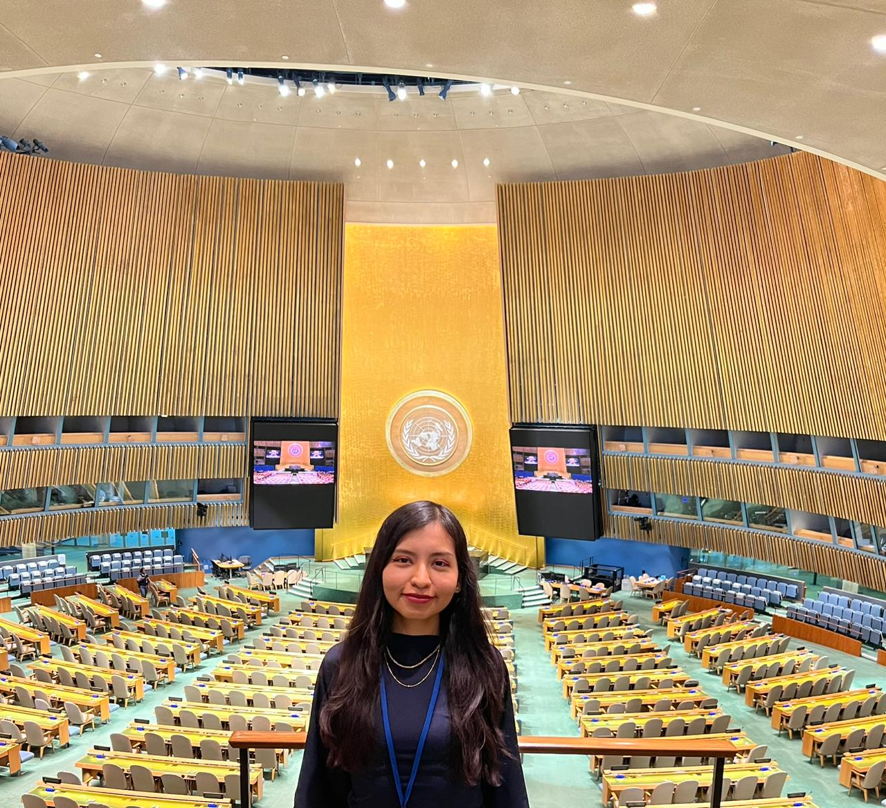
Editor’s Note. It is important to us that interns take the tine to reflect on their experience at the UN before their lives get busy with other commitments. In the end, some take this responsibility seriously and others don’t. Andrea’s effort here is most appreciated.
For a month I had the opportunity to be selected as a fellow for Global Action to Prevent War at the United Nations, which allowed me to experience the High-Level Political Forum (HLPF) 2026, the General Assembly, and in a rare opportunity sessions of the Security Council, the UN’s most restricted body when it comes to peace and international security. I also had access to dozens of side events, including ones organized by the diplomatic missions of Switzerland, Canada, the United Kingdom, South Korea, Germany, Spain, and the Netherlands, as well as international organizations. All of this happened in an international context marked by the highest number of active conflicts since 1946 (65 active conflicts in 35 countries in 2025), and growing pressure on development financing (Peace Research Institute Oslo, 2026).
The HLPF 2026 and the critical cycle of the 2030 Agenda
The HLPF 2026 took place from July 7 to 15 and deeply reviewed SDGs 6 (water and sanitation), 7 (affordable energy), 9 (industry and innovation), 11 (sustainable cities), and 17 (partnerships for the goals). Being consistently present at the Security Council, the General Assembly, and the HLPF meant experiencing the same critical cycle of 2026: the penultimate one before the SDG Summit 2027, with only a third of the 2030 Agenda targets on track in Latin America and the Caribbean, and, according to the United Nations Inter-agency Task Force on Financing for Development (2026), a financing gap that now exceeds 4 trillion dollars annually.
This cycle also coincides with a time of strong pressure on international cooperation: according to the OECD (2026), global Official Development Assistance (ODA) fell by 23% in 2025 — the largest annual contraction on record — following an 8.5% reduction in 2024, with a further 6.9% decline projected for 2026. This would bring ODA to its lowest level since 2014 and mark a third consecutive annual decline, something that has only happened once before in history (1992–1995). In this context, the Sevilla Commitment on financing gained prominence as the reference framework to support the implementation of the 2030 Agenda.
The Security Council: reading power from the inside
In July 2026, under the presidency of the Democratic Republic of the Congo, high-impact topics were discussed such as sexual violence in conflicts, natural resource governance as a basis for peace, the Middle East, Ukraine, Haiti, Sudan, and the peace process in Colombia. Being there right when the multilateral system is discussing how to sustain itself with fewer resources gave me an early view of where international cooperation is heading, and how geopolitics are increasingly intersecting directly with access to capital, regulatory risks, and new public-private partnerships. What you see from the inside, day by day, is how three layers that the private sector and high-level diplomacy need to read precisely are either articulated—or blocked: power and veto dynamics in the Security Council, position and coalition negotiations in the General Assembly, and the translation of those balances.
A recurring pattern in side events
In side events, important and balanced panels are usually convened. There is openness to dialogue, as indicated by the official schedule, but in practice, many of these spaces end up being just a place to listen to the panelists’ presentations. Requests to speak from attendees — such as civil society representatives, young people, or smaller delegations attending with their own resources or as scholarship recipients — are not always prioritized. Sometimes, it is simply omitted.
This matters because these forums are not just one among thousands of international events. They are some of the most important spaces the world has for bringing together those who make decisions and those who experience them, and not just from the panel, but from the other side of the seat.
Why is this more urgent now
This pattern becomes especially relevant at a time marked by at least three intersecting forces: the historic cut in international cooperation mentioned earlier, a growing distrust of multilateralism and democratic institutions, particularly among younger people, and a climate crisis that has already crossed thresholds that once seemed distant.
Data from the Americas Barometer (LAPOP, 2023) show that support for democracy declined sharply after 2016 and remained low for nearly a decade. Younger generations, moreover, consistently expressed less support than older ones. However, the most recent survey, the 2026 Pulse of Democracy, found the first broad regional upturn in a generation: support for democracy in Latin America rose to 65%, six points higher than in 2023, with gains recorded across nearly every country, age group, and education level.
Even so, this recovery appears fragile and paradoxical. It coincides with serious institutional erosion across the region, ranging from the suspension of elections in Nicaragua to the removal of presidential term limits in El Salvador; this suggests that the renewed support for democracy does not necessarily reflect a deeper commitment to its liberal norms, that is, to the checks that limit those in power, such as the separation of powers, an independent judiciary, respect for political opposition, and the protection of minority rights.
According to the report itself, many citizens in the region associate democracy more with satisfaction with government performance than with institutional commitment. In other words, they value above all whether the government in power addresses their concrete everyday needs, such as security, the economy, and public services, without this necessarily implying support for or respect for institutional checks and balances.
On the climate front, the Global Tipping Points Report 2025 (University of Exeter et al., 2025), authored by 160 scientists from 87 institutions in 23 countries, documents the first climate tipping point that humanity has already crossed, namely the massive and unprecedented die-off of coral reefs due to ocean warming, an ecological collapse that threatens the livelihoods of nearly a billion people and a quarter of all marine life. On top of that, the World Meteorological Organization (WMO, 2026) estimates a 91% chance that at least one year between 2026 and 2030 will temporarily exceed 1.5°C above pre-industrial levels, with an 86% chance that one of those years will surpass 2024 as the warmest year on record.
Cuts in funding, institutional distrust, and the climate crisis are not three parallel problems: they feed into each other. And those who are going to live with the consequences the longest, and largely those who are already organizing to face it, are the younger generations.
Who is going to solve this?
The question is not rhetorical: who is going to fix these overlapping problems? Generation Z is already part of the present and the future. They are a generation that has built its own social awareness movement, in the middle of the digital age and, at the same time, a widespread mental exhaustion. Without their involvement, it’s hard to imagine that the upcoming leaders, those who will inherit these same crises, can solve them on their own.
That’s why it’s crucial that the UN doesn’t just invite them. It’s about giving them, in a strong way, a real opportunity so that the return of trust in multilateralism also falls on them. They are one of the most decisive age groups for the future of these institutions. We also must not forget the youth organizations that, for years, have been promoting democracy and peace in their own countries and regions, often without the recognition or the speaking space their work deserves.
The pending challenge
If the UN seeks to regain legitimacy in a moment of global distrust, the challenge is not just to bring more diverse voices to its side events. It’s truly listening to those who are already in the room.
Referencias bibliográficas
Global Tipping Points. (2025). Global Tipping Points Report 2025. University of Exeter / Stockholm Resilience Centre. https://www.stockholmresilience.org/research/research-stories/2025-10-13-world-reaches-first-climate-tipping-point—widespread-mortality-of-coral-reefs.html
Organization for Economic Co-operation and Development. (2026). ODA projections for 2026 and the near-term: Implications for vulnerable countries and sectors. OECD Policy Briefs, No. 59, OECD Publishing, Paris. https://www.oecd.org/en/publications/oda-projections-for-2026-and-the-near-term_d7c74fa2-en/full-report.html
Peace Research Institute Oslo. (2026). Conflict Trends: A Global Overview, 1946–2025. Based on data from the Uppsala Conflict Data Program (UCDP), Uppsala University.
United Nations, Inter-agency Task Force on Financing for Development. (2026). Financing for Sustainable Development Report 2026: Implementing the Sevilla Commitment. United Nations. https://financing.desa.un.org/iatf/report/financing-sustainable-development-report-2026-implementing-sevilla-commitment
Vanderbilt University, LAPOP Lab. (2023). Support for democracy in the Americas remains low, opening door for politicians with undemocratic plans, Vanderbilt survey finds. https://news.vanderbilt.edu/2023/11/29/support-for-democracy-in-the-americas-remains-low-opening-door-for-politicians-with-undemocratic-plans-vanderbilt-survey-finds/
Vanderbilt University Center for Global Democracy & University of Notre Dame Kellogg Institute. (2026). 2026 Pulse of Democracy. https://news.nd.edu/news/new-americasbarometer-report-finds-modest-but-widespread-recovery-in-support-for-democracy-across-the-americas/
World Meteorological Organization. (2026). Global Annual to Decadal Climate Update: Target years 2026–2030. https://wmo.int/publication-series/wmo-global-annual-decadal-climate-update


