
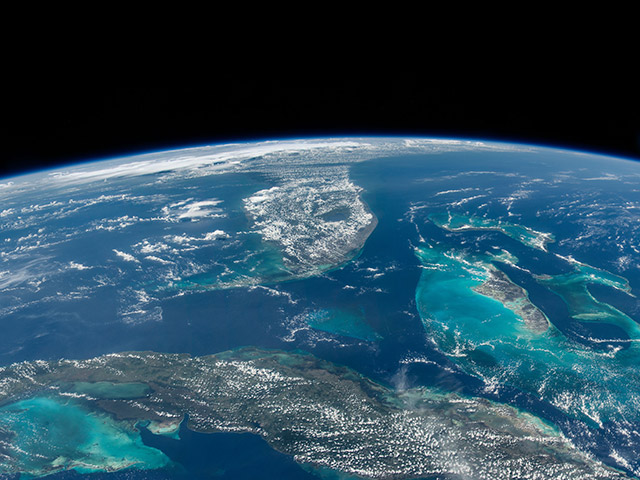
From NASA
The holy men say we are entering a period of clarity. Rigoberta Menchu
The greatest privilege is to live well in flourishing lands. Hamza Yusuf
Virtue can only flourish among equals. Mary Wollstonecraft
For millions of years, this world has been a great gift to nearly everything living on it. Rebecca Solnit
If beautiful lilies bloom in ugly waters, you too can blossom in ugly situations. Matshona Dhliwayo
Peace is the creation of an environment where all can flourish regardless of race, color, creed, religion, gender, class, caste or any other social markers of difference. Nelson Mandela
Around the globe, people from all walks of life are holding their breath in the hope that a flurry of activity at all levels of policy and human community will be sufficient to reverse what is commonly known at the UN as the “triple” planetary threats from climate change, biodiversity loss and pollution (especially plastics pollution).
The UN has seen its own frenetic activity as leaderships tries to both make up for precious lost time while encouraging member states to take more political risks and step-up ambitions to find more robust and cooperative measures to address threats which clearly are not inclined to wait for us to make the change we need to make in order to secure a future for our children, especially those children residing in the most climate-vulnerable regions.
The UN has certainly created numerous spaces for member state deliberations on virtually all aspects and dimensions related to the “triple threat,” including implications for human health (mental, physical and nutritional), for international peace and security, and for more inclusive processes which not only heed the voices of women, youth and indigenous people but which actually seek to incorporate their learning and insights into policy decision making.
Some of these processes, as many of you recognize, take the form of large, carbon-intensive events which create some consensus-driven movement but generally lacking in practical implementation of pledges which fully mirror their rhetorical origins. Case in point is the fund for “loss and damage” agreed to at COP 27 in Egypt, an important step which has yet to generate the remedial funding which the most climate affected states had anticipated (and still anticipate). Diplomats also agreed recently on elements of a treaty to impose structures of governance on ocean areas beyond national jurisdiction (BBNJ), a theoretically important framework to mitigate at least some of the “wild west” mentality which has encouraged massive ocean dumping and deep-sea mining and has also precipitated a decline in ocean species as waters warm and the remains of our collective overconsumption now reach the furthest ocean depths. The recently concluded UN Water Conference resulted in over 600 pledges (albeit voluntary) to strengthen “trans-boundary water cooperation, promote universal sanitation and explore security and other implications of severe access challenges regarding this most precious of resources. The General Assembly for its part passed a unanimous resolution (sponsored by Vanuatu and others) seeking clarity from the International Court of Justice regarding the legal obligations of states whose production and consumption patterns, as noted during the week by UNEP director Inger Andersen, now serve to threaten the very existence of other states. Even the Security Council got into the act recently as Mozambique chaired an Arria Formula discussion on protecting water-related infrastructure. But despite what (to us at least) seems like an obvious linkage between a dangerously warming climate and prospects for armed conflict, several Council members past and present remain unconvinced that climate concerns should be folded into the Council’s peace and security mandate.
This bevy of activity (we didn’t even mention the biodiversity conference in Montreal or the Forum on Forests) is welcome but can also obscure the fact that most of these commitments are voluntary, are unenforceable or constitute some subtle form of “greenwashing” which leads people beyond UN confines to think that more is happening to forestall disaster than is actually the case. Having been around the UN for what seems like forever, we understand well that in large multi-lateral spaces facilitated by the UN, spaces filled with diplomats representing national positions and increasingly insisting on elusive consensus, progress is likely to be slow, perhaps too slow given crises weighing down human community like a bad case of COPD. It certainly seems as such to the growing number of youth environmental activists who, despite their energies and practical commitments across the globe, still struggle for their place at the policy table to help ensure progress that is more than textual and rhetorical. Indeed, as one youth activist noted during the days of the UN Water Conference, holding these large eco-events in expensive UN cities literally ensures that many of the people who wish to present testimony regarding the effects of and responses to climate change, pollution and biodiversity loss in their communities – testimony unmediated by diplomats and NGOs like me – will continue to experience great difficulty in doing so.
While some turn red at the suggestion that the UN isn’t doing enough on a range of environmental challenges, the troubling consensus of senior UN leadership (and many of the rest of us) reveals a serious disconnect between what is needed, what is being proposed in response, and the risks that member states – including some of the world’s largest polluters – are willing to take in order to preserve healthy options for succeeding generations. And because states in the main are not doing enough despite some claims to the contrary in UN conference rooms, the rest of us are thereby encouraged to not do enough also. Indeed, to our minds at least, the mass of discouragement experienced about the state of the world by many is another unfortunate consequence of rhetoric that is not matched by concrete policy support for the actions at community level, actions which ultimately have the most to do with whether or not the current “triple threat” becomes what Costa Rica referred to recently as a full-on “death sentence.”
Thankfully, there are many communities and individuals from all walks of life who have refused to have the potential for abundant living by their families and communities sidetracked by misleading policy utterances including those from senior officials which are insufficiently hopeful or mindful of the vast and increasing web of environmentally healing measures proliferating worldwide. From habitat restoration and community composting to organic agriculture, bee-keeping and tree planting on a massive scale in countries like Pakistan and across the Sahel, people of all ages and cultures are seeking a new clarity, refusing to be distracted by either doom and gloom or passive indifference. They have not given up on prospects for a world which can genuinely flourish for many more people, a world which remains plausible despite the circulating metrics from competent researchers associated with insects decline, plastics inundation and sea level rise.
The UN, for all its contributions and deliberations, is not really in the “flourishing business;” indeed it is at its best a place which provides a policy platform to support and enable work which needs to take place elsewhere. But we know how easy it is to get distracted by the glamour of UN conferences or discouraged by the sometimes-dismal reports emanating from UN sources which such conferences often do too little to address. We must remind ourselves that what both glamour and doom have in common is that they are poor recruiters for hopeful, virtuous, collaborative activity at community level which can do much to rebalance our world of sometimes gross inequalities, a world which we have been told much too often has reached or even exceeded survival “tipping points.”
In this momentous year for the earth and our presence within it, we must not allow ourselves to be deterred by the eminence and capacity of our large institutional frameworks and spokespersons nor allow ourselves to retreat into smaller circles of life in an attempt to protect what is closest to us from the “ugly” storms looming over an uncertain horizon. We cannot survive the storms by ourselves, but the truth is that neither can they be survived without us. In this Earth Year, we all need to urgently recalibrate the sustainability of our own lives; but perhaps even more importantly we need to help ensure that millions more people now situated firmly on the sidelines of climate action are encouraged and supported to lend hands and hearts to prospects for planetary abundance, such that more and more of us and other life forms might “live well in flourishing lands” on a planet we are running out of time to truly love.


 gapwblog