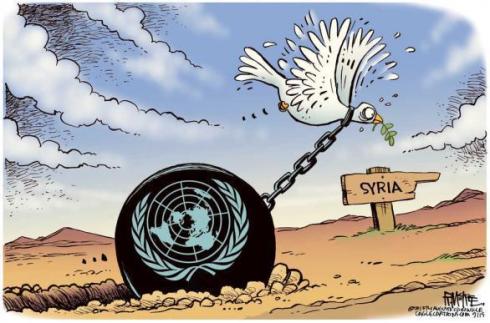
Water Slide:   A Shrinking Resource Creates a Peace and Security Dilemma for the UN, Dr. Robert Zuber

27 Nov

To value gold over water is to value economy over ecology, that which can be locked up over that which connects all things.  Rebecca Solnit

Thousands have lived without love, not one without water.  W. H. Auden

On Thursday in the US, many of us gathered with family or other loved ones, glasses and dinner plates on overload, all under the guise of confessing and sharing with each other our many blessings.

We pause too seldom in our busy lives to assess the many ways in which our lives in the so-called developed world have exceeded the global norm – more abundance, more opportunity, surely more access. If gratitude is an engine that makes our lives more meaningful and generous towards others, too many of us have left that engine on perpetual idle.  Or worse than that, we have bought into the more aggressive idea that the things we are lacking are more important to happy living than the things already provided. Despite what often appears to be our many blessings, we protest quite loudly about alleged deprivations regarding the things others have that we feel should be our right as well.

Especially in a time of increasing inequalities and incessant marketing, the temptation to identify our desires with those most well-off is overwhelming.   We want what others want; we desire more for ourselves but also “for our children.”  We can’t easily fathom that others could be rewarded so handsomely for their efforts while the rest of us struggle to merely push the envelope on material success.

Meanwhile, the simple things in life, the things we take for granted, remain largely beyond grateful consciousness.   In many places, we mostly assume that supermarkets will be filled with fresh produce, that water from our taps will be safe to drink, that waste from our consumption will be safely carted away well beyond the reach of our senses.  Our “taken for granted-ness” has taken our souls on a wild ride that clouds our vision while fanning our desires, endangering our own prospects and those around us.

And we so often refuse to connect the dots, to consider those untold millions on the move because the crops will no longer grow and the bombs cannot be silenced; the millions who can barely quench a deep thirst or wash away the layers of dust and ash from their hair and clothing; the millions who can provide no guarantees to their traumatized children that it will get no worse for them, children in conflict zones who must (as noted recently by the ICRC) spend their days in search of water instead of an education; the millions who now dream of even one day of clean water and fresh vegetables in the same way that some of us dream of Mcmansions and secluded seaside resorts.

Many of these “millions” have seen the advertisements as well.  They know something of what we in the “developed” world long for, what we have been taught to “crave.”  If our frustrations boil over at the perceived “injustices” of modern economic life, what response from these millions trapped in places like Aleppo, riding makeshift crafts across the seas from Libya, or recovering from corporate-induced water stresses in El Salvador would we consider to be justified?

This week in the UN Security Council, under leadership of Senegal, the issue of water access took center stage as the principle threat to international peace and security which it surely is.  While some Council members – especially Russia – preferred that discussions such as this take place in more clearly mandated UN conference rooms, all states acknowledged the peace and security implications of this most precious of resources, the degree to which, as Egypt noted, the world is characterized by “uneven distribution” of fresh water resources with potential to raise state tension levels.  With so much of our planet’s remaining unpolluted fresh water now melting into oceans or otherwise under control of only a handful of states, the conflict impacts of water scarcity will (and should) likely remain at the top of our collective security agendas.

Many Council members and briefers highlighted the complex relationship between water and conflict including, as noted by the US and Angola, the case study of the Lake Chad basin where water insecurity is both a cause and consequence of armed conflict.  Uruguay jointed with the ICRC in condemning the degree to which water access by local populations, especially in already water starved areas, is used as a “weapon of war.”  Malaysia rightly described water scarcity as a “threat multiplier,” a condition only made more urgent in the aftermath of military or terror activity.  New Zealand, as one of the very few states exercising sovereign control over more fresh water than it needs for domestic purposes, cited the “existential threat” to many Pacific island states experiencing rising sea water levels mixing with what little domestic fresh water resources exist.   As in other parts of the world, this Pacific  region is enduring what the UK more generally referred to as “a matter of life or death,” a desperation that can only fuel despair and increase prospects for violent conflict.

Of all the briefers and responders this day in the Security Council, perhaps the most impressive was Danilo Turk of Slovenia, formerly a candidate to become the next Secretary-General and now Chair of the Global High-Level Panel on Water & Peace.  In his remarks, Turk urged the UN to do more towards what he referred to as “hydro-diplomacy,” embedding expertise in water infrastructure into peacekeeping missions, ensuring that water protection becomes an integral component of civilian protection.   He also urged the UN to support successful, trans-boundary water management efforts – such as with the Senegal River – as well as offer to mediate agreements in other regions where cooperative water management could yield significant tension-reducing benefits – such as in Central Asia and in the Lake Chad region of Africa.   In this time of inequality and scarcity, water cooperation, Turk noted, “predicts peace.”

This is a prediction that all of us have a role in ensuring.  This is a form of conflict prevention in which all of us with blessings to spare can take part. We can learn to be as sensitive to the water demands of our consumption patterns as we are to the fat and calories in the foods we eat.  We can demand that infrastructure priorities include more reservoirs or, even better, more ways for private homes, apartments and industries to “catch” rainwater before it finds its way to the sea. We can eat more “imperfect” fruits and vegetables that are largely discarded by supermarkets and that consume, in the growing stage, every bit as much water as “perfect” specimens.  We can avoid watering our gardens as though all the plants therein were transplants from a distant rainforest.

And we can do more to promote resource justice. If water and other natural resources are the likely backdrop for new iterations of political and social unrest, we all have a role to play in reducing that potential.   This will be one test of the ability of our species to recover mindfulness and generosity at the heart of our consumptive desires. As Japan noted during the Security Council meeting, “a species made up primarily of water should treat water resources more kindly,” a kindness which surely must be extended to those millions longing for that day when reliable access to fresh water resources for their families can finally be guaranteed.


The UN’s Coordination Dilemma, Kai Schaefer

25 Nov

Editor’s Note:  Kai is one of our fine group of fall 2016 interns and fellows.  Having orginally come here to pursue an interest in Responsibility to Protect, Kai has taken a keen interest in both disarmament affairs and the working methods of key UN agencies, including and especially the Security Council.  The following reflects his rapidly expanding policy interests. 

With heightening tensions at the international level– recently manifest during the Security Council meeting of October 27th which ended with a walkout by the U.S, UK, and Ukrainian delegations when the Syrian representative took the floor — the efficient functioning of the United Nations system and its subsidiary bodies is of increased importance. However, in addition to increasing tensions among the world’s great powers — especially Russia and the United States — which prevents the efficient functioning of the Security Council, the UN system itself and its lack of coordination creates various obstacles that need to be overcome.

The problem of coordination and cooperation shortcomings among the various GA committees, UN bodies and subsidiary organs is not a novel problem. As the 71st GA session continues to unfold, the international community would well benefit from increased dialogue especially between the disarmament and human rights committees, but also in linking to diverse areas of peace and security more generally.

A recent example of the lack of coordination is draft resolution L.41 that was introduced by Austria and adopted by the first committee on October 27th with almost three-quarters support from the General Assembly. L.41 calls on all states to start negotiations on a legally binding treaty to ban nuclear weapons in 2017.  Especially given the fact that the resolution was not supported by any of the nuclear weapons states, the lack of coordination and failure of states to link crucial issues of security, development, and human rights is equally hampering in creating treaty bodies and resolutions that will have lasting impact.

First Committee disarmament debates in New York seemingly occur in a vacuum, shielded from external influences and events, as well as security-related trends highlighted in other UNGA committees especially in 3rd. The inherent connections between disarmament and socio-economic development, human rights, and international law often remain unexamined. Likewise, the NGO’s involve in the promotion of L.41 would benefit from a widening of their vision for disarmament by taking note of other events and advancements occurring at UNHQ.

This problem, however, is systemic in nature and goes beyond narrowly focused NGO’s and member-states negotiating at the UN. The UN cannot necessarily be characterized as a learning community, which is in part desired by certain member-states. The shuffling around of diplomatic delegations and missions in New York make sustained efforts in developing robust and lasting political commitments difficult to achieve. Moreover, as the UN is often described as one of the world’s largest bureaucracies, a certain degree of overlap, duplication, waste, and lack of coordination is hard to avoid.

Much of the work carried out at the UN suffers from the oft-mentioned “silo approach.”Many delegations now realize that in order to create policies that will have a lasting and sustained impact on the ground, increased coordination among the numerous UN bodies is needed. The value of cooperation and coordination among NGO’s, IGO’s, civil society, academics, epistemic communities, MNC’s, and nation-states has long been recognized. However, the continuing lack of practical coordination within the UN itself often remains unaddressed. Certainly, the amount of specialized knowledge which is at the UN’s disposal is one of its core strengths. Nonetheless, the current compartmentalized approach taken by the UN often misses crucial links among security topics and across policy spheres. The UN membership continues to insist that peace cannot exist without development, and development cannot be achieved without lasting peace. However, public rhetoric and institutional structures are clearly not always aligned.

In regard to the previously mentioned resolution L.41 calling for negotiations to ban nuclear weapons, it is noteworthy to state that many of the arguably most compelling and probably more effective security-related discussions occur not in First Committee but instead in the
Third, a committee largely centered on the protection and promotion of human rights. In order to create effective and efficient treaties centered on disarmament that will end up having a genuine effect on the ground, it is crucial to consult with voices of locally engaged staff, special rapporteurs, and persons directly affected by weapon inflicted violence. Thus the ongoing stalemate in First Committee could be overcome by joint events between first and third committee, and more significantly between all relevant stakeholders, and not solely by the disarmament community alone.

In like manner, the UN and international community as a whole, would benefit from stronger emphasis on preventive measures instead of acting largely retroactively. This holds especially true for the Security Council which tends to only take action when crises become unsurmountable. Increased consultations between the SC and TCC’s / PCC’s as occurred on November 10th is also welcome in order to create sustainable peace and foster capacity building. Furthermore, coordination shortcomings within the security domain at the UN could be overcome in part by not scheduling Security Council and Peacebuilding Commission sessions at the same time. The link between coordination and prevention is crucial in this regard. Essentially, a fundamental flaw is not the lack of information available at the UN, but how such information is being processed, disseminated (and even scheduled) throughout the organization.

Nevertheless, despite coordination and cooperation shortcomings within the UN, it remains the epicenter of multilateral diplomacy. The Security Council continues to be the arguably single most important chamber in the world.  However, due to deadlocks over Syria, the rest of the UN membership is becoming increasingly anxious to find an end to six years of brutal conflict. A General Assembly informal dialogue organized by Canada on October 20th underlines efforts of various states no longer willing to sit on the sidelines until the Council finds the means to take urgent action on Syria, especially in Eastern Aleppo. The participation in this GA dialogue by Council members both permanent and non-permanent accentuates this general concern.

The UN is tasked with settling the world’s most protracted conflicts and finding solutions to some of mankind’s most pressing issues and problems. There is almost no issue area in today’s globalized world that has not been impacted by the UN or at least found its way on to the UN’s agenda. This becomes evident upon examination of a plethora of “side events” at UNHQ sponsored by states, NGO’s, civil society, and the UN itself. During these side events the real scope of UN activities becomes apparent, highlighting the ongoing relevance and importance of the UN, providing a forum where a multitude of relevant stakeholders can raise awareness, set agendas, and sustain momentum towards agreed upon policies and treaties. Nevertheless, it is vital that the UN remains more than a mere talk-shop. Enhancing internal coordination regarding issues, scheduling and more can help create broader, sounder security policy.

Explanation of Vote: Procedures that Clarify and Heal, Dr. Robert Zuber

20 Nov

angry-kid

During a week in which considerable energy was expended on responses to a threatened US assault on climate-related multilateralism, UN Headquarters had on display its own controversies and contentions.  The 3rd Committee of the UN General Assembly (human rights) absorbed more than its share of conflict as delegates struggled over resolutions condemning the human rights records of individual states (Iran, Myanmar, Belarus, etc.) as well as the still-contentious matter of capital punishment – how to eliminate the practice (our preference) or at least to extend national moratoriums to minimize its use or threat of use by states.

Global Action’s interns were present for these discussions, the actual votes, and what the UN describes as “explanations of vote,” the opportunity for states to clarify why they supported a particular resolution or – more often – why they did not.  Our interns have been present for many of these “clarifications” and have noticed the diverse manifestations of “no” in UN processes: some states object on procedural grounds (such as believing that country-specific rights resolutions are invalid); others seek to protect their sovereign “ground” (as when deciding on national criminal penalties); still others seek to defend the interests of their political allies.  “No” can embody diverse sentiments, and for all their limitations and associated political drama, the UN’s “explanations of vote” helpfully bring at least some of these to the surface.

Such “explanations” might soften the impact of “no” in our personal lives as well. Small children often come to associate “no” with power, or at least the ability to manipulate or control circumstances – in no small measure because of the frequency with which they hear some variation of “no” from parents and other adults. “Don’t touch the stove.”  “Don’t spit out your food.” “Don’t leave the porch.” “Don’t pull the cat’s tail.”  “Don’t play with that bottle.”  “Don’t poke your sister.”  No, No, No, No, No.

The commands often come from a caring place.   There are many legitimate dangers lurking for unsuspecting children as well as people all-too-ready to judge families because of their ill-behaved progeny.  But for the children themselves, the relentless restrictions and modifications of behavior are often absent of “explanation,” interpreted as much arbitrary manifestations of adult authority than the acts of care that they so often are.  What appears to be mere “defiance” of a world in which desires are routinely thwarted is also a form of mimic – learning “no” as their lives are so often filled with “no.”

When children become teens, more of the complexities of “no” come into focus.   For most teens, some aspects of autonomy cannot arrive quickly enough, though generally quicker than the arrival of personal responsibility.  The all-too-typical teenage pattern in many societies – demanding privacy and separation on the one hand, dependency and an often relentless need for reassurance on the other – often drives parents and teachers to the brink.   Such reactions, it seems, come attached to the disclaimer (an “explanation” rarely uttered) that needs are subject to sometimes wild shifts — that what was perfectly acceptable on Tuesday has somehow morphed into a borderline “human rights” violation by Friday.

For many people, the more nefarious legacies of “no” – manipulating circumstances, creating distance, assuming malevolent intent when desires are thwarted, changing preferences and commitments more often than we change our socks – persist well into adult living.   Too often, we willingly continue on a path of suspicion and a prickly defiance.  Too often we state preferences devoid of real commitments – we want to keep our “options open” above all.  Too often there is an “edge” in our voice coupled with a certain withholding of emotional content that almost guarantees negative reactions from others.  Don’t give away too much.  Don’t reveal too much.  Keep your distance.

We are also now painfully prone to give in to suspicion about almost everything inside and outside our limited circles except what we probably should be suspicious of – and that is ourselves.  We have generalized excess confidence in what we “know” in part based on an excessive reliance on smart-phone mediated judgments.   We “know” what “other people” are thinking and feeling without asking.  We “know” how deplorable the “deplorables” are and how virtuous the intent is of those who share our political or religious judgments.   We know.

In a world where “explanations of vote” — in both the narrow and larger sense — are neither required nor requested, we are left to blithely assume much of the worst about the people and things that offend or allegedly threaten us.  No honest inquiries are made, and none are anticipated.

This edgy, suspicious worldview is neither as clever as we make it out to be nor helpful to the peaceful, inclusive world that many of us say we are trying to build.  And it is by no means inevitable.  Last week, the New York Chapter of Women in International Security held a discussion entitled “Perspectives on Colombia’s Peace Process.”   While there were several helpful interventions of note, the star of the discussion was Laura Ulloa, a woman twice kidnapped in Colombia by the FARC who has worked since at demobilizing combatants and improving life for underserved populations in her country.

As many of you recognize, Colombia went through its own crisis of “no” as the (voluminous) peace agreement that had been negotiated was rejected in its initial iteration.   As with other countries facing similar political turmoil, the recrimination in Colombia was evident as soon as the verdict was clear.  Do “these people” not want peace?   How could so many of “those people” fail to vote?  The questions, if seems, were largely rhetorical, born largely out of pain and frustration from a long war with adversaries obsessed about but little understood.

Laura’s take was refreshing.  She highlighted efforts to revise the agreement prior to its resubmission to voters.  She explained how her time with the FARC, while alarming at times, eventually humanized her feelings towards people whose life experience has largely been about the conduct and consequences of war.   Without condemning the FARC (or the government for that matter), she pointed to the need to put “truth first:” the truth about the violence, to be sure, but also the truth about the years of social neglect, disparagement and displacement.  The full truth is what she sought, not a self-interested version by one or more of the parties.  After all, she noted, we are seeking “agreement” on how to move forward together towards a more peaceful, inclusive society. This is not surrender.

And she communicated all of this seemingly with no traces of anger or bitterness.  She was firm in her convictions, but in a way that invited discussion, learning, flexibility in the face of overly-hardened opinions.  It is clear that she has spent much of her life watching and listening, not assuming and dictating.  She didn’t “know” for certain why people voted the way they did in this initial referendum or why some failed to vote at all; but she was certain that the reasons were diverse and complex, and she believed that those things “wrong” with the agreement – as with the country in which the agreement would be implemented – could (and would) ultimately be fixed.

This all was a wonderful reminder for me and others in the room.   Request more “explanations” and then listen respectfully to the answers.  Speak to others with less of an accusing edge.  Assume less, especially about the motives and intentions of those who appear to “vote” against our interests.

“No” is a complex word that is tied to some of the best and worst in our politics and in ourselves.   More “explanations” solicited and accepted would help heal our many current divides.

Swamp Things:  The UN Family Considers New Challenges to a Multilateral World, Dr. Robert Zuber

13 Nov

Hope and the future for me are not in lawns and cultivated fields, not in towns and cities, but in the impervious and quaking swamps.  Henry David Thoreau

As has certainly been the case this week, US elections often send shock waves through the international community as political decisions made in Washington impact so many around the world – those whom we in the US care about and those others whom we apparently don’t care about so much.

The potential “collateral damage” from US elections is not limited to the deployment of ever more deadly weapons systems but also to economic and social policies, external debt and other factors.  The US can be a helpful and generous society, but also a bit of a “bull in a China shop,” knocking over and even carelessly trampling the items that other communities depend upon in order that their families have a fair and fighting chance at a better life.

That bull is apparently about to get noticeably more ornery!

Now in Washington DC, a group of (mostly) white men has assumed an electoral (modestly legitimate) and even divine (illegitimate) mandate in an attempt to remake the political culture from which so many have grown increasingly alienated.  The term now in vogue around Washington is “draining the swamp.”

This is an interesting though not particularly apt metaphor, repeated by erstwhile leaders who, I am quite sure, don’t know so much about swamps.   The “swamps” that need draining are hardly swamps at all, but rather unhealthy, stagnant pools of standing water, breeding grounds for mosquitoes and other life forms dangerous to human health.

Healthy swamps, on the other hand, are regularly refreshed and have multiple ecological benefits, including security for threatened wildlife, rain retention and flood control during severe storms, breeding areas for fish, barriers to soil erosion, filters for otherwise polluted water.  Moreover, the mangrove swamps that exist in the south of the US and in other global regions represent some of the most mesmerizing and bio-rich ecological features on earth.

Clearly we in the US have already drained more healthy swamps than is in our best interests, creating more standing water through deforestation and pavement than we have eliminated.  Ironically, one of the most influential political settlements sitting atop a drained swamp is Washington, DC itself.  And in this settlement, it isn’t such a wild leap to apply the prevailing (if highly imperfect) swamp metaphor to existing standards and circumstances to much of our governance –the stagnation from which breeds a bitter, divided, self-important political culture that indulges itself while too often failing to feed those who authorize its representatives.

Whatever happens next in the “swamp” that is now the city of Washington — and some of it could well be grim for the family of nations — there will hopefully be fewer stagnant pools in the end, fewer political entitlements, fewer back room deals and duplicity that we must rely on hackers to expose.

But how do we get there?   How do societies that have misplaced the capacity to distinguish between healthy swamps and stagnant pools (in metaphor as in reality) recover their proper perspective?

This is an especially important question this week in the US as some in an electorate that too often neglects  basic civic duties has indulged for various reasons in bitter tears and even street anger to protest someone who will not even take office for two months.  The mournful and angry reactions are reminiscent of the aftermath of Brexit – seemingly more robust and organized expressions of concern after the vote than before – a miscalculation perhaps that what “we” want to see in the world and the values driving those perceptions are somehow ordained, inevitable, guaranteed.

There is a strain of self-importance that seems to have leaked into these electoral reactions – characteristic of a people who have forgotten much of their own history and its manifold limitations and illusions, who have put out of mind how many have had to suffer and die, how many healthy swamps have been recklessly drained, in pursuit of values and practices that we now assume are “inevitable.“  Inevitability, we apparently need to be reminded, is an obstacle to a healthy political culture, not its lifeline.

What people needed to hear instead in this just-concluded US election cycle – and didn’t – is not so much about how our institutions need to change (of course they do) but the “curve” along which we ourselves – those of us who presume to make policy decisions on behalf of broader constituencies — have also grown and changed.   What have our candidates and their surrogates learned about themselves and about our collective place in the world?  What have they come to realize that leads anyone to believe that they can turn away from past mistakes; that they can be more discerning about differences between healthy swamps and standing pools; that their decisions going forward will be guided by the humble recognition that most of their “adoring” constituents would have preferred to see others making policy promises at the political buffet bar?

Ironically it was Glenn Beck, habitually one of my least favorite US social commentators, who has recently been seen reflecting on US television about the ways in which he has been chastened by life, how the certainties that drove his politics (and his often nasty, media-stoking demeanor) have given way to a kinder, humbler, more discerning disposition.  These changes do not come as easily as he makes it sound;  but we are what we practice, and the more we practice kindness, the more we apply standards to ourselves that we so easily apply to others, the more likely any new “Beck behaviors” are to stick.

Humility, we must surely admit, was in very short supply in this election cycle as it is wanting in virtually every aspect of our modern political culture.  One of the reminders for us in this post-election period is that not all the stagnant pools are in Washington.   Not by a long shot.  There is plenty of self-indulgent stagnation within a mile or two radius of where I began this writing. There is plenty to drain in all our centers of political and economic governance, much stagnation in all the places that people have long since stopped depending on for services promised, the promises that represent what is left of our fraying social contract.  Candidates advocate for ties of trust in every election cycle, and then conspire to loosen those laces as soon as the votes are recorded.

The UN, it must be said, could face major challenges from this next US president.   The new government will be sorely tempted to walk away from agreements like Paris climate accords and the Convention against Torture.  The US might well decide to burn more coal, tear down more forests, indulge more inciting rhetoric, put up more walls.  We’ll likely continue to “drain” in a reckless manner, endangering our own health and, as is so often the case with this sometimes clumsy superpower, that of citizens in many other UN member states.  The world will nervously be about its diplomatic business while the US becomes even more insistent that the UN and other multilateral forums exist primarily to serve its own national interests.

For some of us, hopefully not for too much longer, we’ll shed more tears and shout more anger, actions that are understandable at one level but are also likely only to widen misunderstandings with the very same cultural counter-weights that helped give rise to this current, acrimonious political moment, the moment that we surely had the power to prevent if only so many of our “pools” of politics and governance hadn’t been allowed to become so stagnant.

Hopefully we in the US can create space for a truly discerning moment, an opportunity to assess what we’ve learned, what we’ve failed to learn, and why that matters for ourselves and much of the rest of the world.   Hopefully we can internalize, at least for a season, one of the life lessons from healthy swamps:  when you’ve lost your way in the dense undergrowth the only path to safety is to back out the way you came.

Registering Discontent: The UN seeks to renovate a damaged democracy gateway, Dr. Robert Zuber

6 Nov

voting

The ignorance of one voter in a democracy impairs the security of all.  John F. Kennedy

Today is Marathon Sunday in New York, a time for fireworks, physical achievements and extraordinary courage by those overcoming significant limitations to push themselves across the finish line.

This is also, of course, the Sunday before the US presidential elections, a marathon of another sort, as sordid a civic affair as I can ever recall.

The disappointment goes deeper than the compromised candidates, the numerous leaks of known and unknown origins, the obsession with fondling that slides past legitimate human rights concerns into reality TV titillation, the ascriptions of “deplorables” that obsess on the specs in the eyes of others but fail to see the logs blinding ourselves.

Seemingly hundreds of reasons exist to not vote for the “other” candidate, but few rationales seem to have been offered to vote “for” someone, for something, for a vision of the future that doesn’t lock us into perpetual mistrust of others, impeding pursuit of our lofty and urgent social projects, including projects on climate health and the prevention of mass atrocities undertaken with the United Nations and other multilateral settings.

Are our candidates to blame for this mess?  Is the media?   Is it our “culture” of violence?  Is it the fault of habituated, self-interested neglect emanating from too many of our political and economic elites?  Is it really just a matter, as the late US President Kennedy (along with many others) seemed to imply, that some people are smart enough to “get it” and others just can’t?

Can it possibly be that simple?   Is “ignorance” really that easy to identify?

And it’s not only here on this corner of our planet.   From El Salvador to the Philippines, people are grasping for ointment to sooth their own deep disappointments, the sense that their lives have not improved as promised, that the system is perpetually tilted away from themselves and their families, that life has been needlessly stressful, needlessly challenged, needlessly insecure, but also deficient in key elements that make life worth the bother – including dimensions of importance and meaning.

And this struggle to discern genuine pathways from disappointment is not getting easier. What is now held to be “true,” apparently, is little more than what you can convince others to be true.   We do it on Facebook.   We do it in politics.  There is too little now that we can place our trust in beyond branding, beyond self-promotion, beyond our “distractions” of preference, beyond the masks that conceal who we really are, what we are fearful of revealing to those close to us, let alone to Wikileaks.

We can do better than this.   We can fix what is broken.  But this clock is winding down.

On Friday, a small segment of the UN community took a short break from controversies over nuclear weapons, the International Criminal Court and the treatment of Syria refugees to ponder ways to “strengthen electoral integrity.”   This timely, frank and urgent discussion was sponsored by the government of Mongolia and involved representatives from International IDEA, the UN Development Programme, the UN Department of Political Affairs and Harvard’s Electoral Integrity Project.

Insights from the session were both numerous and relevant to current circumstances. One observation of note urged us to abandon a “free and fair elections” mantra that implies electoral “perfection” often beyond our capacity to reach. The panelists spoke rather of “credible elections” with robust protection of ballot integrity, the prevention of voter harassments and, perhaps most important, the willingness of the parties to peacefully (if bitterly) recognize and accept election results.

There was also acknowledgment that we make a mistake by at times assuming such a strong link between our “right to vote” and the maintenance of healthy democracies.  Harvard’s Pippa Norris made a strong pitch for oft-neglected “civics education” while also noting that elections (and the growing business of election monitoring) are merely the opening gambit in a process to ensure that all political factions and all stakeholders have a place at the policy table.   How we elect is one crucial matter.  How we work together (or not) in the post-election period is even more important, even more determining of our ability to resolve our conflicts and fix lingering matters such as voter access and security sector intimidation before the start of our next, also likely contentious, election cycle.

Indeed, as the very wealthy in the US are now legally permitted to both recognize and operationalize, voting itself is one of our more modest “influence footprints.”  Indeed, the health of our democratic system is only partially about casting a political preference; but also in part about how closely we listen to and care about each other, how much we are willing to overlook (or even forgive) each other’s flaws, how willing we are to resist substituting a “rooting interest” (at times even at the tip of a gun) for a sincere engagement with political processes from the local to the global, the needs and rights of others (not only the well-positioned) placed on par with our own.

Voting is to democracy what Christmas-only church attendance is to Christianity – helpful in its own way, but by no means an engagement sufficient to the challenges of political or religious life.  As one of the UN panelists on Friday noted rightly, “good elections” are not the same as “good governance.” Both matter greatly, but the latter will always matter more, will always demand more of us.

The claim of one of the US candidates notwithstanding, there appears to be little chance that our upcoming elections will be corrupted from forces beyond the ballot box. The “insider” erosion of our democratic processes, however, is quite another matter.  At the end of this electoral marathon, there will be few roses to hand out as we reach the finish line, little to celebrate beyond the families of the candidates and their closest political confidants.  For the rest of us, a bit of temporary relief perhaps, but also worry that the larger political marathon – the one about rescuing our democracies from ourselves – remains very much stuck in the starting blocks.

Do African Lives Matter for African Leaders? By Hussein Solomon[1]

31 Oct

Editor’s Note:  Later this morning (10/31), the president of the International Criminal Court will address the UN General Assembly.  A high priority for her presentation is sure to be the recent decision by South Africa to withdraw from the Court.  Here, Professor Hussein Solomon, one of our most insightful colleagues, offers reflections on the contexts and implications of South Africa’s decision. 

Africans have grown accustomed to the West ignoring their suffering. This is hardly a new phenomenon. Consider the fact that Belgian King Leopold II’s atrocities was historically ignored in Europe at the time and barely gets a footnote in recent European books on its African colonies. To be clear, 15 million Congolese were murdered and numerous others were mutilated by this ‘civilized’ European king as he sought to extract rubber from this blighted country. More recently, more than 6 million Congolese have been killed since the 2nd August 1998. Once again, there is scarcely a mention on the front pages of The Washington Post or the New York Times.

At one level, perhaps, this is understandable. According to psychologists one is supposed to have greater empathy for one’s in-group as opposed to the proverbial “other.” What is particularly galling for Africans, however, is when their own leaders display such callous disregard for their lives. Worse, still, is the hypocrisy accompanying the callousness on the part of Africa’s leadership. Consider for instance the events surrounding the 7 January 2015. This was the date of the brutal terrorist attack on the Charlie Hebdo offices which resulted in 17 people being killed on the streets of Paris. The world rallied with the French and a mass march of 1,6 million people took to the streets of Paris. This march also included 40 world leaders, including several African leaders who mourned the lives of the innocent savagely cut short. This is as it should be.

At the same time, of the Paris killings, however, there was another atrocity taking place. In the dusty town of Baga, northern Nigeria, Boko Haram militants slaughtered 2000 innocent people. There was no similar Paris march. No African leader took to the streets to commemorate the lives of those lost. Even the Nigerian President at the time, Goodluck Jonathan, did not immediately respond to the tragedy which took place on his own territory where his own citizens lost their life in such a cold-blooded way. This prompts the question: Do African lives matter to African leaders?

I asked this question several times following the decision by my own government – South Africa – to withdraw from the International Criminal Court (ICC). The South African decision may well be related to domestic politics. According to Anton du Plessis of the Institute for Security Studies, the Zuma administration is attempting to protect itself from an imminent Constitutional Court hearing in relation to the 2015 visit of Sudanese President Omar al-Bashir when Pretoria refused to arrest him as it was obligated to do under the Rome Statute. Instead Bashir and his entourage were whisked out of the country by the South African authorities.

To be clear, the arrest warrant for Bashir was based on the charge that he oversaw the war in Darfur which resulted in the deaths of between 200,000 and 400,000 people and the displacement of a further 2.5 million people in Darfur out of a population of 6.2 million. The so-called leaders of Africa denounced the ICC decision ostensibly because heads of state should have immunity of prosecution. The counter-argument is simply this: as Head of State should the buck not stop with him? Do not forget that Bashir was not merely Commander-in-Chief by virtue of him being President of Sudan. He was a military man who staged a coup in 1989 to come to power. The second charge levelled against the ICC was that it was unfairly targeting Africa. Let us be frank: many of the ICC investigations were initiated by African countries themselves since they did not have the resources to conduct an investigation and engage in a trial themselves. Do not forget, too, that the ICC is a court of last resort. The attack on the ICC is simultaneously taking place at a time when Africa’s own domestic and regional judicial mechanisms have come under threat from Africa’s self-serving leaders who desire to escape accountability at all costs whilst they simultaneously steal from and brutalize their citizens.

Perhaps the most powerful response to these objections put forward would simply be this: Do African lives matter to African leaders? Their deep concern for Bashir is akin to sympathizing with the aggressor as opposed to the victims. After all who speaks for the hundreds of thousands of innocent victims who needlessly lost their lives in Darfur?

[1] Professor Hussein Solomon lectures in the Department of Political Studies and Governance at the University of the Free State, South Africa.

Green Day: The UN Seeks the Means to Defend Environmental Rights Defenders, Dr. Robert Zuber

30 Oct


activists

Environmental human rights defenders are at the heart of our future and the future of our planet.  2016 Report of the UN Secretary General on the “Situation of human rights defenders”

At the UN, as in much of the world as a whole, the policy news on a daily basis seems to run the gamut from hopeful to dreadful:

  • Some extraordinary progress on ocean preserves is offset by rapid polar melting and massive ocean storms
  • A breakthrough on negotiations to eventually “ban” nuclear weapons is compromised by reckless arms transfers and illicit arms movements that endanger civilians, destroy schools and medical infrastructure, and threaten an already fragile negotiating trust
  • Global progress on ending capital punishment is undermined by states citing drug trafficking and terrorism as “justifications” for continuing state-sanctioned executions
  • Policy gains on women’s equality are stymied by institutional sexism and political systems more comfortable with making promises on gender than keeping them

Perhaps nowhere at the UN is this schizophrenic path to progress more apparent than in the 3rd Committee (Social, Humanitarian and Cultural) of the UN General Assembly,  one of six GA committees meeting throughout October (and sometimes beyond). Chaired this year by Colombia’s Ambassador María Emma Mejía, the 3rd Committee embraces a stunning, ambitious schedule of rights-related issues that span a full spectrum of UN concerns – from persons with disabilities facing discrimination or journalists under siege to persons forcibly “disappeared” by governments or executed without due process.

Over the month, an extraordinary lineup of independent experts, Special Rapporteurs and Special Procedure Mandate Holders appear before the 3rd Committee to describe the progress they’ve made, the obstacles still to be overcome, and the reasons why attentiveness to the issues of their respective mandates still matters so much to the world.  This was also (and sadly) a time to honor extraordinary experts whose mandates (though not the issues themselves) are set to expire, including Juan Mendez (torture), Rita Izsak (minority rights), Maina Kai (peaceful assembly) and Fabian Salvioli (Human Rights Committee Chair).

My fall interns are forced (by me) to experience all facets of UN policy, but they seem to have a special interest in the skillfulness and diverse interests represented by these mandate holders.  As painful and even horrifying as some of their testimony surely is, interns are amazed (as well they ought) at the range of substantive UN human rights concerns – trafficking and child pornography, health care and adequate housing, the land rights of indigenous people and the plight of displaced children.  Despite limited implementation successes in a number of instances, these rights stand as almost “sacred” obligations of states parties, obligations that are not compromised — let alone disappear — because some states refuse their full acknowledgment.

But these rights obligations need champions outside the UN as well as within, as has been noted often by Michel Forst, Special Rapporteur on the Situation of Human Rights Defenders.  And as we have all come to know, the dangers faced by these “outside” champions show few signs of abating. Last Monday, in a side event –“Empower environmental defenders, safeguard our future” – Forst joined with Norway’s Ambassador May-Elin Stener and an activist from Honduras (CEHPRODEC) to chronicle some of the grave threats experienced by environmental rights activists seeking to organize communities to safeguard health and livelihoods in the face of aggressive corporate predation, state corruption and broad international indifference.

Many in the room were still mourning the death of Honduran activist Berta Cáceres, not the only activist to lose her life defending land and community in states such as Honduras and, given the current state of our limited protective mechanisms, unlikely to be the last.  Within the Global Action orbit, we have also mourned friends and colleagues who have paid the ultimate price for our collective indifference.  We have watched families torn apart as land-owning corporations pay family members to shoot their “trespassing” kinfolk. We have seen first-hand the effects of logging and mining that bring few local benefits but inflict staggering local hardships.  We have seen activists’ reputations rent asunder by forces eager to label them as “criminals” or “terrorists” while exempting their own actions from virtually all means of accountability.

As states prepare to assemble in Morocco to assess the early stages of implementation of the Paris Climate Agreement, they would do well to confess this schizophrenic policy moment – on the one hand, urgency to control emissions and create a more healthful planet characterized by peaceful and inclusive societies; on the other hand, business as usual under cover of states underwhelming in their commitment to protect their own citizens – and those who seek to defend them — from external threats of diverse human origins.

As the UN Secretary-General has intimated, human rights defenders are the essential link between sound global policy and community resiliency.  We cannot do without their tireless and courageous commitments.  We cannot fulfill our “leave no one behind” promises while abandoning communities – especially their women and indigenous — to defend legitimate local interests while their leadership languishes in prisons or even in morgues.  We cannot hope to inspire stable, healthy communities when the voices of so many of its citizens are mute – or facing a dangerous backlash.

As Rapporteur Forst himself noted during this side event, the world is characterized by growing “power imbalances” that imperil rights defenders and the community interests they seek to defend.  There is, he warned, a “crisis of retribution” which the Honduran activist asserted almost never results in punitive legal judgments.  As we seek a fairer, greener and more just planet, it is important to honor and sustain the community-based courage that must be part of any viable pathway to change.  As Ambassador Stener noted, state, corporate and community interests will not always align, but respectful dialogue –not threats– is the only sustainable way forward.  The international community can and should do more to guarantee that such dialogue takes place, and that it takes place on a more level playing field.

The Wonder Years:  The UN Seeks Super Powers to Navigate the Current Crises, Dr. Robert Zuber

23 Oct

wonder-woman

This was yet another one of those weeks at the UN.   Apparently, we now have a cartoon character serving as our collective symbol of women’s empowerment: an athletic, thoroughly Anglo. scantily-dressed figure of some artist’s imagination who ostensibly will inspire and mentor young women and girls more effectively than the many women of high intelligence and character already roaming our hallways and conference rooms.

This week also featured an informal discussion led by PGA Thompson between Secretary-General-elect Guterres and the full membership of the General Assembly.  It was a good and reassuring session, even as some states lamented the lost opportunity to select a woman SG.  As many of you know, there is still to come the appointment of a Deputy SG, and some with us in the “blue seats” half-jokingly speculated about the possibility of Wonder Woman being tapped for that post as well, noting that while her wardrobe would not be particularly well-suited to Security Council meetings and grand state functions, it might actually be helpful to have a figure at the most senior levels of the UN who could single-handedly enforce Security Council resolutions without resort to punitive sanctions or aerial bombardments.

The PGA also led a more somber discussion later in the week, this time on the unresolved horror in Syria.  Special Envoy de Mistura joined the conversation by video, and after painting the grisly scene yet again (Aleppo might well be “gone” by December), welcomed efforts by the General Assembly to seek options for response beyond what the Security Council has been able to successfully muster. Non-Permanent Council members joined the chorus of those many UN states seeking traction on what Uruguay referred to as the “massacre” of Aleppo (and other areas of grave violence) as the Security Council itself appears in too many instances to impede more progress to peace than it promotes.

We’ve been in many such meetings where atrocity crimes and other horrors are laid bare only to then elude the imposition of practical, remedial measures.  And there is, of course, no direct pathway leading us from the perception of human misery to effective policy response. Knowing that your own child is in pain may well ratchet up the urgency, but that does not in and of itself suggest the best way forward. This is especially the case in instances as in Syria or Yemen where the causes of the current misery –its backgrounds, stakeholders and motivations – are complexities challenging to sort. Only in the world of comics are ethical situations given to the clarity that makes it possible for super-heroines to spring to effective action, time and time again.

In regards to Syria as elsewhere, the threat of terrorism looms large in virtually any policy discussion. In and out of the Security Council, state leadership often declares terrorists to be akin to “savages” an understandable ascription at some level but not terribly helpful from the standpoint of discerning policy relief.  For some states, counter-terror almost takes the form of a righteous crusade, a rhetorical clash of good and evil, a fight to the death between the forces of stability and chaos, the children of light taking on the children of darkness.

Moreover, terrorism is now widely utilized around the UN by member states as a justification for state behavior of all kinds.   Russia, for one, justifies its horrific bombing campaign in Aleppo by citing the need to eliminate terrorists, while France defines such bombing (as it did at the GA meeting with de Mistura) as more like a “gift” to terrorists. But France, like most states in and out of the Council, has its own horses in this race for national policy justification, even as it speaks – and rightly so – of the importance of keeping covenant with our values throughout an era of unprecedented non-state threats.

The justifications linked to terrorism can be seen in one of our core issues/values as an office, one which we share with our close associates FIACAT, regarding the abolition of the death penalty. At a side event during this week when so many Human Rights Rapporteurs are in town to meet with General Assembly committees, one of the UN’s newer Rapporteurs, Professor Callamard, took the floor with Norway, Palau and Australia to both advocate for death penalty abolition and to delink abolition from some of its foremost “retentionist excuses,” including and especially its alleged rationalization as “just punishment” for the high crimes of terror.

All speakers at this side event were clear on the inadmissibility of the death penalty regardless of the severity of alleged crimes.  Norway’s testimony here was especially compelling, as Ambassador Stener recounted the intense pressure for a time that her state was under to reinstate the death penalty following the horrific and (for Norway) unprecedented violence perpetrated by Anders Behring Breivik in 2011.   She noted that the people of Norway somehow found a way to stay connected to the most fundamental of their values regardless of the horrific circumstances calling them into serious question.  Even in those dark hours, she maintained, reinstitution of the death penalty was never considered as a serious option.

But on the same panel, newly-minted Human Rights ASG David Marshall highlighted the disappointing (though not entirely surprising) reality that setbacks on moving towards full abolition of the death penalty (or even a full moratorium) are now mostly attributable to the politics of terrorism response.  In too many places, it seems, we are giving way to political expediency and the self-defeating call to vengeance. In too many places, we have convinced ourselves by our own bellicose rhetoric that our “will to punishment” is just.  In too many places, we have forgotten that, across the psychological and policy spectrum, violence does indeed beget violence.  Too often, we willfully misplace our responsibilities under international law to uphold the basic rights of even the most egregious criminals.

The world that we currently slog through – a world that yearns for more capable, more equitable leadership — is complex in its threats, root causes and potential for meaningful change.  We’ll navigate through these tumultuous years, I’m sure, but we’ll need to tap an array of resources within ourselves far beyond the carefully scripted narratives of cartoon heroines if we are to make it safely to the other shore.

Crying Wolf:  The UN Hedges its Bets on Crisis Response, Dr. Robert Zuber

16 Oct

As most readers of these posts know, we’ve been around the UN for quite some time.  And we find that most of the people who work here, in and out of the diplomatic missions, really do care about making the world a better place.  But there is also a pervasive cynicism afoot in our time, including the belief that crises are sometimes manufactured by elites in order to consolidate their authority.  The view in such instances is that elites put out images of threats to people who are largely powerless to respond themselves and thus must rely on “leadership” they barely trust to determine the policy path forward.

We can tell you from many long hours in diverse UN conference rooms that the wolves are running loose all around the building — on weapons and climate, on oceans and pandemics, on inequalities in economics and politics.  But given what we often experience regarding UN political culture, there are indeed legitimate questions about whether the UN is equipped to handle this collection of sometimes existential threats, to lead with integrity and by example, bringing together the resources and cooperative spirit needed to get the human race over its current, stubborn humps: a tangible sense of urgency on the one hand; a sincere willingness to rethink unreliable strategies and alliances on the other.

From the standpoint of integrity in policy decision making, these past few days at the UN were a mixed blessing at best:

The highlight of the week clearly was the selection of the next UN Secretary-General .  Mr. Guterres is a smart and good man, and we wish him well.   He is also arguably the person we would have gotten regardless of how transparent (or not) the SG selection process was, especially given all of the men who are currently seated around the Security Council oval and whose recommendation for SG was unlikely to be overturned.   Given the large number of singularly qualified women vying for that post, given the volume of gendered discourse permeating virtually all UN conference rooms, and given the broad perception that the UN is in serious need of an administrative “shake down,” the time seemed right to turn the page on what has been a male-dominated leadership post.   Except it wasn’t.

Downstairs from the Council chamber in the First Committee of the General Assembly, discussions focused largely on what to do about the threat posed by nuclear weapons.   Increasingly, as many of you recognize, the international community is gathering behind proposals for a negotiated treaty to “ban” these weapons.   The principle hold-outs, of course, are the current nuclear-armed states, the same states (rightly) grinding their teeth over nuclear weapons in the hands of the DPRK and – potentially — terror groups while (wrongly) spending many billions of dollars modernizing their own arsenals and even exploring their extra-terrestrial deployment.  The “anti-ban” statements made Friday by the US and UK – punctuated by a “fist bump” at the end – signified to onlookers that the nuclear armed states don’t take the threat from these weapons as seriously as much of their rhetoric might otherwise suggest.

While the Security Council was busy negotiating the selection of Mr. Guterres, it was also immersed in a series of security –related discussions “lowlighted” by the October 8 emergency session on Syria during which not one but two different resolutions on the Aleppo violence failed to pass.    In addition, the Council attempted this week to clarify its intent regarding peacekeepers in Central African Republic while receiving an underwhelming briefing on ISIL, including its potential expansion within Yemen.  Despite the horrors inflicted by the repeated bombings of hospitals and other civilian targets, the excruciating and widening famine, and the escalating violence now involving a US warship off its coast, the ISIL briefing was barely the only mention of Yemen this week in chambers.

As with other global crises, the Council seems at times unable to back up urgent rhetoric with practical remedial strategies.  In addition, the Council often seems unwilling to “share the ball,” assuming that if there is going to be a “winning shot,” they are going to be the ones to take it.

One partial exception to these unsettling circumstances was in response to the damage to Haiti caused by Hurricane Matthew.   Here Security Council members were joined by other member states such as Brazil pledging immediate support for victims and urging a delay in plans to draw down the UN’s peacekeeping mission (MINUSTAH) there. During the mostly helpful discussion, there was also some acknowledgment of the UN’s role in initially bringing cholera to the country, the post-Matthew recurrence of which adds another (and needless) dimension to Haiti’s already-massive relief challenges.

And then there is Iraq, where the pathways to freedom from ISIL are simply horrific to behold:  the political and geographic divisions that begat a dictator that begat a US invasion that begat a partial power vacuum that begat a terrorist movement that begat a caliphate that have now necessitated some of the most heartbreaking “liberations” we will have seen in our lifetime.

As the Iraqi army prepares to move on liberating Mosul, there are already concerns of a massive humanitarian disaster awaiting us beyond the pale of what we have already seen in Falluja.  At the UN, Iraq’s Ambassador has been visible, acknowledging the profound physical wounds, social dislocations and emotional trauma that are likely to accompany this “liberation” from ISIL’s clutches.   He has also been active in seeking support from the UN and other member states.   In this, the response of the UN Mine Action Service has been particularly noteworthy especially its work to help eliminate short and long-term threats from landmines and the ubiquitous, easy-to-make, improvised explosive devices.

People in Iraq, as elsewhere in the world, have endured multiple sufferings as one faulty policy decision is ostensibly “corrected” by another – decisions seemingly based on political expediency more than on a sense of urgent, attentive compassion – addressing the current crisis but not quite in a manner that anticipates and plans for contingencies, that involves all meaningful stakeholders, that takes account of any past policy deficiencies, and that places potential victims at the very center of our policy planning.

It is possible, indeed essential, for us to have more of this type of policy planning which can build public confidence in the integrity of our leaders and which can help ensure that the cycles of policy errors and consequences that establish the context for so many of our current threats and crises are effectively curtailed.   If Mr. Guterres can inspire more of this planning to effectively (and enduringly) address the wolves currently howling at so many of our doors, his time in office will be time well spent.

Full-Court Press:  Placing the UN’s Accomplishments and Shortcomings in Context, Dr. Robert Zuber

9 Oct

We bombard people with sensation. That substitutes for thinking .―Ray Bradbury, Fahrenheit 451

Those of you who follow the UN (either through us or other sources) know that this hasn’t been the very best of weeks.   We appear to have a new Secretary-General, but it remains to be seen if he can rise above the disappointment of both Eastern Europeans anticipating the selection of one of “their own” and countless others who believed that this was finally the time for the UN to choose from among a bevy of highly qualified female candidates.

In the UN General Assembly Committees meeting this month, teeth were clenched over matters such as the status of Western Sahara and other non-self-governing territories (4th), the human rights responsibilities of counter-terror operations (6th) and the relative merits of a negotiating process in 2017 that might at some point lead to a “Ban Treaty” on nuclear weapons.

We also received disappointing news this week that a suit brought on behalf of the Marshall Islands in the International Court of Justice by a legal team which included our office mate, John Burroughs, was turned away by votes of 8-8 (for the UK) and 9-7 (for both Pakistan and India).  The suit represented an attempt to create legal pressure on nuclear weapons states to fulfill their international nuclear disarmament obligations “in good faith. “  Such pressure, wistfully, must await a different diplomatic opening.

There was some positive news on the climate front as European Union member states held a hopeful event to highlight their ratification of the Paris climate agreement, thus pushing it over the line towards Entry into Force.   But even here, even as the Paris agreement set a record for rapid ratification, optimism and reality managed to distort one other. As president of the General Assembly Thompson (Fiji) noted, this event occurred as Haiti lay in ruins from hurricane Matthew and polar melting affecting coastal and small states accelerates:  a glass struggling to retain its half-portion of fluid.

And then there is Syria, the topic of a rare Saturday session of the Security Council, a session that Russia itself – the current Council president and sponsor of one of two resolutions offered up for vote – referred to as a “spectacle” that would accomplish little and simply waste valuable time.   Russia itself vetoed the alternate proposal on the table – offered chiefly by France and Spain – setting off a bitter exchange that strained Council protocol and featured a “walk out” by 3 permanent members when the Syrian Ambassador began his own Council remarks.  Egypt captured the mood of many left in the room, wondering aloud if anyone in Syria any longer cares what the Council does or doesn’t do.

For those of us who make a point to be present as these and related deliberations take shape, there are several priorities for us – attentiveness to the topic at hand and to subtle shifts in government positions; linking conversations across various meeting rooms to get (and communicate) the full measure of the UN’s engagements on its most important issues; and – perhaps most important –showing interest in how our “bubble” deliberations are perceived by communities far beyond the UN.

This final consideration is critical for us as it seems to be for a growing number of delegations and civil society.   If the reputation of the UN is defined largely by perceptions of policy incompetence, ill will and/or internal branding that raises expectations beyond the capacity and will of the UN system, then there is ultimately little point to our work here.  If the UN Security Council –to cite one example — is turning into a “dialogue of the deaf” then we should be directing our own and others’ energies to places of greater resonance and effectiveness.

We still believe in the UN’s promise though we remain concerned that promises made here are quite more numerous than promises kept.  We also continue to see value in our mandate made more possible by the increasing transparency of the UN system – a mandate related to dissemination and analysis defined in part by what we feel are the best and worst, the most and least hopeful, aspects of UN activity.

In that light, there was a small event hosted this week by Ireland that highlighted some of our concerns regarding the dissemination aspects of our work.   At this side event, devoted to the question, “Do we live in an age of misinformation,” media representatives from inside and outside the UN discussed the ways in which the current media climate impacts public perceptions of migrants and refugees now on the move in record-shattering numbers.  Ireland’s Ambassador Donoghue shared his concern about media accounts that raise the bar on prejudice rather than on understanding.   A social media expert from CNN offered opaque linkages between the media we come to “trust” and the media which merely validates opinions and values that we already hold, in too many instances to the denigration and/or stereotyping of others.

It is important for us as an office to remember three things here:  First while increased transparency at the UN is welcome, it is no substitute for accountability.   While we are grateful to sit in the meetings that we do, we are well aware that, for the most part, we are staring through an ever-larger picture window at a meal that we ourselves are not allowed to eat.   Much like our professional journalist colleagues, we must struggle to find the gaps – often evident only after many visits to many different conference rooms – that allow us to make meaningful contributions to state and UN accountability.  We need to do more than cite UN intent; we and other must help ensure that intent is actionable.

The second is that those in positions of authority who perceive a problem “on their watch” have some remedial responsibility relative to it.  If it is the case that social media — and specifically the way in which it is used by corporate media – contributes to ever-more, like-minded “ghettos” where people only hear what they want to hear, then it is the responsibility of media companies to help figure out how to address this shortcoming.  To raise a legitimate concern in a UN conference room and then throw metaphorical hands in the air as though we are powerless to address that concern seems a bit disingenuous. After all, the point of knowing is only partially about validation or control; it must also be about possibility and change.

The third lesson has to do with assumptions of bias on the part of media professionals but also garden-variety bloggers such as ourselves.  There is certainly ample bias to examine; however as many media professionals recognize (even if they refuse to acknowledge it publicly), bias is only partially about the things we say about the things we choose to cover.  It is also about what we choose to cover in the first place and the “contexts” we establish for the claims we subsequently make. And these latter “choices” now trend too often towards the sensational, the scandalous.  We are well along to becoming “ambulance chasers” of breaking “news,” which itself represents a bias of monumental proportions.

The UN community can surely do much to counter misinformation on complex global challenges such as global migration, including its own role in moving this community of nations forward in ways that would be virtually impossible if the UN itself did not exist.  But people deserve more, need more than “half stories” and official spin.  They deserve instead a fair and full accounting of UN practices, practices beyond the celebratory, beyond the sensational, even beyond the gravely disappointing; practices that hold the promise of a more stable, peaceful world, but mostly for now (as we have seen this week at the UN) only incompletely.

During the Irish media event, a speaker from Syria spoke of the need to “humanize” migrants, to see and communicate migration in its full complexity beyond stereotypes and “challenges” posed to host communities.   This embrace of complexity is sound advice for every stakeholder in UN coverage and for our communication with diverse constituencies. Following that advice will require more –from those who produce UN-related content and from those who consume it.