Tag Archives: Advent

Cruel and Incessantly Usual: An Advent Reflection, Dr. Robert Zuber

30 Nov

Cruelty has a human heart
And jealousy a human face,
Terror the human form divine,
And secrecy the human dress
. William Blake

I discovered in myself sweet dreams of oppression.  Albert Camus

If God is keeping out of sight, it’s because he’s ashamed of his followers and all the cruelty and ignorance they’re responsible for promoting in his name. Philip Pullman

We can never be gods, after all–but we can become something less than human with frightening ease. N.K. Jemisin

You cannot use cruelty against yourself to justify cruelty to others. Marie Lu

All cruel people describe themselves as paragons of frankness. Tennessee Williams

Cruelty is easy, cheap and rampant.  Brene Brown

It seems to me that liberal and humane people, of whom there are many among us, would, if they were asked to rank the vices, put cruelty first, intuitively they would choose cruelty as the worst thing we do. Judith Shklar

Those of you who have endured many years of these annual messages know of my personal fondness for the image of the Jewish man or woman sitting on the end of a remote cliff, staring into the vastness of space, wondering if there is any relief for the suffering borne of an enveloping cruelty  part personal and part embedded in the institutions of the day, sadly including that embedded in  religious institutions.  

It is hard for some of us to imagine that moment of being seemingly rebuffed by such a vastness and then having to return to domiciles and communities under oppressive occupation complete with religious leaders who have turned their backs on the needy and dispossessed, people longing for relief who will accept even its faintest hope, a  veritable whiff of a world that is kinder and more just than the one which defines most all of their daily business.

We moderns who like to imagine the superior manner in which we conduct our earthly affairs are more than occasionally guilty of scoffing at the cruelty of those earlier times and the misery they inflicted, scoffing as though we have somehow graduated from the lusts of degrading and subjugating other human beings, graduated from muck to which too many of our ancestors were consigned and about which they felt they could do little.  Look at how far we’ve come.  Look at our “mixed blessing” achievements and successes. Look at our evermore fancy gadgets and the clever economic predations they enable. Look at our decision making which consistently magnifies current interest to the detriment of future interest. Look at the overly confident, divisive, self-satisfied proclamations that our modernity privileges some of us to spout. 

Maybe this isn’t the Advent to look too closely at ourselves.  Or maybe it is precisely the moment to do so.

For the sojourn at the edge of the cliff is not only about the longing for a redeemer.  It is also about the discomfort – at times severe – during those all-too-rare moments when there is nothing but vastness and quiet to distract us from ourselves, to remind us of our relative impotence, the many things we have done and especially left undone, the potential once identified and then summarily squandered, the love and care we failed to provide in sufficient measure or rebuffed as others tried to provide for us.

And the cruelty.  Always the cruelty, perhaps the most shocking feature of our current, collective incarnation, cruelty disturbingly linked to those long-ago days of occupation and crucifixion, those days which relegated sickness to the demonic and branded as unclean anyone who broke any of the complex regulations brandished by religious elites, regulations which such elites often felt entitled to ignore themselves, regulations sold as revelations of a God who ostensibly prioritized honor and deference over compassion and reconciliation.

As many of “God’s people” try to sell in our own time. Psychologists such as Erich Fromm had long identified the “death wish” that can consume people defined by grievance, some of whom are people of faith, a wish that manifests itself in decisions which are short-sighted and anger-fueled, decisions neither in our best interest nor in the interest of generations to come who may well face formidable trouble coping with the massive damage we now eagerly inflict with full impunity. 

Let’s be honest with ourselves.  Cruelty has always been our species companion, the demon that literally consumes much of our life energy and conspires to make a mockery of our values once we stop identifying and wrestling with its threats and allures.  There are certainly many moments when kindness, compassion, fairness and other, deeper and more “horizontal” virtues seem to have pride of place, when we seem to “have it in us” to rise to a higher, more attentive and more responsive standard.

But then we too often allow ourselves to get complacent, or self-satisfied, or we give in to multiple impulses which should have been thoroughly examined and then placed under wraps. In all of this we tend to neglect the uncomfortable spaces which remind us of uncomfortable truths.  And at such times, cruelty is poised to make a comeback, returning to a stage complete with autonomous weapons and violent rhetoric, with ethnic cleansing and partisan hatred, with all of the self-serving justifications one could possibly invoke including willful, decontextualized misinterpretations of religious texts which are at times astounding in their arrogance.

It is a truism of sorts to insist that we are responsible both for what we do and what we enable, that which our own actions inadvertently grant permission for others to do.  A bit like children in a kindergarten class, we defend our own behavior by pointing fingers at those who not only behave contrary to our own interests but who we might feel get away with it, serving personal preferences petty and more profound with what appears to be full impunity. In a similar vein, we trend towards laser focus on behavior we find offensive in others and then too often try to attribute the offense to an entire class of human beings defined by race or ethnicity or gender or religion, all while doing what we can to ensure that the laser never turns back on us.

Amidst all of these manifestations of self-deception is a pervasive cruelty.  While recognizing the degree to which social media skews judgments on this matter – providing compelling visuals on incidents individual and collective which would have remained hidden in previous times – it is nevertheless the case that our human compassion has taken a serious hit.  At levels both official and community, a generic indifference serves to  endorse and justify the most obvious instances of cruelty, those which have dented our rational and moral capacities – rapes in El-Fasher and Goma, target practice and food insecurity against Palestinian children in Gaza, brown-skinned people brutalized by aggrieved and poorly trained ICE agents in US cities, religious bias, domestic violence, racial discrimination and killing largely without remorse, without accountability, without any sense of the implications of such brutality for a world which must sooner or later be passed on to children in whatever shape we leave it.  And beyond active cruelty, we move with lightning speed from individual instances of abuse to more categorical denunciations of “other” humans which ultimately encourage more abuse than they identify.

I certainly do not believe that cruelty constitutions our entire genetic and social footprint, not by any means, but from my UN policy vantage point it seems to occupy more of our current frame than most of us would have deemed possible, certainly more than our civilizations can likely survive over the long term.

Returning to the lonely figure at the edge of a cliff, it is also important to acknowledge the degree to which making time and space for self-reflection is also to make time and space which can be filled by anxiety, by self-doubt, by disappointment.  The space of Advent is a moment for reminding me of how far I’ve come but how very much is left undone, the self-honesty and amendment of life which remains an insufficient portion of my seasonal preparation, the  vestiges my own “sweet dreams of oppression” which have led over the years to trespasses which are to be forgiven only in the same measure that I forgive the trespasses of others. 

Collectively, our demons are now well out of the places where they had been at least partially confined, tricking us into renewing cycles of distrust and outright violence that compromise our politics, our faith and possibly our future.  It remains alarming at how quickly we can sacrifice our compassion and dignity at the altar of anger and grievance.  It is equally discouraging (if numerous films are any indication) how easily we can become addicted to dystopian worldviews that, beyond entertainment, reinforce the belief that the world is in its essence a harsh, violent, deceitful and fearful place in which values such as cooperation, discernment, kindness and compassion are naïve if not outright dangerous. 

It may be, as Judith Shklar maintains, that cruelty is the behavior which represents the very worst of ourselves.  But what we fail to recognize as often is how this “worst thing we do” lurks just below the surface of civility, just out of sight and reach until it bursts forth like a plague of long-dormant insects which we then choose to feed and otherwise encourage until the outburst has run its course, leaving in its wake a veritable wasteland of disinformation, intolerance and cynicism. This cycle is compounded by the widespread and insufficiently countered belief that cruelty is an inevitable manifestation of our genetic makeup. Cruelty may represent a pervasive factor in human history, but “inevitable” it is not.  

The reason I particularly honor Advent, year after year, is that it represents yet another opportunity for people of much faith and little faith to confront and overcome what Dostoyevsky termed the “artful” cruelty which dominates far too much of our current human landscape. In our words, in our actions and reactions, we very much have it in us to set a tone that can serve to counter the worst of current influences and thereby ensure places where children can live and thrive when we have finally left this world to their loving care. But this “tone” requires more of us, replacing grievance with thanksgiving, swapping out indifference with caring, renouncing in words and deeds what Fromm worried was “our craving for evil,” pledging to take more risks and give in less to cynicism and fearfulness. 

If the opportunities of Advent seem more dauting this year it is because the “syndrome of decay” which we have over-indulged like Thanksgiving leftovers has been allowed to consume larger and larger swaths of our human condition.  But we can roll it back.  We can recover our shattered faith, our lagging courage, our indifferent stewardship of a world which will eventually no longer be ours to pillage.  For me, Advent represents the latest, best opportunity to restore our collective dignity, prepare to better incarnate my understanding of the divine promise, and “save what’s left” of our ailing planet.  This year, let’s agree to honor that potential.

Pedagogy for Preparation: An Advent Reflection, Dr. Robert Zuber

1 Dec

What you are is God’s gift to you, what you become is your gift to God. Hans Urs von Balthasar

Love is not a gift. It is a diploma. Toni Morrison

The whole purpose of education is to turn mirrors into windows. Sydney J. Harris

Everyone is a moon and has a dark side which is never shown to anybody. Mark Twain

The more involved you are, the more significant your learning will be.  Stephen Covey

Only someone who is well prepared has the opportunity to improvise.  Ingmar Bergman

Whatever sorrow shakes from your heart, far better things will take their place.  Rumi

We are not human beings having a spiritual experience. We are spiritual beings having a human experience. Pierre Teilhard de Chardin

Re-examine all you have been told. Dismiss what insults your soul. Walt Whitman

I distrust those people who know so well what God wants them to do because I notice it always coincides with their own desires. Susan B. Anthony

Leave the door open for the unknown, the door into the dark. Rebecca Solnit

Nothing in all creation is so like God as stillness. Meister Eckhart

Education is not preparation for life; education is life itself. John Dewey

In a time of drastic change, it is the learners who inherit the future. Eric Hoffer

I am not afraid of storms for I am learning how to sail my ship. Louisa May Alcott

The least of the work of learning is done in classrooms. Thomas Merton

As some of you recognize, Advent is a special season for me, a time of preparation for what remains as one of the great mysteries, even ironies, of my faith tradition – the baby in a manger representing an incarnate hope for the world that has, needless to say, yet to be fully realized.

To put so much stock in such a vulnerable setting has always seemed a marvelous leap of faith to me. In our own time, some factions of Christianity  seem to prefer the God of wrath and vengeance to the figure who left the cold manger to forgive – and transform — the coldness of our hearts, calling us to feed multitudes, put away swords, cease petty competitions, give cloaks to the poor, and help others to feel the grace that had long been denied. 

For some self-proclaimed Christians, apparently, this post-manger Jesus is simply too naïve, too divorced from the dog-eat-dog societies which we have crafted for ourselves, too willing to extend an invitation to soften hearts and minds that we have willingly cased in metaphorical cement.  Jesus may “get us” as the US television commercial proclaims, but for some in our Christian orbit, he apparently doesn’t “get” our times, doesn’t “get” the rampant “evil” knocking at our doors which apparently obscures” the “evil” for which we are also responsible while giving us license to hate and purge the “evil” which some of us are quite convinced lies wholly beyond our remit.

This time of what I at least would consider a form of pseudo faith would not seem to easily accommodate the self-preparation and commitment to growth and learning to which the season of Advent invites us all.

Perhaps it is because I am now too old to embrace so much of our modern mind-set, but I remain almost serially disinterested in the incessant branding and self-promotion which characterizes the current moment.  I am less interested in hearing what people “know” than what they have learned about their craft, about themselves and the “dark sides” of their metaphorical moons, about their responsibility to others close and far, about the world and its multiple challenges and blessings. I am less interested in where people think they “are” and more interested in where they’ve been and where they’re heading. It is the path that appeals to me, especially the path that beckons our better selves and which provides a context for the forgiveness of our less-better ones.

After all, if Advent is to mean anything beyond consulting our budgets and making sure our cars are sufficiently gassed to endure the malls, it means preparation of a special sort, a preparation that is one part attention and two parts assessment, one part seeking comfort in tradition and two parts allowing tradition to breath and grow, to stare down the inherited recipes for life and refuse to follow them entirely straight, to keep the windows of learning, growth and change open even as we stare into a mirror reflecting all we have been and failed to be, all we have neglected and all we have cherished.

And so as this new Advent adventure unfolds, I know that I too have learned, albeit often too late, often too casually, often with transaction in mind rather than grace.  What I have learned, especially during Advent season, is reflected in some of the quotations above.  Those same quotations no doubt also mark the limits of my current learning, mark the way still to sojourn on a long and wonder-filled path towards a life that is finally and ultimately in sync with itself, becoming more of a “gift to God” that might actually be in sync with God.  

And what are some of those Advent learnings you might ask? Well as with my other posts, it might be more fruitful to visit the introductory quotations rather than dwell on my own reflection.  But a few things come to the fore. For starters, I’ve often felt that many of us need a crash course in wonder, leaving those windows open for the unknown which is not entirely unknowable, making space for the new ingredients which could spice up a recipe, or even energize a life.  So many of us struggle with letting God be God, giving ample credence to the belief that God honors our path, honors our growth, even when we backslide, even when we misrepresent grace in all its forms, even when we fail to acknowledge that our failures are not God’s failure, our spiritual ignorance is not God’s ignorance, our enemies are not God’s enemies. 

There is something seriously wrong at this time given those within my own faith tradition who proclaim to know precisely what God wants from us, what God has in mind for us, but who are so often steeped in grievance, preferring to vanquish rather than to forgive, proclaiming enemies as though such was a badge of divine favor rather than a symbol of divine distance.  I’m not sure I always know what Advent requires of me, but I’m pretty sure that making and destroying enemies is not it.

And this leads me to the next point, perhaps the final one lest I test your patience further.  For faith to be real, and for the quality of learning which faith in Advent seems to require, it must be fully and practically engaged. I know that there have been times – too many in number – when I have talked a better game than I have played, when I have doubled down on the learning I’ve acquired and shut the windows on the wonderous revelations which continue to flood our world, albeit those which we largely ignore. I don’t always recall that we have actually been given metaphorical guidance for this revelation in the form of parents and guardians who routinely, at times even seemlessly, adjust their caregiving to the stages of the children under their charge.  We know that children are continually evolving, and we know that our own adjustments to their growth are the healthy and loving responses. Truly, the life of Advent is also about change and the God who honors it, who adjusts the forms and contours of divine love as we struggle to move in directions which allow us to celebrate a created order which needs more care from us and about which we still have so much to learn.

This learning may have something to do with classrooms but has more to do with life itself.  We point here to an immersion experience, immersing in the not-yet-known to both confirm and revise what it is that we thought we knew about faith, about the world, or about ourselves. It is learning as a preparation of sorts, but a preparation which is more layered and nuanced than merely breaking out last year’s metaphorical tree ornaments, social schedules and cookie recipes. It is about preparing ourselves to be those “spiritual beings having human experiences,” to learn how best to both be active and to sit still, to be both curious and grateful, to be both attentive and reflective, to sail our own ship and help others sail as well by risking a more robust and dynamic worldly presence, by learning all that we can in those places where learning is best served, the world which we believe has experienced the gift of divine presence and which calls us to share in that presence yet again.

Of all the quotations at the front of this post, the one from Toni Morrison probably expresses best my understanding of the Advent Season. For love, indeed, is a diploma, an elusive achievement that is greater perhaps than all other achievements to be had in this world, one which tests us, humbles us, confounds us, sometimes bringing us to our knees, sometimes bringing us to our senses. Love is a hard practice. Faith is a hard practice as well.  During this season, in a time of armed violence, acrimony and division, a time when trust is scarce and forgiveness scarcer still, it seems as though Morisson’s “diploma” is further from reach than ever. But there is a path of learning and preparation for us to follow. There is a way forward to graduation for us.  

So far as I can tell, the Advent path to this graduation is to recommit to turning at least some of our mirrors into windows, to learn and prepare as though the full flowering of our spiritual and physical lives depended on it.  Advent represents our annual calling to do precisely that.

Wondrous and Mundane: An Advent Reflection, Dr. Robert Zuber

3 Dec

Space is still filled with the noise of destruction and annihilation, the shouts of self-assurance and arrogance, the weeping of despair and helplessness. But round about the horizon the eternal realities stand silent in their age-old longing.  Alfred Delp

The thing I love most about Advent is the heartbreak. The utter and complete heartbreak. Jerusalem Jackson Greer

Demons are like obedient dogs; they come when they are called.  Remy de Gourmont

There are wounds that never show on the body that are deeper and more hurtful than anything that bleeds. Laurell K. Hamilton

We don’t heal in isolation, but in community. S. Kelley Harrell

We were refugees from ourselves.  Chris Cleave

One should be kinder than needed.  R. J. Palacio

The science behind nudging is little more than a thin set of claims about how humans are “predictably irrational,” and our policies and systems should heavily divest from its influence. Leif Weatherby

This mere snippet of our Milky Way, for me and others, serves as a daily reminder of the incomprehensible vastness of our universe as well as the extraordinary “constellation” of ingredients – including our relative planetary isolation – which has given life on this “third rock from the sun” at least a “puncher’s chance” of sustainable survival.

For me, images such as the one above courtesy of Hubble and Webb, speak to both the nature of Advent and to the complexities of our human condition.  Somehow, someway, we are the beneficiaries of life-permitting distance from the black holes, massive meteor incursions, supernovas and other solar instability which punctuate our galaxy and which could easily hasten the end of life as we know it.  That we have not treated our planetary abundance with the reverence that our galactic positioning warrants is yet another example of our genetic and temperamental limitations, one more reason for all of us to pay closer attention to who we are, what we long for, what we actually cherish, and who we might still become, timing, courage and intention permitting.

Little of the above, of course, would make sense to those long ago, praying under galactic illumination for something or someone to come and redirect the course of humanity, any more than would the eventual, incarnate embodiment of this redirection – a child of cosmic implications and modest means huddled in a barn.

This Advent as with others, I have tried to highlight what for me is a compelling image of a figure in “lonely exile” sitting on the edge of hill beholding the vastness of space in a world without artificial light and the conveniences and distractions which it brings to our own time. How do we make sense of the brilliance and awesomeness of the firmament juxtaposed against the drudgery of much of life then as now, drudgery punctuated by the longing that something or someone can come to us – to our families and communities – providing balm for our seasonal heartbreak while restoring our largely broken hope, a hope that many of us have almost given up believing we have what it takes to bring it home for ourselves and those we cherish.

This “lonely exile” motif highlights some of the complexities of our earthly sojourn, reaching for the stars and yet compelled to attend to some oft-mundane human needs, scanning the heavens for signs of hope while remembering to plant the crops, feed the livestock, prepare the meals, wash the utensils, and change the diapers (or whatever passed for diapers in those times).  Even in Advent, for some of us especially in Advent, we are constantly being dragged back into the habits of our pragmatic busyness, our preparations for the season of the manger which are more about material satisfaction than about spiritual consumption, more about getting our worldly goods in their preferred alignment than honoring the one we had long had the temerity to anticipate, the hope for humanity born into a thinly veiled chaos of social discrimination, straw bedding and bitter cold.   

There is little that would help most in times past to anticipate or even make sense of THAT child in THAT manger at the end of a sequence of longing, reflection and even heartbreak. For more than a few, it makes even less now as we have more or less resigned ourselves to our addictive and even counter-productive politics and diplomatic convenings, accepting the production of ever-new weapons that can kill ever-more antiseptically, threatening the future of the children we proclaim to love in order to satisfy current cravings, and introducing ever new technological manifestations such as “Artificial Intelligence” which among other things underscores the failures of humans to fully cultivate the full range of our indigenous capacities, the memory, reason and skill which constitute our inheritance- — genetic and divine – and which should have placed us long ago on a saner, kinder, less predatory, more just and peaceful path than the one we now routinely tread.

My personal “path” to Advent has not always been as aware nor as productive as it could have been.  I often spend Sunday mornings in New York engaged in a combination of activities which help to cleanse my often-clogged, spiritual palate, and which almost always include skype calls with friends and colleagues and a visit to a nearby farmer’s market with my best neighbor. But another Sunday ritual with Advent implications involves a walk to a neighborhood park to take in the bells of Riverside Church. Sitting under a rendition of Gabriel and his trumpet, I often find myself wishing that the stone could magically turn to flesh and that the trumpet could finally sound out its urgent notes, signaling some desperately needed backup from the beyond, some fortification of our now tepid and at times even duplicitous efforts to reverse climate impacts or halt our various predations and the conflicts from which they stem.  Even I who have thrown my life (alongside so many others) into an unsettled pot of policy and service can at times give in to the temptation – indeed the heartbreak – of fearing that we (and I) just don’t have what it takes to straighten out the messes we have made, that the elements of our cognitive and emotional inheritance are simply insufficiently practiced and cultivated to save us from ourselves. 

But save us we must, with whatever human capacities we can bring to bear, hopefully to include the full range of skills and intelligences that we have been endowed with but have yet to fully energize.  To help this process along in my own life, when I am able and when the darkness enveloping me grants opportunity, I join the “lonely exile”in peering into the vastness of space as a means of recovering my sense of place in all its blessings and limitations, perceiving light reaching the end of its unintentional sojourn to earth spanning many thousands, even millions of our earthly years, light emanating from celestial bodies which now bear only provisional resemblance in real time to what the light reveals to us in our own time, light which also suggests that maybe we are not so imposing a species after all, indeed as much of our treatment of the natural world (and of each other) would already suggest.

For me, such revelations from the great void tend to shake me to my core. For is it not the miracle of Advent that despite our “failure to launch” as a species, despite our often lazy and self-referential engagements with our otherwise formidable capacities, despite our persistent bouts of “self-assurance and arrogance” in the material plane which routinely call out the demons of greed and indifference but less often the courage or the wonder, is it not a miracle of sorts that the vastness of cosmos and divinity has been mindful of us, has bothered with us in this time and place, has perhaps even taken us to heart at times more than we seem to have taken ourselves?

Indeed, is this not also the wonder of the manger from the standpoint of faith, this incarnate blending of the divine and the mundane, the peace which passes all understanding informing a peace to which we only occasionally give expression and which we often do not know how to effect even in our most intimate spaces? We have, to quote a Christian prayer book, “erred and strayed from thy ways like lost sheep.” But even more, we have set ourselves on the path to become “refugees to ourselves,” unsure how to fuse the wonder of the heavens and the chores of our immediate circumstances; how to reach for the stars and fetch the waters essential to this life; how to integrate humility and show kindness beyond that which is immediately required; how to heal wounds — together — which are often deep but which never physically show themselves; how to incarnate, cultivate and sustain skills and capacities which our world still needs and which we still have at the ready, albeit in forms too-often reminiscent of beautiful gardens overcome with weeds or sumptuous foodstuffs contaminated with mold. 

This is too much about we refugees and our limitations perhaps.  But if so, Advent can serve as a reminder to ensure that our reflections on the season are also about the best of us, the best of what we can imagine, the best of what we can desire, the best of what we can accomplish. The longings and mysteries of Advent and the coming of the manger child, for me at least, bear witness to many things, perhaps the most significant of which is that our collective best of skills and capacities remain as a formidable conduit for mercy and healing, for peace and caring. And somehow, by some measure of the grace we can barely comprehend, all this lies still within our grasp.

Wait List: An Advent Reflection, Dr. Robert Zuber

27 Nov

Wallup.net

Every waiting day makes your life a little less. Every lonely day makes you a little smaller. Every day you put off your life makes you less capable of living it. Ann Brashares

What does the anticipation feel like? The sensation of staring into the void, the awareness of an end’s impending arrival? Burning and being extinguished simultaneously?  Teo Yi Han

One of the greatest strains in life is the strain of waiting for God. Oswald Chambers

Life can seem like a gloomy wait in the thick of black shadows. And still there are those who smile at the darkness, anticipating the beauty of an eventual sunrise.  Richelle E. Goodrich

“For a while” is a phrase whose length can’t be measured. At least by the person who’s waiting. Haruki Murakami

We never live; we are always in the expectation of living. Voltaire

So much of all this, so much of all living was patience and thinking.  Gary Paulsen

Whatever happens, do not let waiting become procrastination.  Neeraj Agnihotri

Tides do what tides do–they turn.  Derek Landy

Here we are at the beginning of another Advent season, another opportunity to remind ourselves, as several thoughtful figures have recently sought to do, that we should not let the struggles of the present annul feelings of anticipation that the promise of a brighter, more equitable and peaceful future can somehow be realized.

Somehow.

As with other years, this season leading up to Christmas seems to be more about preparation than anticipation, making our lists and checking them twice rather than discerning the times and its sometimes-frightening messaging. Such times require more from those of us who would once again dare to welcome into our lives in a few short weeks a baby lying in a barn whose presence in our world still yearns to teach and guide more than we are collectively willing to be taught and led.

But this season is less about the manger per se than about that which we long for, that for which we wait.  As we peer into the vastness of both a large and awesome universe and of our own inner realities, as we search for fresh signs that life on this planet, however damaged and threatened at present, is truly worth preserving by each of us, we must also acknowledge that the promise of such a world has not sufficiently informed our judgments or guided our actions.  We live for the most part as though the reality we recognize today is the one we will encounter tomorrow, and the day after, and the day after that.  A virtual carbon copy, if you will, of the tasks and their schedules which largely make up our weeks and months, tasks which reflect habits of the heart of which we are scarcely aware and mostly loath to shift in any event.  

But the tides are, indeed, continuing to turn.  Whether we choose to be moved to response by that reality or not, the planet we inhabit continues to become busier, warmer, less biologically diverse.   Rights are being rolled back.  Institutions of governance and finance are proving themselves to be less effective, indeed less trustworthy, than we had hoped they might be, often claiming more in the way of “leadership” than they are actually providing. Collectively, we still seem keen on soiling our own beds, on snuffing out much of the life on earth that has made our own life possible and thus jeopardizing prospects for those we have brought into this world (and those they will choose to bring as well).

And what of our religious life at a moment when so much of the humility and awe of our erstwhile divinely inspired universe has degenerated into mean-spirited and petty reflections of communications from a “God” many of us simply don’t recognize; a deity which seems to be stuck in age-old patterns of advocating violence and revenge rather than kindness and service; a God who has apparently authorized people of deep (if not altogether unjustified) grievance to take to the streets with their deadly weapons and smote those who offend their own sense of righteousness, who are at least as quick as the rest of us to pass judgment on others but not on themselves, and who somehow have allowed themselves to believe that the baby in the manger whom we anticipate yet again this Advent  represents a call to vengeance rather than compassion, of rampant materialism rather than reconciliation, of goodness somehow better reflected in our pigmentation than in the works of our hands, hearts and souls.

Thankfully, for many of us still, this is not what we long for in this season. This is not what we wait for nor what we hope for. Some still long instead for that time when the manger chill becomes a season of warmth, when the healing of body and mind can help us cast out our demons of hatred and violence, when the multitudes can be fed in a world of plenty as intent on sharing as on consuming, when the rumbling sounds we have come to hear so often are from many feet walking along paths of justice and mercy rather than from climate-induced devastation or from rockets slamming into apartment complexes.

We have written of this before and wish it did not bear repeating, but we must remind our readers and ourselves that our assessments in life our largely a function of our expectations.  And we do acknowledge that our expectations of humans remain considerable, even as we probe the depth of our own unhelpful habits, even as we continue to search the night skies and our own souls hoping to find more inspiration for ourselves and others, the “more” which can better enable, yet alone ensure, a planet fit for our children, all our children. 

We do indeed expect more of ourselves and of others, and this in spite the debris which I and so many have scattered over a too-broad section of our lives  We also expect more of institutional and political officials who continue to insist on the spoils of “leadership” while habitually overpromising and under-delivering.  We also expect more of self-justifying religious leadership which seems to be making this spiritual thing up as they go along, dragging us into places more arrogant than humble, more judgmental than kind, faith which presumes much but which dodges much of the emotional content of this Advent season and those moments which convey dimensions of a deeper and more common human aspiration. 

And we understand that anticipation worthy of the name is not to be equated with passive waiting, certainly not the waiting to be confused with lethargy or procrastination, clearly not the waiting which brings us pain or simply condenses our lives into smaller and smaller spaces. Rather it is about living such that what we anticipate is already alive within us, already burning and consuming what stands in the way of the changes we have mostly waited too long to make, already encouraging us to align ourselves, our actions and faith, with those times which could well be just around the bend, those times which can finally bring to pass the full promise of the manger. 

There is much to learn in this Advent season, much to fix as well, in the world and in ourselves.  What I wish most for each of you, for myself also, is the waiting which transitions into anticipation and which further transitions into a deeper commitment to discernment and service.   The sun will surely shine over us after this long season of darkness.  We can live in these moments as though its rays have already begun to melt away the Advent chill.

Anticipating Newness:  An Advent Reflection, Dr. Robert Zuber

28 Nov
See the source image

Once they’ve rejected resignation, humans gain the privilege of making humanity their footpath.  Kouta Hirano

Anticipation is a gift. Perhaps there is none greater. Anticipation is born of hope. Indeed it is hope’s finest expression.  Steven L. Peck

So many of us grow into doubting, hopeless, callous adults protecting hardened hearts. Medicating the pain. Life isn’t what we imagined. Nor are we.  Charles Martin

One who is fed on promises feeds from an empty bowl.  Marsha Hinds

What is called resignation is confirmed desperation.   Henry David Thoreau

You should seek answers, although it is better to anticipate some, to be the light and dream. Dejan Stojanovic

For unhappiness has nothing to teach, and resignation is ugly.   Françoise Sagan

As we close this long chapter of weekly posts in anticipation of less frequent but perhaps more impactful contributions, there is much to reflect upon, much to give thanks for.  While the audience for these posts has declined in recent times – a sign perhaps of a voice that has become tiresome and even redundant – I am so grateful to all of you who have dipped your toes in the water we have collected over many years, water which hopefully has helped to nourish both the day to day of this edgy world and that also anticipates a world that is on a path to become cleaner, fairer and greener, one more conducive to the health and well-being of our collective progeny.

I began these weekly posts several years ago in Advent and I will end them with Advent as well.  For those located (or stuck) within the Christian tradition, Advent is perhaps the most neglected of our ecclesial seasons.  We are so anxious to get to Christmas that we utterly fail this season of preparation, of discernment, even of longing.  We too often ignore the value in anticipation of a world in which human and divine converge, where a vast universe of creation deigns to shine its light on our relatively tiny planet and its equally tiny pursuits, light which emanated from the stars long before the dawn of the human age.  The light was there before we were, before our species embarked on this long journey – one clever in large measure but less so in wisdom – a species which now seems alternately passionate about renewal and resigned to what, in some key sectors of human existence at least, has become a precipitous and even ugly decline. 

This pervasive and creeping resignation is why Advent still matters, perhaps matters as much as the holiday season of incarnation to which it is attached, that holiday towards which we drive much too recklessly and certainly over the speed limit.   For how can we fully grasp the significance of the Christmas incarnation – of God with us (if you are able to accompany me there), and thus of a world that can be more than we have imagined it being — if we bypass the anticipatory stage to which it is rightly tethered?  How do we make full sense of a season which has become captive in too many instances of addictive consumption and awkward reunions around a dinner table without also sitting in contemplation of all that is in danger of being lost from life now, and all that could be if we were truly and fully engaged in the task of making it so, indeed if we still believed that such a world is possible?

The anticipation associated with this season is not to be confused with wishful thinking or an excuse to avoid the localized affairs which constitute so much of daily living.  Yes, the universe is vast beyond belief; yes, we are being called to discern more, to abandon resignation and embrace a kinder, fairer scale of possibility.  And yet, there are also diapers to change, wood and water to gather, children and elderly to protect and reassure, bills to pay, dishes to wash, bathrooms to clean, rice to harvest and cook.  On and on it goes, practical responsibilities that force our attention and focus our energy, the many details of responsible living which for many of us are challenging enough all year round, let alone as Christmas approaches, a logistical burden such that this seasonal call of the universe to us – this call of the divine if you will – cannot easily be heard let alone heeded. 

And yet we cannot escape the fact It is anticipation in its best sense that is the glue that literally holds this time of Advent and incarnation and its myriad details together, giving it a full meaning.  Theologians including Paul Tillich understood that to anticipate is to enable the energy of what our hearts long for to directly influence our thoughts and actions, to begin in essence to live in us as though the promise we anticipate is actually on its way, or more precisely is in some way already a living force within us, if not quite yet at its final landing spot. 

We don’t have to look far to see this insight in action.  The woman for whom an engagement ring is a symbol which allows her to anticipate and even map out the contours of a long life with another.  The child anticipating a bicycle for Christmas that is not so much about the object itself but about the future ability to ride through the parks and around the neighborhood.  The farmer attending to the question of to whom to sell and/or give his/her harvested crop while that crop is still months from its full ripeness. 

We know how to do anticipation.  We have experienced some of the effects of longings which have already taken up space in our hearts.  But it is so difficult now to capture this one, unique Advent longing as the logistics of the Christmas holiday drown out the promise of an Advent season that strives to beam hope into lives that, in too many instances, have largely short-circuited their hopeful connection.

But we must be clear: The problem we face now is more than logistical, more than ensuring that our personal effects are in order or that our laws and (in the case of the UN) resolutions are properly framed.  The problem now is in part that so many of us seem resigned to our current slide.  Many of us, including in our own policy sector, seem to be giving up on the possibility that climate change and species extinction can be reversed, that nations can replace enmity with trust, that the vast inequalities of wealth and power can revert to the mean, that our vast expenditures on coercive security measures can be diverted to solving problems that are still within our capacity to solve, that our communities and families can do better than building walls and shunning diversity.

Collectively, we are indeed increasingly in a resignation frame of mind.  We are increasingly suspicious of everything and everyone save for ourselves. But we are in some ways, if the sages and psychologists are on point, also desperate to be rescued from smug and callous versions of ourselves. Sadly our faith communities are simply not doing enough to reverse this toxic course.  This applies as well, perhaps especially, to my own Christian faith, one which should stake its claim fully on anticipation rather than resignation, at least if the core of Advent is to be believed.

In this regard, I am reminded of an old professor of mine at Yale, Jaroslav Pelikan, who used to refer to a Christian faith characterized by “pessimism about life and optimism about God.”  What this meant was that there buried deep within an otherwise hopeful faith is a resignation about ever having the world we might want, a world that is more than a snare and temptation to sin, a world envisioned by agreements like the UN Sustainable Development goals, but even more by the promise of incarnation — coming and already here –; a promise that is much more than an “empty bowl,” a promise to both honor and answer the vastness of a universe almost beyond comprehension, vastness which might otherwise make us despair of ever mattering in anything approximating the grand scheme of things. But the Advent promise reminds us that we matter anyway.  The world matters anyway. We matter to each other anyway. 

Mattering, perhaps, does not seem like a particularly high bar to many of you, but ours is a bar that has been slipping for some time and is now sliding lower still, a bar that needs so desperately to be repositioned such that it can inspire us to live out our lives in the light of the world we anticipate, to place our energies, talents and aspirations out where the light of a divine universe can shine upon them. We need to recover that place which confirms that a better world is possible, indeed that such a world is poised to appear if only we would consent to the “privilege of making humanity our footpath,” pledging to do at least our part to both anticipate the coming of a kinder, gentler, healthier planet and ensure its safe passage.

For the past six years, one Sunday after another, these missives have been devoted to that Advent spirit, one which eschews the temptations of inattentiveness, logistical chaos, personal resignation and, yes, of hardened hearts, one which attempts to inspire institutions large and small to keep the promises they make and, more particularly, that splendid promise of a world which has managed to come back from the brink, a world filled with people from all regions and backgrounds who have also found a way in this time of indifference, poverty and pandemic to come back from brinks of their own. For our part, we continue to live in anticipation of a world fit to sustain the lives of children, a world of doors not walls, a world of modest lifestyles and ambitious generosity, a world striving to bury every metaphorical hatchet — from hate speech to weapons of mass destruction.

For all our partial achievements and palpable failures over many years, this is what we continue to anticipate; this is what has been and remains alive in us; this is what we will do our best to grow and sustain until we meet again.

Lonely Exile: An Advent Reflection, Dr. Robert Zuber

29 Nov
Feeling lonely? You've got company. | The World from PRX

The loneliest moment in someone’s life is when they are watching their whole world fall apart, and all they can do is stare blankly.  F. Scott Fitzgerald

Every grievance you hold hides a little more of the light of the world from your eyes until the darkness becomes overwhelming. Donna Goddard

So many people are shut up tight inside themselves like boxes, yet they would open up, unfolding quite wonderfully, if only you were interested in them. Sylvia Plath

Of all the hardships a person had to face, none was more punishing than the simple act of waiting. Khaled Hossein

They’d elevate small grievances; they’d cherish hurt feelings and ill treatment like they were signs of virtue. Amy Bloom

As we have said about many things in this strange and uncomfortable year, this Advent season feels like few we have experienced in our collective lifetime.

One of the reasons, I suspect, why Advent is not more resonant within communities and even across faith traditions is that we don’t routinely engage in the reflections and reactions that the season demands. The word “Advent” is perhaps best translated as “expectation.” The signature image is, as we have noted over many years, the lone person peering into the night sky, knowing that something is out there that can reverse the trend of lonely exile, that can provide a lift to relationships in disarray and the loosening of the iron grip of occupation both of our nations and our souls.

This peering into the Milky Way was never merely wishful thinking, for Isiah and other prophets had long-anticipated “a light to those who sit in darkness” indeed even to those who find themselves sitting “in the shadow of death.” And yet this expectation was accompanied neither by a timeline nor a script. Something out there would surely come, a visitation would commence that could “guide our feet into the way of peace,” peace in our families, our communities, our world, but the timing and the program elements were as yet unclear, as yet uncertain. And the wait for clarity was genuinely painful as “the simple act of waiting” so often is.

But longing and waiting for a visitation are insufficient. This “way of peace” demands more of us as well. The visitation that can “guide our feet” requires us to use those feet to walk that path, to trust the direction but do so willfully and mindfully, to push ourselves forward and not wait for some unseen hand to keep pushing from behind. And as we walk, to engage in the two demands that, for me at least, signify the essence of the Advent season, the essence of our longing and response.

For me, the core of Advent takes the forms of Anticipation and Preparation: anticipation of the world made possible in part through the promise of a visitation; preparation to seize that opportunity, to be as ready as we can be as that world of promise takes its welcome shape.

On the surface, these two attributes seem like obvious conduits for the best of our modern age; indeed in healthy families, institutions or even governments, both play a key role. Such health requires an attentive and active investment in the world and its peoples, a willingness to see past our often-petty, soul-clogging grievances and our sometimes discouraging logistics to a time when, as the Anglican Book of Common Prayer puts it, we have “cast away the works of darkness” and now bathe in a light which is accessible to all and not just to some, a light which never dims in part because we ourselves have accepted the responsibility for illumination.

But all this sounds now like a bit fantasy, doesn’t it? Those in our time who dare to anticipate at all often see a future filled with obstacles for which we are no more prepared than we were for prior sets of challenges. We “expect” the next major storms to devastate coastlines, the next geo-political tensions to spill over into brutal conflict, the next species to be made extinct through our own greed and negligence, the next pandemics lying in wait to inflict their damage once the current virus has had its fill of us.

On and on, anticipating an epoch of impediments for which we do not know how to adequately prepare, indeed that our elected representatives and policymakers don’t seem properly equipped to address either. Rather than anticipating that time when our feet finally reach that place of light and peace, that time when anticipated visitation becomes trusted presence, we expect to see only the faintest glimmers of a world that seems perpetually beyond our reach. Indeed, especially in this pandemic year, it seems to many as though our sun is always setting, regardless of the hour.

But Advent calls out circumstances not in perpetual dusk — calls us to anticipate and prepare for the world that can and must exist beyond the loneliness that has disabled so many of our current connections, beyond the (non-virtuous) grievances that rob the world of light and disfigure our very souls, beyond the masks and social distancing which are necessary for physical health but challenging to emotional stability. We fear the dusk and the darkness which soon envelops it, but we fail to properly discern what such fear reveals about the status of our own resilience, our own courage to stay the course of peace, our own capacity to illuminate a path different from the one we are on now, a path inconsistent with Advent’s calling.

In writing this, my thoughts turned to a deceased Aunt who helped raise me but whose later years were a veritable cauldron of suspicion and grievance, immersed in conspiracy theories and half-truths she never bothered to interrogate. She was one of those people who when the phone or doorbell rang, would erupt in expletive-saturated discourse as though the voice on the other end had no goal other than to take her money or make her life more confusing and threatening than it already seemed.

With all due regard for the prevalence of elder abuse, I used to think that my Aunt was a relatively extreme, isolated case. But in this era of pandemic, climate and economic threats, when even a jaunt to the market has potentially grave health and budgetary implications, the numbers of socially isolated persons are vast approaching epidemic proportions. Indeed, one explanation for the failure of political polling to make accurate forecasts in the US election just concluded is the large number of people who now simply refuse to answer the phone or whose grievance-laden and conspiratorial responses made pollsters wish they hadn’t bothered.

Most of us are not as angry and self-protective as this, of course, but many of us seem unable to see past the current circumstances to that time when it is no longer necessary or appropriate to see others primarily as viral conduits or threats to our increasingly privatized spaces, but rather as fellow beings who need our touch, our encouragement, our tangible expressions of interest. It is thus cause for concern, especially apparent during this season of anticipation, that our heart-habits are still tracking in dubious directions, that the visitation of Advent finds so many of us in hardened, isolated, impatient, even desolate places.

As circumstances better enable, it will be instructive to see if and how we are able to pivot to a world where solidarity makes more sense than competition; where vulnerability makes more sense than isolation; where sharing makes more sense than hoarding; where showing interest in others makes more sense than demanding attention; where gratitude makes more sense than grievance; where our aching feet carry on the path towards that revelatory state wherein the world remains illuminated and lasting peace remains within our grasp.

This Advent more than others, such instruction still indicates a risk of of slipping deeper into “lonely exile,” a place of disconnect from ourselves but also from those who can bring richness to our lives, including those who can inspire visions of a better world and help enable the multiple preparations we must now be about in order to to get there. Thankfully this Advent can also serve as a reminder of what months of isolation, social distancing and face coverings have tended to obscure, that the keys to our recovery from this pandemic are also keys to our recovery as a species.

The blank stares which define so much our battered present must not be allowed any longer to blur anticipation of a healthier, fairer, saner planet. Something is coming to help push us down a path towards a world that is no longer falling apart, that is no longer shedding species and hope, that is no longer enveloped in a fog of virus, mistrust and indifference. Advent is our time time to prepare for that visit, for that push, and for that world.

Starry Night:  An Advent Reflection, Dr. Robert Zuber

1 Dec

Stars

From afar sound the first notes as of pipes and voices, not yet discernible as a song or melody. It is all far off still, and only just announced and foretold. But it is happening, today.  Alfred Delp

Living without mystery means knowing nothing of the mystery of our own life, nothing of the mystery of another person, nothing of the mystery of the world; it means passing over our own hidden qualities and those of others and the world. It means remaining on the surface, taking the world seriously only to the extent that it can be calculated and exploited, and not going beyond the world of calculation and exploitation. Dietrich Bonhoeffer

Anticipation lifts the heart.  Luci Shaw

To be human is nothing less than to be caught in the great congested pilgrimage of existence and to join ourselves freely to it in the face of the evidence of its never-ending troubles. Eugene Kennedy

So stay. Sit. Linger. Tarry. Ponder. Wait. Behold. Wonder. There will be time enough for running. For rushing. For worrying. For pushing. For now, stay. Wait. Something is on the horizon.  Jan L. Richardson

For those of you who have enjoyed or at least endured over a decade of these Advent messages, you recognize my own fixation with the scene of the man (or woman) sitting on top of a large rock beholding a universe that envelops from all directions, casting a light whose origins sometimes well predate human civilization, beseeching Emmanuel to come, to offer us a pathway out of our patterns of violence and pettiness, the “never-ending” troubles of the lives of still-so-many in this world.

To witness the universe in all its wonder and glory, not burdened by artificial illumination or equally artificial optimism, is an experience that we all should have more often.  It is, in its own way, a counterpoint for so much of what our lives have become, especially in this global capital of self-importance in which I continue to reside – the rushing and running, the pushing and fretting, the reduction of life to six inch screens and brown smiley boxes, the almost inconceivable blend of aggressiveness and inattentiveness that makes life here more of a distracted obstacle course than a place where wonder and mystery can inform our multiple movements.

In urban centers like this one there is little sky to behold, few places beyond our ubiquitous electrification to contemplate an inconceivably vast universe both wonderful and seemingly unforgiving, a starry night that promises little aside perhaps for the reminder that we have been – and remain — this remarkable and frequently unimplemented combination of skills and capacities that can probe the mysteries of both the cosmos and our own souls, all while remaining attentive to the increasingly complex logistics and often-daunting caregiving responsibilities of our daily lives.

Much like parents who feed and clothe, toilet train and character-build their children in anticipation of lives that have shed childhood dependencies, we have work to do to ensure that the tasks that consume us now manifest a larger purpose, that they are simultaneously about serving the copious demands and appetites of living and caregiving with the larger purpose of preparing the world for a future that is mysteriously healing, a future with peacefulness at its material core.  But we need reminders to direct our energies in acknowledgment of that belief, that feeling of anticipation which can “lift our hearts,” that sense of liberation from our self-imposed follies which is actually on its way, indeed which is banging on the doors of our hearts this very moment.

I often wonder what the man/woman on the rock did once this encounter with the cosmos was concluded.  Perhaps caring for children or for animals, or tending to the harvest, or repairing a roof that was otherwise unlikely to survive the winter?  Was there a take-away from this sojourn with the stars, perhaps a fear that the cosmos was indifferent to our suffering? Or perhaps a glimmer of hope that something out there was communicating with something “in here,” permitting an anticipation that could “lift the heart,” to return to the more mundane portions of our lives with some sense that all is not lost, that “Emmanuel” will come in some way, in some form, that the moment of healing from our self-inflicted chaos is closer at hand than the stars that signal its coming could ever be.

The gap between the mystery embedded in the cosmos and the relentlessness of our daily responsibilities is often far too vast. But so too is the gap between the immanent promise of a hopeful and abundant horizon and our equally relentless refusal to prepare for its coming.

This anticipation – essential for some, perhaps fantasy for others – is what still energizes the people of Advent to attend to the myriad of tasks and responsibilities that punctuate our existence and sometimes even threaten to drown it.  Our “conveniences” have, if we are truly honest, mostly “upped the ante,” raised our expectations, ossified material habits over which we have mostly lost control.  As we have often noted (following Wendell Berry) that we have become a people who would rather own a neighbor’s farm than have a neighbor; so we would also rather have an I Phone 10 than a close encounter with the mysteries beyond the immediate – including in our own lives — that still, if we dared to believe it, can put our self-referential errands and consumer lusts in their place.

Especially in this season of relentless “giving,” we have so many “bills” that are coming due and that we must attend to in the material world, but also “bills” in our inner lives, the costs accruing from the full-bore substitution of wonder for competition, of mystery for consumption.   Our politics continue to become even more mean-spirited and petty at national and global levels. Our economics, moreover, continue to widen income gaps and seduce purchase-beyond-means.  And at a personal level, we continue on a collective path that almost ensures that our isolated blue ball at the edge of one galaxy will continue to melt away, will continue to groan under the burdens of our willful ignorance and under-modified self-indulgence, affecting the survival of many life forms but mostly of the one that created the melting in the first instance.

But the groaning masks another epiphany, another melody. Something is coming.  It’s just beyond the starry horizon, just about to break through our stubborn self-interest and invite us yet again to a richer and more abundant life.   We have just enough time – but not a minute more – to get ready for the change.  In these times – precarious for some, stressful for many – we can work harder at resisting the urge to pull in the reigns, to disengage, to assuage our discouragement by doubling-down on comfort and self-protection.  We have just enough time to create a better blend of the complex mixture demanded of the times and of this season; a mixture that holds space for the mystery of the qualities we overlook in ourselves and others; a mixture that holds our complex and consuming logistics in a more cosmic and anticipatory frame; a mixture that knows to answer the door when the “peace which passes understanding” deigns to knock.

I who should know better already overlook far too much. It’s time to reacquaint myself with the stars.

The Gift of Anticipation:   An Advent Reflection, Dr. Robert Zuber

25 Nov

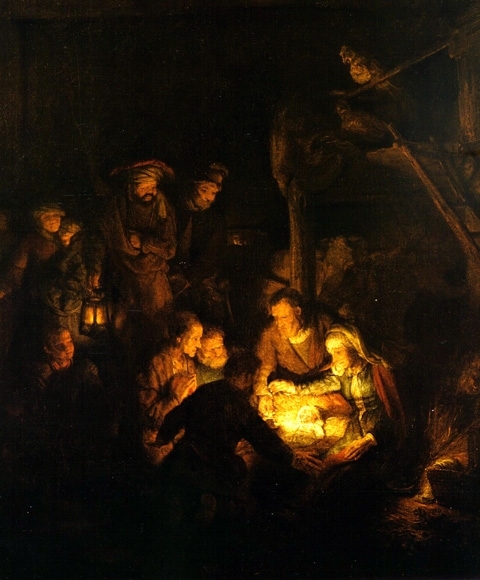
rembrandt-van-rijn-adoration-of-the-shepherds-1339152516_b

For Jim Torrens

If you come at four in the afternoon, I’ll begin to be happy by three.  Antoine de Saint-Exupéry

This present hour of joy should run at half the speed of those long hours of waiting. Albert Camus

It is desire that can live with deferral, an embrace of the God-shaped vacuum in us and a commitment to stop trying to make it full, a healthy hunger that is content to wait for the feast.  Amy Simpson

It is no exaggeration to say that the suffering we most frequently encounter is the suffering of memories.  Henri Nouwen

I was like a child leaving a gift unwrapped, the anticipation more exciting than the reality.  Karen White

We in the West have an odd relationship to anticipation.  Our current worldview is based so much on control – of circumstances, of our own brand and the narratives that define it – that anticipation for us mostly drives our anxiety.  And anxiety tends to push the envelope of self-referential aggressiveness, burying envelopes labeled “kindness” and “self-reflection” deep within our shelves.  Anxiety also tends to distort vision for both our challenging present and a more promising future, a bit like the dark lenses some of us choose to wear around town on an already gloomy day.

I have reflected a bit this week on the scene around the manger where, in Christian lore, the shepherds gathered to witness the coming of the Christ child.   Some of the greatest painters in western history have tried to capture this scene – but for me none quite like Rembrandt and his studio.  In London, in Munich and elsewhere, this precious scene and its affects are given the care and attention they deserve.  The results are neither sentimental nor quizzical.  The look in the eyes of the shepherds suggests that this dusty manger is where they belonged. The setting in which their anticipation became incarnate was surely not entirely what they expected.  But somewhere deep inside they expected the arrival of this energy, this hope, this message emanating from both beyond and within, a signal that life now stood a fundamentally better chance than was the case only one cold evening before.

Through the brush-strokes of Rembrandt, it seems clear (to me at least) that the shepherds had prepared to experience such a moment. They were not mere passers-by, indulging a curiosity, taking the antiquities-version of a selfie in case what they were seeing turned out to be “likeable.”  They were there because somehow or other they had prepared to be there.  They were in deeply moved by what they were witnessing, as well they might have been.  But they who spent much of their lives working their flocks had somehow anticipated this moment, anticipated that life could not go on as it had, that the hope represented by the manger child was one that had to be embraced and lived before it could be directly (and fully) experienced.

Were it otherwise, this scene might never have had the impact it did, an impact that a great painter and his best students could capture anew many centuries on.  Instead the effect would have been closer to “just one more baby born in a barn,” one more baby facing a life on the run, under occupation, with meager provisions and opportunities, a baby whose only option would be to line up alongside the legions already consumed by the demands of the present, including the “suffering of memories,” not the anticipation and wonder associated with a potentially renewed creation.

As most of you recognize, I spend a lot of time at the United Nations, perhaps more than my psychological and spiritual resources can manage.   And we who are focused mostly  on security threats and arrangements have also been preoccupied with the Sustainable Development Goals,  perhaps the most comprehensive and far-reaching promise that we human creatures can make to ourselves and our children — that by 2030 the world will be cleaner, cooler, safer, healthier, more just and more peaceful.

The 2030 Development Agenda has engendered many important discussions at and beyond the UN on key elements that will determine whether this promise becomes incarnate on a planet that might not be able for much longer to continue indulging our foolishness if we fail: securing real-time data and concessional funding, promoting good governance and development cooperation, ensuring inclusiveness and biodiversity.

It’s all good but, as many are whispering in the corridors outside UN conference rooms, it doesn’t yet seem to be enough.   We’re not making progress in many key areas and in some we are actually losing ground.   We’re not hitting our climate targets.  Hunger is on the rise as is nationalism-fueled discrimination.  Our appetite for weapons and fossil fuels seems at times insatiable, while our appetite for justice is easily appeased and our collective priorities seem mired – at least for the time being — in predatory economics and cynical politics.

What is the matter here?  Why are even our best efforts not resulting in better metrics?  The message of Advent seems clear on this point:  We have adjusted our policies, but so far failed to adjust our expectations, our commitments, even our appetites.  We have made our noble promises but so far largely failed to embrace —-in our energies and values — the peaceful and balanced world to which these promises point.  Too often, we are waiting for change without living the change.

Many certainly acknowledge the challenges, but too-often conclude that they have nothing to do with us or, more frequently, that we will adjust as little as possible about ourselves and our priorities, simply hoping to ride out this storm.  Ironically, perhaps, the very governments and international institutions that many now say they don’t trust are nevertheless being entrusted with the responsibility to turn this world around – largely, still, without our involvement let alone our practical commitment.

Something is clearly missing. We have this glorious blueprint for sustainable change, but few of us (and certainly few in power) have put their personal adjustments on the table.  What have those of us who work with these issues on a daily basis, who witness the current decline and the limits of our capacity to reverse it, what have we pledged to change in our own lives?  How are we living in anticipation of the world that can sustain the life which is currently under such severe threat?  How have dimensions of our participation in the current culture of predation evolved into a “healthier hunger?”

These are not snarky questions.  Indeed, the answers are more than instructive and could even be inspirational.  If the world we inhabit is not substantially different by 2030, it will be in large part because we have not prepared sufficiently for the hope that the Sustainable Development Goals represent.  As a species, we are not yet resolved to live out the promise of a healthier, fairer more peaceful world in anticipation of its eventual fulfillment.  What will the world look like if we get what we say we want?  Will it convey all (or most) of the benefits that we have promised?  And how can those benefits possibly convey in the absence of the best of ourselves–our willingness to live in anticipation of a world that, in several key ways, must look little like the current order, to recognize that this is more about us than about policy and technique, that 2030 is not the starting line for our planetary hope, though it may become its terminus?

If one searches “living in the power of the future,” one of the very first items you get back is an article about living off the grid.  Indeed, the current “grid” which holds us in its grasp is technologically sophisticated but often morally barren and mostly uninspiring.  It is a grid that demands as little from us as possible, that discourages us from thinking hard about the world to come, what that world will look like, and what it will require of us; indeed what it requires of us now.  Getting distance from such a grid, renouncing some of its uninvited power over our lives, might well be our own “manger moment.”

The baby in the hay is, for this unworthy servant at least, the place where anticipation meets incarnation, where the recognition that we simply “cannot go on this way” meets the energy and grace that can get us through to a better place. But there is no magic moment here, no point at which a world capable of sustaining our lives going forward simply appears.  The manger may represent a divine promise, but it’s one which we who pretend to hear it have never done enough to keep.  Despite our past malfunctions and sometimes anguished memories, we must do our part and do it with greater resolve.

If the world we seek is promised to arrive at 4PM then we must commit, in aspiration and in practice, to being happier and better-prepared by 3.

Treasure Hunt: An Advent Reflection on Pathways and Resources, Dr. Robert Zuber

3 Dec

Advent Image

For outlandish creatures like us, on our way to a heart, a brain, and courage, Bethlehem is not the end of our journey but only the beginning – not home but the place through which we must pass if ever we are to reach home at last. Frederick Buechner

Life in a prison cell may well be compared to Advent; one waits, hopes, and does this, that, or the other- things that are of no real consequence- the door is shut, and can be opened only from the outside.   Dietrich Bonhoeffer

To be human is nothing less than to be caught in the great congested pilgrimage of existence and to join ourselves freely to it in the face of the evidence of its never-ending troubles.  Eugene Kennedy

For where your treasure is there will your heart be also.   Matthew 6:21

I’m not usually asked to write things by others – more likely asked NOT to write things, actually.   But there was one recent exception – a valued colleague asked if I would comment on an important, recent NGO discussion on the “perils and challenges of a shrinking UN budget.”    Since it is also time for my annual Advent letter, I will attempt to conflate the two responsibilities.  (You might want to consider a stronger cup of coffee before proceeding further.)

At the UN, much of the constriction just alluded to is based on threats from the current US administration and some other donor governments, officials seeking a leaner system that can do “more with less.”  As we know, this often translates into “doing less with less,” a problem for an institution that is being pulled in a variety of challenging policy directions and is having more and more difficulty taking care of basic expectations to staff and constituents on top of evolving concerns related to issues as diverse as autonomous weapons, forced migration, mass climate incidents, ethnic and disability-based discrimination, species extinction and pandemic threats.  Our global community – even those parts that don’t much trust us here in New York – simply has no viable recommendation to offer for how we might, together, ever make it “home” to a world of peace and well-being without the UN’s occasionally clumsy – and now also funding-challenged — efforts to clear away some of the debris that inhibits our collective progress.

There are challenges as well for those of us who labor in UN confines, and not only for the institution itself.  Some of those have clearly “seasonal” references.

My profound admiration for the late Dr. Bonhoeffer notwithstanding, my own take on this season of Advent is less about “killing time” in a confined space waiting for some divine (or human) power to turn the lock, and more about discerning what we plan to do – and with whom we plan to do it – in order to bring this current, difficult and confining sojourn finally to an end.

Like many people with far better excuses for this neglect than I have, I don’t spend enough time in reflection or –if you prefer –prayer, in Advent or any other season.  I don’t spend enough time simply dwelling with myself – the good and uglier aspects of that – figuring out both where I want to go but, more importantly, where I want to invest my treasure and with what values?  Moreover, who do I wish to stand alongside, and for which causes and objectives shall we together stand?  How can we best point out the many structural and, at times, self-imposed obstacles that litter our path home without sounding shrill, or mean, or even self-righteous?

Beyond such self-analysis, the reflection time of Advent allows me to take at least partial stock of all the people in my life who matter, some of whom are facing their own trials of health or meaning,  others of whom now finding themselves killing time in mostly hopeless spaces with no obvious exit.  When I reflect — when I pray — I remember all the people I am usually too “preoccupied” to think about in the ways that they deserve. And in my best moments, I recall that capacity to care about people in practical ways commensurate with the genuine value they can and do add to my life (and my world).

Advent for me represents a time of longing, of the hope that the heavens will open revealing the way out of the tiny rooms in which we have, sometimes willfully, restricted ourselves.   But it is also a time for planning what we will do once our full release is secured, and with whom we will walk ahead on a path towards greater inclusiveness and equity.

For many of us, this planning and walking clearly has something to do with money.  In an expensive and economically skewed city such as New York, those of us who work in this UN vineyard have to pay attention more than we wish to the financial implications of our respective missions.   It is difficult at times to live with simplicity and generosity beneath a bevy of shining towers saturated with moneyed interests but with little or no concern for what we are attempting to accomplish with and for each other in the realm of global policy.  It is even more difficult to share this space in the way we should with the many stakeholders worldwide who can effectively “check” our elite realities but can’t foot most or all of the bills associated with their presence here.

The UN, as already noted, has many of its own fiscal laments, sometimes substituting slogans and scheming for thoughtful reflection on what are often utterly daunting program and funding tasks.   One of those slogans relates to the Sustainable Development Goals (SDGs) tag line of “leaving no-one behind.”  I have written previously about this once game-changing but now tired and overused formula that now represents an aspiration likely to exhaust our collective energy, probably also our powers of attention, certainly our currently available (and perhaps even projected) resources.

UN budget challenges, including the preference by some states for greater austerity and “earmarked funding,” have indeed been complicated by the ambition of the SDGs but also by the global events that make fulfilling these goals so essential to our very survival.   More and more attention is now being paid to addressing the massive price tag associated with our sustainable development promises, including through commitments to end state corruption, solidify domestic revenue streams, and integrate the so-called “private sector” in what must become a fully transparent and rights-based manner.  Military spending, much to our chagrin, remains an obvious and largely “off limits” source of potential SDG revenue.

Along with SDG-related imperatives, there are now frequent, UN-sponsored “pledging conferences” focused on forcibly displaced persons facing deprivation and trauma, the victims of discrimination and armed violence that we have done less-than-enough to prevent, the stranded and water-logged residents of coastal areas battered by storms made worse through our collective climate negligence.  A shockingly high percentage of funds pledged for disaster and humanitarian relief are actually never honored while the humanitarian and environmental crises-of-our-making seem continually to evolve.

It would seem appropriate at this point to apply some iteration of the biblical reminder regarding the links between our treasure and our heart to UN policy contexts.  To paraphrase:  where our treasure is withheld or withdrawn, where it is beholden to institutional politics more than to people, thus might well our hearts be hardened.

And there are NGO dimensions associated with current budgetary challenges.  Every time I walk into the UN, a place where I spend an average of 9 hours each day, I cost the UN money.  The security officers whom I often greatly admire, who are the “face” of UN hospitality, and who are often not treated with sufficient respect by diplomats or NGOs, are paid to make sure that people like me and my interns/fellows don’t trespass on diplomatic prerogatives, don’t get off the elevators on the wrong floor or sneak into closed meetings.  Moreover, we don’t pay for the earplugs we use in UN conference rooms; we don’t pay for the electricity or the wireless that allows us to communicate UN deliberations to the outside world; we don’t pay for any of the access passes I and my colleagues liberally bestow upon others; we don’t pay for the literature we collect and then stack up throughout our office.

And so part of the discussion about UN budgets must focus on the benefits (sometimes begrudgingly) enjoyed by offices like my own but, even more, about the financial limitations that even now impact the ability of others to sit where I sit – those many “outlandish creatures” worldwide who have every reason to insist on their place in this policy space, on their ability to “add value” in ways that I can only pray we do as well.  In a time of abundant and mean-spirited austerity threats, including towards the UN, there is little reason to believe that important and hopeful voices will find their way out of the spaces where they have for too long been confined and into UN conference rooms where “what they know” can and must inform “what we do.”   Little reason, that is, unless we commit more of our treasure to making that happen, to insist that our (still-intact if shrinking) institutional privileges are available for them as well.

For unless we all make more time for reflection on both our commitments and our own privilege, unless we are fully prepared to use whatever treasure is at our disposal to reach as far as we can to connect with those in need of both justice and a voice – and then stretch a bit further still – we are more likely to remain as “toothless plaintiffs” towards a system already well into its embrace of what Global Policy Forum calls “selective multilateralism.”  Our road home to a place of inclusion and equity is littered with debris that we have often scattered ourselves – our self-preoccupations and excessive material interests, our numerous distractions and competitive suspicions.  Ours is indeed a “congested pilgrimage,” albeit one we maintain (at least for now) the power to de-clutter.

Some of this business about sustaining multilateral policy space is about funding, specifically about a fair, predictable, transparent and depoliticized balancing of resources and expectations. And some is about reminding governments and other international stakeholders that their often-furtive and restrained financial commitments in the face of global crises tell us much about the size and health of their collective heart. But some of it is about us as NGOs as well:  our willingness to use opportunities — including the reflection space of Advent — to interrogate the promises we keep, the value we contribute, the conflict we prevent, the voices we enable—commitments that we must “own” each and every day regardless of the current health of our organizational balance sheets.

As we lobby for a sane, sufficient and promise-oriented allocation of resources based on something akin to what NGOs often refer to as “full funding” of the UN, we would also do well to ensure that our own treasure is fully engaged — that the self-reflection encouraged in this season begets some newly-minted, heart-felt and tangible commitments to inclusive access and a sustainable peace for more of the world’s people.