Tag Archives: civil society

Raising the Stakes on Conflict Prevention Stakeholders

25 May

On Thursday, an unusually large crowd of diplomats, invited guests and NGOs gathered in the Security Council to observe the veto of a resolution on Syria (S/2014/348) that had been drafted by France and endorsed by an array of other states inside and outside the Council.

The gist of the resolution was a referral to the International Criminal Court as one measure of ending impunity or at least, in the words of the Australians, to remind abusers that there is no ‘statute of limitation’ on crimes being committed in Syria.

Such reminders are important, to be sure, though it is unclear that the ICC is well suited to conduct investigations and render judgments in the midst of a protracted civil war.   The Chief Prosecutor of the ICC speaking at a briefing on Libya earlier in the month pointed out to the Council that conducting investigations with little funding while confronting massive security threats is difficult at best.  That Syria (like Libya) features massive abuses by multiple parties only complicates jurisprudence, perhaps placing the attainment of justice in this instance well beyond the reasonable capacity of the court.

The failed resolution on Syria seemed somehow consistent with a recent pattern in the Council of trying to ‘do something’ by punting the political football to DPKO (in the form of more complex and coercive mandates) or the ICC (in the form of hastily conceived, unfunded, imprecise referrals) rather than examining the limitations of its own power and process.   The Council remains among the most politicized spaces in the UN.  It is also among the most uneven spaces from the standpoint of power and influence.   The non-permanent members (with the exception of their time as president) largely populate sub-committees and make public statements.  The Russians and Chinese would have little say on many resolutions if they could not force Council members to pay attention to them through threat of the veto.   And the rest of the UN system too often sits on its proverbial hands waiting to see if the Council will take on yet more ‘thematic concerns’ for which it then presumes to act as global legislator.

The present preoccupation with veto restraint within some parts of our policy community is a diversion that belies full recognition of the limitations of the Security Council and the under-tapped resources of the broader UN system (including the Joint Office on the Prevention of Genocide and the Responsibility to Protect) which the Council seems largely to ignore.    As we have written previously, effective veto restraint implies the existence of depoliticized findings of impending mass atrocity violence, a sincere and robust commitment to solve violence primarily through diplomatic means, and Council members whose motives are transparent and attached to the kinds of assessments and accountabilities that have eluded that body for most of its history.  In a system where findings are politicized, where preventive measures are under financed and too often disregarded, and where there is no way to hold the Council accountable for its own mistakes, veto restraint would simply be a gift to the P-3, one which they have not necessarily merited.  Whether or not such restraint would also be a ‘gift’ to victims has to do in part with organizational assessments of the relative efficacy of diplomatic vs. militarized solutions to complex patterns of violence.

Capacity support is the lifeblood of the UN system, and this is true for atrocity crime prevention as in other areas.   But the success of such support is only enhanced when the full complement of stakeholders is acknowledged and engaged.  Regarding RtoP, for instance, it has never been clear who the relevant stakeholders are.  Is it permanent Council members?  Other member states?   The small group of NGOs that gather around the issue here in NY?  Regional or national governmental/military alliances?   What is the role for a small office like GAPW aside from routine (and often ineffective) ‘squawking’ about systemic limitations?   What is the role of media?  Business?   Education?  Development agencies?   Local civil society organizations? Is atrocity crime prevention a responsibility of the entire, extended UN ‘family’ or is it a responsibility of a few powerful states and some random national focal points?   It has often seemed as though the RtoP/atrocity crime prevention community has been more effective in shutting off hard questions than in welcoming them, of closing the gates on offers of energy and commitment rather than finding ways to put such to work.   But our own limitations notwithstanding, the stakes remain critical for the prevention of mass atrocities. We need to get this right, by which we mean to establish reliable and fair structures that are largely prevention oriented and that encourage the broadest possible stakeholder involvement.   We remain far from that goal.

The UN Charter does, indeed, confer upon the Council the primary responsibility for maintaining peace and security.    However, this does not indicate ‘sole’ responsibility nor does it imply that ‘maintenance’ is primarily a reactive matter rather than a preventive one.  Whatever the results of the parallel reform movements afoot within the UN regarding the membership and working methods of the Council, it is imperative that the current Council takes stock of itself and does more to address violence than fling accusations across the desks of political adversaries. Perhaps it could start with an examination of its own ‘franchise.’ After all, the more the Council is understood (or understands itself) as the only relevant player on atrocity violence the more unlikely it is to endorse and encourage other stakeholders.  However, such endorsements and encouragements are the key to an effective system of protection from mass violence that can both energize diverse conflict prevention capacities and help spare the international community the spectacle on Syria that we recently witnessed and which frankly was hard to watch.

Dr. Robert Zuber


A Call for Stable and Peaceful Policies

4 May

On April 25, Global Action joined with other civil society organizations (WFUNA, FES, WILPF) in launching an initiative to support the work of the Office of the President of the UN General Assembly in promoting the cross-cutting theme, “Ensuring Stable and Peaceful Societies.”  These organizations affirm the important value of this theme as the UN seeks adoption of a new (and hopefully expanded) set of sustainable development goals.

Our event immediately followed a day and a half long Thematic Debate in the General Assembly on ‘Ensuring Stable and Peaceful Societies’ that sought to field comment outlining both state aspirations and responsibilities within this dynamic normative framework.

As one might anticipate, the range of lenses that diplomats sought to include in their analysis of ‘stable and peaceful societies,’ was quite broad.   This is as it should be.  The normative framework suggested by this Thematic Debate touches on all facets of the UN’s work as diplomats were quick to acknowledge.   Some, like Qatar and Israel, noted the need for more ‘honest and responsible governance.’ Cuba underscored the deep divides that must be overcome between rich and poor.  Switzerland called for dramatic improvements in accessible public space.  Japan called for more attention to the management of ‘disaster risk.’ Australia, Nicaragua and others highlighted the need for more efforts to empower women.  Ecuador called for restraints on over-consumption and the end of what it called ‘speculative economies.’  Argentina affirmed the need for more attention to ‘rule of law’ obligations.  Egypt called for more efforts to address ‘massive refugee flows.’  Kenya noted challenges to peace represented by both illicit weapons and shortages of precious water.  The US and others clarified and solidified the linkages between violence and impediments to the fulfillment of development priorities.  Indonesia called for internal UN reforms to better serve the interests of a ‘rebalanced’ economic system.

On and on it went for over a day: states sometimes being provocative but mostly pointing out diverse elements of the massive, multi-dimensional undertaking that is ‘stable and peaceful societies.’   The Thematic Debate in the GA underscored the degree to which challenges associate with all three pillars that delineate the UN’s primary responsibilities – peace and security, human rights and development –   must be addressed in tandem.  Indeed, our growing populations and shrinking access to available resources; our increasingly sophisticated, digitally-driven military tools; and a new set of often-gruesome human rights responsibilities from Damascus to Bangui are more than sufficient to keep the policy community engaged at multiple levels.    The bar is set high here. The expectations for action coming from beyond UN headquarters are considerable.   This is not a ball we can afford to drop.

We know from the NGO side that we need to do more to support states and UN secretariat officials in keeping linkages relevant to the promotion of ‘stable and peaceful societies’ fresh among diverse stakeholders.  This involves a deeper level of partnership commitment, more than simply telling diplomats what’s missing and what ‘they’ need to do about it.    Through our own related initiatives, we seek to take more responsibility for goal setting and implementation, to do more to redress imbalances and end violence than merely pointing out the limitations of others.

As the presidency of the General Assembly shifts from year to year, we can do our part to be both facilitator and ‘institutional memory’ when it comes to ‘stable and peaceful societies.’     This involves a commitment to work closely and effectively with the new GA president’s staff on another round of diplomatic engagements with this thematic issue.  But it also involves a commitment to take account of broader fields of inquiry and their stakeholders, to perceive wider relevance and open doors to different kinds of constituent participation. ‘Stable and peaceful societies’ represents both a compelling aspiration and a profound test of our policy commitment and maturity.   This is one test we need to study hard for.

Dr. Robert Zuber

Nigerian-American Artist and LGBT Activist Addresses Nigeria’s Criminalizing of Gays

24 Jan

Editors Note:   This piece by GAPW’s Lia Petridis Maiello, originally written for The Huffington Post, represents another effort to explore the ways in which state-sanctioned discrimination violates human rights obligations but also poses security threats — specifically to those being discriminated against, but also to others who might find themselves the next to be ‘singled out.’   

As an immediate reaction, U.S. Secretary of State John Kerry deplored the “Same Sex Marriage Prohibition Act” in Nigeria, signed into law this month by Nigerian President Goodluck Jonathan, calling it a “dangerous” restriction on freedom. “The United States is deeply concerned by Nigeria’s enactment of the Same Sex Marriage Prohibition Act,” Kerry explained. “Beyond even prohibiting same-sex marriage, this law dangerously restricts freedom of assembly, association, and expression for all Nigerians.”

Ever since, arrests have risen quite dramatically in Nigeria where dozens more people that have been under the suspicion of being homosexual have been herded up and interrogated. In the last few days, more than 30 people were arrested, with a higher number coming from the Southern states of Nigeria that are predominantly Christian. So far prosecution of gay people had largely been centered on the Muslim North, where gays can get lynched and beaten to death under Shariah law.

Nigeria’s more than 160 million citizens are almost equally scattered in the North and mainly Christian South, with a widespread damnation of homosexuality all over the country. “Under the Islamic Shariah law that prevails in nine of its 36 states gay people can get lynched and beaten to death, or legally executed by stoning for the offense. Sodomy was already illegal, but the bill signed into law January 7 bans all gay associations and gay marriage, with penalties of up to 14 years’ imprisonment for marriage”, AP reports.

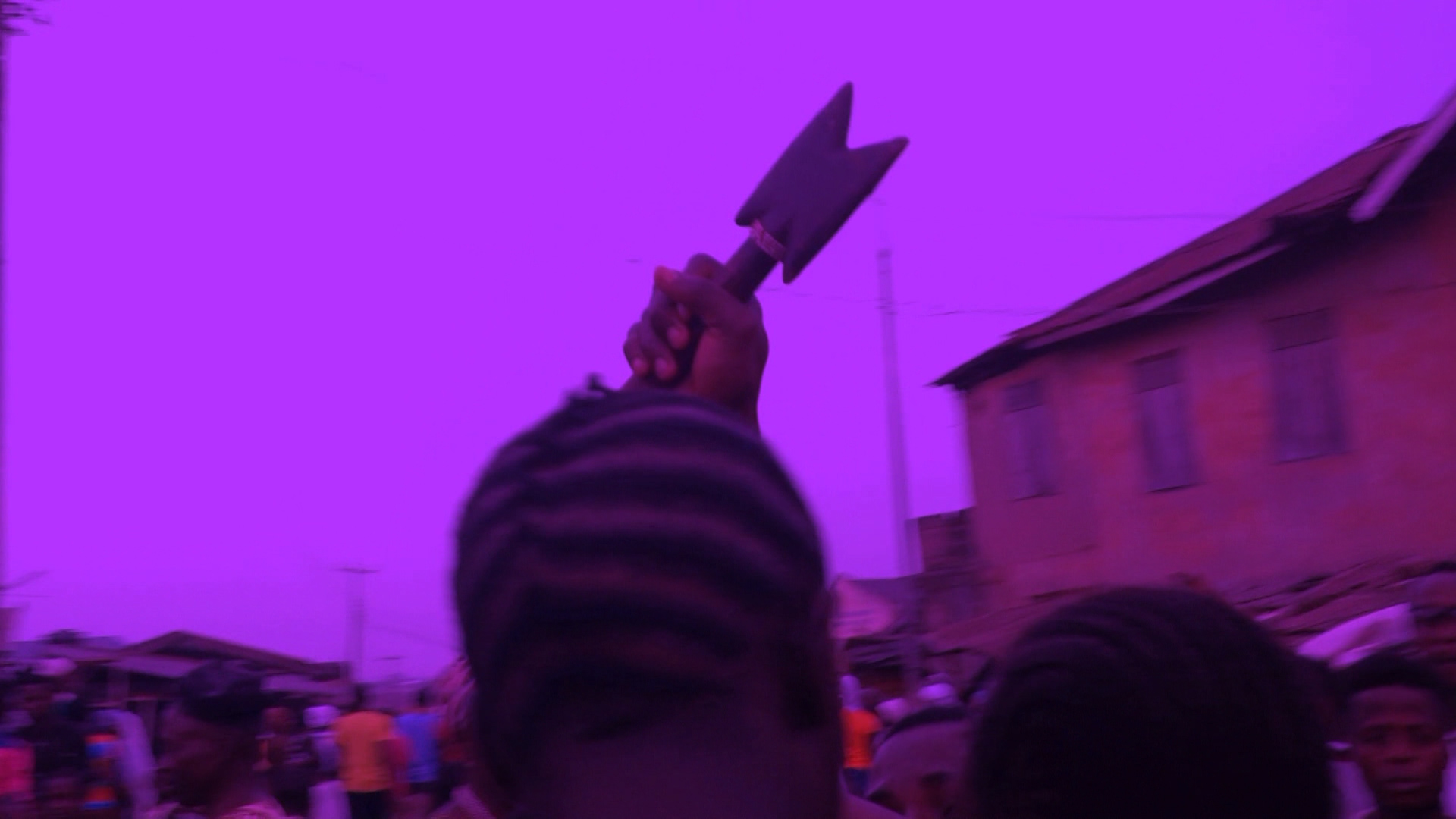
Nigerian-American artist and LGBT activist Ade has been residing in Lagos on a Fulbright scholarship when the law came into effect. Her project AfroOdyssey IV: 100 Years Latercaptures some of her impressions and feelings related to queer life in Nigeria, impacted severely by religious fanaticism, equally practiced by Christians and Muslims in Nigeria. “I just completed an experimental short-film entitled AfroOdyssey IV: 100 Years Later, which plays with images, figures and objects that help us critique religion’s subtle and/or overt machinations within Nigerian society,” Ade explains.

2014-01-20-Sangostaff.Still006.jpg

Picture: Ade from AfroOdyssey IV: 100 Years Later

What was your first reaction to the “Same Sex Marriage Prohibition Act” that was signed into law by Nigeria’s President Goodluck Jonathan this month?

My first reaction to the signing of the bill was pure rage. I felt as though someone had just doused my body with boiled water. I also felt wildly perplexed, like someone who had suddenly been transported back in time to the Middle Ages. In the year 2014, Nigeria’s 100th birth-year (it was amalgamated in 1914 by the British), this country decided to move backwards in its evolutionary process. What a shame! The same country that just allowed a senator to marry an innocent fourteen year-old girl, has now criminalized homosexuality under the false disguise of same-sex marriage. Whose rights are they planning to go after next?

History teaches us that the target criminals next in line are women, after innocent children and gay people. Especially if the Bible and the Koran guide the law. So if you are an unmarried woman, beware! If you are married but have no children, beware! If you have ever cheated on your husband, beware! If you dress a little too sexy, beware! If you have your own opinion about anything as a woman, beware!

What were the immediate consequences for the gay/lesbian community in Lagos?

The queer community is keeping a low profile. The streets have been rendered unsafe by this bill. Anyone who even looks like he or she may be queer could be subject to violent mob action, talk less of jail. The Initiative for Equal Rights (TIERS), a human rights organization based in Lagos, has created a 24-hour hotline for people to call into in case of an emergency.
There are scary stories coming from Northern and Eastern Nigeria of police targets and gay-lists being used to round up members of the community. We have also heard that people are being arrested in Oyo and Ibadan. Gay people are terrified and thus playing it safe should the same start happening in Lagos.

Have you been personally affected by it?

I started getting sick. Since the bill was signed into law I have had diarrhea, headaches, sleep deprivation and low-appetite. I did not anticipate the physical reactions to my emotional and mental states. I choose to treat myself at home, because a trip to the hospital would mean I would have to tell the doctor why I started getting sick in the first place.

As soon as he or she hears that I was stressed out by my opposition to the bill, they could refuse treatment or worse, report me to the police. On the other hand, my sickness doesn’t even come close to the problems of those who have been picked up by the police and whisked off to jail simply because they were born gay. I don’t envy those whose parents recently kicked them out of the house so that their gay child doesn’t bring shame to the family, rendering their child homeless. The list goes on.

You have been in Nigeria for several months now. How have you experienced gay/lesbian life so far?

I have attended community meetings, gay parties, LGBT film screenings, but most importantly made a few good friends. This has allowed me to watch how the queer community supports each other on a daily basis. I truly feel like they are now part of my family. During this stressful time, we have constantly been checking on each other’s well-being.

Apparently, I am not the only one who has gotten sick! An entire community exists underground that most Nigerians are not aware of, and it mirrors the same experiences in mainstream society to a large extent. Lately, the gay community is feeling traumatized. While some people are looking for a way out of Nigeria, others are contemplating suicide. The community is in a lot of pain.

How do homosexuals meet or organize under these circumstances?

When physical space is threatened, virtual spaces takes over. Virtual sites have become the stage for debate. It is the place where friendships become null and void and when new alliances can be formed. This is what is happening within the queer community here. Gay people have already been operating largely underground for years now. And I am talking about those who accept themselves as gay and live a gay lifestyle. There are others who hide their sexuality behind a spouse and five children. I suspect there are many of them in the federal government.

For openly gay people, meeting up will become even more secretive than it was before. Organizing is a totally different story. Organizing would require the emergence of a leader or several leaders, who can rally the community in a way that inspires them to stand up and challenge authority. While there are several individuals doing important human rights/gay rights work in their own way, I have not yet come across anyone who is actively bringing all the different sub-groups of the queer community together to come up with a clear strategic plan for action. That does not mean this person or organization could not emerge in the coming months.

In what way has your sexual orientation impacted your artwork so far and how does this oppressive situation in Nigeria impact it currently?

To some degree, I can relate to the loss of family ties based on sexual orientation. I came out of the closet as an adult after being married previously to a man. My experience with family was largely governed by “what the bible says.” It was and still is very hard for me to accept or swallow that religion is the basis of ignorance. I could not have a reasonable, logical conversation with certain family members because of how literally they interpreted the Bible and their inability to put it in historical context. I find the same problem among Nigerians and here in Lagos, it is even more magnified. Religious institutions play a major role in all aspects of people’s lives and are the site of moral teaching on everything from marriage to entrepreneurship.

So of course, it was rather easy to convince the masses to accept this oppressive bill. Because of my personal experiences prior to coming to Nigeria, my research focused mainly on how queer Nigerians navigated though the antagonistic worlds called spirituality and sexuality. I just completed an experimental short-film entitled AfroOdyssey IV: 100 Years Later, which plays with images, figures and objects that help us critique religion’s subtle and/or overt machinations within Nigerian society.

The mosquito is a metaphor for the corrupt nature of government, which continues to suck the blood of its citizenry. The interpretative dancers speak to emotions within day-to-day queer experience, against the backdrop of traditional drummers, traditional church bells, and organ music. Throughout the film the church is both the site of struggle as well as warmth and embrace. Outside of the church, an underground scene thrives in Lagos.

The gay scene is not in mainstream view just as traditional Yoruba spirituality has to hide from the damnation of mainstream religious institutions. There are churches in Lagos that actively burn “wooden idols “(that is, traditional Yoruba sculpture) in front of thousands of people. This film challenges such beliefs/practices and attempts to educate viewers on contemporary queer life in Nigeria. It will screen in several countries in 2014 including the United States, Spain, Germany and Nigeria.

You are of Nigerian decent, but were raised in the U.S. I am assuming that you strongly identify with both countries. How would you define your role or obligations as a Nigerian at the moment?

I am torn between wanting to fight for a new Nigeria, and disowning it all-together. My family left Nigeria during the military dictatorship in the mid-eighties, just like many middle-class families that created a brain-drain across the country. Having been born in New York, growing up in the United States, yet having ancestral roots here, I came to Nigeria because I wanted being Nigerian to mean more to me than simply loving the taste of jollof rice and fried plantain. I have been having much fun while researching and in fact, my pidgin is getting better. This bill has nearly erased all the joy I have experienced since coming here. Before the bill, I used to wake up early, call a bike-man to take me to Obalende or call a driver to take me to the movies at Ozone.

Now, I have to force myself to leave the house. The energy I once had to go out and explore is now being used to write this very response/article. The bill nearly zapped all my motivation, and I can clearly see how any brilliant, hardworking Nigerian can easily lose motivation in a country that calls him or her a criminal. However, I do feel a sense of duty to speak truth to justice at times like this. People need to be seriously educated on what it means to be homosexual, before accepting draconian laws into their country. My late uncle used to say, “when a man is tired of learning, he is tired of life.” Is the federal government of Nigeria filled with a bunch of walking zombies?

And on the other hand, how is your U.S.-American identity affecting your thoughts and actions?

In America we like to say — Freedom ain’t free! America has many good lessons Nigeria can learn from when it comes to the fight for civil rights. I keep this in mind while I am here. What Nigeria is attempting to do to its people is set the stage for mass incarceration of homosexuals.

Ask yourself — why wouldn’t the government do this, when they have never apologized for the genocide of Biafra? History should not repeat itself. But it seems Nigeria, whether it realizes it or not, has laid the grounds for another disastrous situation which will affect millions of people.

Lia Petridis Maiello, GAPW Media Consultant

The State of Nuclear Disarmament in 2013: The First High-Level Meeting on Nuclear Disarmament and Links to Civil Society

3 Oct

Editor’s Note:  This is the first post by GAPW’s disarmament fellow for Fall 2013, Marianne Rijke.  Marianne will be working on several disarmament projects and covering the First Committee of the UN General Assembly.  She will make frequent posts in this space.

Even though they have only been used twice in the course of warfare, by the United States (US) at the end of World War II, nuclear weapons have posed a threat to mankind ever since their creation. Since these bombings, there have been over two thousand detonations for testing and demonstration purposes. Every time a bomb is detonated human communities and environmental health are both put at risk. There have been several attempts by the international community to stop these tests, to halt the proliferation of nuclear weapons and to ensure total nuclear disarmament. So far these attempts have not resulted in the desired outcome because certain state parties refuse to honor their agreements to dismantle their nuclear weapons.

In 1970 the Nuclear Non-Proliferation Treaty (NPT) went into force. A total of 190 parties have joined the Treaty, including the five nuclear-weapon states (NWS): US, Russia, United Kingdom (UK), France and China (also known as the P5 states). The Treaty had been extended indefinitely in 1995 and will be reviewed every five years. The 2010 NPT Review Conference resulted in a Action Plan, agreed upon by state parties, which contains measures to advance nuclear disarmament, nuclear non-proliferation, the peaceful uses of nuclear energy and regional issues, including the implementation of the 1995 Resolution on the Middle East.

With the 2015 NPT Conference around the corner and frustrations building up by the lack of substantial progress in nuclear disarmament, the Movement of Non-Aligned Countries participated with the office of the GA president in organizing the First High-Level Meeting (HLM) of the General Assembly on Nuclear Disarmament (September 26, 2013). The original draft resolution which called for the HLM was approved by a vote of 165 to none, with five abstentions. The countries that abstained were the P3 states (US, UK and France), Israel and Ukraine. During the HLM, the P3 gave a combined statement in which they expressed the view that the HLM was essentially a waste of time and energy. In their eyes there are already enough efforts to speed up nuclear disarmament and states should focus on the 2010 Action Plan. This statement received a lot of criticism, as the first deadline of this Plan, the convening of a weapons of mass destruction free-zone (WMDFZ) in Middle East, was already missed.

This missed deadline was acknowledged at the HLM, and the states, once again, insisted on the need for this WMDFZ. One problem with attaining this zone, is a lack of involvement of Israel in the disarmament conversations. Even though Israel neither denies nor confirms having nuclear weapons, there is a wide belief that they do posses them. These undeclared weapons form a key impediment to a WMDFZ in the Middle East. “All countries in the region”, as stated by Saudi Arabia, “should call on Israel to open its doors for the inspections of the International Atomic Energy Agency”. Israel has not yet opened its doors and since they have the support of the US, it is also crucial for the US to be more involved in talks related to the formation of the zone.

Another problem for nuclear disarmament is the fact that neither the P3 states nor Russia seem willing to engage in multilateral dialogues about this subject. This produces an insolvable problem, since it is strongly maintained by some parties that nuclear disarmament must start with the US and Russia before the rest will follow. They refer to the NWS as falling behind due to the lack of new ideas from these countries and their unwillingness to participate in new disarmament initiatives. The P5 states decided not to be part of the Open-Ended Working Group (OEWG), which was convened by the General Assembly in October 2012 to develop proposals to take forward multilateral nuclear disarmament negotiations for the achievement and maintenance of a world without nuclear weapons. This decision to ignore the OEWG was referred to by some parties as the “P5 digging their own grave”. At the side event, organized by United Nations Institute for Disarmament Research (UNIDIR) and the Friedrich-Ebert Stiftung (FES), with the support of the Indonesian Permanent Mission to the UN, the OEWG was hailed as a success with a minimum of ‘blaming and shaming.’ However, the realization was there that there were a lot of interesting ideas, but a lot also needs to be done to turn good ideas into concrete action plans.

UNIDIR stated that for the HLM to fulfill its mandate there has to be a change in national security doctrines of both the NWS and the umbrella states (states that ‘benefit’ from extended nuclear deterrence). These states need to realize that nuclear weapons are no longer needed to ensure their security. “Only if the majority of a given country’s population is convinced that nuclear weapons are no longer required to ensure its security, and may indeed decrease rather than increase it, will the government of that country be encouraged to begin to adapt its security doctrines”.

At the side event, the role of civil society and the importance of getting it more involved was also emphasized, but the way to do so was not clear. Some parties stressed the importance of partnerships between civil society and states. Others believe that talking to governments is a waste of time and that the existing structures will not have the preferred outcome because civil society has no say within a lot of states, including some P5 states. A way for these groups to be involved is by building partnerships between civil societies in different countries and by connecting stakeholders within regions to build a movement at the grassroots level. There was also talk of reaching out to institutions in non-nuclear states that are not yet on board to get their support to persuade the NWS to give up their nuclear weapons. There seems to be a lot of frustration within non-nuclear states about being excluded from the actual disarmament talks and feeling powerless due to this process. It was underlined that all states and stakeholders need to be engaged in the disarmament discussions if disarmament is to succeed.

It was interesting to see that there was only a little talk about making connections to other pressing global issues we are facing such as regional conflicts, human rights, poverty and climate health. Global Action to Prevent War stresses that security issues, such as nuclear weapons, are always connected to these other security concerns. To make these linkages, it might be helpful if these meetings were more accessible to people from outside the nuclear weapons community. People not working primarily on nuclear disarmament could possibly add some fresh ideas to the table. It seemed that the meetings, mostly containing the ‘like-minded’, may have gotten into a stalemate on how to actually develop and execute plans that would help the nuclear disarmament process. The overall impression these meetings left on me, was the lack of such plans. I believe that it is a good thing to get civil societies more involved to strengthen the international community’s call for disarmament. But I am afraid that if there are no actual plans to follow up on, these meetings will function as just another ‘talk shop’.

Marianne Rijke

Civil Society and RtoP: Prevention and Strong State Capacity

16 Sep

On September 9, 2013 the Auschwitz Institute for Peace and Reconciliation (AIPR), the Friedrich-Ebert-Stiftung (FES-NY), the International Coalition for the Responsibility to Protect (ICRtoP), and the Stanley Foundation held the event titled Civil SocietyPerspectives: Building State Capacity to Prevent Atrocity Crimes. This was held as a pre-meeting to the 5th annual General Assembly informal interactive dialogue on the Responsibility to Protect, scheduled for September 11, 2013. Dr. Jennifer Welsh, the newly appointed Special Adviser to the United Nations Secretary General on the Responsibility to Protect, as well as Mr. Adama Dieng, the Special Adviser to the United Nations Secretary-General on the Prevention of Genocide, were both present. The event was also attended by many civil society representatives as well as diplomats from numerous Permanent Missions. The event featured civil society representatives who shared their experiences in working towards the prevention of atrocity crimes as well as their recommendations on strengthening domestic capacity. Ms. Valnora Edwin, the Director of the Campaign for Good Governance, provided first-hand experience of RtoP in practice. She explained the post-conflict work of the Truth and Reconciliation Commission and the transitional justice process through the Special Court for Sierra Leone. She also explained how her organization is engaging with the Sierra Leonean government in order to prevent future atrocities.

Both this event and this year’s UN dialogue are focused on Pillar 1 of the Responsibility to Protect, which states, “The state carries the primary responsibility for the protection of populations from genocide, war crimes, crimes against humanity and ethnic cleansing”. This is reflected in the UN Secretary-General’s latest report on RtoP, State Responsibility and Prevention.  In the opening remarks Mr. Keith Porter, the President and Chief Executive Officer of the Stanley Foundation, stressed that one of the key aims of the dialogue was to discuss how civil society can contribute to the building of societies where mass atrocities are not an acceptable means of holding power. Although the current situation in Syria was widely acknowledged as a challenge, the debate did not focus on it. Instead, Syria was referred to in order to clarify the norm. Dr. Welsh acknowledged that RtoP has been operationalized in the Syrian conflict through the form of sanctions, the acceptance of refugees by surrounding states, and the work of civil society groups as well as UN bodies such as the Human Rights Council and other humanitarian organizations. Nonetheless, the effect of Syria on the future of RtoP was not fully addressed.

In the keynote speech by Dr. Welsh, emphasis was placed on civil society’s role in advancing RtoP and affirming the need for prevention. Dr. Welsh addressed the next steps that need to be taken in the norm’s development including: the necessity for the development of a clearer framework which would facilitate early warning and response, the fact that regional and sub-regional organizations need to take greater ownership of the agenda, the need to strengthen interaction with the members of the Security Council, and that member states should work together to remind the Security Council of its responsibility to prevent atrocities. Moreover, apart from continuing to advance Pillar 1, Dr. Welsh argued that it is time for the General Assembly to pay greater attention to the Pillar 2, or the idea that the international community needs to support states in carrying out their responsibility to protect their citizens.

The first panel of the meeting was chaired by Ms. Angela Bruce-Raeburn, the Program Officer of the Stanley Foundation. The panelists discussed how their organizations work to influence political actors to cooperate in strengthening institutions. Rev. Cannon Thomas Muyya Godda emphasized the need for a common sense of equality and that key causes of conflict, such as poverty, must be addressed. Mr. Kyle Matthews highlighted some of the internal political obstacles to successful RtoP implementation. Referring to Canada he explained how although once a leader of RtoP, Canada has lost this position due to the fact that the current government views RtoP as the work its predecessors – the opposition. Finally, Mr. Noel Morada explained the ‘bibngka approach’ or the necessity for cooperation between the top and bottom – just like when cooking a rice cake, the cooperation of the pan on top with the fire on the bottom is key.

Although all panelists presented great examples of how civil society encourages national legislatures, Ms. Bruce-Raeburn asked a thought-provoking question of what happens when a government changes? In other words, what happens to atrocity prevention when those supporting it are no longer in power? The panelists generally did not provide an answer to this question; nevertheless Mr. Matthews explained how civil societies in Canada try to overcome this issue. Despite his statement, no substantive answer was given. Another issue discussed by the panelists was the relationship of RtoP and sovereignty. There was a general consensus among the speakers that RtoP needs to be presented as a friend, rather than an enemy of sovereignty. The problem of sovereignty often arises in relation to RtoP discussions primarily regarding Pillar 3 or the use of force if a government is not fulfilling its responsibility to protect its citizens. Panelists and Dr. Welsh agreed that rather than restricting sovereignty, RtoP actually has a sovereignty enhancing purpose. This is where the work of civil societies in aiding the strengthening of states and the implementation of RtoP principles into legislatures remains highly important.

The second panel chaired by Mr. Tibi Galis, the Executive Director of the Auschwitz Institute for Peace and Reconciliation, focused on reconciliation and peacebuilding as important factors in atrocity prevention. In many post-conflict situations a relapse into violence is highly likely unless appropriate action is taken to address the key issues that caused violence in the first place. Important peacebuilding efforts such as the inclusion of women in decision-making, the use of judicial processes and the development of good governance were also presented through the cases of Sierra Leone, Guatemala and Kenya. Although the presentations were relevant in content, at points the debate seemed to have gotten too specific and the message of how these case studies can contribute to the future general policy development of the RtoP was a bit lost. The overarching issue remains to be the fact that there are very few cases of when RtoP was successfully used in atrocity prevention. Both Sierra Leone and Guatemala highlight situations of post-conflict violence prevention rather than the initial prevention of the opportunities for mass atrocities. Therefore, the Kenyan case, which is often celebrated as a prime example of effective diplomatic action under the RtoP banner, remains perhaps one of the only real examples of RtoP application. Regrettably, there are still cases where atrocities have happened or are now happening, yet where RtoP has not been invoked.

Overall the event presented a good discussion on issues related to the role of civil society in working with states to strengthen their domestic institutions in order to successfully prevent mass atrocities. As the title of the event suggested, much emphasis was placed on the experiences of civil societies from different parts of the world in working together with national governments in order to strengthen measures for atrocity prevention. The debate reaffirmed the crucial role of civil society groups in pushing governments in strengthening their institutions in order to adopt RtoP principles into their national agendas. With many governments remaining skeptical about RtoP and its effectiveness, the role of civil society in keeping the norm at the forefront of government deliberations is key. RtoP is a noble concept yet it continues to go about unfulfilled due to hesitation by governments based in part on a failure to heed their legitimate concerns.


Tereza Steinhublova, GAPW Junior Associate


Sounds of Silence: Low Level Energy for a High Level Opportunity

2 Jul

On July 2, the GA president’s office and UNODA conferred a preparatory session for diplomats whose governments are expected to attend the high level summit on nuclear disarmament to be held on September 26 at UN headquarters.

The briefing included discussion of efforts to attract “regionally balanced” heads of state to headline the gathering, the need for time constraints on delegate presentations, and the possibility of having short presentations from civil society near the close of the day-long discussions.

Responses from the delegations who attended (there was limited P-5 involvement) were few and far between.  Speaking on behalf of the NAM, Indonesia made welcome reference to the possibility that the event will send a “strong political message” on the need for continued scrutiny and movement on nuclear disarmament.  The Nigerian delegation, speaking on behalf of the Africa Group, reminded delegates that the “only solution” to the threat of nuclear weapons is their elimination and complete disavowal of use.   The Nigerian delegate also mentioned the need to promote more WMD-free zones (such as in the Middle East) and to strengthen those zones that already exist.

After these statements, the room fell silent.    The briefing was adjourned in less than 25 minutes much to the surprised of onlookers – and even the security guards!

In our many presentations here at headquarters and in the field, we have learned to interrogate audience silence.  There are times when silence means satisfaction.  The audience has gotten what they need from the event and energy is now shifting to their next responsibilities. Silence might also indicate some confusion about expectations, specifically regarding the need for delegations to respond directly to specific proposals from the GA president’s office.  If indeed there was some confusion about expectations, the silence in the Trusteeship Council Chambers would then seem more appropriate.   Diplomats, after all, rarely speak out in situations where they are not prepared to adequately represent the policies of their respective missions.

Silence can also indicate disinterest, a polite but disengaged response to what is being shared or proposed.  At the UN, especially, it is highly unusual for delegations to publicly question the relevance of a briefing or other event, even if they were hoping for or expecting more.   Diplomats are skilled at endurance through multiple events – even on disarmament – that they might otherwise interpret as not of personal interest nor relevant to their missions.   The fact that this meeting was virtually bereft of inspiration contributed to our concern that the energy of the room might reflect something more troublesome than polite attentiveness to high level logistics.

Those of us who are deeply involved with First Committee diplomats and issues certainly hope that this last interpretation of ‘silence’ is not pertinent here.   Despite some understandable frustrations with the UN’s disarmament machinery, most participating diplomats understand well the stakes of September 26 for international security.   While none of us know when we will reach the breaking point on resistance to nuclear disarmament, a high level event such as this can certainly move us closer.  It must be given every opportunity to do so.

The silence in Tuesday’s briefing was deafening.   The volume needs to be turned up much louder in September.

Dr. Robert Zuber

Conversation Starter: Civil Society Consultations

14 May

On the morning of the 14 of May at UN headquarters in New York, four panelists reflected on an important regional consultation that took place recently in Guadalajara, Mexico with the support of the Mexican government.  The Guadalajara meeting was part of a larger process designed, in part, to assess and integrate regional civil society concerns in laying out follow-up processes for the post-2015 Millennium Development Goals (MDGs) framework and the Rio plus 20 Conference on Sustainable Development held in June 2012.

The speakers highlighted the value of more regional engagement as a post-2015 agenda begins to take shape.   Also noted was the need for clear feedback loops that can help civil society track their impact on documents prepared by States and the UN Secretariat to help guide movement on development going forward.

In listening to the speakers, I was both grateful for this attention by UN stakeholders to the needs and wishes of civil society groups and also dismayed by what seems to be the unwillingness of speakers to publicly identify some of the enormous challenges associated with conducting a genuinely consultative process at this moment in our collective history.  There are now so many civil society groups, so little civil society consensus, and some particularly ‘muscular’ non-governmental organizations (especially in New York) that brand their work in ways that deflect as much civil society involvement as they invite.   We in New York are too often prone to gate-keeping more than assessing and promoting a wide range of voices from diverse social, geographic and economic circumstances to help address shifting circumstances. Gate keeping, perhaps more than any other NGO activity, is anathema to the kinds of consultations which the panelists envisioned.

It is probably valid to say, as one or more of the speakers mentioned, that the initial MDG process in 2000 lacked a clear consultative element.  It is also true that we were in a different period then with respect to civil society involvement.   For one thing, there are so many more of us than there used to be, a great blessing to be sure, but one which makes fair and transparent consultation difficult to implement.  What is the dividing line for involvement–   a history with the issue, connections to groups in New York, or perhaps a defined skills set related to some sustainable development priority?

There are certainly no firm criteria for participation in consultations and certainly no consensus by civil society groups regarding how development-related issues should be articulated and supported, both politically and financially.   It is wishful thinking to think that it is otherwise, and it is disappointing to hear people talk as though the key to a good consultative process is merely wanting it to be so.

Moreover, there is an issue about how civil society interventions in consultative processes should be assessed.  Is it solely about the number of times when language favorable to our own organizational mandates appears in resolutions of the General Assembly or its constitutive bodies?   Given the uneasy relationship between resolutions and practical engagements on the ground, is resolution language alone the bar that we need to be reaching for?  Are there deeper levels of engagement to which we should be pointing, engagement that continues to reach out beyond the most widely known ‘players’ to the many new leaders and organizational assets anxiously awaiting their turn?

This is not a critique of the specific panel hosted by Mexico, but rather a reflection on the degrees of difficulty that we face when we try to organize a field (civil society) that is expanding more quickly and in more diverse directions than we can map its movements.   There are many challenges and limitations in our sector that we must address, such as when we settle for new resolution language when so many in the world are clamoring for just and robust implementation of existing resolutions; or when we endorse existing ‘seating’ arrangements at a time when there are so many more chairs that need to be set up at the policy table.

It is possible to be thankful to the Mexican government and speakers that there is more consultation moving forward on development priorities, and still lament all of the ways in which civil society participation is still very much a work in progress.   While there is an abundance of responsibility to share among different stakeholders, including governments and the UN itself, much of this development-related work is the responsibility of civil society groups themselves. We need development in our sector that can complement and enrich prospects for development on the ground.

–Dr. Robert Zuber