Tag Archives: climate change

Timber Line: The UN Labors to Encourage Reverence for Forests, Dr. Robert Zuber

24 Mar

Forests II=

Trees have long thoughts, long-breathing and restful, just as they have longer lives than ours.  Herman Hesse

When great trees fall in forests, small things recoil into silence, their senses eroded beyond fear.  Maya Angelou

When trees burn, they leave the smell of heartbreak in the air.  Jodi Thomas

The tree which moves some to tears of joy is in the eyes of others only a green thing that stands in the way. William Blake

To come in contact with the tree you have to put your hand on it and the word will not help you to touch it.  Jiddu Krishnamurti

And see the peaceful trees extend, their myriad leaves in leisured dance— they bear the weight of sky and cloud upon the fountain of their veins.  Kathleen Raine

The UN took up some important issues this week, including the economic and social benefits of Universal Health Care, the need to fulfill our participation promises from the Women, Peace and Security Agenda, and the implementation challenges of “biometrics” technology in securing national borders and positively identifying “foreign terrorist fighters” and other members of terror movements.

The biometrics event, organized by the ever- thoughtful UN Counter-Terrorism Executive Directorate, was particularly instructive as expert after expert wrestled with how to balance the technological benefits with the human rights pitfalls.  How do manage the “secret sharing” of this technology with intelligence and law-enforcement officials across borders while ensuring that rights of privacy and freedom from politicized applications are duly protected.  As is so often the case in such matters, we were left with an unfulfilling formula with many more concrete assurances regarding the counter-terror functionality of biometrics than regarding its own potential for rights abuses.

While some in this policy space would diminish its relevance, this is actually a pervasive problem at the UN.  We can prod and cajole, we can institutionalize our normative concerns and “turn up the heat” on serially-offending states.  But at the end of the day, it remains easier to “sell” governments (and other stakeholders to be sure) on the benefits of technology than on the vigilance required to ensure that such technology is not “repurposed” to political or economic goals inconsistent with Charter obligations to uphold human rights let alone the people-centered promises we have made to global constituents on sustainable development and a healthy environment.

Part of this dilemma is courtesy of a modern mind-set that “trusts” technology more than the motives of governments or even other human beings.  We have certainly adjusted our collective policy work to accommodate the language and thought-processes of technology and, on that basis, assumed that technology will more or less “sell itself” to an audience perhaps much too eager to embrace its benefits without bothering to assess, and then recover, what we might otherwise be in danger of losing.

Some of this disconnect was in evidence at this week’s International Day of Forests event, a precursor to May’s Forum on Forests to be held at UN Headquarters.   We eagerly anticipated this event, in part, based on our understanding of the important role that forests play worldwide in absorbing and storing carbon, but also the degree to which the lack of healthy forests (due to disease or deforestation) is itself a significant contributor to climate risks.  Thanks to UN reports and local agents of change, we know that healthy forests have direct implications for water, soil quality and other quality-of-life issues in rural areas.  Thanks to Green Map and others, we also know of the multiple benefits of trees in urban areas, including energy conservation, CO2 reduction, storm-water capture and pollutant removal, as well as traffic calming and crash reduction, healthier walking and cycling, even “an enhanced sense of well-being and conviviality brought by singing birds and shaded sidewalks.”

Some of these topics were mentioned, mostly in passing, at an event that (even with the presence of eco-engaged children) created little “buzz” among the scarce audience in the ECOSOC chamber. From a purely policy level, there were several missed opportunities to drive this discussion further.  Among those “misses” was a focus on the role of forests in maintaining our dangerously shrinking biodiversity, not only as habitats for individual species but in preserving the symbiotic bonds between species, bonds increasingly threatened by our habituated carbon loading and resource exploitation. Moreover, there was no mention of the rights and implications of respecting “land tenure,” even by the representative from the Food and Agriculture Administration (FAO) which is largely credited with placing land tenure issues squarely on the UN’s agenda in the first place.

Tenure issues are critical to healthy forests, as “insecure tenure rights” courtesy of corrupt government or corporate entities creates conditions conducive to “conflict and environmental degradation.”  The arbitrary separation of people (including indigenous peoples) from their forests and other lands also has grave stewardship implications, inasmuch as the persons “closest” to the land, persons who understand best the rhythms and relations that keep forests and other ecosystems healthy are no longer able to render those sustainable services.   As tenure rights are violated, often with impunity and despite official promises to the contrary, natural resources are more likely to be exploited and promises for eco-protection and restoration are more likely to go by the wayside.

As part of the International Day event, a representative from China’s “Shelterbelt” Program shared an ambitious, forest-focused government program (started in 1978) to protect communities and agriculture from “dusty wind, desertification, water erosion and soil loss.”  As technologically impressive as this project has been, more poignant for me was the testimony of young people who have successfully “localized” the protection and expansion of forests and trees, planting and caring for life forms that might well outlive them, recognizing their many benefits — well beyond the commercial and the technical — for the abundance and health that they (and many millions of others) hope to enjoy.

And in the process, perhaps helping us to revive a bit of the “romance” of the forest as well, a romance well-represented in the quotes at the beginning of this post, odes to trees that inspire awe as well as offer protection from flooding and pollution, trees that offer “long thoughts” as well as long shade, trees that “bear the weight of sky and cloud” as well as the weight of the millions of people and countless species under stress relying on them for sustenance and shelter. To be able to touch the trees that themselves touch the sky, trees which hold secrets long–forgotten or ignored by humans more anxious to use modern tools to exploit the “green thing that stands in our way,” this can be a life-changing, even “romantic” experience that can enrich and sustain forest protection commitments over many years.

I have been so fortunate to touch so many threatened “great trees” – the majestic redwoods on both sides of San Francisco, the Cedars of Lebanon that once fostered mighty ships, the tangled web of vegetation in the Panamanian rain forest, the Black Pines of Japan interspersed with bamboo, the brilliant fall Maples of New Hampshire, the Sycamores of sub-Saharan Africa, the Cypress of Robeson County, North Carolina.  These and other trees inspire awe even as more and more of them are isolated both from their own kind and from the deeper forests which were once their incubators.

It has been said that we have done to the forests what we have done to each other – degrading their inherent dignity and disrespecting connections that are crucial to our common existence.  Through greed and indifference, through careless fires and the endless whining of chain saws, we have caused our share of “heartbreak” among the trees. The promises of technology notwithstanding, we will not survive our current climate threats without millions of local commitments to larger and healthier forests, nor will we end poverty and protect the languages and cultures that remain most directly “in touch” with the canopies on which we all depend.

Let us then be about the urgent business of revering, protecting and above all, planting.

Home Depot: Reliable Spaces to and From Familiar Places, Dr. Robert Zuber

9 Dec

A person is, among all else, a material thing, easily torn and not easily mended. Ian McEwan

He showed me his scars, and in return he let me pretend that I had none. Madeline Miller

One of the most important things you can do on this earth is to let people know they are not alone. Shannon Alder

There can be few situations more fearful than breaking down in darkness on the highway leading to Casablanca. I have rarely felt quite so vulnerable or alone. Tahir Shah

The UN spent the week meeting in far-flung corners on issues that in some key ways would have fit nicely together.  In New York, a special event called to mind the special needs and special potentials of persons with disabilities.  Despite the fact that as many as 1 billion of our species has a recognized (if not always recognizable) disability, we continue to organize the world around those who can demonstrate more than a modicum of mobility, emotional restraint or sensory normalcy.   Even more insidious, we still look upon persons with disability through the lens of that disability, as though they could somehow be reduced to the “thing they don’t have,” as if “normal” was the objective to be aspired to rather than placing the unique set of skills one does possess – sometimes in abundance – into productive use in the world.

The failure to accommodate persons who don’t, through no fault of their own, conform to some arbitrary notion of “normalcy” has implications beyond access to education, employment or social services.   Indeed at two major events “off campus,” the reluctance to factor difference into our planning was on display, specifically our reticence to recognize that our current, severe and common vulnerabilities provide distinct opportunities and challenges for persons who perhaps “can’t keep up” in one sense but can contribute much in another.

These major events – one in Poland (on climate change) and the other in Morocco (on migration) could well have been organized in tandem as the failure to satisfactorily address one crisis directly exacerbates the other.  While there was some attempt to address issue linkages, especially in some of the Poland side events, it isn’t clear that the international community completely grasps the degree to which severe storms and unprecedented drought (not to mention bombs and landmines) drive often dangerous and chaotic migration flows of persons who can no longer make a go of it in the places they call home.  The Global Compact on Migration, which is scheduled to be signed by many high officials as this essay is being posted, is not completely silent on climate and disability challenges, but neither does it recognize the degree to which our planet has become a starting gate of sorts for all kinds of persons racing (if they can) towards borders and makeshift ports in the hope of escaping the effects of lakes turned to sand, schools and hospitals reduced to rubble.

If they can: There is no wheelchair access at the embarkation points.   There is no foam to brace the falls from clumsy ascents of border walls on legs that simply cannot hold the weight.   There is no security for those forced to run from border guards but who cannot see the flimsy trails to freedom or safety.  In every respect the desperate path to the possibility of a better life is made more difficult, more treacherous, more frustrating, more dangerous by “difference.”

And while the Global Compact’s concern is with establishing consensus principles of migration governance (which it does well by the way), it is less focused on persons for whom migration is essentially coerced, driven by circumstance at least as much as by voluntary will.   On one afternoon during an exposure in Marrakesh with Churches Witnessing With Migrants (CWWM), an event on the margins of the Global Compact signing, we sat with a courtyard full of (mostly men) who had fled from violence and economic uncertainty in several African countries, but primarily from the Anglophone regions of Cameroon where I have spent some good time in the past.  The circumstances in the courtyard were dire, but the people themselves were not.   While they waited for blankets and basic provisions with a stoicism that occasionally leaked anger and frustration we talked about the places they had come from, the places they hoped to go, the skills they sought to share, and the myriad of obstacles that seemed to block every point of potential access.

The mood in the courtyard, despite the remarkable efforts of the local church staff, was subdued, even resigned.  Were it not for the few children running around, making up their games, the life energy of these people would have suggested that they were at an impasse – unable to go further and yet unwilling for now to go back.  They all shared scars from violence endured and family support forfeited but the blind and the lame were not among their numbers.  This was not a journey for them to make.  They have little choice but to remain behind with hopefully enough of a safety net to keep them afloat until the political crises abate and the soils regain their fertility.

The people who made it to the courtyard were described as alternately angry and frustrated, in part because they were persons of some honor before their world caved in, persons who likely never imagined they would find themselves in an alleyway waiting for someone to distribute a few provisions so they could make it through another cold Marrakesh night. Even if these people had not been torn from their communities by a state and security establishment that couldn’t leave well enough alone, it is still disconcerting to discover that doors are more often closed than ajar – doors to basic necessities but also to the jobs and dignity they left behind many miles ago.

While some of us in Marrakesh tried to think through our responsibilities to a world increasingly pushed out of homes and livelihoods, the news coming from Poland was little short of grim.  We are not making our collective climate targets.  Indeed, due in part to influential climate skeptics and the millions who continue to live as though massive storms and mass extinctions are mere anomalies, this past year set a dubious and dangerous record for emissions.  Despite all the warnings, despite weather maps that resemble Hollywood-produced alien invasions, we mostly continue on our merry way, keeping our credit lines open and our borders closed.

Our CWWM event had moments of good policy insight though such were sometimes buried in the clear and present responsibility to meet the needs that manifested themselves (in this instance) at the church door, to feed and cover and comfort and refer, and even to make the stories of those on almost unimaginable journeys speak to the unconvinced or merely indifferent, journeys in this age of climate shocks, state-sanctioned violence and discrimination that are only likely to increase in number and dimensions of difficulty.

What most of these journeys have in common is that those making them exhibit limited trust levels, occasionally of the churches and other caregivers, certainly of governments and their multilateral Compacts.  To be fair, this Compact certainly has some wise referrals, including to fulfill our 2030 Development responsibilities so as to minimize the incentives for people to leave their homes as well as an injunction to do more to make a public case that, as with those in the Marrakesh courtyard, most migrants have skills that can contribute much to sustainable development whether in transit, at their intended destination, or back in their preferred communities.

But in this current matrix of mistrust, NGOs and churches are left to do what they so often try to do – fix the broken, bandage the wounded, satisfy some of the empty stomachs and even emptier souls, doing just enough to address the miseries and fill the voids such that government officials and their five-star entourages don’t have to feel too badly about migrant-related agreements that are largely government driven, government negotiated and –when it suits their purposes– government neglected.

Many at our CWWM event have often been in this difficult place, with needs staring us in the face while the responsibilities to make good policy that can impact the many beyond the courtyard also beckon.  We are not so callous that we can step over and around those facing acute need, even with the consequence of enabling governments to care less in the process. But neither can we leave policy entirely to the governments, the same governments who claim a sovereign right to keep internally displaced persons out of the Compact’s protections, the same governments that hesitated to meaningfully integrate special accountability for migrants with disabilities and others facing acute vulnerabilities, the same governments which relegate churches and NGOs to meeting the needs of those in their gaze while state officials grant themselves de facto permission to turn their own gaze towards other “pressing” matters.

The lessons for me this past week are clear:  We must provide care as best we can but not enable other persons and entities to withhold their own.  We must protect the right of movement but also do more to ensure that those wishing to stay in their homes can do so.  We who are able must contribute more to policies of protection and accompaniment for displaced persons remaining within national borders and not only people crossing over.  And we must ensure that persons with disabilities and others facing multiple vulnerabilities are given special attention, that their “right to migrate” is also honored.

We all have our scars; we have all faced metaphorical abandonments on dark and lonely roads.  Moreover all have contributed in some way to a violent, over-heated world where so many need “mending,” need accompaniment, need tangible reminders that they are more than the provisions periodically extended to them. These messes we’ve made; these vulnerabilities we’ve ignored; these will become the tests of our collective character, our collective attentiveness, our collective promise to heal as best we can the wounds of the legion of persons from many cultures and walks of life now on the move.

Missing Ingredients:  Consolidating a Consequential UN Week, Dr. Robert Zuber

15 Jul

Contract Image

Peter was, simply, what a person would look like if you boiled down the most raw emotions and filtered them of any social contract. If you hurt, cry. If you rage, strike out. If you hope, get ready for a disappointment.  Jodi Picoult

While prosperity does not trickle down from the most powerful to the rest of us, all too often indifference and even intolerance do.  Hillary Clinton

I am not surprised that the people who want to unravel the social contract start with young adults. Those who are urged to feel afraid, very afraid, have both the greatest sense of independence and the most finely honed skepticism about government.  Ellen Goodman

We may demand that the citizens of each sovereign state view citizens of other states (or even stateless people) with compassion, respect and sympathy, satisfying some requirements of “minimal humanitarianism.” Amartya Sen

This was in several ways one of the more remarkable weeks in recent UN memory, capped off by the historic agreement on the text of the Global Compact for Safe, Orderly and Regular Migration which will be formerly adopted in Morocco in December.  The document was negotiated under the able stewardship of the co-facilitators (Mexico and Switzerland) and was rightly hailed by Deputy Secretary-General Mohammed, President of the General Assembly Lajčák and Special Representative Arbour as a triumph of multilateralism, a way forward for governments to address and honor the challenges of migration but also the many contributions that the 258 million or so migrants in our world today can make (many already making) to our sustainable development priorities.

In other conference rooms, the UN was alive with delegations and discussions assessing progress (or its lack) on fulfilling our 2030 Development Agenda promises.   From sustainable cities and financing “partnerships,” to the right and access to fresh water, sanitation and sustainable energy, the High Level Political Forum (HLPF) held important discussions that explored gaps and celebrated successes, but also aired frustrations about the lack of progress in implementing several development goals and about the lack of transparency regarding the “partnerships” currently being proposed (few of which involve reductions in military spending) to pay for our 2030 development ambitions.

As a small office with diverse policy interests, we could cover only a few of the HLPF events (most reflecting the current interns’ interests in the right to water, African affairs, environmental care and sustainable cities).  But as is our want we remained intrigued by the “cross-over” events that remind us of the systemic nature of our development promises, the degree to which sustainable development must be pursued at multiple levels and must integrate as fully as possible both the human rights and peace and security pillars of the UN’s policy mandate.  Indeed, presentations by the resplendent UN Climate Envoy Mary Robinson as well as by Assistant Secretary General for Human Rights Andrew Gilmore and the ocean-focused, former president of the General Assembly Peter Thomson helped give sustainable development a wider lens if not always an optimistic one.

True to form, Gilmore and Thomson were particularly blunt.  Gilmore in fact went so far as to call trickle-down economics a “staggering oxymoron,” noting that the forces in the economy  exacerbating inequalities are not as “inevitable”  as we sometimes make them out to be.   For his part, Thomson underscored the urgent need to “re-establish and respect planetary boundaries.”  No categorical critic of profit (nor are we), Thomson yet wondered aloud about the value of short-and medium-term pursuit of such profit when our longer-term sustainability is under continuous assault, when our “plastic plague” shows too few signs of abating, and when we have been too slow to usher in a “new generation of stewardship” represented by our young people, stewardship that can help our markets and governments respond more urgently to growing inequalities while inspiring our consumer appetites to become less voracious and wasteful.

And as has been the case for the last couple of summers, we eagerly welcomed the release this week of Spotlight on Sustainable Development, a compendium of viewpoints assessing our sustainable development responsibilities, progress and failings produced by the “Civil Society Reflection Group” on the 2030 Agenda for Sustainable Development.   The 2018 version of the report contains a diverse array of data and commentary including and beyond the SDGs tagged for assessment at this HLPF.  What the authors (many of whom also presented during the HLPF) seemed most to have in common was a commitment to narrowing what have become almost grotesque social and economic inequalities in many regions of the world, in part through important calls to reverse our recent “privatizing” obsessions and restore more accountable municipal control over water and other essential services.

The Security Council, which at times seems a bit “tone deaf” to developments and achievements elsewhere in the UN system, also had a good week.  Despite some considerable controversy resulting in a razor-thin vote to impose an arms embargo on South Sudan (over the objections of South Sudan itself and the African organizations currently seeking to broker SS peace), Sweden’s presidency was off to a positive and collaborative start with high level discussions on children in armed conflict, on women, peace and security in African states, and on climate as a peace and security issue.

All are worthy of sustained attention by this Council, not so much to control these narratives (a persistent concern of non-Council members and many Council watchers)  but to support efforts taking place elsewhere in the UN system, and indeed in communities around the world.  Regarding climate, while some members remain a tad suspicious (the US never actually uttered the term during its Wednesday remarks) and others (such as Russia) maintain that there is sufficient policy robustness on climate in other UN settings, most agreed with the Netherlands, represented at this meeting by the Prime Minister of Curaçao, that “we are all in the same canoe, and need to collectively paddle faster than the threats that are now overtaking us.”  Such “paddling,” he insisted, must involve greater responsibility for ensuring that all UN agencies with a mandate and/or determination to mitigate climate threats, including the Security Council itself, be about those tasks as though the future of the planet depended on it.

The grandest moment for us of ths particular Council session, perhaps of the entire week, was when indigenous representative Hindou Ibrahim addressed Council members.  For Hindou and the often-vulnerable people with whom she lives and works, climate change is no abstraction.  Its impacts dominate every aspect of their lives, forcing people into adaptations that strain resources, security arrangements and community bonds. “We don’t have a choice,” she noted (raising her finger), “but you do.”  “You choose to sit on this Council.”  You must, she intoned, do more to “give the people hope.”

I caught up with Hindou later in the day and congratulated her for her courageous words, noting how much better balanced the UN system could be if there were more people like her wandering its halls and fewer people like me.  She replied that “everyone has a role to play.”  Everyone, including people with uneven skill sets and financially challenged offices; everyone, including people who have been battered by climate events that have destroyed their homes and ruined their farms; everyone, including those who have never once been invited to make a better world for others; everyone, including those who have already spent too much energy trying to convince themselves that things cannot be so very different from what they have now become.

In a week as momentous as this one at the UN was, in a building that was filled to the brim with talented and creative people, some of the most important takeaways appear to be pretty straightforward:  that those who choose to occupy seats of authority must set a hopeful bar for themselves and others that renounces both indifference to our ever-more unequal world and intolerance to our ever-greater human diversity; that our national and multilateral institutions don’t quite have the precise blend of human ingredients needed to bake some variety of the bread of life to offer to our children and those who come after; and that a mixture of “compassion, respect and sympathy” is a prerequisite for hopeful and sustainable policy, not an afterthought.

We’re getting there.

Hedging Our Bets:  Tepid Responses to Existential Challenges, Dr. Robert Zuber

16 Apr

Haiti

With so much evidence of depleting natural resources, toxic waste, climate change, irreparable harm to our food chain and rapidly increasing instances of natural disasters, why do we keep perpetuating the problem? Why do we continue marching at the same alarming beat?  Yehuda Berg

The average person is a conformist, accepting miseries and disasters with the stoicism of a cow standing in the rain. Colin Wilson

Economic disasters or foolish wars are hardly guaranteed to bring about large-scale individual self-examination or renew the appeal of truly participatory democracy. Pankaj Mishra

It’s Easter Sunday and outside in UN Plaza it is likely to reach 85 degrees F today.   This July-like warmth, following a spell of January weather in March and a dramatic cool-down predicted for later this week, is what the climate change models I’ve seen routinely predict:  a lack of predictability and on a growing scale.  At a metaphorical level, we no longer know from one day to the next whether to put on sun-screen or grab the scarf.

But we can draw at least one predictable linkage between the Christian resurrection narrative and our rising global seas:  we tend not to take either seriously enough.

I’ve long maintained that participation in the Easter ritual should result in a greater tangible impact, certainly for Christians whose very faith is premised on a sacred hope.   This hope of resurrection, what Fox News apparently referred to today as “the greatest truth,” should mean more, change more, be more visible in our behavior and discourse, punctuate more of how we prioritize our time and action.  People shouldn’t have to guess if attentiveness, compassion, kindness and respect lie behind our Easter rhetoric and seasonal fashion statements; they shouldn’t have to wonder if our Easter devotion is anything more than simply “hedging a bet” on the possibility that at least some aspects of the resurrection narrative just might be turn out to be true.

And what about climate, another bet resolutely “hedged” by some governments and many global citizens but affirmed by a growing consensus of scientists, religious leaders and government officials?  At a policy level, the jury is still out.  As much as climate change is discussed at the UN and within many of its member states, it too easily gets crowded out of consciousness by more “hard” security concerns, including military confrontations and terrorist acts.

For example: While the failed Security Council resolution this week in response to chemical weapons use in Syria produced its share of sparks and grabbed several of the global headlines, plenty of news space was also reserved for the “mother of all bombs” used in Afghanistan, and even more for the escalating, potential “cloak and dagger” hostilities taking shape in the Korean peninsula.   In this last instance, the unpredictable story line is enhanced due to the erratic personalities in the US and North Korea (DPRK) leadership as well as some in the policy community who seem more concerned about how we’re going to respond to the humanitarian needs stemming from a potential conflict than our responsibility to prevent the conflict’s occurrence in the first place.

As hard as it is to sit in the Security Council and cover statements by members unified in theory over the DPRK’s nuclear ascendency but largely stifled in practice, it must be so much harder to sit in front of television screens and watch a major potential crisis unfold about which one can do virtually nothing.   This in some ways is the great paradox of our time:  more information pertinent to specific global emergencies – mostly security related — in response to which we remain essentially powerless.

But there are clear pathways to meaningful participation on climate health as there are pathways to a more thorough reflection on our responsibilities to the promise of Easter.  At individual and community levels, we do have power to take stock of ourselves, to examine lifestyles and personal choices, to demand less and give more, to renounce old patterns of consumption and march to a simpler beat, to find communities of concern and allow ourselves to “go on record” with our own, to live Easter values such that they become identifiable habits no longer constrained by the rhythms of a spring ritual.

At a policy level we can also do more and better.  At the UN, the Mission of Ukraine was quite visible this week, hosting both a Security Council “Arria Formula” discussion on the multiple interactions of climate and conflict, and another event linking environmental and human health with a focus on oceans.  Both were insightful, though our primary interest was in the discussion examining the multiple ways in which climate change and conflict interact, a growing concern within diverse sectors of the policy community, including notably by Refugees International.  As we now widely recognize, climate change can drive mass human mobility, but also exacerbate tensions over increasingly scarce water and other resources.   We also recognize that climate-inspired incidents such as massive, over-water storms are increasing in number and ferocity, threatening any and all efforts to rebuild state institutions or stabilize populations in vulnerable states already ravaged by poverty, corruption and conflict.

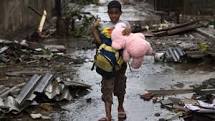
But when it came time this week for the full Security Council to discuss the downsizing of the UN’s peacekeeping mission in Haiti (MINUSTAH), such climate insights were surprisingly scarce.  The new mission (MINUJUSTH) will focus on important outcomes for a country that has been battered by earthquakes, invading forces and patterns of state corruption for so many years:  policing and security sector reform, rule-of-law institution building, and human rights monitoring and reporting.  But as Senegal was almost alone in pointing out, all of this good work presumes stable ground and clear skies – prospects for new earthquakes and ominous storm clouds can foretell massive setbacks for people who have already and often endured the worst.  And there is every science-supported reason to assume new and more dangerous levels of climate assault – for Haiti and for many other island nations.

So on this overly-heated Easter Sunday, we note with urgency the need for reflection in the policy community as well, within but also much beyond the Security Council. We must insist that climate impacts permeate our conflict prevention and resolution strategies.  We must make climate resilience a higher priority within our peacebuilding and migration-related policy planning and implementation.  And we must make full use of all capacities to address our current, urgent climate challenges, identifying and breaking bread with as many stakeholders as possible who demonstrate the will and skills to help heal a natural world under considerable siege.

For many and various reasons, climate health is a bet we cannot afford to hedge.  If we do, and if we lose, there may well be no resurrection narrative sufficient to rescue us from the condemnation and scorn of succeeding generations.

Between a Rock and a Hard Place:  UN Legal Obligations and their Operational Inconsistencies, Dr. Robert Zuber

2 Oct

elsalvadorphoto

There are many weeks when global affairs seem to be operating on parallel (and largely un-complementary) tracks.   For instance, the Security Council this week took up the horrific matter of hospital bombings in Syria, Yemen and elsewhere.   Despite the existence of settled “hard” humanitarian law and relevant Security Council resolutions, hospitals continue to be targets of heavy bombing, medical supplies are in ever-shorter supply, and medical staff from Médecins Sans Frontières and other organizations now speak openly of dying at their posts, resigned to the reality that “hard” law in the international arena is insufficient to motivate the “hard” choices that are now needed to stop the bombing and open reliable pathways to healing and relief.

In South Africa this week, states and experts met under the aegis of the Convention on International Trade in Endangered Species of Wild Fauna and Flora (CITES).  Endorsed by virtually all UN member states, this meeting of CITES was devoted to discussions on “how best to integrate law enforcement, development, environmental and social approaches to combating illegal wildlife trade,” trafficking that rivals narcotics, weapons and persons as major sources of illicit revenue.  There are aspects of this general pursuit that make us uneasy – specifically the overused notion that we are “saving” species that our lifestyle choices and pervasive economic inequalities have endangered in the first place.  Still, CITES underscoring of the criminal aspects of wildlife trafficking –reinforced by the presence in South Africa of officials from INTERPOL and the UN Office of Drugs and Crime – may lead to some (but perhaps only temporary) relief for highly stressed species teetering on the brink of extinction.

In the climate arena, India has declared its imminent intent to ratify the Paris Climate Agreement, bringing another major carbon producer into the fold, and thereby bringing us that much closer to entry-into-force.  But prior to entry of this “harder” obligation, Costa Rica joined Iceland in demonstrating the technical capability and political will to power their countries with 100% renewable energy.  Small states, yes, and boasting an abundance of geo-thermal and other energy advantages to tap; but states also demonstrating that it is possible to take “softer” obligations and turn them into hopeful options for a planet melting faster than our “hard” agreements have to date contemplated.

But here there are also “parallel track” events that came to our attention this week and that make us wonder if the “memos” on climate that send out from the UN are finding their way to the appropriate state and corporate desks:  including the pursuit of licenses to mine the floors of oceans already shedding biodiversity and harboring vast islands of plastic ; the rapid destruction of habitat and mass poaching of wildlife in African states; mining interests from El Salvador to the Philippines that needlessly threaten precious local water supplies and undermine local economies;  a decision by state ministers to spend vast sums on the UK’s Hinkley Point Nuclear Power plant rather than increase investment in renewable energy options;  the exposing of California’s mass refining of oil purchased from sources in the Amazon.   And these are only a sample of this week’s (for us) “head-scratching” acts of climate defiance.

We wonder:  What are we not seeing?   Is such behavior a deliberate flaunting of existing regulations?  Is it a matter of making all the profit available before more “serious” regulations take effect?   Is it just a matter of economic addictions that lie beyond the reach of governments and their treaties?

Our colleagues at Global Policy Forum (GPF) have recently published a study in which they call for a “hard law” treaty to enforce human rights obligations on transnational corporations.  Such a treaty would replace the voluntary UN Guiding Principles adopted in 2011, principles that have proven a bit too easy to redefine and circumnavigate.  At the same time, and despite the many recognized limitations in our collective application of so-called “hard law” obligations, objections to a ‘treaty process” have been considerable, especially noteworthy from the US and European Union.

The authors of this report appear to have more faith than we do in the innate compliance effectiveness of “hard” treaty law.  Nevertheless, they are right to note that many corporations are now seeking guidance on human rights obligations — and not because they aim to avoid them.  But most want to comply on a level playing field, and “hard law” obligations — especially if that law provides for investigative and oversight mechanisms –are the “levelers” that many corporate entities are thankfully now desiring.

Moreover, a treaty of the sort envisioned by GPF could have benefits to states struggling to reign in the behavior of corporate entities dismissive of “host” domestic law and largely lacking oversight from the countries where they are legally registered.  It is easier to hold entities accountable, or to seek assistance on enforcing compliance, when the obligations in question are both clear and (to the extent possible) uniformly binding.  In a state such as El Salvador, purely “voluntary” obligations are rarely subject to binding international legal review.  Moreover, the state itself might well lack the power or will to enforce domestic laws governing corporate conduct.  Reinforcement in the form of “hard” international law might spell the difference between corporate attentiveness to local rights interests and the total disregard of such interests.

But the success of “hard law” requires more than specified, non-voluntary obligations.  Success requires enforcement and, more than that, the will to enforce.  More often than not, it is “will” that is lacking.   Even in the Security Council, ostensibly the seat of the UN’s most robust binding obligations, enforcement is at a premium.  Indeed many Council meetings are punctuated by states imploring – sometimes bitterly – for the Council to honor its own binding resolutions – “honor” in the sense of ensuring its own internal compliance but also “honor” in the sense of enforcing previously negotiated obligations.

As we have seen in many areas of international law, treaties can have considerable value in affirming core international norms and raising levels of compliance, especially treaties which are accompanied by compliance-enriching mechanisms in the form of treaty bodies.   But in a world characterized by diverse existential threats and numerous instances of willful discounting of such threats, we must be careful not to put all our eggs in the treaty basket.  There is other key work to accomplish– as relevant to “soft” law as “hard” – including continued vigilance regarding the impacts of reckless corporate choices (and government enabling of those choices) on options for rights-based, peaceful, inclusive, sustainable living.

We at the UN rightly talk a lot about the need for more “prevention,” especially in the areas of armed conflict and severe human rights crimes.   But “prevention” related to our diverse international obligations – as in what “prevents” us from achieving full respect for human rights and other life- affirming goals — is prevention that we must do more to counteract.  Given the crises that dominate our media and clog our in-boxes, our collective responsibilities seem clear – more vigilance, more thoughtfulness, more collaborative activity, more active and persuasive engagement with diverse corporate and state authorities. For civil society, these responsibilities persevere regardless of how “hard” or “soft” the regulations might be that we now find at our disposal.

Birthday Bashing:  The UN Seeks a New Resolve to Focus on What Matters, Dr. Robert Zuber

25 Oct

On the 70th anniversary of the UN Charter, I’m on a flight path that will eventually take me to Mexico City for the launch of a volume with scholars from Instituto Mora and other institutions examining the impact of armed violence on the priorities and practices of the recently-minted Sustainable Development Goals (SDGs) , with a particular focus on the violence currently plaguing Central America.

While some governments refuse to acknowledge that there is any relevant relationship at all, it is clear to my office and other authors of this volume that armed violence in its various manifestations has implications for development that are alternately frightening and frustrating.  The presence of so many weapons in criminal hands (or in the hands of a ruthless security sector) creates conditions that suppress education, commerce, political participation and other essential human activities.

At this point in the life of the UN, there is general recognition of these linkages. The issue of course is how to ensure that our responses are genuinely consequential for communities.  Part of our work in Mexico City will be to discern strategic options for security sector engagement necessary to successful development and full political participation. But we seek engagement without “securitizing” development, that is, seeing security as an end in itself that can justify a range of discriminatory policies and human rights violations in the name of combating trafficking in weapons, narcotics and persons, or even combating insurgencies.  We seek alternative to a security system that, in the name of protecting communities, too often robs them of hope and contributes to gravely diminished prospects for diverse social and political involvement.

We will report on the outcomes from Mexico City in future posts.  What is clear now is that on this day when there is so much reflection on what the UN has and has not accomplished over 70 years, the recently endorsed SDGs represent a potentially monumental achievement, one that provides hope for diverse constituencies but also blends all three pillars of the UN system – development, human rights and peace and security – in productive and helpful ways that might well have encountered sustained political resistance just a few short years ago.

This more mature understanding of the policy web that can sustain peaceful societies is welcome news to Global Action, but also creates new challenges for our mostly young and part-time colleagues.   The philosophy of our work at the UN has some familiar benchmarks – providing hospitality for individuals and groups around the world seeking access to the UN system; paying close attention to what diplomats are doing and thinking; making issue connections between conference rooms, agencies and key organs such as the Security Council; and identifying the issues and relationships that can help define a life’s work for a new generation of schaolars and policy advocates.

And perhaps the most important of all, we encourage careful triage on the activities of the entire system at UN Headquarters to make sure, as best we are able, that we are covering, learning from and communicating what we have deemed to be the most consequential discussions taking place in the conference rooms that house our primary work.

This is no mean feat in a system that is bursting with activities of all kinds from contentious Security Council meetings to heavily branded side events.  More states are taking initiative to host events.  There is a deepening recognition that norms are not sufficient – that the SDGs for instance require reliable, flexible data and dependable sources of funding if they are to fulfill anything close to their potential.   There is much to do and much to think about – ideal for a small office such as ours consisting mostly of extraordinary younger people and dedicated more to discernment than to advocacy.

And there have indeed been some extraordinary events this month:  joint meetings of the General Assembly First and Fourth Committees on Outer Space Security, as well as between the Second Committee and the Economic and Social Council on ways to strengthen African development financing.    A Security Council debate on the Middle East found Council members (and DSG Eliasson) united in their growing frustration at the unresponsiveness of the relevant states parties to Council mandates.   Open discussions about the need to seriously vet women candidates for the next UN Secretary General within a process that is more than a backroom deal involving the P-5.   Sixth Committee efforts to strengthen codes of conduct for UN personnel such that we can begin to eliminate chasms of trust which some of those personnel created.  Second Committee discussions on climate health that point towards a hopeful blend of thoughtful policy and existential urgency.

Two of the other genuinely important events from our vantage point happened virtually simultaneously – the annual report of the High Commissioner for Human Rights, Jordan’s Zeid Ra’ad Al Hussein, and a report from the Special Rapporteur on Torture and other Cruel, Inhuman and Degrading Treatment, Juan Mendez, on some of the recent opportunities and challenges of his generally familiar mandate.

The High Commissioners statement was a bit of a tour de force inasmuch as it represented the flowering of a human rights consciousness beyond “first generation” rights concerns, including applications to fields such as business practices, counter-terrorism measures, UN peacekeeping and humanitarian operations, and the right to privacy.  He reminded us all that human rights norms and treaties are not ends in themselves, but are part of a larger effort to “reach and improve people’s lives.”

For Mendez, his focus was on important issues raised by recent events, the practice of torture in the context of migration and of armed violence.  But even more, with support of Demark and other states, he concentrated his attention on refuting claims by some states that their dual obligations to prevent torture and work towards its general abolition have no jurisdiction beyond national borders.  Mendez makes clear that there are no territorial limitations on most provisions of the Convention against Torture and that states have practical, positive obligations to respect the rights of persons everywhere – not just within their own borders — “to be free from torture and ill-treatment.”

We have written previously on why the abolition of torture –much  like the elimination of armed violence itself — is a precondition for both development and participation.   Torture represents a high stakes imposition of security sector abusiveness that is designed to humiliate both the tortured and the communities surrounding them, sending a chilling message to anyone whose political or social aspirations conflict with the dominant state narrative.

Mendez knows how states cleverly seek to justify practices such as torture on grounds that it helps prevent larger violence. But he is also clear: there is no credible manner consistent with UN treaty obligations in which we can justify the abuse of rights to preserve rights.   We must find ways to address trafficking of weapons and persons without authoring abuses of our own.  We must find ways to counter terrorism that does not create new civilian casualties and provides motivations for dangerous migrations and new terror recruits.

In our search for sound policy, we must be guided by the principle, as the author Wendell Berry used to declare, not to live “beyond the effects of our own bad work.”   In the present context, Berry might well urge us not to make policies for others that we would not accept for ourselves, nor to promote policies which are long on promise and short on substance.   And certainly not to serve up policies when we have not fully considered their unintended consequences to rights and prosperity, the very consequences likely to wreck havoc in communities we had already convinced ourselves we were there to “help.”

Indeed, this is the primary virtue of a human rights based approach to security and development:  the aspiration to fairness and respect, to the elimination of exclusion and discrimination, and to a system with (hopefully) adequate resources and robustness to hold states (and ourselves) directly accountable for our conduct, if not always to guarantee compliance.  This is important work and we need for it to continue throughout the UN system.

Of course, not everything that happens within the UN is consequential or sometimes even helpful, as critics of the UN on its 70th birthday have been quick to note. There are still too many repetitive statements by governments, too many policy gimmicks, too much thoughtless branding of policies without attention to potential consequences, too much recourse to politicized policies when honestly brokered policies are well within our grasp.

These are components of “bad work” whose impacts are generally felt, not by those of us in the UN bubble, by others far from UN headquarters.  But as we have already noted there is much of positive importance taking place here as well, much we are beginning to figure out, to blend together, to embrace beyond the restrictions of national interest.  There are voices here (and others brought here) that point us to a future that has great potential albeit wrapped within peril.

Put more bluntly, the 70th birthday of the UN reflects an uneven prognosis.  We have made healing progress together on so many issues and at so many levels and yet the genuinely existential crises – nuclear weapons, climate change, mass atrocity violence, terrorism—sit with us like so many inter-connected, terminal illnesses.

Given this troubling prognosis, we simply must do better about abandoning practices and policies that lack sufficient consequence.  The UN’s 8th decade must be the one wherein together we cast aside vestiges of failed structures and narrow interests and address the scourges that truly jeopardize our common future.

UN General Assembly President John Ashe on Climate Change: The Need for Swift and Collective Action

25 Jan

The sitting president of the 68th United Nations General Assembly John Ashe, a trained bio-engineer from the Caribbean islands Antigua and Barbuda, has for a long time dedicated his energy and expertise to the causes of climate change and sustainability.

According to a biographical note published by the UN Department of Information:

Ashe successfully led negotiations that resulted in Chapter X of the Johannesburg Plan of Implementation at the 2002 World Summit on Sustainable Development, and co-chaired the United Nations Conference on Sustainable Development (Rio+20) in 2012. In 2004, he presided over the thirteenth session of the United Nations Commission on Sustainable Development, the body responsible for reviewing programmes on the implementation of Agenda 21, the blueprint for rethinking economic growth, advancing social equity and ensuring environmental protection. He was the first Chairman of the Executive Board of the Clean Development Mechanism of the Kyoto Protocol to the United Nations Framework Convention on Climate Change. Ashe also chaired the Convention’s Subsidiary Body on Implementation and, most recently, the Ad Hoc Working Group on Further Commitments for Annex I Parties under the Kyoto Protocol.

According to Ashe: “I still have a passion for these topics. I am no longer involved in the day to day negotiations as far as climate change goes, but I still do follow the issues. The most recent event where I was involved in my capacity as President of the General Assembly was the climate conference in Warsaw.”

He set the stage for sustainability post 2015 by making this issue the last General Assembly’s main theme. Early on he warned that climate change can have severe, disruptive consequences for economies across the globe, a topic that will be discussed at this week’s World Economic Forum (WEF) in Davos, Switzerland.

In an interview with news channel Al Jazeera, Ashe pointed out:

“In the Caribbean, one of the biggest dangers — and it’s frequently overlooked — is the effect of a hurricane on the economy. One hurricane can set back a country’s economy by decades. And if a scientist predicts that these are going to be more frequent, you can imagine the alarm bells that are ringing down there in terms of climate change.”

When you move on from the GA president’s office, how do you hope to stay involved with the urgent matters of sustainability and climate change you have dedicated so much time and expertise to?

I don’t know what happens on September 16, 2014, but the interest in the issues will certainly not die away; I will still find some way to stay engaged.

A recently leaked draft report from the Intergovernmental Panel on Climate Change, published last week by the New York Times, described the following, “Another 15 years of failure to limit carbon emissions could make the problem virtually impossible to solve with current technologies, experts found.” How would you comment on this statement? What should be the immediate consequences?

These findings are not new. Just today Secretary General Ban Ki-moon gave a briefing to member states on his priorities for 2014 and he reminded member states that he intends to convene the climate change summit here at UN headquarters in September of this year. (A summit that will prepare member states for the climate change convention in Paris in 2015.) In my summing-up of the meeting, I reminded member states that the goal we all hope to achieve is a legally binding agreement, attained by all parties to the climate change convention in 2015, at the conference in Paris. But it should not be an agreement for the sake of having one. It should be ambitious in content with defined targets and timelines for every single party, irrespective of whether it is classified as an industrial country or a developing country.

An NBC report from yesterday notes that the number of Americans who don’t believe in climate change is rising. How do you explain that trend?

They say leadership starts at the top. Recent developments here in the US would lead one to the sad conclusion that the interest within the current US administration seems to be waning. It was never going to be easy, but I think with the other concerns that have risen, particularly on the political front, it doesn’t leave one with much hope that we will suddenly see an upwelling of interest in the climate change issue here in the US. One would hope that this would not be the case, but if one looks at the climate change induced events that have taken place outside of the US, I think it would be a sad commentary if citizens of this country did not at least take note.

Once a clear environmental leader but now consumed by the looming economic crisis, the European Union is likely to set a more cautious tone for the global debate on climate with new green energy guides released this week. What would you wish from Europe in terms of climate change, reduction goals in carbon emissions, and expansion targets for renewable energies?

I am not aware of this particular development, but if that is the cause of action taken by the EU than I think the message sent would be negative. We who have followed this debate for quite some time got quite used to the EU being in the forefront. I simply hope that that would continue to be the case, especially because the seminal conference will take place in Paris in 2015.

Recently I heard the German scientist Ulrich von Weizsaecker speaking at the Open Working Group on SDG’s about the possible need to provide a psychological crutch for the global North regarding the implementation of reduced consumption and carbon emission, if the South would signal the willingness to cooperate. Is there a bit of a global North-South, South-North blame game going on? And if yes, how could that be avoided, going forward?

There have always been differences in approach regarding the climate change question between the North and South and that probably will be so for quite some time. There is a feeling that the industrialized countries were supposed to take the lead and they have not yet done so. I am sure those would argue differently. And until that happens, developing countries, where the emphasis has always been on the eradication of poverty, should not be asked to assume additional burdens. We have a global problem that requires a global solution, and for that to happen each and every country has to assume some sort of responsibility. I think time is certainly running out and until the proverbial all hands are on deck we will be forever looking back and say twenty years from now, we should have acted faster. And certainly we should have done so, collectively.

How effective in your opinion has the 68th GA session been in order to present and push the agenda for sustainability efficiently within the UN system and publicly?

The theme of the 68th session is the post 2015 development agenda. We are looking at the broader development question and development agenda and climate change could be a key part of it. We should keep in mind that climate change, as far as negotiations go, are handled outside of the GA as per the wish of its member states. But at some point in time, it will all go together, hopefully in 2015.

Lia Petridis Maiello, GAPW Media Consultant

The original interview was published with The Huffington Post.