
The desire to reach for the stars is ambitious. The desire to reach hearts is wise. Maya Angelou
Live for each second without hesitation. Elton John
True progress is to know more, and be more, and to do more. Oscar Wilde
It doesn’t matter how great your shoes are if you don’t accomplish anything in them. Martina Boone
We must do extraordinary things. We have to. Dave Eggers
They can’t see the distant shore anymore, and they wonder if their paddling is moving them forward. None of the trees behind them are getting smaller and none of the trees ahead are getting bigger. Donald Miller
Something – the eternal ‘what’s the use?’ – sets its bronze barrier across every avenue that I open up in the realm of hypothesis. Gustave Flaubert
In this time of multiple crises affecting all corners of our planet, the UN finds itself in a place both pivotal and peculiar. Despite restrictions due to a stubborn pandemic and resulting financial constraints, the UN has maintained its pivotal convening function, holding the attentions of states on issues (and the mix of stakeholders) that might otherwise slide further down the list of national priorities.
Over the past several days, including a rare Saturday convening, UN officials and agencies converged around issues ranging from famine in Yemen and ensuring accountability for ISIL abuses committed in Iraq to the link between stemming illicit financial flows and silencing the guns across Africa, and a formal honoring of those often-beleaguered frontline health workers who help ensure our right to health care during a pandemic while putting their own right to life in daily jeopardy.
Added to this was the main Saturday event, an assessment of our ambitions for achieving the Paris Climate goals five years after passage. In several ways, the event was a let down, filled with statements and accompanying images of the climate emergency about which we really do not need a reminder, images offered with scant explanation of how some legitimately hopeful initiatives on renewable energy, reforestation, biodiversity protection and more will quickly add up to a successfully decarbonized planet.
Indeed, in assessing the impact of this “Climate Ambition Summit,” the president of next November’s 26th UN Climate Change Conference of the Parties (COP26) in Glasgow, Scotland publicly lamented that while Saturday’s event resulted in some innovative climate commitments, we are also forced to face up to the fact that “this is not enough.” We need higher levels of ambition, much higher in fact, to resist the coming wave of “climate catastrophe.”
Indeed we do. But where is the “higher” going to come from? How can we encourage more “urgency in action” with regard to climate and famine, conflict prevention and inclusive political participation? How do we compel more of this urgency and then link it, arm in arm, in a timely and effective manner? What are the missing ingredients in our approaches? What obstacles do we continue to place in our own way?
Part of the problem for us at the UN is related to the way in which we do our business and how the pandemic has, in some ways, reinforced some already dubious habits. Having worked out some of the kinks in earlier iterations of our digital policymaking, we are now literally inundated with virtual policy events. These are relatively easy to organize, carbon-friendly and allow diplomats to come away believing that something tangible has happened for the world while we non-diplomats imagine that we actually have some role in global governance and its functional priorities complements of zoom and other platforms.
These digital events are certainly helpful to the organizers insofar as it allows them to “brand” their work and solicit funding based on the assumption that these events actually “make a difference.” But do they really? Do they actually get us closer to a world that is defined less by catastrophe and violence and more by inclusion, abundance and stability? And if so, how does that happen? And for whom does that happen?
Recent events don’t allow for excessive optimism regarding impact. In the case of the Climate Ambition Summit, we got what we are now accustomed to getting in our currently digitalize policy spaces – prerecorded (or pre-fabricated) messages by “global leaders” attempting to put their best feet forward, telling us what they want us to hear through presentation content that, for the most part, falls far short of what is needed if we are truly to avert climate catastrophe. Such statements are generally measured, even formalistic, short on assessment of national policy measures and even shorter on inspiration. The leaders represented at the Summit were speaking, not listening, sharing what they are doing and what they plan to do — some of which is quite good –but mostly failing to reference the multiple levels at which change must occur and be enabled, especially those manifold initiatives at local level which remain key to habitat restoration, sustainable agriculture and a host of other planet-restoring measures.
There was also at this Summit a bit what has become ubiquitous gushing over “civil society participation” with some innovative and hopeful interventions from that sector, including several compelling short videos courtesy of the World Wildlife Fund. In another part of the program, the voices of young people could be heard, voices of frustration due to their largely unheeded calls for robust and urgent climate action, for meaningful paths to policy participation, for taking with proper seriousness the warnings of science and then adopting measures that are not confined by the conveniences of bureaucracies or government agencies.
The pre-recorded statements by global leaders made no mention of this frustration. They didn’t hear it. And even if they had, there would likely be little penance forthcoming for the wasted opportunity of Paris, that moment five years ago when what we did in the Paris aftermath might have mattered more than it has, that time when we could have prevented more of the fires from raging, the ice from melting, the species from going extinct, the droughts and floods from spreading out their carnage, the ocean storms from achieving ever-higher categories of energy and destruction. We could have done this, we should have done this, but we didn’t listen to the children. Our commitment to their collective future has, to date at least, proven shamefully deficient.
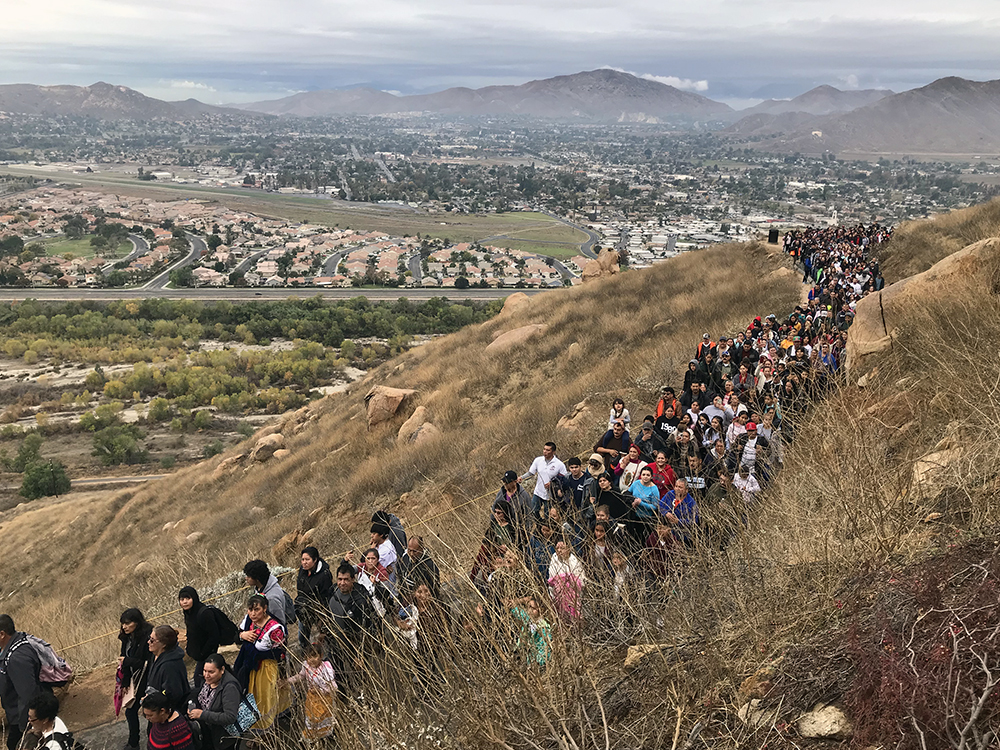
Perhaps ironically, far from our centers of policy influence, there was another call to movement on Saturday, a movement typically involving many thousands of persons by vehicle or on foot (even on their knees) whose lives are often directly impacted by climate change and armed violence, by corrupt practices in institutions large and small, sacred and secular.
On this Saturday was the Feast of Guadalupe, a time in past years for people across Mexico and beyond to practice their devotion to their blessed Mary, but also to share in that devotion energy with the many who gather at the Basilica in Mexico City and the many more who have drunk from this energizing reservoir of faith and commitment in years past.
I have seen this devotion first hand, enough to probe a few of its virtues and shortcomings, enough to see the looks on the faces of pilgrims who could not survive, would not wish to survive, without the sustaining energy that comes from a commitment deeper and more consuming than most of us could hardly imagine beyond the domain of our children and other close family members.
It is sad that this devotional energy, like so much else this year, has moved online due to the pandemic, a digital setting which cannot possibly convey the depth of devotion displayed by people from all walks of life, many of whom likely do not have digital access and wouldn’t accept the substitute if they had. But there is a lesson still looming here for the rest of us, a lesson about the limitations of our bureaucratized discourse, about our inadvertently patronizing attitudes towards local initiatives and actors, about our tone-deafness towards the very stakeholders we routinely seek to bring into our midst.
When it comes to climate change or other global challenges, the need for urgent action is fully apparent as are some hopeful technologies and other initiatives developed to give us a puncher’s chance to shift course in a sustainable direction, to overcome the “bronze barrier” of our “what’s the use” cynicism that pervades too many persons and sectors, even in our churches and government agencies. Still our current trajectory remains simply insufficient to the health and healing of the planet or of ourselves, and we should promptly cease defending levels of policy progress or personal dedication that appear unlikely to bend that curve.
In this time of events running apace of outcomes, it would actually be helpful to hear a few honest expressions of remorse from our leadership, penance for opportunities missed that may not come our way again, expressions of devotion – real devotion – for our planet and its diverse inhabitants. It’s not good politics, I suppose, but If we are to convince the audiences that must be convinced – including the youth in climate vulnerable states, and the small-holder farmers, drivers and shop-keepers walking that long road to Guadalupe — we need to demonstrate our capacity to reach their hearts and not only their “interests,” to “wear” at least some of the devotion which they know full well is essential to getting us over the hump regarding responses to threats that we have merely dabbled in for far too long.
Metaphorically speaking, we’re actually now wearing the right shoes, but its long past time to do important things in them and to do those things without hesitation, without excessive weight from protocols and bureaucracies, without the excuses that stand in the way of learning, doing and being more than we now are. If our incessant policy “paddling” is ever to get us close to safer and saner shores, the craft we paddle must be fueled in greater portion by devotion, that energy which communicates to people everywhere and in all circumstances that their current and future lives, their current and future well-being, are genuinely worth paddling for.


 gapwblog