
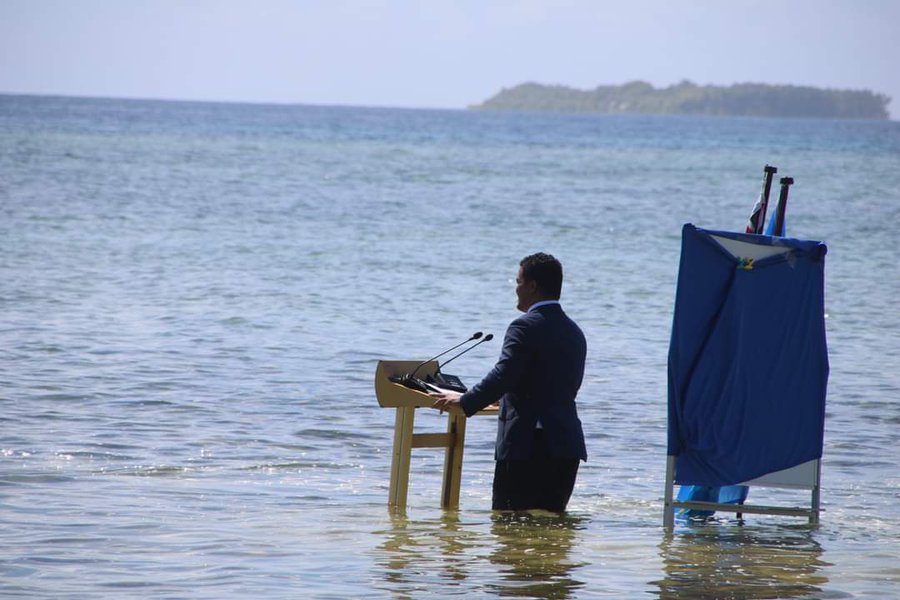
Tuvalu Addresses COP 26
We have become a place of long weeping; A house of scattered feathers; There is no home for us between earth and sky. Rebecca Roanhorse
And so you travel. Forgetting that the problem is you. And wherever you go, you carry yourself. Ezinne Orjiako
The ultimate paradox and irony of this tragedy is that, in many cases, those who caused their displacement and those who hate them in their newfound ‘homes’ in exile are the same people! Louis Yako
There is no destination other than towards yet another refuge from yet another war. Theresa Hak Kyung
Distance is the journey. Displacement is the result. Jaclyn Moriarty
People returned to live on city streets and pavements, in hovels on dusty construction sites, wondering which corner of this huge country was meant for them. Arundhati Roy
She had sculpted the mist, the way those who have no choice do. Padma Lakshmi
One of the seemingly eternal struggles of small organizations as ours has been for a generation is how to add value: how to support the work of others without taking credit for its outcomes; how to call attention to the pain of others without appropriating that pain to raise our funds or build our brand; how to join voices with others without losing our own distinctive notes; how to honor those “sculpting the mist” without losing sight for one moment of the privileges associated with honoring such profoundly challenging sculpting in the first place.
For me, for us, as we end our current iteration the journey towards a fresh engagement with global crises is already underway. What is already clear is that the path to engagement will likely run through the issue of displacement, those who have lost their homes as the result of family meltdown or economic collapse, those “taking refuge from another war” as we now see in Ethiopia, those who can no longer harvest their lands or their traditional fishing grounds due to ruinous levels of flooding and drought, especially those living on relatively remote islands facing climate shocks which they did not create, for which they cannot possible be prepared, and from the increasing fury of which there is simply nowhere to hide.
Of course, settling on a rubric is not the same as settling on a strategy to encourage and support change. To that end, I joined yesterday with some activist friends on a march in support of unhoused people and the services which are both insufficient and indispensable in moving people off the streets, helping them find both stability and identity in multiple forms, from reliable indoor plumping to a equally reliable mailing address.
Sadly, this march took place not in a populated area, not in a place where homeless people gather, but in the parking lot of a sports arena. Somehow, some way, the decision was made to organize a 5K walk in a place with no relationship whatsoever to the people for whom we were allegedly advocating. There were apparently few if any unhoused persons on the march. There was no audience to inspire along the route. There were no occupied homes or apartments in sight. There was no press to speak of. No one could even enter the march route through security unless they could demonstrate that they had both paid their fee and had been vaccinated for COVID, two requirements virtually guaranteeing that none of those experiencing the “long weeping” of displacement (or perhaps none of those currently on the cusp of their own homelessness) would be able to join the lovefest ostensible organized on their behalf.
It was difficult to escape the conclusion that I and the others on that march had done nothing of substance to help the displaced. What we had done, if anything, was to help brand the sports arena and the major donors who are, after all, so often the preferred destination for the efforts of the organizers. It was all about money, we didn’t have much of it to offer, and so we were relegated to walking around an empty parking lot as though being exiled as punishment for our modest resources and/or our political naivete.
This trek in the parking lot at least called to my own mind scenes on the other side of the world: in Ethiopia where armed groups inch closer to Addis Ababa, creating both panic in the capital and fresh displacements along the route of conflict. And, of course, in Glasgow where erstwhile global “leadership” convened, yet again, to offer a bevy of “solutions” to the climate crisis ranging from the genuinely hopeful to the merely distracting, a crisis already displacing millions with millions more likely to come.
More than officialdom made its way to Glasgow. Thousands of young people did also, youth for whom climate change represents more than an inconvenience requiring more than a chain of UN-brokered “talk-fests” which might well result in more dangerous carbon emissions than prospects for meaningful change. These youth filled the streets and, in some limited instances, the conference rooms, lamenting the reality that youth are much more likely to be heard than heeded, that decisions about the policy trajectory for climate mitigation and adaptation, for reducing disaster risks and increasing options for survival when risks turn so many lives of the affected into “scattered feathers;” these decisions continue to be made by older folks like me. Many of these decisionmakers are unlikely to ever be displaced from their private jets let alone their homes. Moreover, they will never have to sit across a table and break the news to climate-affected people that their dreams are soon to be burned or washed away, or that the footsteps of armed groups are fast approaching. Older folks not unlike myself will never have to share the news with affected people, as former Liberia president Ellen Johnson Sirleaf noted this weekend, “that they must leave their community or drown.”
The youth in Glasgow this week were thankfully not marching back and forth across the parking lot of a sports stadium. They were visible to the public, to the global press, surely even to those inside the COP 26 conference rooms. And their urgent, frustrated and at times defiant messaging was picked up, especially by those from the least developed and small island states who, as we and others have noted time and again, have done the least to create climate change but who suffer the most from its impacts. Such impacts include many displaced crossing borders and regions seeking a modicum of safety and stability from climate threats and the economic ruin and armed violence which often follow, those forced frequently to take refuge amidst hostility from people who, in more than a few instances, made significant contributions to the conditions that prompted displacement in the first place.
The impact of these youthful voices on small island and other officials was clearly apparent, including on Fiji’s fine Ambassador Satyendra Prasad who bluntly asked, “If we are not to achieve 1.5 degrees, what are we here for? Everything else is a side-show.” The president of climate-impacted Madagascar reminded us all that “forests are the lungs of our planet,” but that these lungs are being damaged at a staggering rate. And perhaps the most compelling address from officialdom was delivered by the remarkable Prime Minister of Barbados, Mia Mottley, who underscored the “immoral and unjust” implications of lives and livelihoods lost as we continue to ignore our climate pledges or fulfill them only incompletely. As did the youth on Glasgow streets, Mottley pondered boldly and wistfully, “when will leaders lead?”
On the UN side, Secretary-General Guterres warned about the “delusion” that we are making the progress we need to make on climate change. The former Ambassador of Jamaica, Courtney Rattray, now Under Secretary-General for the Least Developed States, made several high profile appeals for climate funding to help stabilize least developed societies and avoid mass displacement. And in a related event on tsunami risk, the head of the UN’s Disaster Risk Reduction program Mami Mizutori urged us to never forget the “the disasters we were unprepared for and the casualties they caused.”
But it was the ever-passionate David Attenborough, early on at this COP event, who worried and wondered if “this is how it ends” for we humans, allegedly the greatest problem solvers in the history of this planet? Ends in fires and floods, ends in mass displacement and homelessness, ends in “bad faith” engagements by officials who know better and refuse to act on what they know? One compelling response to this lament came later from a Samoa youth advocate who reminded us of the power of words “to save us or sell us out.” You all know why you are here, she proclaimed. “Do the right thing” and while you are doing that, look to the leadership of Pacific youth. “We are fighting not drowning.”
Indeed, their struggle must be our struggle as well. The alienation, insecurity and displacement they experience now are coming for us as well. For people like me, the grave might save us from having to confront the consequences of our folly, of our willingness to only make the changes it is convenient to make, not the changes that we know we must make. But this should offer no comfort, no excuses. Instead, while we are still able, we must do more to ensure that the toxic consequences of our inept climate and economic policies – the unhoused, the unfed and the unprotected – are not allowed to define life for other generations.
This week, Costa Rica’s president reminded delegations of the absurdity of conducting war — military or economic — on a planet which is slowly dying. He called instead for an “army of ideas, of courage, of peace.” It is increasingly likely that such an “army,” if it comes to exist, will consist largely of the young. If the rest of us want to make a real difference, including on the causes and consequences of human displacement, we will need to do more to support, sustain and enrich youthful aspirations.


 gapwblog