Tag Archives: elections

An Electoral Primer for our Deeper Selves, Dr. Robert Zuber

27 Oct

Always forgive your enemies nothing annoys them so much.  Oscar Wilde

I suppose I’ll have to add the force of gravity to my list of enemies.  Lemony Snicket

Prodigious birth of love it is to me, That I must love a loathed enemy.  William Shakespeare

The Bible tells us to love our neighbors, and also to love our enemies; probably because generally they are the same people.   G.K. Chesterton

I have never made but one prayer to God, a very short one: Oh Lord, make my enemies ridiculous. And God granted it.   Voltaire

Let’s have a toast. To the incompetence of our enemies.  Holly Black

If we could read the secret history of our enemies, we should find in each man’s life sorrow and suffering enough to disarm all hostility.  Henry Wadsworth Longfellow

Dear All,

This post is going to be on the “short but sweet end.”  There are many lessons to be learned from this electoral season , including how far we all have fallen down the shaft of greed, indifference, grievance, enmity and ignorance.  With so much political rhetoric seeking to tear us down and exploit divisions beyond what any evidence would suggest, it is time for us to hold our society and our responsibilities to it in a better light, beginning with the thoughtful casting of ballots over the next week or so.

However, you come down on the political spectrum, and this here is not my business, there are at least two core duties which I feel are my business and which we all need to keep in mind.

The first is to reject the notion that our country is so dysfunctional, so ridden with corruption, fear and hatred, that only a singular politician (or group thereof) can save us.  That this is a claim made largely by a rapidly aging former president is certainly to be noted, but it is also a notion which is now baked into our political infrastructure of many stripes, a virtual credo of our unresponsive bureaucracies and elected officials who act as though they’ve been issued an American Express card with such privileges that the metal in which these cards of privilege are made of  has yet to be invented. 

We have messes to clean up to be sure, but we have also allowed the fog of personal and political grievance to seep into our private domains, allowing for the indulgence of more fear, more hostility, more indifference to pain and violence than is good for any of us.  And rather than welcoming and sharing the sun that burns off the fog, too many of our churches have magnified the grievance, have given succor to some of our worst instincts, those which Jesus and indeed all the world’s great religious figures came to highlight and then to offer another path.  I can only speak for my own tradition here, but I am constantly at practical odds with a growing number of “Christians” who have blinded themselves to the complexities of our collective souls, who have as well meandered so far from the teachings of Jesus that they now actually find such teachings quaint or naïve, apparently not what the God of Leviticus had in mind for “His” most ardent followers.

And this leads me to the second point, which in many ways merely flows from the first.  In this political campaign, we have found precious little counterpoint to the more strategic, competent indulgence of enemies and expanding enemies lists which are ridiculous at one level but also  an increasingly dangerous component of the social fabric we are now weaving. People we only know well enough to hate.  People we fear as though the world were little  more at present than a minefield full of the sorts of “horrible” folks not like us who increasingly populate our movie screens and social media feeds.  Indeed, more and more of us seem convinced that the world offers little but scary people and scary movies, a world where your best options are to tend to your own business and vote for people who claim to be “tough enough” to keep the monsters at bay.

But as we know, fear and its co-pilot anxiety are the raw materials for societies whose best features are increasingly closeted.  Not a shining city on a hill but a dark dungeon filled with potential enemies  we don’t know, don’t want to know, and don’t have a shred of sympathy for.  Not a model for the world but a country caught up in the muck of competition among political adversaries who have become acceptable, even desirable, depending on political proclivities. Not a beacon of freedom and opportunity for all but only for some, only for those who can buy their way to political influence without ever having to put themselves in front of a voting public, perhaps also for those who look like the “nice” folks we are, not the folks who invoke anger and discrimination in our often-unexamined selves.

Let us not delude ourselves: These legacies are likely going to be with us regardless of the electoral outcome in just a few days.  We are likely in too deep to just walk away from electoral outcomes as though this one was just like the others.  But we must cast our vote, we must encourage others to do likewise, and then we must all do our next part to clean up the messes our votes have failed to address, including  enmity at the  ready to deliver a package we surely don’t want and likely don’t even remember ordering.

I have heard people I generally respect talking about leaving the country in case their candidate is not elected. That is a choice I will not be making.  This is the country of my birth, the country that many of my relatives fought and died alongside so many others to preserve.  It is also the country that other countries in this world need to be better and do better, to at least project the value of equality, maturity, fairness and generosity even if these and others of their ilk are now more elusive and in shorter supply than we might wish.

 We have work to do before election day.  We have more work to do afterwards.  Please stay the course.
Race Track: Driving Discrimination from our Ranks, Dr. Robert Zuber

8 Nov
Social diversity is initially threatening but people do adapt over time –  new research

The animals of the world exist for their own reasons. They were not made for humans any more than black people were made for white, or women created for men. Alice Walker

We must dissent from the indifference. We must dissent from the apathy. We must dissent from the fear, the hatred and the mistrust.  Thurgood Marshall

My color is my joy and not my burden. Bebe Moore Campbell

Wherein is the cause for anger, envy or discrimination?  Mahatma Gandhi

But she knows where her ticket takes her. She will find her place in the sun. Tracy Chapman

The Black woman in the South who raises sons, grandsons and nephews had her heartstrings tied to a hanging noose.   Maya Angelou

Excessive praise arises from the same bigotry matrix as excessive criticism. Stefan Molyneux

It is a glorious November Sunday in New York, a day more like late September than the Sunday after a US presidential election.  I had vowed not to say much about the election results, though there is plenty to reflect on, plenty that elicits fair portions of both celebration and caution; with especially deep gratitude to the remarkable poll workers and vote tabulators who ignored and even at times defied a bevy of threats, including from the leadership of the US Postal Service, armed protestors and a spreading pandemic, to deliver what appears by all independent accounts to be free and fair voting for some 150 million US citizens.  

Despite this gift, we know that threats to this democracy, as to others worldwide, have not been laid to rest.  We know that there are tricks left to be played by those still in power (and those heaping “excessive praise” on them), people who understand full well the metaphorical knives that have been drawn by prosecutors and regulators once they leave the sanctuary of the White House.  Those of us who have been holding our breath (at times even our tongue) that this period of political – even criminal – hardball will soon pass recognize that democratic oxygen is still in short supply and that the grievances – legitimate and otherwise – that have driven us to an authoritarian brink are likely only to intensify over the next 10 weeks.

Assuming that a genuine political transition occurs in my country, and that is no foregone conclusion, we anticipate that (what we interpret as) benefits from a new US administration will accrue in the form of climate action and other multilateral efforts to curb the pandemic, reduce social and economic inequalities, disarm weapons and promote sustainable development.  The UN, which has largely refrained from criticism of the US (as it does routinely with all major state powers and funders), can expect a bit of a post-inaugural holiday as dues are paid in full and abandoned political commitments that can readily be reinstated will be.

This US election season also cast light on a UN agenda that is often-discussed but less-often implemented, and that is the concern for inclusion, the basic belief that all should have a say on matters which affect them; the belief that our increasingly inter-dependent world requires diverse voices on a wide range of matters both complex and mundane, including on matters of governance.  In  the US, our own myth of inclusivity has taken a pounding in recent years by those in positions of authority espousing equivalences between “whiteness” and “greatness.” This has resulted in some hard-to-remove stains on our national character including children separated from families and parents afraid to send their children to the grocery store for fear of confrontation with store managers or police; but also ordinary citizens having to fight through what appears to be willful disenfranchisement as polling places were closed, ballots arbitrarily rejected,  and voting lines in some “minority” neighborhoods permitted to stretch for miles.   

While grievances in my country now spring forth like weeds in an abandoned garden, there are some that have deeper roots, louder echoes of oppression, producing more pervasive anxieties.  There is much listening we need to do far beyond our comfort zones, ideological bubbles, evidence-less presumptions and political preferences.  And a special listening post must be dedicated to those whose “ticket” has yet to guarantee them a seat on most every ride, the mothers and grandmothers whose heartstrings are “tied to a hanging noose,” those who live under threat every day that their next venture outdoors will trigger some hate-filled response or even a one-way trip across the nearest border.  

The UN in its own way has tried to keep alive the flickering flame of inclusiveness, insisting with varying levels of success that we find the courage and the means to ensure that those habitually left behind are invited to the head table; that their “ticket” to viability and safety is deemed as valid as any other’s; that their full franchise is both encouraged and protected; that the fruits of development (or a COVID vaccine) are distributed without politics or prejudice; and that the justifications we employ regarding the “causes” of our discriminatory ways are recognized to be largely without merit.

This past week there were several key events (mostly virtual) at the UN that underscored the ever-deepening relationship between inclusiveness and the promotion of peaceful societies. In the Security Council, in the General Assembly, and during events celebrating the increasingly gendered commitments of UN policing and highlighting efforts to abolish capital punishment, the mantra of inclusiveness and an end to discriminatory practices — as well as the incitement which stokes racism, xenophobia and other human behavior we could better live without — were duly reinforced.

Among the primary takeaways from this long and exhausting week included Malaysia’s lament in the General Assembly’s 3rd Committee that the COVID pandemic “has brought out the worst in us,” specifically with regard to racial and religious discrimination. And in a Security Council discussion on “drivers of conflict, Sir Hilary Beckles underscored the tangible steps needed to reinforce this current “age of apology,” while the Prime Minister of Saint Vincent and the Grenadines reminded delegations that we cannot hope to overcome chasms of distrust and apathy unless we can speed up our current “baby steps”

There was even more of value to digest including UN Special Rapporteur Day’s plea to address and eliminate the “habituation” in many societies that allows people to tolerate discrimination, Mexico’s call for higher levels of government consultation and trust-building with the most vulnerable and marginalized within national borders, and the Netherlands urging of UN member states to be better “truth-tellers” on racial justice.

While one could surely chide the UN for its own “baby steps” regarding its long-delayed success in gender-balancing peace operations and other core security-sector functions, the UN also enables valuable guidance on how hold together a global community which has too often threatened to disengage from one another. Keys to the reconciliation we need include broader-based consultations, higher levels of truth telling and truth-hearing, firmer commitments to address the scourge of incitement in public and online settings, and better protection of spaces where “public goods” (such as a potential COVID vaccine) take precedence over private interests.

But will we listen? The US president-elect’s oft-repeated claim to represent all US citizens — “those who voted for me and those who didn’t” — is a welcome if somewhat conventional claim, albeit with challenges destined to frustrate all but the most sincere and robust of -commitments. We have, regrettably, conspired over many years to create a culture that is long on acrimony and short on listening; long on grievances and conspiracies and short on evidence and compassion; long on self-delusion and short on self-reflection. We are less mindful than it is in our best interest to be, both about the demonizing we do routinely within our own borders, and the violence we inflict — directly or by proxy — beyond them. We simply cannot survive much more of this no matter who occupies the White House.

I want to end on a more hopeful note by referencing last night’s speech by vice-president-elect Kamala Harris. She delivered a strong and humane point of contact with women and men across my country (and likely beyond) for whom “color” has been a burden; a burden for those who have suffered much, often over many generations, but also a burden for those who can see no way out of their own predicaments other than through more threats, more intolerance, more dubious claims of “superiority.”

For Ms. Harris, her own burden seemed, for a glorious moment at least, to have become something more akin to a joy. As she proclaimed with great enthusiasm, “I am the first, but I will not be the last.” She has found her well-deserved place in the sun, but she also recognizes that if that same sun is somehow prevented from shining on all, the ones we like and the ones we don’t, the ones we trust and the ones we don’t, then the democratic values and processes we presume to cherish will eventually and finally slip through our grasp.

Clearly we need more “firsts” in our country and our world, “firsts” emanating from every corner of human community, especially where people are feeling neglected or abandoned, disrespected or humiliated. And as Ms. Harris rightly suggested, we need more “seconds” and “thirds” as well.

Ballot Blunders: Election Influence in a Partisan Age, Dr. Robert Zuber

18 Oct
Oregon's vote-by-mail gets scrutiny from inside, outside state

To win the people, always cook them something savory that pleases them.  Aristophanes

Numbers by themselves cannot produce wisdom and may give the best favors of office to the grossest flatterers. Will Durant

Good governance in a democracy is impossible without fostering in our communities and the electorate, an appetite for leaders who are committed to respectful conduct. Diane Kalen-Sukra

The wish to be elected cannot be more important than the wish to do the right thing.  Victor Bello Accioly

An election must be more than a search for honesty in a snake pit.  Stewart Stafford

Apparently, a democracy is a place where numerous elections are held at great cost without issues and with interchangeable candidates.  Alfred E. Smith

This is likely to be news to none of you, but the US is holding an election for president in a bit over two weeks.

And while national elections are frequently held with greater and lesser degrees of integrity – voting results New Zealand and Bolivia have recently attracted a fair amount of attention in the global press – the US presidential race has become something of an obsession (if not a circus), especially for policymakers and poll watchers in many global regions.

Despite (or perhaps due to) our commitment to weigh in on national issues only to the extent that they impact multilateral effectiveness, we have shared more of this obsession than would normally be the case.  It is a temptation at the ready to spend endless ink critiquing one’s own country under the guise of interrogating multilateral processes.  It is a temptation we have largely avoided over the past 20 years, though challenges to multilateral cooperation on pandemics, food insecurity and climate change have never seemed as daunting – and untimely – as they do at present.

Some of this recent obsession has a “bull in a china shop” feel to it.  Even after the past few years of attempting to roll-back US engagements in the world, my country retains an outsized influence in economic, military and even to some extent in diplomatic circles such as the UN Security Council.   And as citizens and leadership gawk in amazement (at times even pity) at the acrimony and disinformation that has infected our political life – or at least forced it out into the open – many fear the implications for small states and vulnerable peoples when rich and powerful states see their often sub-optimal checks and balances heading completely off the rails. 

When the largest animals scuffle, the smaller ones have the sense to move away.  But in a world that is as interconnected as this one now is, there is simply nowhere to run.  Many smaller states – in Latin America certainly but also in other global regions – have had to adjust with alarming frequency to the political and economic whims of their northern neighbor.  But in this time of pandemic and security unpredictability, when that neighbor seems to have less and less interest in honoring agreements and championing core norms and values meant to bind states in collaborative action, the chills felt across multiple global regions are no trifling matter.

And so this US election does matter to many beyond national borders as well – a referendum not on our hegemony so much as our sanity, not on our irascibility so much as our reliability.   Despite our laundry list of hypocrisies and self-exemptions based on some perverse notion of exceptionalism, there has been some sense at least that the values we say we admire – and that infuse most of the multi-lateral charters that we once sponsored and from which we now seek our distance – were deemed ours to uphold as well to champion for others.  There was some sense, albeit one now largely relegated to our rearview mirror, that to whom much is given, much is expected; that blessings are to be shared more than hoarded and that others have a right to judge us as we often judge others — by our deeds and not by our carefully and often self-righteously crafted brands.

As elections draw near and anxiety levels rise within and across borders, a couple of points on where we currently stand.  First a reminder that Article 25 of the International Covenant on Civil and Political Rights – to which the US accedes — conveys to all people “universal and equal suffrage,” which pertains not only to the right to vote, but to participate in civic life and have access to public services.    These are rights which the US has steadfastly – if imperfectly – sought to encourage in other states. 

Thus the shock from many global quarters as measures to disenfranchise domestically have been as numerous and shameless as the disinformation that accompanies them.  Thus the shock as our pre-electoral discourse lays out political competition among erstwhile domestic enemies seeking each others’ ruin rather than among citizens who share a franchise and a constitution.   Thus the shock as domestic gun sales go through the roof as though we were preparing not for a peaceful transition of power but for a violence-prone showdown among people whose differences – real and provoked — can no longer be reconciled.

As the agencies of the UN know full well, elections, are a pre-condition for good governance, not its guarantor.  But elections matter most when they are conducted with proper regard for rights of access, and when they are free of fraud and intimidation, as they can then contribute to elevating the legitimacy and authority of the duly elected government.  To those ends, many millions in the US are now determined to cast their ballots, even if it takes a full day to exercise their right to do so, and even if it is often with fingers crossed that their ballots will not arbitrarily be discarded or “harvested;” fingers crossed that the local heroes who have committed to deliver massive numbers of ballots by mail, who will count and certify ballot totals, and who strive to minimize illegal impediments to the legal exercise of a franchise, can somehow help produce a result that we can, quite literally, all live with.

In this context, the campaign season for this election is as troubling as any potential outcome itself, for it reminds us once again of how far we have fallen from the grace that our founders sought to bestow on those who would follow, a grace that we have sullied through selfishness and willful ignorance, through self-justifying lenses of partisanship and a corrupted nationalism which, as lamented this week in the General Assembly’s Third Committee by UN Special Rapporteur Okafor, “obscures multilateral benefits.”  Added to this is our propensity for short-termism that soils our own bed and risks a world for our progeny bereft of any bed at all.

Though we are hardly alone in this, we in the US have slowly chipped away at the effectiveness and credibility of our structures of governance.  We seem more willing than ever in my lifetime to gouge and humiliate each other in order to “win” and, if victory eludes us, to then deliberately and systematically undermine those who prevail even before they are formally inaugurated.  As the Washington Post wondered this week, can any election promise a viable path out of the extreme partisanship that has marooned us on ever-distant islands of opinion and practice?

We’re about to find out.  If you are in the US and legally able to do so, please vote.  If you are not so authorized, help us prepare for the possibility of fresh assaults on the integrity and legitimacy of multilateral processes that we and so many others have strived to uphold.   In either case, we would do well to prepare as best we can for choppy seas that will take all our wisdom and patience to calm and will leave more than a few immobilized with some incarnation of post-electoral nausea.  This election might actually result in a path that takes health disparities and climate threats more seriously, that honors more of our international commitments and shares governance-related information more transparently.  But an election alone will not be enough to rebuild trust in each other, to restore credibility within and across borders where it has been discarded, or to heal domestic divisions that have in some instances been festering for years.  

A commitment from elected leadership to “respectful conduct” would surely be one desirable electoral outcome, as would leadership more interested in “doing the right thing” than in consolidating political power. But these outcomes require common undertakings by the rest of us as well:  a pledge to respect each other across differences and to uphold rights and dignity of those beyond the boundaries of our tribe better than we have done to date.  Whether we recognize it or not, we’ve mostly all been swallowing pills of partisanship and self-interest. If upcoming elections are to achieve the larger result we need them to achieve, it’s past time for us to toss away that bottle.

Ballot Stuffing:  The UN Confronts State Claims of Indispensability, Dr. Robert Zuber

27 Mar

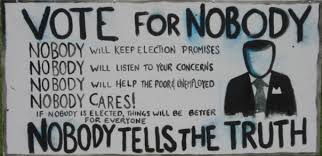
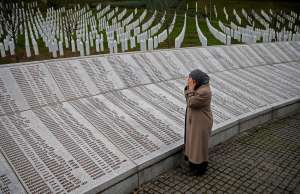
Vote for Nobody           Bosnia

I’m sitting in my office on an Easter morning having just walked through a park filled with Narcissus (Daffodils) – bright yellow and white flowers that bear within themselves the promise of their own regeneration.

In the northern countries, budding flowers have long served as visual confirmation of at least part of the Easter message – that death is not the final word, that renewal is possible and that the keys to renewal reside partially within us.

Some states on and off the UN Security Council claim such a power for elections as well, seeing them as an “elixir” of national stability, an integral step towards any prospects for national regeneration.  In many parts of the UN system, including the Security Council, elections are widely encouraged as an antidote to political stalemate, to insurgent violence, to restorations of both the rule of law and the good graces of the international community.

Nonetheless, as we look around the world on this Easter morning, this ascription of “elixir” would appear to be a hard sell.   High levels of “negatives” for US presidential candidates, confidence in leadership undermined in Brazil, concerns about Turkey and the political collapse of the European community, economic woes in Burundi, the DRC and elsewhere spiking public anxieties and threatening transitions, spoilers within too many states (and not all of them insurgents) stoking violence and unrest that undermines reasonable prospects for the maintenance of some semblance of normalcy.

And then there are those leaders who simply refuse to leave, those who imagine themselves to be “indispensable” to the maintenance of whatever prospects for national stability and prosperity might exist.  Some of these leaders have thumbed their noses at their own constitutions.  Others have committed grave abuses against their own people and then manipulated electoral processes in order to shield themselves from post-office litigation.  Too many lay claim a “mandate” that is neither constitutional nor performance-based, a mandate that serves only to further widen the distrust  of citizens towards a state fully convinced that its continued presence in office is beyond reproach.

Clearly, as noted by Paul Collier, “elections determine who is in power, but they do not determine how power is used.”   Nor, apparently, do they always determine when and how such power is to be transitioned.

In preparing to write this piece, I searched for quotations on elections that I thought might be uplifting.   What I mostly found were quotations both humorous and skeptical.   Among them:

The Portuguese writer José Maria de Eça de Queiroz alleged that “Politicians and diapers should be changed frequently and both for the same reason. “ The US humorist Will Rogers noted that, “If we got one-tenth of what was promised to us in these acceptance speeches there wouldn’t be any inducement to go to heaven.”  Also from the US, Mark Twain noted that “If voting made any difference, they wouldn’t let us do it.”

There were many more in this vein – grateful for the existence of elections and their own ability to participate in them, but skeptical of the motives of those running for office and mostly despairing of the accountability of the winners after all the votes have been counted.  Many are skeptical as well of the disproportionate influence of those holding large fortunes on the political “fortunes” of others, of the ability of leaders to resist the allures of power and redirect that power to public benefit, of the willingness of leaders to battle the demon of “indispensability” through which so much violence, discrimination and political inertia flows.

Clearly, as many within and outside the UN recognize, elections cannot be abstracted from the societies in which they occur.  Moreover, the holding of elections, while useful in helping to “settle” and legitimize the political order, is hardly a panacea for what ails people.  Indeed, much of the violence which occupies the UN Security Council and security establishments in national capitals relates to the inability – or unwillingness – of ostensibly “elected” governments to offer protection, legal integrity, political freedom and development-without-discrimination to their populations.

As the US noted rightly this week in the Security Council, if leaders are “indispensable,” then clearly they have failed at nation building.  Clearly they have too often failed to uphold the rule of law on which most national constitutions are based. Clearly they have also failed to guarantee an end to impunity for violations of public trust committed by any officials of the state. Clearly they have failed — as suggested by UN SRSG Sidikou during that same Security Council meeting — to create and maintain vigorous public spaces for journalists, civil society and even dissenting policy voices, helping to ensure that official promises are addressed in good faith and any abuses of power are not repeated.   Clearly, they have failed to heed Spain’s recent Council urging for electoral processes that do their part to help turn citizens into “protagonists for their own future.”

In other words, “indispensable” leaders who lack the commmitment to enabling rather than obstructing citizens as they seek to express and enact the powers of social regeneration that lie within them.

More and more, elections themselves seem to be more of a “fingers crossed” moment than any guarantee of future inclusiveness – fingers crossed that “changing the diapers” willl result in happier outcomes than another round of diaper burn.  States worldwide are under assault from terrorists and climate-induced drought, from criminal networks and economic predation.   Even the most accountable of states are now staring down multiple traumatic circumstances.   All states now need help in one form or another, from the UN and other mutilateral institutions, of course, but also from their own citizens.

At the UN this past week, Special Envoy Djinnit noted that, in the African region for which he is responsible, successful elections are now the occasion for mostly “fragile achievements.”   Even in these treacherous times, we know some of what it takes to remove the “fragile” tag; replacing repression with open political space, discrimination with fairness, and manipulations of the law with accountability to its cherished provisions.  We must also do better at ensuring vital and thoughtful linkages between national governance and the three, public commitment pillars of the UN system – to security, human rights and development.  “Fragile” is still within our power to change.

And of course we must find ways to do better about selecting people to lead us who have the humility and wisdom to pass the torch when it is time for them to go.

Elections are one significant piece of a larger puzzle towards ensuring peaceful relations, participation and fairness, both elections within member states and even elections within the UN itself: A puzzle incorporating balloting that underscores – rather than undermines – commitments to political and social inclusiveness, while cultivating a “verifiable trust” in government by citizens that is – more than any political leaders themselves – indispensable to a just and effective political order.

After the Spotlight: Following Post-Election Kenya

1 Apr

On 26 March 2013, The World Policy Institute and Fireside Research presented After the Spotlight: Following Post-Election Kenya, a panel discussion featuring, via skype from Kenya, John Githongo, CEO of Inuka Kenya Ltd. and Kwame Owino, CEO of the Institute of Economic Affairs. The panel discussion was moderated by Eddie Mandhry, Associate Director of NYU Africa House, and hosted by Cleary Gottlieb Steen and Hamilton LLP in New York City.

The panel discussion intended to investigate the challenges arising from the most recent elections in Kenya, particularly in the light of the domestic, regional and global complications of the 2007 elections. With over 1000 people dead, 350,000 people displaced, and the mass violence that erupted in the 2007 elections, this discussion was pertinent to the goals and mission of Global Action to Prevent War, which seeks to address broad themes and issues related to human security in diverse global regions.

On 4 March 2013, Uhuru Kenyatta and William Ruto were elected as President and Deputy President Elect of Kenya, respectively. Kenyatta, who is the son of the first Kenyan President Jomo Kenyatta, has been accused by the International Criminal Court of committing crimes against humanity in the 2007 elections. President Elect Kenyatta has since been summoned to The Hague for such indictment of war crimes. Furthermore, in 2010, Kenya became party to the Rome Statute.

The panel discussion began with outlining the importance of ethnicity and identity in Kenyan politics. According to Githongo, this election has been the most important election in Kenyan history since its independence as it marks a new constitution based on so-called “Western liberal models.” Moreover, a new voting procedure was put in place. This included a high-tech biometric voter registration system, on which $250 million was spent, and the electoral provinces were expanded from 8 to 47 providing for new positions and constituencies to encourage free and fair elections and greater representativeness. In this same vein, the former Secretary-General of the United Nations Kofi Annan founded the Election Management Body Policy, which seeks to address arising problems as well as to prevent election-related violence.

Unfortunately, the digital portion of the election failed. The IEBC, Independent Electoral and Boundaries Commission, the so-called contracted election “watchdog,” claimed that the new biometric voter identification system failed. However, opposition parties claim that this was a conspiracy to rig the elections. The two main opposition parties have since contested the results of the election, and, as a result, the official results are still pending.

QUESTIONS TO PARTICIPANTS IN KENYA:

  • So far, many governments from the international community have already called President Elect Uhuru Kenyatta to congratulate him on the elections. These governments include China and other African Nations. Given this, if the Kenyan Supreme Court upholds Kenyatta’s election, what are the implications for an indictment against Kenyatta by the ICC? What if Kenyatta fails to present himself to the ICC?
  • If the Supreme Court does not uphold Kenyatta’s election, another election will need to be held within 60 days. Does Kenya have enough money to do so?  Even more so, does the country have the capacity to do so?
  • If Kenyatta is confirmed, do we suspect there to be violence?
  • Are the institutions that were responsible for this election facing court charges for their handling of the elections?
  • What kind of media was used during the Kenyan elections? Was this majority negative or positive?
  • What kind of campaign was conducted before the elections?

RESPONSES

In the event that the Supreme Court decides on a run-off, the question of who will run the election will be tantamount. Githongo made it very clear that Kenya does not have the capacity to run another election within 60 days following the results of the Supreme Court decision. He stated that perhaps the international community could step in to run a second election, but likewise warned that Kenyans may see this as imperialist sentimentalism, which is already a sensitive issue in Kenya. Therefore, having the international community intervene in this matter may not be a viable option either. He also noted that the Kenyan people have the will and capacity to carry out the elections if necessary, but that they do not have sufficient technological capacity necessary to do so.

Githongo argued that since politics in Kenya have been organized around ethnic lines, this election has consolidated such ethnic-based attitudes even further. Furthermore, there is an ethnic divide among the Kenyan leadership that includes ethnic supremacy and entitlement. The “losers” of the 2007 and 2013 elections continue to feel exclusion from the leadership system and continue to feel as though there has been insufficient justice in the matter. This obviously also increases the likelihood of violence.

Githongo described the silence of the Kenyan people as powerful and that it speaks to the narratives that were cultivated along ethnic lines during the previous election. According to Githongo, there is a “narrative of exclusion” that constitutes an emphasis on numbers such that if an individual is not a part of the right numbers, then one’s vote does not count.

Githongo also explained that the ICC has played a huge role in the external messages of the elections, which has created a dichotomous relationship based on whether or not one supports the ICC. According to Githongo, these messages have been relayed quite simply as: “If you do not support the ICC, then you are not a nationalist and if you support the ICC, then you are an imperialist.” The campaigns were structured in such a way that communicated to citizens that they were not voting against an individual, but rather against the country or against the Western forces.

Githongo stated that it is important to speak about the role the media has played in the coverage of this election. Since the media was accused in 2007 of fueling the violence that ensued post-elections, it is now over-compensating by being ‘overly-cautious’ not to report, on the even “soft violence,” which is happening across the country. It would seem that the media is censoring itself.

Overall, Githongo stated that this election has caused Kenya to revert backwards in terms of its democratization process. Additionally, there is a worry that in the future, depending on the outcome of the ICC trials and the Supreme Court decision, on whether or not to uphold Kenyatta and Ruto’s victory.

It is expected that the incoming government will have to take Kenya out of what Githingo described as a “hole.” Addressing this “hole” is imperative as Kenya is geopolitically important to the international community and global economy. With the discovery of coal, oil and many other mineral elements, it has been argued that the Kenyan private and financial sector is positioned to take off in terms of capital formation, the quality of education and human capital, and skilled labor within the workforce, particularly with regards to financial services.


****Since this panel discussion, the Kenyan Supreme Court has upheld the election of President Uhuru Kenyatta and Deputy President William Ruto even with the former’s impending summons to The Hague for war crimes and crimes against humanity. 


–Shari Smith, Intern GAPW