
Tag Archives: HLPF

Accountability, Compromise and the Future of the UN: A Reflection by Tazia Marie Mohammad.

14 Aug

Editor’s Note:  This reflection is courtesy of one of the more insightful interns/associates we have had at Global Action in my 23+ years.  Tazia did what we want all of our colleagues to do – throw themselves into many areas of UN policy and practice and then assess the current relevance of the UN as convener and problem-solver on an increasingly volatile planet. This task was made easier during July’s High-Level Political Forum when so many UN issues and concerns come to the fore.  But the HLPF also magnified opportunities for frustration, especially for younger people worried about their future and the capacities of existing global institutions to shape a more compassionate, just and sustainable world.

The day after my internship with Global Action ended, I took a 6:00 AM connecting flight from JFK to Tokyo-Haneda. Since then, I have been working as an English tutor in multiple prefectures across Japan, a welcome respite from the bustle and grit of life in New York City. The curriculum I work with, more content-based than instructional, focuses on multicultural communication and attainment of the UN Sustainable Development Goals—noticeably reminiscent of the Japanese mission’s own interventions on the General Assembly floor.

It feels a bit hypocritical to be getting these kids excited about our grand plans to change the world only days after walking out of a circle that blatantly disregards them. America, the country I effectively represent to my students, has rejected the SDGs and withdrawn from the Financing for Development conference—a culmination of decades of unwillingness to commit to its climate promises. Simultaneously, it funds the killings of over 60,000 Palestinian men, women, and children, while strong-arming sovereign bystanders into complicity in the Security Council and beyond.

The UN, over its near-eighty-year tenure, seems to have refashioned itself in America’s image: swift and adept at bullying the weak, but slow and inefficient at aiding those in need. This has long since graduated from mere unfairness: with 2030 just around the corner, only 17% of the SDGs are on track, and each state’s unwillingness to shape up digs us deeper into a grave that seems less escapable each day. If we cannot face ourselves and implement a hard narrative reset, we may well not survive.

Perhaps the greatest hindrance to SDG attainment is the UN’s inability to hold member states accountable. In the Security Council, this dearth of responsibility can be attributed to an irreconcilable truth: every resolution, stance, and condemnation issued is overshadowed by each nation’s own military exploits and casual brutality. Every law-breaker seemingly feels emboldened by the tacit understanding that they will face no substantial punishments for violating international laws, for the states responsible for upholding these laws are often the most infamous violators themselves. This is evident in Israel and America’s noncompliance with the Geneva Convention despite near-universal condemnations, and in Russia’s stubborn continuation of its invasion in Ukraine despite its pariah status in Europe. Until more rigid and autonomous frameworks for unlawful intervention are implemented, the UN cannot in good faith claim to protect the sovereignty of its members or the safety of their citizens.

This accountability crisis also stems from the Western hegemony’s open use of reality-bending narration as a shroud for its own failings. Iran, for instance, engages in a more rigorous nuclear reporting process than any other UN member, yet its compliant status with the IAEA was revoked immediately preceding Israel’s unprovoked terror attacks on its IAEA-protected nuclear plants on June 13th. Iran, which has never been recorded to possess nuclear arms, was declared a volatile adversary seemingly overnight to justify Israel’s warfare. Statements by nearly every Security Council member focused more on urging that Iran—a known non-nuclear entity—must never obtain nuclear weapons than on addressing any details relevant to the matter at hand. This air of favoritism is accentuated by the fact that Israel itself is estimated to possess 90 nuclear warheads yet refuses to sign any non-proliferation treaty or register its arsenal with the IAEA.

One must also look to Palestine, where the plight of Israeli hostages—prolonged solely by Israel’s ceasefire violations and rejection of negotiations with Hamas—is measured at equal, if not greater weight, than the deaths of over sixty thousand Palestinians. Moreover, Israel’s core arguments about the hostages are never challenged despite the obvious question: how can one protect Hamas’s prisoners while simultaneously bombing them? Even factual realities are pushed aside to make room for Israel’s excuses: some member states still push the debunked claim that Palestine’s aid blockages are caused by Hamas’s banditry and not Israel’s denial of humanitarian entry. This utter obedience to the flawed, dehumanizing logic of uncompromisingly self-interested tyrants degrades the credibility of the United Nations, and if there is to be a future for international cooperation, such atrocities cannot continue.

At the same time, efforts at achieving SDG 13 and other climate goals are undercut by the naivete of many member states, who support climate efforts only if they are cost-effective, complementary to their development ideas, and inoffensive to corporate sponsors. To illustrate this, I recall a panel I attended during the early days of the High-Level Political Forum on AI integration into bureaucratic institutions. While charismatic and well-spoken, the presenter painted a future in which AI technology is so ubiquitous that it will become inseparable from our logistical frameworks—a beautiful idea, but without any word on where the energy for such technology would come from, or how environmental implications might be reconciled. When I pressed him on this point, the answer I received was certainly optimistic: “AI will solve for AI.” Though it would be lovely to see this clever catchphrase prove true, it is irresponsible for any diplomat or lawmaker to operate with this notion in mind. The “do no harm” principle dictates that it is the innovator’s responsibility to prove her creation isn’t harmful, and there is no alternative that makes it viable to create and then market problems in hopes of fixing them later.

Yet, it seems the consensus for most wealthy and middle-income nations is to have your cake and eat it too. Climate conversations throughout the HLPF were lathered with appeals for understanding: while states want to try their best for our planet, they refuse to hinder their own economic development. This unwillingness to accept the inherent limitations of sustainability on growth sets us on a dangerous path: climate protection will always require sacrifice, and member states must compromise on growth expectations if they hope to meaningfully contribute to SDG 13 or any of the other goals.

It is easy to be swept up by the pomp and circumstance of the UN Headquarters: diplomats are ushered from their limousines by entourages at every hour, and there is constant pressure to cave to the status quo of self-aggrandizing optimism and verbose inertia. However, we cannot forget the main purpose of its existence: to protect and care for our fellow human beings. Integrity can no longer remain an afterthought on the General Assembly floor; we must be diligent in our moral convictions, and honest in our efforts at carving out a better world. Only then can we look our children in the eye and tell them sincerely that the SDGs are worth being excited about.
Kicking the Can: A Plea for More Tangible Urgency, Dr. Robert Zuber

27 Jul

From this instant on, vow to stop disappointing yourself. ― Epictetus

Only put off until tomorrow what you are willing to die having left undone. Pablo Picasso

A year from now you may wish you had started today. Karen Lamb

Some of us keep missing the breakthrough because we don’t want to cross the bridges of growth that look like weakness, solitude, loneliness, and delay. Andrena Sawyer

If you choose not to deal with an issue, then you give up your right of control over the issue
and it will select the path of least resistance.
 Susan Del Gatto

That glorious vision of doing good is so often the sanguine mirage of so many good minds. Charles Dickens

We tremble with the violence of the conflict within us — of the definite with the indefinite — of the substance with the shadow. Edgar Allan Poe

You may think twice about beginning to build your ark once it has already started raining. Max Brooks

The comfort zone is a region where great dreams go to get murdered, buried and forgotten.  Michael Bassey Johnson

The truth which has been spoken too late is more damaging than a lie. Amit Kalantri

The High-Level Political Forum has concluded for yet another year.  Under the leadership of Ambassador Bob Rae of Canada, Ministers, other diplomats and NGOs convened at UN Headquarters to assess both global and national efforts to fulfill a multitude of promises made in 2015 on sustainable development and good governance, including getting the 2030 Development Agenda back on some reasonable facsimile of a right track.

The HLPF consists of plenary sessions, side events (often the most interesting aspects) and what are known as Voluntary National Reviews where governments present efforts and outcomes on sustainable development priorities and receive input on how they can expand/improve such efforts.  One major culmination of all these efforts is the adoption of a Ministerial Declaration which will be presented in the General Assembly in September at the opening of its 80th session in the hope of achieving some sort of consensus adoption by those a bit higher up the political food chain than most of those who attended the HLPF.

The Declaration (https://docs.un.org/en/E/HLPF/2025/L.1) is a difficult read in at least two senses.  The 21-page, single-spaced document is a litany of issues which the global community acknowledges require urgent attention, especially in the five key focus areas of this HLPF – ensuring health lives, promoting gender equality, decent work for all, sustainable use of oceans and marine resources, and revitalizing global partnerships with a special focus on finance for development.  Moreover, side events attempted to incarnate some of the urgency suggested by these priorities, through topics such as access to housing and workforce empowerment, localizing social development and how AI is reshaping government operations.

he HLPF represented some of what is best about the UN, even amidst its current financial limitations, as issue after issue which weighs heavily on both our global agenda and on future prospects for younger staff and interns are given significant attention. There is perhaps no place on earth where so many global problems –problems which cannot be managed by any one country alone – are put on the table for consideration by diplomats and other stakeholders.  In this “see no evil” moment in our collective history, the willingness to acknowledge and specify the gravity of these times is most welcome.

But acknowledgment has its own caveats which our younger colleagues are often quick to point out. Negotiators at the UN are rarely key decisionmakers in their own governments, nor are they responsible for implementing the resolutions they pass – the “promises” which they make but have by professional design little or no role in honoring. 

Moreover, there is a growing disconnect between the loftiness of our aspirations and the current malaise (at best) of our human condition, our propensity to tell only the truth which suits our purposes, to accept cruelty and abusive governance as signposts of a corrupted reality we have not done enough to challenge, to cheer on technological advances without asking ourselves if human beings now seemingly resigned to a “race to the bottom” can do any better than exploiting such technology for private gain. If we collectively fail the test of a fairer and more compassionate humanity, and even the recent “Mandela Day” events suggested that we might well be on our way to doing so, is there any chance that we can rescue technological advance from being a shiny new toy to increase our already draconian levels of inequality?  Some young people are dubious.  I am compelled to join that sentiment.

But there is a second, related theme in the Declaration which comes up over the over at the UN and certainly at this HLPF – the virtual obsession by the UN and its member states with large conference events on topics from climate change and finance for development to ocean health and the status of the Least Developed States.  You often hear at the UN statements such as “the upcoming conference on (name a topic) provides an important opportunity” to push forward on commitments which, in the main, were made at previous major conferences and which largely remain as un-ripened fruit on the vine.

Why do we need conference after conference, pact after pact, outcome document after outcome document as though the major, often carbon-sucking events from which all this emanates will ever justify the expense of energy and money they require?  And why do we need so many of these events when the UN exists on a daily basis to promote those sorts of collaborations?  And dare we ask: Has the Paris agreement actually resulted in lowered global emissions?  Do we really need more climate-focused COPs (now on number 30) hosted by governments often hostile to significant aspects of climate activism, whose policies in more than a few instances promote deforestation and fossil fuel use which has gotten us into this mess from which we are now struggling to extricate ourselves?

Why is it considered to be some incarnation of multilateral heresy – mild or severe — to raise these conerns?

And while we’re at it, what of the failures of the Security Council on peace and security and its blatantly obvious impacts on our ability to meet our sustainable development obligations?  Peace and security were not a major focus on this HLPF but in the Council chamber where we spend much time implications for sustainable development were disturbingly and stubbornly clear. How do conflicts in Gaza and Ukraine impact our sustainability scorecard?  What about Sudan and Myanmar which have largely fallen off the diplomatic radar?  What of the tensions in South Sudan, Libya and elsewhere which threaten to unravel some very hard-won political and protection gains?  And why did the HLPF and the Council, as in years past, choose to keep each other at arm’s length?

The point here is really not to bash the UN so much as to call attention to some of its structural and procedural flaws as it enters a period of profound budgetary uncertainties in a world which stands in desperate need of sanity and healing.  Why do we continue to hold large international meetings with little regard for whether the outcomes actually justify the event? Why does the president of ECOSOC leave office upon the conclusion of the HLPF rather than continuing to use the office to push harder for outcomes and consequences that truly matter?  Why, given all that we know about the state of the world and its current trajectories, do we continue to kick the proverbial can down the road, pointing longingly towards the next major event which is as unlikely to break policy impasses as were previous ones?  Why do we act as though what we have been doing is good enough when the indicators of sustainability continue to point, often decisively, in the wrong direction?

For the sake of us all, especially for the young and those yet to come, this serial policy procrastination must end.  We need more truth-telling, more honest discernment, a greater capacity for compassion for those who have been waiting far too long for relief, a resolve to stop confounding constituents and, if we are able, to stop disappointing ourselves as well.

We are called now, more perhaps than in the past, to cross bridges of growth which have long beckoned, bridges for ourselves which can enable more tangible outcomes for our institutions and constituencies. The HLPF and its Declaration are heavy on sound analysis of our dire straits but short on breakthroughs.  We need breakthroughs and we need them soon.


A Moment of Truth: Reflections on the UN System from the Inside, by Himadri Ratnayake  

4 Aug

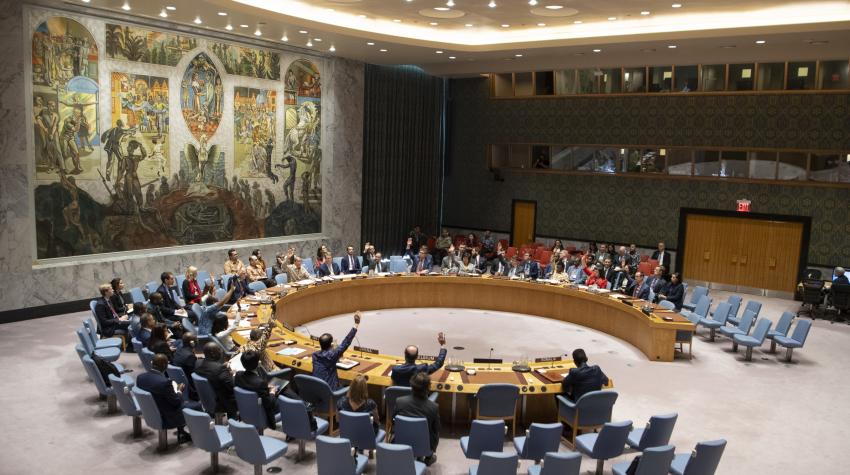
View of the Security Council chamber from the left side of the room, with a round table for delegations and a mural of a pheonix on the wall.

Editor’s Note: A student at Columbia University of Sri Lankan heritage, Himadri has concluded her summer internship with us, adding much value to our work and making the most of the opportunities which the UN presented. Her task here was to reflect on how being at the UN differed from (or confirmed) learning about the UN in a classroom setting, how her assessments of the UN were influenced by expectations of the UN generated in other contexts. We were really happy to have her with us especially during July’s High-Level Political Forum.

We have six years…six years left to go. In 2030, I will be 30. In 2040, I will be 40. In 2050, I will be 50 and so on. Only six years to make comprehensive progress on the 2030 Sustainable Development Goals, with only 17% of the goals and targets now on track. . While it may seem like there is a lot of time left, there is also still a lot of work to do to fully address all the goals and their targets, to honor the promises we have made to global constituents.    

As a 24-year-old graduate student studying international affairs with an emphasis on Economic and Political Development, International Organizations/UN Studies and International Conflict Resolution, I have been able to understand some of the behind-the-scenes of what takes place within UN spaces. When you are in school, there is only so much you can take away from articles, resolutions and the knowledge of a professor. Having now been at the UN, I have been able to apply what I have learned and understand more of the system and processes that occur within that sphere. Overall, it has been an absolute privilege to have been able to attend meetings covering a span of topics: the conflicts in Gaza, Yemen, Ukraine, etc., food insecurity, children impacted by climate change and war, oceans, decolonization, etc. I have acquired an abundance of knowledge just by attending such meetings and side events, learning about various climate and terrorist threats, UN agency mandates and rules of procedure, preferred UN terminology, and so on. There were some topics that I had never truly known about until I attended a meeting, and that only goes to show the range of conversations which are taking place at the UN, especially during July’s High-Level Political Forum.   

Throughout my time here, I have had multiple opportunities to engage in meetings held within the Security Council, ECOSOC and the General Assembly as well as “side events” in many other conference rooms. Upon my first time sitting in on a Security Council meeting, I felt excited to be able to witness discussions in a manner that is  often closed to the outside world. There is a level of seriousness and intensity in the room that one can’t necessarily experience on UNTV or in a classroom. The briefings initially held at the beginning of meetings by various officials from UN agencies ranging from the OHCHR to the IOM and so on, offer incredible insight regarding statistics and stories of urgent situations taking place on the ground.  

Initially, during the first few meetings, all the country’s statements appeared to be full of hope and promise, offering a great chance of making progress toward resolving situations on the UN agenda. However, upon attending several meetings and listening to multiple country statements back-to-back, I noticed the repetition of information and beliefs expressed by the country representatives. The statements would usually start the same, often including the same statistics that would already have been mentioned in an opening briefing. The words “let me make three points” were frequently mentioned as well. I bring up the structure of these speeches because it shows how much repetition we witness, not only in structure but in content as well.  

While I still retain so much hope in the UN, and still wish to join the Foreign Service soon along with involving myself in humanitarian field work, I cannot help but wonder how much progress and change we are truly creating in terms of resolving many existing global threats. This is also the case for emerging crises; everyone but the people at the very top of governance seem so highly limited in terms of decision-making access and impact. Even those residing at or near  the top experience their own limitations.  

 In addition to what I have previously noted, I have also observed other unfortunate occurrences in the meetings I attended. There are Member State representatives who walk out of the Council chamber when certain countries are preparing to speak, Member States who change the narrative (facts being turned into fiction and vice versa) and those who do not seem passionate or even interested in their own or other country’s speeches. I have also noticed the lack of attention given to those that are speaking or participating in the meetings. There have been countless times where it is evident that people were on their phones, ostensibly on social media, scrolling endlessly and even occasionally forgetting to turn their volume off. During my short tenure in the Council, I have heard bag pipes playing, some hip-hop music, etc. amidst deliberations on critical matters pertaining to peace and security. This may not seem like a big deal to some, but when discussing matters of war, the effects of it on civilians, etc. what does the lack of careful listening tell us?  

These past couple of months have brought great insight into processes which had mostly been closed off to me and others in my cohort. On the outside, the UN often represents a symbol of peace, hope, strength and unity. It also serves as a promise to current and future generations, that there will not be another world war and that peace can eventually prevail. However, it seems that presently there are more wars (regional conflicts) occurring now than perhaps ever before. My question is thus, what are we doing exactly to help resolve these situations?  

One of my favorite adornments in the Council chamber is the “Untitled (Mural for Peace)” by Norwegian artist Per Krohg. It sits as a perfect backdrop to the purpose of the Council, and further emphasizes the importance for peace and security in our world today. What a powerful message and image this is, where the phoenix is rising above the ashes of a conflict-ridden society. That is the future I wish to see, not a continuation of what is currently happening. If anything, we are now driving the phoenix back down into the ashes. The Damask wall tapestry further embodies faith with the growing wheat representing “hope and the heart of charity.” While such beliefs still persist, it is imperative that we fulfill these symbolic aspirations and apply them to the world.  

On the inside, the Council meetings usually start in the same manner. The three dings go off, and the agenda is usually announced and adopted for the session. In some meetings, the level of intensity is relatively tame while in others there is finger-pointing and hostility that permeates the air. As a student, I see the hypocrisy within certain country statements, and while I understand the justification behind them should we not be looking for more sustainable solutions than reflect minimum concessions to peace? There are certainly hopeful solutions that representatives present to their colleagues, but not everyone is committed to following what seems to be the obvious answer to the issues presented in such meetings.  

As I am entering my second year of my master’s program with this new outlook on the UN, I am hoping to discover what my place will be in that place post-graduation. I do not want to wait until 2050, when I am 50 years old, for change to take place in our world today. Not more discouraging  change, which we surely don’t need, but good change. We need more good change, we need more progress on sustainability, and we need it quickly.   

One final thought:  Throughout my time  at the UN, many discussions that took place in the context of smaller events, especially during the High-Level Political Forum (HLPF), mentioned the need to involve the youth by incorporating them in conversations and even decisions. These conversations include the evolving climate crisis, peacebuilding priorities, multiple human rights issues, etc. The problem is that prominent figures in the room may listen to youth  but there is little to no progress which can be measured as a result of these interactions. Involving younger generations in actual development processes, whether it be policymaking or other discussions at multiple levels of policy and practice, is necessary if we wish to fulfill our SDG commitments.   

As a member of the “younger generations,” there is so much I wish to do in terms of solving these global challenges that only seem to be growing. But it seems unlikely that I can make any impact or real change at my current stage. The more UN meetings I attended, the more I observed the age range of people leading discussions, and they were mostly (with all due respect) from the older generations. There were even some events where one could easily notice the lack of bodies of any age in the room, perhaps because not many people were aware of the event, perhaps they were too busy with other matters, or (I fear) perhaps some people in the system (or attending the HLPF) may be losing hope in an organization that has demonstrated limited capabilities to resolve many security and development concerns.  

With that being said, I hope my reflection offers some helpful insight into a youth’s developing perspective on the UN. My passion for international affairs and this journey into diplomacy stems from my time in Model United Nations (MUN). In learning about various world issues at an even younger age and then being privileged to travel the world, I acquired this hope that the UN could be the answer to solving these pressing challenges. Over time, as my knowledge and experiences have grown, I realized that it is not only the UN but also and primarily world governments who are the keys to forging positive change. They are the primary policymakers and the ones who hold the power in decision-making when it comes to war, the climate crisis, peacebuilding priorities, etc. Thank you to FIACAT and all who made my UN sojourn possible. By 2030, I hope more significant progress on all of the SDGs will be possible. .  

Brave Heart: A Mindset for Sustainable Development, Dr. Robert Zuber

11 Jul
See the source image

Solidarity isn’t merely a task, it is a pleasure and the best assurance of security.  Erich Fromm

Sometimes it is nothing more than gritting your teeth through pain, and the work of every day, the slow walk toward a better life.  Veronica Roth

For if they come for you in the morning, they will be coming for us that night.  James Baldwin

It is curious that physical courage should be so common in the world and moral courage so rare.  Mark Twain

Our minds must be as ready to move as capital is, to trace its paths and to imagine alternative destinations. Chandra Talpade Mohanty

The moment we begin to fear the opinions of others and hesitate to tell the truth that is in us, and from motives of policy are silent when we should speak, the divine floods of light and life no longer flow into our souls.  Elizabeth Cady Stanton

Solidarity is not discovered by reflection but created.  Richard Rorty

In a week that witnessed renewals of armed violence, assassination attempts and successes, and heat excesses oozing from virtually every pore of the earth’s membrane, the UN met in the context of the High Level Political Forum (HLPF) to consider a way forward on our lagging sustainable development (SDG) commitments.

In largely virtual formats, figures of global prominence from government, private investment houses, universities and a bevy of civil society organizations shared their sense of what was possible to achieve now given a world still struggling with COVID-19 variants and vaccine inequities. Despite the constraints imposed by time and (occasionally) technology, several plenary discussions and (especially) side events made substantial contributions to our search for a common, viable way forward on issues from poverty and governance to food security and climate change, reminding us of the struggles of the moment but also summoning us to take bolder steps, to embrace bolder measures, to build a healthier, more sustainable world while the opportunity to do so still presents itself.

As one might imagine, the pandemic occupied center-stage, with the Foreign Minister of Barbados reminding the opening session of the HLPF that vaccine access (the “what”) is key to allowing tourism-based economies in the Caribbean and elsewhere to at least begin to recover.  But in a theme recurring throughout the week, the “how” of equitable vaccine distribution and access remained elusive.  As that same session, the World Health Organization’s Dr. Tedros chimed in that in the absence of “local health security,” global health security and other SDG commitments will surely remain “off track.” But Tedros also highlighted “profound gaps of sharing” in our world and urged efforts towards a “pandemic treaty” to identify and address new pathogens before they are allowed to replicate the current levels of social and economic ruin to which many government officials this week consistently pointed.

As others also reminded the digital UN audience, the current pandemic might be the most recent, major impediment to SDG implementation, but it is hardly the only one. Indeed, as OXFAM’s director and others made clear, the tendency to “privilege private wealth over the public good” was in force well before the pandemic.  COVID-19 did not create the food insecurity that ravages millions under threat from climate change and armed violence.  It did not invent what was noted throughout the week as the “shrinking civic space” which endangers journalists and civil society leaders alike and allows disinformation to flourish.  It did not create pervasive discriminations of race and culture which Costa Rica’s Ambassador Chan noted perpetuates the existence of “second class citizens” and impedes progress towards equality, let alone genuine “equity.”  And it certainly did not invent the gross inequalities of power and income which have only grown more grotesque during the pandemic.  As noted by the World Food Program’s David Beasley, as many as 41 million people in our world are now facing grave food insecurity which could be alleviated if we could only find the $6 billion dollars to do so, a mere 0.2% of the $28.7 trillion dollars in global wealth generated last year despite pandemic limitations. 

The pandemic, as many have noted this week, has also become a “cover” of sorts for steps that we know we need to take but now have an “excuse” not to do so.   Many during the HLPF, including VP of the Economic and Social Council, Mexico’s Ambassador Sandoval, called again for urgent action on matters from “decent work” to “full digital connectivity” which have long been on the UN agenda. Beyond the HLPF, a discussion this week, in the General Assembly on the UN’s global counter-terror strategy yielded insights from many, including from the Malaysian representative who advocated for the creation of “mental firewalls” against the growing (and equally well-known) ability of extremists to radicalize its youth.  Terrorists have not taken time off during this pandemic, as many delegations noted, but our responses to these threats, as Afghanistan warned, have largely remained “static.”

So what do we do now?  How do we move from the “what” that we well know to the “how” which continues to elude us in more than a few key areas of sustainable development and which is more urgent with each passing day, let alone with each passing HLPF?  What is missing in our individual and collective approaches? To reiterate, we know that we have agendas of longstanding, some of which have become more severe during the pandemic, and which require urgent and practical attention.  We know that we must do more to eliminate corruption and illicit financial flows.  We also know that we must do more to open avenues of concessional finance and relieve the debt burdens of the small island and least developed states, to respond to the call of Seychelles president RamKalawan for assistance on problems that “everyone knows exist” and for which “we should not have to beg on our knees.”  We know that we need to push back harder on violence against children and schools, on our stubborn digital divides, on disinformation by climate and COVID deniers, on threats to progress on rights for women, persons with disabilities and cultural minorities, on the seductive messaging of terror groups, on trade-related and other regulations that continue to privilege the privileged.  And we know, as Italy’s Minister intoned, that we have an obligation to “rethink” governance and public institutions at all levels, ensuring that we can sustain peacebuilding in conflict and climate-affected states and create “people-centered justice systems” which have a real chance to ensure accountability for the grave crimes which we continue to perpetuate against one another.

It is a large agenda, as large as the SDGs themselves, a test for the global community unlike any we have taken on in our history.  And it will continue to require more from each of us, including the will to renounce what Pakistan’s Ambassador Akram (ECOSOC president) referred to as “wishful thinking,” the belief that these problems will somehow resolve themselves without deep and effective partnership-based policies.   A similar theme was invoked by South African during the HLPF side event on racial discrimination, reminding us that laws “can only go so far” towards the eradication of racism in the absence of complementary, supportive social structures.

And complementary, supportive peoples.  Those of you who still read these posts surely know where this is going – a plea for bravery and solidarity to embrace the challenges of the moment, challenges that will do us in unless we find in ourselves and each other the energies and capacities needed to reverse a bevy of current, worrying trends.

Fortunately, the HLPF seems to have embraced this need as well.  This week, Under-Secretary Liu advocated a “global response plan” for the pandemic.  UNICEF’s director Fore urged a “shared purpose” to enhance the welfare of children now suffering in multiple ways.  The IMF’s Managing Director Georgieva invoked the need for “bravery to move towards the light” and stay focused in our pursuit of sustainable development.  Dr. Tedros and many others called for a narrowing of our “sharing gaps.” Costa Rica’s Chan highlighted the benefits of pluralism, noting that “each new culture introduced, each new language spoken, makes us richer.” Tunisia expressed the hope that a recent Security Council agreement on Syria humanitarian assistance reflects a fresh and “common will” to resolve conflict and related political impasses. And Mexico’s Sandoval aptly summarized a trend across this HLPF, noting that there is “big hope for the world if human solidarity prevails!”

One could well ask, What is going on here?  It seems that the mindset much conducive to multilateralism is coming out of a bit of hibernation in helpful and productive ways.  Yes, there is hope for the world if solidarity prevails.  Yes, there is hope for the world if we all take responsibility for fixing what we can, healing who we can, and doing both by reaching out to others for whom the “essential blocks of social protection” are blocks we largely have in common.  Beyond resolutions and legal frameworks, beyond the stale rhetoric sometimes characteristic of UN spaces, virtual and otherwise, such hopeful solidarity requires a different type of bravery, a different breed of investment, a commitment to hearts and minds more open, honest and engaged than we have allowed them to be in quite some time; a commitment as well to pick up the pace of our often “slow walk” towards a better life, to address challenges at the speed and in the multiplicity of forms in which they now appear to us.

Let’s run with this one before we change our minds, before we return to that space where physical courage is abundant but moral courage is rare, before we frighten ourselves into inertia by the energy and “grit” needed to generate “alternative destinations,” create greater solidarity with the entire natural order, and dare speak the truths we know to speak.  As Fromm suggests, solidarity may well be a pleasure, but it is also key to our security in a world where security for many millions is clearly at a premium.  To grasp it, we must dare to grasp each other, to brave the holding of hands and affirm in practical terms the interconnectivity which lies at the heart of all life, including our own.