Tag Archives: climate change

African Security in the Anthropocene: Book Discussion and Follow-up Interview, Dr. Robert Zuber

3 Jul

Dear Folks,

The following link takes you to an interview I did over the weekend with a South African investigative journalist, Chris Steyn. The interview followed a successful UN visit and book discussion led by Dr. Hussein Solomon of South Africa and Dr. Jude Cocodia of Nigeria. Their fine book, “African Security in the Anthropocene,” is one to which they graciously allowed me to contribute, albeit modestly.

The interview, which was very well handled by Chris and which includes a couple of “commercial interruptions,” was my attempt to link current events, including with regard to latest Wagner Group drama, to broader security interests which the book highlights and to which our New York-based work has long sought to contribute. It was an early-morning interview for which there was probably not enough coffee in my zip code, but I think there is some value here. I hope you will find it so. Bob

Earth Year: A Call to Clarity of Hands and Hearts, Dr. Robert Zuber

2 Apr
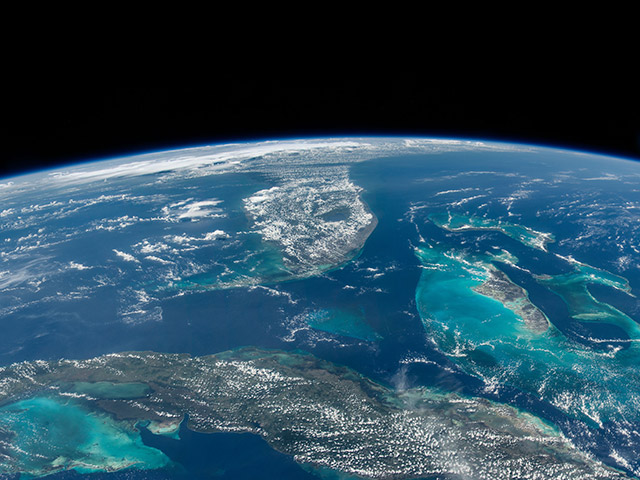
Florida, the Bahamas and Cuba as seen by the International Space Station.

From NASA

The holy men say we are entering a period of clarity. Rigoberta Menchu

The greatest privilege is to live well in flourishing lands. Hamza Yusuf

Virtue can only flourish among equals.  Mary Wollstonecraft

For millions of years, this world has been a great gift to nearly everything living on it. Rebecca Solnit

If beautiful lilies bloom in ugly waters, you too can blossom in ugly situations. Matshona Dhliwayo

Peace is the creation of an environment where all can flourish regardless of race, color, creed, religion, gender, class, caste or any other social markers of difference. Nelson Mandela

Around the globe, people from all walks of life are holding their breath in the hope that a flurry of activity at all levels of policy and human community will be sufficient to reverse what is commonly known at the UN as the “triple” planetary threats from climate change, biodiversity loss and pollution (especially plastics pollution).  

The UN has seen its own frenetic activity as leaderships tries to both make up for precious lost time while encouraging member states to take more political risks and step-up ambitions to find more robust and cooperative measures to address threats which clearly are not inclined to wait for us to make the change we need to make in order to secure a future for our children, especially those children residing in the most climate-vulnerable regions.

The UN has certainly created numerous spaces for member state deliberations on virtually all aspects and dimensions related to the “triple threat,” including implications for human health (mental, physical and nutritional), for international peace and security, and for more inclusive processes which not only heed the voices of women, youth and indigenous people but which actually seek to incorporate their learning and insights into policy decision making.    

Some of these processes, as many of you recognize, take the form of large, carbon-intensive events which create some consensus-driven movement but generally lacking in practical implementation of pledges which fully mirror their rhetorical origins.   Case in point is the fund for “loss and damage” agreed to at COP 27 in Egypt, an important step which has yet to generate the remedial funding which the most climate affected states had anticipated (and still anticipate).  Diplomats also agreed recently on elements of a treaty to impose structures of governance on ocean areas beyond national jurisdiction (BBNJ), a theoretically important framework to mitigate at least some of the “wild west” mentality which has encouraged massive ocean dumping and deep-sea mining and has also precipitated a decline in ocean species as waters warm and the remains of our collective overconsumption now reach the furthest ocean depths. The recently concluded UN Water Conference resulted in over 600 pledges (albeit voluntary) to strengthen “trans-boundary water cooperation, promote universal sanitation and explore security and other implications of severe access challenges regarding this most precious of resources.  The General Assembly for its part passed a unanimous resolution (sponsored by Vanuatu and others) seeking clarity from the International Court of Justice regarding the legal obligations of states whose production and consumption patterns, as noted during the week by UNEP director Inger Andersen, now serve to threaten the very existence of other states.   Even the Security Council got into the act recently as Mozambique chaired an Arria Formula discussion on protecting water-related infrastructure.  But despite what (to us at least) seems like an obvious linkage between a dangerously warming climate and prospects for armed conflict, several Council members past and present remain unconvinced that climate concerns should be folded into the Council’s peace and security mandate.

This bevy of activity (we didn’t even mention the biodiversity conference in Montreal or the Forum on Forests) is welcome but can also obscure the fact that most of these commitments are voluntary, are unenforceable or constitute some subtle form of “greenwashing” which leads people beyond UN confines to think that more is happening to forestall disaster than is actually the case. Having been around the UN for what seems like forever, we understand well that in large multi-lateral spaces facilitated by the UN, spaces filled with diplomats representing national positions and increasingly insisting on elusive consensus, progress is likely to be slow, perhaps too slow given crises weighing down human community like a bad case of COPD.  It certainly seems as such to the growing number of youth environmental activists who, despite their energies and practical commitments across the globe, still struggle for their place at the policy table to help ensure progress that is more than textual and rhetorical.  Indeed, as one youth activist noted during the days of the UN Water Conference, holding these large eco-events in expensive UN cities literally ensures that many of the people who wish to present testimony regarding the effects of and responses to climate change, pollution and biodiversity loss in their communities – testimony unmediated by diplomats and NGOs like me – will continue to experience great difficulty in doing so.

While some turn red at the suggestion that the UN isn’t doing enough on a range of environmental challenges, the troubling consensus of senior UN leadership (and many of the rest of us) reveals a serious disconnect between what is needed, what is being proposed in response, and the risks that member states – including some of the world’s largest polluters – are willing to take in order to preserve healthy options for succeeding generations.  And because states in the main are not doing enough despite some claims to the contrary in UN conference rooms, the rest of us are thereby encouraged to not do enough also.  Indeed, to our minds at least, the mass of discouragement experienced about the state of the world by many is another unfortunate consequence of rhetoric that is not matched by concrete policy support for the actions at community level, actions which ultimately have the most to do with whether or not the current “triple threat” becomes what Costa Rica referred to recently as a full-on “death sentence.”

Thankfully, there are many communities and individuals from all walks of life who have refused to have the potential for abundant living by their families and communities sidetracked by misleading policy utterances including those from senior officials which are insufficiently hopeful or mindful  of the vast and increasing web of environmentally healing measures proliferating worldwide.  From habitat restoration and community composting to organic agriculture, bee-keeping and tree planting on a massive scale in countries like Pakistan and across the Sahel, people of all ages and cultures are seeking a new clarity, refusing to be distracted by either doom and gloom or passive indifference.  They have not given up on prospects for a world which can genuinely flourish for many more people, a world which remains plausible despite the circulating metrics from competent researchers associated with insects decline, plastics inundation and sea level rise.  

The UN, for all its contributions and deliberations, is not really in the “flourishing business;” indeed it is at its best a place which provides a policy platform to support and enable work which needs to take place elsewhere. But we know how easy it is to get distracted by the glamour of UN conferences or discouraged by the sometimes-dismal reports emanating from UN sources which such conferences often do too little to address.  We must remind ourselves that what both glamour and doom have in common is that they are poor recruiters for hopeful, virtuous, collaborative activity at community level which can do much to rebalance our world of sometimes gross inequalities, a world which we have been told much too often has reached or even exceeded survival “tipping points.”   

In this momentous year for the earth and our presence within it, we must not allow ourselves to be deterred by the eminence and capacity of our large institutional frameworks and spokespersons nor allow ourselves to retreat into smaller circles of life in an attempt to protect what is closest to us from the “ugly” storms looming over an uncertain horizon. We cannot survive the storms by ourselves, but the truth is that neither can they be survived without us.  In this Earth Year, we all need to urgently recalibrate the sustainability of our own lives; but perhaps even more importantly we need to help ensure that millions more people now situated firmly on the sidelines of climate action are encouraged and supported to lend hands and hearts to prospects for planetary abundance, such that more and more of us and other life forms might “live well in flourishing lands” on a planet we are running out of time to truly love. 

On Caring and Enabling: Navigating Crisis Response on a Post-Twitter Planet, Dr. Robert Zuber

19 Nov

The goal is not to get something said but to get something heard.  Fred Craddock

We cannot feel good about an imaginary future when we are busy feeling bad about an actual present.  Daniel Gilbert

It is our daily lament that we cannot love enough.  Charles H. Spurgeon

We want our leaders to inspire us because we’ve been inspiring them for so long.

This last quotation from Vanessa Nakate, one of the leading youth representatives at COP 27 in Egypt, hit me in ways that most of the oft-compromised, policy speechmaking emanating from this climate COP (and previous COPs for that matter) has not. 

While preparing yet another Advent Letter and while assessing the value of our work and how it needs to change going forward given the possible end of twitter and some predictable disappointments from the latest (and now extended) UN climate change event in Egypt, the words of a compelling young advocate seeking from “leaders” what they should be providing to our youth as a matter of course is, to my mind at least, both jarring and dispiriting.   

For over 20 years, we at Global Action have chosen to tether ourselves to institutions which tend towards being long on activity and short on progress and the inspiration which progress engenders, institutions (and their talented people) which largely mean well but which fail to communicate the limits of their own efficacy; institutions which urge people to have confidence in state capacities which have proven largely insufficient given the magnitude of threats and challenges which now dominate our social and political landscape. In process and rhetoric, the emphasis seems to be on maintaining control of issues and their response narratives much more than most officials of these institutions would ever acknowledge.

Many of us know what it feels like to “mean well,” to grant ourselves some form of emotional participation trophy for efforts – good faith and not – to honor our promises and commitments to others.  In our own modest line of activity at the UN and beyond, such honoring has taken the form of both careful scrutiny and feedback which has attempted to be harsh when needed, complimentary when deserved, and mindful that the insight and skills of our policy competitors and even our adversaries are likely to be as indispensable to a healthy, secure, peaceful future as our own.

After years of engagement, we continue to believe that our own small-scale energies are mostly on the hopeful side of issues from climate change and capital punishment to weapons spending and the well-being of persons with disabilities.  And while we may have over-rated a bit the capacities of we humans to rise to difficult occasions, especially in cases where our status and income might be called into question, we have seen enough change over the years – much of it welcome — to know that the fact of change – if not its general direction – is inevitable.  Painful to navigate at times, raw material for a barrage of grievances often, but also potential never to be dismissed. 

Still, we who spend time in the endless gabfests of international policy have forgotten things which are perhaps not in our remit but are indispensable to the success of our efforts to address problems beyond operative paragraphs in resolutions that all governments (and even some civil society organizations) can accept in theory if subsequently ignore in practice. We especially forget that beyond the range of our policy bubbles, resolutions represent promises.  People anticipate, and have the right to anticipate, that our erstwhile “leaders” are fully committed to global well-being, and that the skilled diplomats who carry their messages and incarnate them in agreements are as committed to honoring public expectations in a timely manner as they are to honoring “political realities” or diplomatic consensus.  

We also seem to forget that the messes we have made in the world are unlikely to resolve themselves, that the sickening mold on our walls will only expand unless we take firm measures to remove it and then impede it from returning.  Such firmness in the policy realm requires commitments to both boldness and fairness, ensuring that crises are met with actions that can bring us back from the brink and can do so to the best of their ability without inflaming further the tensions currently tearing our grossly unequal world apart. 

Such a scenario is not outside the realm of possibility, even in this time of shrinking response options. But we need more – much more – from the people who hog the podium, negotiate tepid agreements beyond public view, accept outcomes which they know will not solve the problems to which they point, and dare to get inspiration from talented, energized youth advocates rather than providing more of it themselves. 

No, the ones who gobble up the speaking slots and then stand and accept the applause for their “leadership” should also be providing a larger share of the inspiration, encouraging the rest of us to do more, care more, and take more risks while promising to watch our collective back.  It should not be left to a group of diverse and determined teens to inspire leaders to do more to mitigate climate and other global threats, to take more tangible responsibility for the health and well-being of this next generation as they would take for those of that generation in their own households.

Nor is it unreasonable for me to wonder if after all these years of monitoring and organizing, of creating spaces of hospitality and access for people who could otherwise not afford to have their voices heard in UN policy spaces, if we haven’t also, at times inadvertently, enabled the perpetuation of some of what we say needs to be fixed. Enabled by showing up every day and tacitly (and at times explicitly) equating what the UN does with what the world now needs; emabled by sharing critiques that are little more than feathery blows against a system which has amply fortified itself against much stronger winds; enabled by failing at times to communicate the best of what we see at the UN in anticipation of its potential recurrence, or to hold up the worst of what we see in the hope that repairs can commence at the earliest possible moment.

I don’t want to be that sort of enabler any longer.  To the extent that I and my colleagues have been so, we should have had the sense to divert from that path long ago.  Of course, enabling itself can be (and often is) an act of love, one which commits to attentiveness beyond our comforts, which seeks to magnify the voices, capacities and skills of others, to help more and more people find places in the world where they can not only speak but be heard, and where possible, even be heeded.  This is the sort of enabling we wish to do, what we have long sought (and sometimes failed) to do, the sort of enabling which helps create and inspire more in the world of what we seek beyond the limits of our own mandates, energies and capacities for care.

The possible demise of twitter has sent many users, including within our own community of some 6800 followers, into a state of alarm. Some have already found an alternative platform in an effort to preserve a modicum of community engagement which an otherwise-flawed resource has for some time allowed them.  If twitter dissolves, a large portion of our own monitoring work will likely dissolve with it.  But we will continue to write, continue to engage our lists, continue to create spaces for hospitality and presence in and around multilateral settings, continue to enable others to take up their hopeful tasks in the world as our frustratingly constrained capacity for loving this planet and its diverse inhabitants permits. 

Reports this morning suggest that COP 27 might actually have endorsed creation of a fund for “loss and damage” directed towards the states and peoples suffering disproportionate impacts from climate threats. We greatly honor those who have advocated for this breakthrough while we wait to see if this fund can be sufficiently capitalized to address the fossil fuel-influenced loss and damage which continues to slowly, inexorably engulf our world and which too many of our policy compromises — including at COP 27 –seem as likely to inflame as to abate. Given this and going forward, twitter or no twitter, we all must do more and better to enable life-preserving outcomes.

Preface to a Volume of African Reflections on the Future of Climate and Security Threats, Dr. Robert Zuber

30 Oct

Editor’s Note: While contemplating my next post, I was asked to write a preface for a volume on climate and security in African contexts written by diversely-situated African scholars. Without revealing the name of the book, which is yet to be published, I thought that some of you might be interested in our collective “take” on these pressing security concerns. We’ll advertise the book in this space once it is available to the public.

In the policy spaces which we cover, many of which are at UN Headquarters in New York, we see fresh evidence, if not sufficient implementation, of what we here refer to as the “climate-conflict nexus,” or what the authors of this volume refer to more explicitly and broadly as intersected “insecurity in the age of the Anthropocene.” 

Without minimizing any of the challenges facing African countries, the African authors of this compendium stress both internal issues of governance, terrorism and control of natural resources and of colonial legacies which have transformed but not abated, legacies which are perhaps more subtle but which nevertheless continue to keep an oversized foot securely planted on the neck of so many African aspirations.

Movement within global policy often crawls when running is called for, including on addressing climate threats, and yet there are signs that major institutions and their powerful patrons are beginning to take at least some responsibility for crises which they have enabled more than abated, crises related to (in my own country at least) growing economic inequities, concentrations of consumption and attendant waste for which the term “conspicuous” barely suffices, and levels of military spending which drain global coffers of funds which could be used to build more caring and collaborative societies and fund all of our sustainable development commitments.

The moniker inside the UN Security Council and beyond routinely stresses “African solutions to African problems.”  But this can only happen as the voices of African scholars and policy advocates, of civil society leaders and others living and working on the front lines of conflict and our ever-widening climate emergency, are respected and, above all, heeded. Some of this is happening at the level of international policy. Some demands have taken shape, albeit unevenly, and are now eliciting some positive global responses. There is more talk of a permanent African seat on the UN Security Council.  There are discussions about the importance of predictable funding for African peace operations.  There are reflections, including by UN Human Rights mandate holders, of the human rights dimensions of climate challenges, including the racially-charged implications of climate response which marginalizes those voices – including African voices — which suffer most from and contributed least to our climate emergency. There is even some remorse shed for failures both to ensure fair and adequate distribution of Covid vaccines and to support Africa’s own vaccine production capacities more actively.

But much more is needed to which this volume clearly and resolutely attests.  More self-reflection, sovereign respect and urgent climate action (including climate finance) on the part of major economic and political powers.  More efforts to eliminate corrupt practices and ensure that the abundance of natural resources across Africa yields greater blessings and fewer curses to African peoples.  More on the part of the major arms merchants to end the scourge of widely available, trafficked weapons to groups which terrorize and humiliate, and which impede even African states’ best efforts to roll back climate risks, ensure higher levels of food security, preserve and expand livelihoods, and restore the trust of diverse communities.  More efforts by African governments to ensure that a continent of active and often anxious young people can have confidence in state motives and plot a sustainable future which can be realized on African soil. 

As the authors note from their various contexts, if we are to effectively reverse what Gabon’s Minister of Foreign Affairs referred to recently in the Security Council as our current, “slow death,” this will require more from each of us: including higher levels of people-centered solidarity, more effective, collaborative policy energies, and sustained attention to the essential needs and aspirations of our brothers and sisters across a vast, diverse, multiply challenged and equally abundant continent. The authors of this volume are showing us the dimensions of a a more peaceful, sustainable path.  We need to walk alongside them.

Morbid Symptoms: Shedding Tears of Change, Dr. Robert Zuber

16 Oct

This is the time we have to walk stepping on the storm. Suman Pokhrel

We must rewild the world! David Attenborough

We are greater than, and greater for, the sum of us. Heather McGhee

The real problem of humanity is the following: We have Paleolithic emotions, medieval institutions and godlike technology. Edward O. Wilson

The crisis consists precisely in the fact that the old is dying and the new cannot be born; in this interregnum a great variety of morbid symptoms appear.  Antonio Gramsci

What remains in diseases after the crisis is apt to produce relapses.  Hippocrates

It’s just a hard moment for him, a low point, not some soul-shaking crisis; you know those aren’t sudden or public, they take years, worming inside you like a disease.  Stewart O’Nan

You have shed tears endlessly, and nothing seems to change you because you are relying on somebody else to do the job. Jiddu Krishnamurti

October is a particularly busy month at and around the UN as the six General Assembly committees scramble to put into consensus language operative paragraphs that are, sadly enough, often inoperable.  Year after year, these committees struggle with non-self-governing territories which remain less than fully free, and testimony from human rights rapporteurs which generate support mostly from the states who are already in compliance with those norms. In addition, we are witness to pious declarations of disarmament intent while nuclear weapons are both threatened and modernized and while massive defense expenditures both threaten the fulfillment of the Sustainable Development Goals and find justification in the Russian aggression against Ukraine and other global conflicts where the major arms producers have a compelling interest.

There are many instances in UN conference rooms where the storm seems to be stepping all over us rather than its opposite, where our resolutions (crafted by diplomats with often too-little discretion beyond “instructions from capitol”) with some exceptions seem designed less to offend than to inspire, designed to do what diplomats do best, which is to keep the windows open perhaps in the hopes of better, stronger statements of intent, somewhere down the line.

Sometimes, the problems are running ahead of the resolutions, at times well ahead.  As we dither over language, the “symptoms” which that language highlights continue to “kill us softly.”  The “solutions” which we propose but don’t often enforce are as likely to breed relapse as not, as we manage just enough of the dimensions of our maladies to mostly ensure that our habits (of the heart and of practice) will generate variants on longstanding human disorders, like patients who take enough of the antibiotics to feel better but not to rid their system of what caused their infection in the first instance.

Some of the crises we face at the moment are loud and visible even to the crisis-resistant and at least some of the now-numerous and noisy crisis-deniers which have sprung up in our societies like vegetation enjoying an infrequent rainfall.  Ukraine has taken up much of the crisis-energy of the UN in this recent period, including in the Security Council where serial mind-boggling justifications and righteous indignation have largely obscured the direct threat which the Council continues to pose to the credibility of the UN system as a whole.  Indeed, as the Ukraine conflict lurches towards further escalation rather than resolution; as a cease fire agreement in Yemen has, at least for now, gone by the boards; as armed groups continue to threaten governance and livelihoods across the Sahel; as Haiti continues to struggle mightily with both anarchy and unwanted outside interference; and as violence against Palestinians in the Occupied Territories reaches a new and grisly threshold, the Council’s inability to agree on courses of action and then enforce those agreements is, for many, particularly gauling.

So too on climate change. While the activism of environmentally conscious youth becomes more and more definant, and as the UN prepares for a 27th “COP” event which is likely to again disappoint those looking for more from officials than the massive carbon footprint and tepid results we have grown to expect from these elite gab fests, more than the “Loss and Damage” reparations to which small island states are clearly entitled, the Security Council met this week at the behest of Gabon’s Foreign Minister to consider linkages between climate change impacts and the spread of armed violence by state and non-state actors across his African continent.

One after another, as is so often the case in the Council, members followed the briefers and opening statement by the Gabon Foreign Minister to either reinforce the conflict-related impacts of climate change in Africa and elsewhere, or else to deny that Council has any vested interest in a matter which ostenstibly lies within the jurisdiction of other UN bodies and which they would prefer to remain lodged in those policy agencies.

What we did not hear often in these carefully scripted statemens sent over from various capitols were confessions of how little has changed on climate change on their watch aside from emissions at still-record levels and an Arctic ice cap experiencing fall temperatures more appropriate to Portugal. There were no mea-culpas from the major emitting states. There was no mention by Brazil of the deforestation prioirties that are quickly turning the Amazon into a net carbon emitter rather than the carbon sink we have relied too much on it to perform. The emissions implications of the energy policies of the UK or other major powers were not up for review, nor was the degredation complements of arms production and trade fueling environment-wrecking armed conflicts of varying degrees of “legitimacy.” Indeed, it was Ambassador Kimani of Kenya, who is thankfully using his last months on the Council to set records straight, who reminded all of us of the colonialist double-standards which still threaten African progress on climate and development as a “natural capital superpower.”

Certainly we all need to set records straight as we are able. I came across a reflection recently that the most effective messages and strategies for social change are directed not at middle-aged contemporaries but at the next generations. But these generations don’t need our messaging. They know the “morbid symptoms” which characterize these times and they also know that we erstwhile adults have done little enough to mitigate their impacts. They also know, for all the floods and droughts, for all the fires out of control and species we never new existed on the brink of extinction, that the climate crisis remains akin to a tumor, a tumor the existance of which we can delude oursevels about only so long as the grave threats it poses remain hidden, subtle, not yet sufficiently affecting our own daily movements and priorities.

And let’s be real. There are too many “tumors” in our world now which are poised to become fully symptomatic at precisely the point at which our palliative options face severe limitations. More and more, our youth can barely grasp how it is that such threats are not sufficient to put habits and policies on a fresh course, do not represent morbid crises sufficient to replace the suits and private planes of our bubble-wrapped international events with the metaphorical equivalent of sackcloth and ashes. When will we be prepared to bring our “paleolithic emotions” and “medieval institutions” fully in line with the energy and commitment — our energy and commitment — which these times demand? When will we be ready to truly “re-wild” a life-endangered planet which is slowly slipping from our predatory grasp? When will we shed the tears commensurate with our prior indifference and future devotion?

I’ve been wondering the same.

Home Wrecking: Fleeing Callous Humans and our Warming Planet, Dr. Robert Zuber

7 Nov
Image

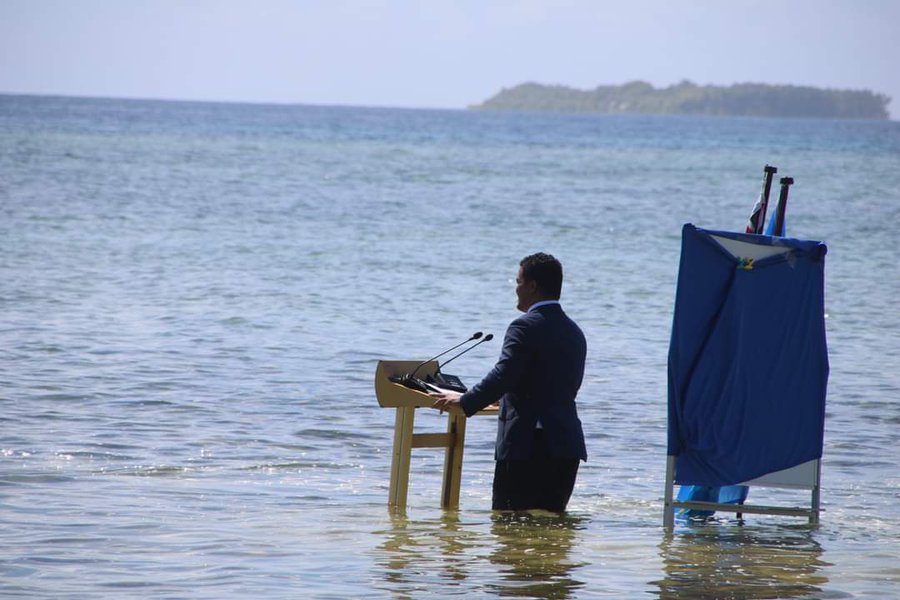
Tuvalu Addresses COP 26

We have become a place of long weeping; A house of scattered feathers; There is no home for us between earth and sky.   Rebecca Roanhorse

And so you travel.  Forgetting that the problem is you.  And wherever you go, you carry yourself.  Ezinne Orjiako

The ultimate paradox and irony of this tragedy is that, in many cases, those who caused their displacement and those who hate them in their newfound ‘homes’ in exile are the same people! Louis Yako

There is no destination other than towards yet another refuge from yet another war. Theresa Hak Kyung

Distance is the journey. Displacement is the result.  Jaclyn Moriarty

People returned to live on city streets and pavements, in hovels on dusty construction sites, wondering which corner of this huge country was meant for them.  Arundhati Roy

She had sculpted the mist, the way those who have no choice do. Padma Lakshmi

One of the seemingly eternal struggles of small organizations as ours has been for a generation is how to add value:  how to support the work of others without taking credit for its outcomes; how to call attention to the pain of others without appropriating that pain to raise our funds or build our brand;  how to join voices with others without losing our own distinctive notes; how to honor those “sculpting the mist” without losing sight for one moment of the privileges associated with honoring such profoundly challenging sculpting in the first place.

For me, for us, as we end our current iteration the journey towards a fresh engagement with global crises is already underway. What is already clear is that the path to engagement will likely run through the issue of displacement, those who have lost their homes as the result of family meltdown or economic collapse, those “taking refuge from another war” as we now see in Ethiopia, those who can no longer harvest their lands or their traditional fishing grounds due to ruinous levels of flooding and drought, especially those living on relatively remote islands facing climate shocks which they did not create, for which they cannot possible be prepared, and from the increasing fury of which there is simply nowhere to hide.

Of course, settling on a rubric is not the same as settling on a strategy to encourage and support change.  To that end, I joined yesterday with some activist friends on a march in support of unhoused people and the services which are both insufficient and indispensable in moving people off the streets, helping them find both stability and identity in multiple forms, from reliable indoor plumping to a equally reliable mailing address.

Sadly, this march took place not in a populated area, not in a place where homeless people gather, but in the parking lot of a sports arena.  Somehow, some way, the decision was made to organize a 5K walk in a place with no relationship whatsoever to the people for whom we were allegedly advocating.  There were apparently few if any unhoused persons on the march. There was no audience to inspire along the route.  There were no occupied homes or apartments in sight. There was no press to speak of.  No one could even enter the march route through security unless they could demonstrate that they had both paid their fee and had been vaccinated for COVID, two requirements virtually guaranteeing that none of those experiencing the “long weeping” of displacement (or perhaps none of those currently on the cusp of their own homelessness) would be able to join the lovefest ostensible organized on their behalf.

It was difficult to escape the conclusion that I and the others on that march had done nothing of substance to help the displaced.  What we had done, if anything, was to help brand the sports arena and the major donors who are, after all, so often the preferred destination for the efforts of the organizers.  It was all about money, we didn’t have much of it to offer, and so we were relegated to walking around an empty parking lot as though being exiled as punishment for our modest resources and/or our political naivete.

This trek in the parking lot at least called to my own mind scenes on the other side of the world: in Ethiopia where armed groups inch closer to Addis Ababa, creating both panic in the capital and fresh displacements along the route of conflict.  And, of course, in Glasgow where erstwhile global “leadership” convened, yet again, to offer a bevy of “solutions” to the climate crisis ranging from the genuinely hopeful to the merely distracting, a crisis already displacing millions with millions more likely to come.

More than officialdom made its way to Glasgow.  Thousands of young people did also, youth for whom climate change represents more than an inconvenience requiring more than a chain of UN-brokered “talk-fests” which might well result in more dangerous carbon emissions than prospects for meaningful change.  These youth filled the streets and, in some limited instances, the conference rooms, lamenting the reality that youth are much more likely to be heard than heeded, that decisions about the policy trajectory for climate mitigation and adaptation, for reducing disaster risks and increasing options for survival when risks turn so many lives of the affected into “scattered feathers;” these decisions continue to be made by older folks like me. Many of these decisionmakers are unlikely to ever be displaced from their private jets let alone their homes. Moreover, they will never have to sit across a table and break the news to climate-affected people that their dreams are soon to be burned or washed away, or that the footsteps of armed groups are fast approaching. Older folks not unlike myself will never have to share the news with affected people, as former Liberia president Ellen Johnson Sirleaf noted this weekend, “that they must leave their community or drown.” 

The youth in Glasgow this week were thankfully not marching back and forth across the parking lot of a sports stadium.  They were visible to the public, to the global press, surely even to those inside the COP 26 conference rooms. And their urgent, frustrated and at times defiant messaging was picked up, especially by those from the least developed and small island states who, as we and others have noted time and again, have done the least to create climate change but who suffer the most from its impacts. Such impacts include many displaced crossing borders and regions seeking a modicum of safety and stability from climate threats and the economic ruin and armed violence which often follow, those forced frequently to take refuge amidst hostility from people who, in more than a few instances, made significant contributions to the conditions that prompted displacement in the first place.

The impact of these youthful voices on small island and other officials was clearly apparent, including on  Fiji’s fine Ambassador Satyendra Prasad who bluntly asked, “If we are not to achieve 1.5 degrees, what are we here for?  Everything else is a side-show.” The president of climate-impacted Madagascar reminded us all that “forests are the lungs of our planet,” but that these lungs are being damaged at a staggering rate. And perhaps the most compelling address from officialdom was delivered by the remarkable Prime Minister of Barbados, Mia Mottley, who underscored the “immoral and unjust” implications of lives and livelihoods lost as we continue to ignore our climate pledges or fulfill them only incompletely. As did the youth on Glasgow streets, Mottley pondered boldly and wistfully, “when will leaders lead?”

On the UN side, Secretary-General Guterres warned about the “delusion” that we are making the progress we need to make on climate change. The former Ambassador of Jamaica, Courtney Rattray, now Under Secretary-General for the Least Developed States, made several high profile appeals for climate funding to help stabilize least developed societies and avoid mass displacement. And in a related event on tsunami risk, the head of the UN’s Disaster Risk Reduction program Mami Mizutori urged us to never forget the “the disasters we were unprepared for and the casualties they caused.”

But it was the ever-passionate David Attenborough, early on at this COP event, who worried and wondered if “this is how it ends” for we humans, allegedly the greatest problem solvers in the history of this planet?  Ends in fires and floods, ends in mass displacement and homelessness, ends in “bad faith” engagements by officials who know better and refuse to act on what they know? One compelling response to this lament came later from a Samoa youth advocate who reminded us of the power of words “to save us or sell us out.” You all know why you are here, she proclaimed. “Do the right thing” and while you are doing that, look to the leadership of Pacific youth. “We are fighting not drowning.” 

Indeed, their struggle must be our struggle as well. The alienation, insecurity and displacement they experience now are coming for us as well. For people like me, the grave might save us from having to confront the consequences of our folly, of our willingness to only make the changes it is convenient to make, not the changes that we know we must make.  But this should offer no comfort, no excuses.  Instead, while we are still able, we must do more to ensure that the toxic consequences of our inept climate and economic policies – the unhoused, the unfed and the unprotected – are not allowed to define life for other generations.

This week, Costa Rica’s president reminded delegations of the absurdity of conducting war — military or economic — on a planet which is slowly dying. He called instead for an “army of ideas, of courage, of peace.”  It is increasingly likely that such an “army,” if it comes to exist, will consist largely of the young.  If the rest of us want to make a real difference, including on the causes and consequences of human displacement, we will need to do more to support, sustain and enrich youthful aspirations.

Spare Change: Beyond Policy Convenience and Comfort, Dr. Robert Zuber

17 Oct

The world as we have created it is a process of our thinking. It cannot be changed without changing our thinking.  Albert Einstein

To know what people really think, pay regard to what they do, rather than what they say. René Descartes

Our ability to adapt is amazing. Our ability to change isn’t quite as spectacular.  Lisa Lutz

Nothing is so painful to the human mind as a great and sudden change.  Mary Wollstonecraft Shelley

The only crime is pride.  Sophocles

You can’t make them change if they don’t want to, just like when they do want to, you can’t stop them.  Andy Warhol

If you want to change the world, pick up your pen and write.  Martin Luther

When I was younger (no time recently) and cutting my teeth on nuclear and environmental activism, I was intrigued by notions being floated at that time to help complete the multilateral project through a significant reform of its infrastructure – practically and considerably modifying the statist assumptions of the UN and other institutions, assumptions which presumed that multilateralism was state business and only extended to others when states decided to invite their presence.

Those modifications were deemed necessary at that time by myself and many others not so much because of our demand for a “voice;” (after all, those of us working on nuclear and environmental issues were mostly people of privilege to begin with), but because it was unclear, absent significant pressure from non-government advocates, that states would be able to fully meet the moment – to shed their national pride, their diplomatic protocols, their sovereign concessions, their longstanding political grievances, their ideological predispositions and more — and demonstrate to the world that they are prepared to endure whatever pain is needed, do whatever is necessary, to heal our damaged planet, to move away from the precipice of nuclear and environmental catastrophe and  repair our damaged politics. 

A large component of fulfilling this agenda, of course, is the willingness to make use of all available wisdom and expertise wherever it might be found, to embrace the inconvenient as well as the comfortable, to shed the skin of predictability and replace it with innovation which – then as now – exists in far greater measure in cities and communities than individual governments and even multilateral institutions can apparently appreciate or assimilate (even if they would wish to do so). 

In this context, the pandemic-inspired call by some states, and acquiesced by some others, to return spaces like the UN to the primacy of “inter-governmental processes,” represents in our view a serious misreading of our current moment.  As many UN-based delegations themselves recognize, public trust in governance is lagging almost across the board.  Some of that trust deficit is related to states which seem completely out of touch with the needs and aspirations of their own people, acting as though political power is primarily an entitlement to be used to the benefit of leadership and their circles, that promises are what you use to get elected (or coronated) and then tossed into some metaphorical recycling bin in case they are needed at a later time in an attempt to prop up support for shaky regimes.

But part of this trust deficit is related to assessments of state competence, the fear that (much like in individual therapeutic contexts) some states are only willing to make only the “spare” changes they are comfortable making, not the changes that this current brew of climate change, pandemic spread, biodiversity loss, food insecurity and conflict-without-end now requires of us.  The UN, for instance, is a place where all the critical issues of our time are routinely discussed.  And yet there is also a sense more broadly held than many would like to admit that when it comes time to move from urgent discourse to meaningful change, the system too-often pumps the brakes.  Like the winter heat in my New York City apartment where the old radiators are permitted to emit only enough to stave off illness and frostbite, we are collectively still addicted to only the questions we are comfortable asking and those large, government-hosted events that produce only enough “heat” to keep some of us believing that this time – just maybe – the results will justify the vast expenditures of human energy and carbon emissions required to hold them.

As it was in my past, it is not clear that such a belief is now justified more than in part.  During the next few weeks, the UN will be seen co-sponsoring a series of major events – on sustainable transport, on biodiversity loss and on climate change – all of which have vast and direct implications for what UNSG Guterres has branded as our “suicidal war on nature.”  And while the Sustainable Transport event in Beijing produced some interesting remarks including calls to end “short-termism” by the Panamanian president, the Russia president used his time to tout the construction of new highways and designation of new air and sea corridors, reminding some of the very practices that made this event necessary in the first place.

This all-too-frequent confusion of roles and goals simply isn’t good enough to produce meaningful change, let alone to prevent a global “suicide.”  Every day that we voluntarily pump the brakes on the changes we know full well we need to make, every day that we accede to unnecessary compromises and political conveniences, the world is one step closer to a miserable and preventable end.  And every day our “leadership” fails to deliver progress on the challenges we are running out of time to resolve, it becomes harder and harder for individuals to choose the path of change and renewal in their own lives.  We live in this conundrum now — of more than a few states becoming too comfortable making “spare change,” but also (deliberately or otherwise) impeding those many individuals, organizations and institutions – including many experts in the UN Secretariat itself — who would urgently and willingly rise to to a higher calling, people who recognize that the changes required of us going forward will only become more sudden, more painful to behold.

As Global Action moves inexorably towards hibernation, it has been emotionally moving to hear from so many former colleagues struggling to forge more sustainable habits in the absence of consistent state leadership, to somehow succeed in transforming long-standing dreams of travel and other leisure activities into higher callings of solidarity with those many millions who will never board airplanes or stay in resort hotels, who will never be invited to Glasgow or Beijing or other centers of policy attention, but whose very lives are impacted by the actions we take, all of us, every day. 

I know that over this past pandemic year my own bucket list has shrunk to the size of a measuring cup.  Despite a long adulthood of (relatively) simple living, I have also been so privileged to see enough of the world to know something of its wonders and its struggles, but also to recognize the degree to which the former face precipitous decline while the latter continue to expand.  This is simply untenable.  We can’t presume to care about the future of our children as pride and greed stalk every corner of our planet, and as the gaps between our urgent words and carefully calibrated deeds continue largely un-narrowed.  Our excuses and rationalizations, clever though they may sometimes be, must come to a halt. 

I have had quite enough of my own hypocrisy, throwing spare change at former neighbors and using far more than my share of available resources.  But I have also had enough of “inter-governmental processes” that fail to deliver in proper measure what we all know we need with respect to every one of the UN’s core policy frameworks, from security and rights to climate and development.  The choice at this point for states in capitals or multilateral settings seems clear – find the courage and cooperative means to clean up the messes we’ve collectively made or open the doors to the rest of us with mops and cleanser at the ready and fortified with the full determination to use them.

Roaring 20s: The Voices we Need Now, Dr. Robert Zuber

10 Oct

Next year’s words await another voice.  T.S. Eliot

The loudest words are the ones we live.  Mia Sheridan

If you can roar, roar for others.  M.L. Shanahan

She was a voice with a body as afterthought, a wry smile that sailed through heavy traffic. Don DeLillo

Speech is the voice of the heart.  Anna Quindlen

Their comfort isn’t worth your silence.  Rudy Francisco

Don’t let a loud few determine the nature of the sound. It makes for poor harmony and diminishes the song.  Vera Nazarian

Two things happened at the UN this week, both potentially quite positive and both related to each other at least in my mind, though perhaps only to my mind.  First off, amidst all the appropriate hand-wringing about the decline of both biodiversity and human agricultural health, amidst the gloom in some quarters (including ours) that the upcoming COP 26 meeting in Glasgow will not result in firm commitments to the changes we are running out of time to make, the Human Rights Council passed a resolution affirming that “access to a clean, healthy and sustainable environment is a human right.”  With leadership from Costa Rica and other states, this resolution will soon be passed on to the UN General Assembly for final consideration, hopefully in time to create even more pressure on the Glasgow delegations to negotiate urgently and act boldly while action is still a remedial option.

And in New York, a group of 61 countries with Denmark and Costa Rica (again) in the lead, urged through the Third Committee of the UN General Assembly to end what was deemed the “silence” of civil society, referencing groups that through their lived experiences, diverse range of expertise and feet on the ground, “enrich and improve the relevance and outcomes of our work.” This statement called both for UNHQ access for NGOs and a stronger online component to allow those far from New York to keep abreast of what the UN is doing and not doing to address global needs.   The statement also highlighted that while this silencing of NGO voices impedes engagements between delegations and diverse civil society backgrounds and expertise, it also sends a signal to abusive regimes that civil society involvement is no more than a marginal enterprise, and that attacks on human rights and environmental advocates, indigenous leadership, media professional and more can more easily be conducted absent UN rights scrutiny.  This is especially jarring with respect to civil society leaders who choose to cooperate with the UN in implementing its own human rights and environmental priorities.

Those of you paying attention so far might well have ascertained the linkage that forms the basis of this post.   But if not, please allow me to lay it out as best I can.

As welcome as the Human Rights Council resolution is in placing clean, healthy and sustainable environment squarely within the domain of the UN’s human rights pillar, questions of implementation stalk this resolution as they do most that emanate from this Council or the General Assembly to which it is tethered.  Questions go beyond how we can possibly guarantee such a right to other fundamental questions of how we should best pursue this fresh obligation.  Whose job is it to promote the kind of environment we increasingly do not now have, to enable the benefits of a healthy, sustainable environment to the communities most in need, those who are most threatened by eco-predators, whose fields are most rapidly losing their productivity as floods and drought ravage and pollinators have long since fled the scene?

In our own work and through wonderful partners such as Green Map, we have long advocated a localized approach to mitigate the impacts of environmental deterioration and climate change and have done our small part to develop and disseminate tools that can help recover both a sense of place and the full, healthy recovery of those places, recovery led by those who know their spaces and its diverse inhabitants better than any outsider or algorithm possibly could, leaders with homegrown ideas about how to address threats, including from mining interestes and other eco-predators, which are less likely to make circumstances for themselves and their families even more challenging.  

In this tech-charged and overly bureaucratized world we are fashioning for ourselves, it is relatively easy to romanticize local leadership.  We have certainly done so, though many of our previous travels and connections have led us to the conclusion that this is not a wholly inappropriate exercise.  People in these diverse settings may not always “know” what we know, but they certainly “know” differently, sometimes better, and what they know can be essential elements in both local environmental restoration and in building capacity to cope with shocks to come, shocks generally not of their own making but certainly the cause of their own suffering.  It is this ability to convince local others that restoration is still possible and then to grow the number of hands and minds devoted to that restoration which ultimately gives me hope, indeed as much hope as welcome resolutions emanating from Geneva and New York, some of which have mostly gathered dust after the initial energy generated by their passage has worn off.

We know that there are many such people of commitment and energy, many caretakers of locally-led organizations that offer tangible hope to people who may well feel let down or under-served by people like me, people like me who so badly want to get back inside the UN that we may have forgotten what we are there to do. We can forget what privilege requires of us as we return to a setting where our own voices have always had an outsized volume, a “roar” which is too often about our organizational mandates and not often enough about enabling those who seek and deserve the opportunity to roar for themselves, not only to speak at our conferences and zoom meetings but to have that speech be meaningful, actionable, influential.  We reference here voices that aren’t always required to be polite or driven by protocol, that are able to speak their accumulated truth firm in the knowledge that such is more than a mere exercise to gain status or funding, more than a one-off which moves an audience out of their comfort zones for a fleeting moment but which does not often enough result in real partnership based on the flow of ideas that better connect the norm-builders in our global centers with the people who, from their more local vantage point, don’t always experience those norms as amounting to enough.  

Given the time left for us, and despite my profound gratitude for those seeking to enable our UNHQ return, I don’t know for sure that I will ever again set foot inside the UN.  Our 20 months of remote online coverage has convinced me (and a few of our junior colleauges as well) that the UN has become akin to alien space, well branded, utterly state-centric, attracted to money and organizational heft like bees to honey, stubbornly holding on to antiquated fire codes while the world burns around it.  We have long fought thse trends as we have reisisted what we have seen as the “voice over” disease, the tendency to roar over the aspirations of others, the tendency also to forget that as our speech is the voice of our hearts, so too is it the voice of the hearts of millions of others. These are the millions whose own path to progress remains akin to navigating heavy traffic, overcoming one obstacle after another, one burnt field or frightened child after another, one crisis that they are late to solve before another crosses their path. But these are also some of the voices of persistence, the persistent convinction that sustainable progress is possible, that lands laid low can regain their bounty, that damaged biological chains can recover their predictability, and that the guns which have stood as an almost insurmountable barrier to any sustainable relief can finally go silent.

In a policy world of voices muted or unheeded, ours has mostly had a volume disproportionate to the size of our lungs and the strength of our vocal chords.  Given this, we have tried our darndest to let our lives drive our voice, to embed our values in our policy and organizational choices and less in our speeches. But we also recognize that the world has changed so much over 20 years. There are now so many voices in the queue waiting to roar, waiting for a chance to be heard, waiting to be taken with full seriousness.  Perhaps more than any time in our professional lives, “next year’s words await another voice,” another voice which can convince and contextualize, which can cajole and correct, which can sing an energetic tune demanding the more harmonious relations which have largely eluded us during our own tenure.  With whatever time we have left, and for the sake of a planet in multiple forms of distress, we will continue to do what we can to find and encourage those next voices.

Word Play: Expectations Fit for a World in Crisis, Dr. Robert Zuber

19 Sep
See the source image

Expectations were like fine pottery. The harder you held them, the more likely they were to crack. Brandon Sanderson

If it be now, ’tis not to come. If it be not to come, it will be now. If it be not now, yet it will come—the readiness is all. William Shakespeare

Everyone seems to have a clear idea of how other people should lead their lives, but none about his or her own. Paulo Coelho

To wish was to hope, and to hope was to expect. Jane Austen

It wasn’t that things were harder than you thought they were going to be, it was that they were hard in ways that you didn’t expect. Lev Grossman

After all, what was adult life but one moment of weakness piled on top of another?  Tom Perrotta

You are one of the rare people who can separate your observation from your preconception. John Steinbeck

Earlier this week, my dear friend and Green Map colleague, Wendy Brawer, sent me a photo of a group of young people staging a “die-in” in front of UN Headquarters to protest the lack of movement on climate change from the world body and, more specifically, from many of its member states.

This protest occurred on a week when the UN Intergovernmental Panel on Climate Change released a report which reached conclusions more discouraging than shocking – that at our current rate, we will not only fail to reach the Paris Climate agreement goal of remaining at or below 1.5 degrees C, but that we are likely to exceed 2 degrees C of warming leading to a bevy of unwelcome consequences including exceeding “critical tolerance thresholds for agriculture and health.”

The Secretary-General, as is his want, warned states yet again of the “insufficiency” of current efforts to reduce emissions, proclaiming that we are running out of time to do so while acknowledging in public (as we and others have been warning for some time) that the COP 26 climate conference scheduled for later this year in Glasgow carries “a high risk of failure.”  Indeed, we have been concerned for months that COP 26 might well generate more emissions than its outcome document will mitigate; moreover that we don’t need yet another major conference to underscore the urgency of the moment, an urgency well documented in a bevy of UN reports as well as at prior COP events which, collectively, do not seem to have yet inspired anything akin to a proportionate response.

The young people lying on First Avenue are certainly taking climate warnings seriously.  Their youthful years already compromised by a raging pandemic, personal debt burdens and shrinking economic options, these activists recognize a threat to their future that may soon reach a point of no return, the effects of warming that will keep their adult lives pivoting endlessly from one crisis to another, from drought to flooding, from farmlands which no long yield their bounty to pandemics and hurricanes creating fresh human emergencies with equal frequency.

That they chose to lie down in front of the UN was, to my mind at least, communicating a dual signal; on the one hand a recognition that the UN as a body has not met expectations, has not converted the warnings it liberally proclaims into tangible and proportionate responses by many of the member states which pay its bills and authorize its policy commitments.  At the same time, there is a sense that, if only it could speak with one voice, the UN is still a place where aspirations for peace, equity and environmental health could be converted into something more concrete and results-oriented than large conferences making even larger promises unlikely to be kept.

Assuming that I have this pegged correctly, this dual assessment by these youth activists closely mirrors our own.  As we start to wind down nearly 20 years in and around UN Headquarters we are inspired by the range (and sometimes depth) of issues on the UN’s agenda, but also discouraged by how many of those issues get bogged down in matters both political and procedural.  We are dismayed at how often statements by governments are as likely to cover up key truths as to magnify them, how often the things left unsaid are more significant to the future of the planet than what states actually share, how much easier it is for states – whether on climate or armament, whether on vaccine distribution or aid to Yemen — to make pledges than to honor them.

Like others around this UN system, our assessments are largely a function of our expectations.  We know that people can observe, even without preconceptions, the same institutional circumstances at the same moment and come away with quite different assessments of their value and significance, depending of course on their expectations of those institutions in the first instance.  If we expect little and those expectations are exceeded, assessments are likely to be positive.  If we expect much and such expectations are not met, assessments are likely to be considerably more pessimistic.  And if we expect too much, more than the UN or perhaps any institution can bear without cracking apart altogether, we risk deep disappointment much more inclined to cynicism than to activism.

We have long been in this second camp and sometimes had to struggle not to be in the third. We have always been of the belief that the UN community –including we NGOs — has been insufficiently willing to match policy to urgency, has been insufficiently willing to convert its institutional processes and commitments into actions which demonstrate that we truly understand the times we face, the burning of forests and bridges, the flooding of waters and excessive armaments, the states that talk a better game on multilateralism than their domestic political situations allow them to play.  We have witnessed, time and again, states verbalizing support for urgently-needed policy change or even institutional reforms only to undermine either when the time comes for the UN to meet the moment.  We have also witnessed, more than we would ever wish, states equating national interest with global interest or other stakeholders assuming that one single policy lens or set of recommendations would ever be suitable to reset a world now characterized by such cultural, economic and ideological disharmony.

But to be fair, there are pockets of forthrightness in this multilateral system which give credence to higher expectations that the UN itself continues to both encourage and frustrate; states, UN agencies and NGOs insisting that we talk about reducing the production of armaments and ammunition as well as about arms diversion and trafficking; states and others insisting on fair and equitable representation in Secretariat offices and even in the Security Council; states and others which have shown the way on sustainable energy and ocean health critiquing those still addicted to fossil fuels and/or oblivious to biodiversity loss; states and others urging “readiness” for future pandemics even as we struggle mightily, if unevenly, to contain the current one. 

As this strained planetary moment unfolds, we are compelled to honor all who dare to elevate levels of expectation for the UN system. To that end, one of the signature events of this UN week was the handover of the presidency of the General Assembly from Turkey’s Volkan Bozkir to the Maldives’ Abdulla Shahid.  During his final remarks as president, one which we felt he was a bit sad to relinquish, Mr. Bozkir provided what characterized his entire term, what he himself called a “blunt” assessment of our planetary conditions and the role that the UN should play – must attempt to play – in shaping a more peaceful and sustainable world.  He noted here as he did throughout the year the heavy lifting which must be assumed by this “most representative” Assembly in meeting our responsibilities to sustainable development, to peace and security, and to the reduction of global inequalities.  He implored colleagues to abandon nationalist lenses and “go it alone” approaches, including on climate change, and urged greater attention to how this “unique body” can be used more effectively in the pursuit of a sustainable peace.  And as though any of us around the UN should ever need this reminder, he reminded us anyway that “words are not enough.”

Not nearly enough.  Not now.  Not at this precarious moment in history.  Not for the millions of global constituents longing for peace and the development “dividends” which peace brings.  Not either for youth lying prone on First Avenue hoping both for a voice in global policy and for a clear sign that those working a stone’s throw from their street protest can match the urgency of the moment with leadership and resolve to take at least some of the grave threats facing these young people off their collective plate.

If such an expectation is too much for the UN system, if the bar of an inclusive and sustainable peace proves to be just too high, then we would do well to wonder if the institution will ever be, as we say over and over, “fit for purpose.” Whether we are strong enough to pursue this or not, whether the UN is ultimately able to assume a loftier mantle or not, that “purpose” now is nothing short of saving us from ourselves, of peventing the symbolic “die ins” of our activist youth from becoming an omen of our collective future.


Why Care? A Reflection by Brady Sanders

10 Sep

Editor’s Note: This second and last (for now) post from Brady Sanders seeks to answer a question that we pose to all interns. What should people in your professional or academic circle know about the world? And why should they care? Answers to questions like this are fundamental for us as we try in our own small way to grow the minds, hearts, hands and skills available to contribute to peace in multiple contexts. In such work, knowing and caring are obvious prerequisites.

At the conclusion of my summer internship with GAPW, Dr. Zuber asked me to construct a blog post answering these – seemingly – simple questions, “what should people in my professional circle know about the wider world and the people who inhabit it?  Why should they care about things beyond what their families and professions require them to know?”   On the surface, these seem like straightforward questions, with the answer being, without knowledge of what is going on in the world, one cannot attempt to make it a better place. However, upon delving deeper into this topic, its layers are revealed: specifically, why do individuals not know about global events? In this post, I plan to address not only what I think my peers and colleagues should know, but the overarching issues as to why they don’t know about these topics.

In my life, I have witnessed many people not knowing what is going on in the news, especially globally. Why is this the case? Many argue that people do not care – especially Americans – due to our stereotyped nationalism. However, I must disagree. I think people do care about what is happening, but they feel helpless. Many think that since they cannot do anything about the issue, they are better off just glossing over crises and not using their energy to understand those problems. The second, and the more alarming, reason is that there is so much sorrow in the news today that people have become desensitized to atrocities. The number of times I have heard people say, “I don’t listen to the news, it’s too sad,” is disheartening. This is a complex issue to tackle because the news has to get reported, particularly the sad news, so people can help stop these atrocities. But then when these difficult situations are covered, people say that it is too just too hard to process and stop watching. In my opinion, this is one of the most difficult bits of feedback to fix, and I will be honest, I genuinely have no idea how to break this cycle without a societal change that currently lies beyond my scope.  

Another question that people ask all the time is, “why should I care about something that is happening halfway around the world?” This is a completely valid question. Why should I, someone who lives in the middle of a privileged country, need to worry about what is happening in the middle of a more exploited country, as it has no direct effect on me? For one, if human rights are violated anywhere, it is something everyone should care about. Secondly, while these global events may not seem impactful to you now, they one day will be. For example, people living in Europe should care about the United States and our environmental laws, or honestly, our lack of environmental laws. Why is this? The impact of our emissions is not localized to where we live. Our CO2 levels will impact the global CO2 levels and increase the rate and severity of global warming’s consequences for everyone.

Another may ask, “why should I worry about conflicts if they don’t affect me?” Well, they do. The money spent by governments to pursue and address these conflicts is almost unimaginable; if such conflicts could be rooted out, this money could go towards more human security priorities and lead to a better world for us all. This money could feed the 820 million people around the world who are food insecure. This money could help provide drinking water to the 2.2 billion people who need access to safe, potable water. This money could help the 82.4 million forcibly displaced persons during 2020 alone start a new life. It seems evident that the money spent on conducting these conflicts could be used in much better ways, but the only way to solve conflicts peacefully is through diplomacy, and for this to work, we need to make sure the whole world knows what is going on.

This starts with you. And with me. Watch the news. Find and read a newspaper focused on global affairs because the news we consume in the US is often missing a wider, global picture. But more importantly, find ways to get involved. While your efforts may seem fruitless at times, don’t get discouraged; any help, any start, any means is better than inaction and indifference.