Tag Archives: climate change

Kid Rock: Youth and the Struggle for a More Harmonious Planet, Dr. Robert Zuber

15 Aug
Visual search query image

Magazine.Columbia.Edu

One day, you will be old enough to start reading fairytales again.  C.S. Lewis

For society to attempt to solve its desperate problems without the full participation of even very young people is imbecile.  Alvin Toffler

The older I grow, the more I distrust the familiar doctrine that age brings wisdom.  H.L. Mencken

I can tell you that you will awake someday to find that your life has rushed by at a speed at once impossible and cruel. Meg Rosoff

“Sure, everything is ending,” Jules said, “but not yet.” Jennifer Egan

That’s the duty of the old, to be anxious on behalf of the young. And the duty of the young is to scorn the anxiety of the old.  Philip Pullman

When I was a boy the Dead Sea was only sick.  George Burns

This was a week when many members of the UN family took a bit of rest from the grind of multilateral diplomacy, a time to restore at least a bit of the energy to the “batteries” which seem perpetually in need of a charge.

The world, however, doesn’t privilege holidays.  Indeed, our community was peppered this week by news both urgent and discouraging:   a massive earthquake in “snake-bitten” Haiti, the discovery of new Ebola cases in Guinea and Côte d’Ivoire, the rapid fall of Afghanistan to the Taliban and their enablers, an enhanced potential for civil war in Myanmar, even an increase in piracy and other crimes against maritime trade and the very health of the oceans themselves as acknowledged during a High-Level Security Council debate on Monday hosted by India’s Prime Minister Modi. 

Added to that, surely the most discouraging news of all; the release this week of the “Climate Change 2021: the Physical Science Basis” by the UN’s Intergovernmental Panel on Climate Change.  The report is difficult to wade through (despite its inclusion of an interactive Atlas) and the main conclusions of the report are even more difficult to process: that even if we are able to somehow meet our climate targets, the patterns we now experience are sure to endure: storms of increasing violence and frequency, fires raging on multiple continents depleting even more of the forests we need to absorb excess carbon, water scarcity becoming increasingly the norm in a number of global regions, biodiversity threatened at multiple points on the chain of life endangering both agriculture and human health.  

There is more of course, more to be concerned about even than these. The SG’s response to the IPCC report, a “Code Red” for the planet, was widely disseminated throughout the global media.  The response of the young people around our office as well as those who gathered online this week to acknowledge UN “International Youth Day” was equally firm in the insistence that more can and must be done to “reverse the trend” (as our office colleagues would say), that the speed of our lives, the speed of global changes, must be matched more than has been done to date by the speed of our own responses, our own adaptations, our own resolve and, where appropriate, our own leadership – all of which beckons the skills and energies of young people at its core.

If this indeed is “code red” for the planet, it is surely “code red” for the future of young people, a future already compromised by high levels of economic uncertainty and even higher levels of social inequality and armed violence.   There is much to love about the world, beauty within people and in the wider planet which our short-term and self-referential decisionmaking has not yet managed to eradicate.  But the vantage points of too many elders suggest trouble; the lack of wisdom and discernment that such folks too-often bring to policy, the “advice” we are happy to dispense (often unrequested) without a similar acknowledgement of the crises made more dangerous on our watches, the fires we have not extinguished and which will continue to consume after we have passed on from this life, the frustrations that will keep spinning out of control as more and more people see through the half-hearted, overly-politicized efforts of many of the powerful and affluent to attend to the needs and aspirations of the desperate.

The times may seem a tad distressing, but the social and technological options which govern life in our times remain in healthy motion. We face problems which are unprecedented, but we also have access to avenues of response which are unprecedented as well, technologies which can remove plastics from our oceans and carbon from our atmosphere, communication tools that can help broaden the stake and integrate hopeful responses from youth and others geographically isolated from the global centers of policy.  While people like me press the buttons on our smart phones and just hope for the best, while others attempt to sentimentalize a past that was never as good as we claim it was, many young people are staking out a fresh, hopeful reality which, remarkably, does not reject the ideas, anxieties and suggestions of their elders as much as they might.  As a rule, they know better how to adapt the problem-solving and communications-rich technologies at their disposal to make issue linkages and identify new stakeholders.  They are often more comfortable in multi-cultural settings than their elders were and they are assuredly more comfortable in front of cameras than people like me who can barely stand to have their own picture taken.

 Many young people are also, and thankfully, fairly well attuned to the need to mirror changes in technology with changes in persons. Many seem to understand at some level that neglect of character in pursuit of social change is likely to lead to the same ends as the generations which proceeded them, a world with too many weapons, too little water, and health and other quality-of-life indices which strain existing resources and provide yet another rationale for armed violence. It was reassuring that the interns of Reverse the Trend (RTT) who met with the Kiribati Ambassador to the UN this past Friday on our “patio” seemed inspired by the kindness and hopefulness of his words, but also energized by his resolute stance that young people from every continent and every culture must come prepared to participate meaningfully in the affairs that characterize these times, prepared not only with their skills and ideas, but with their compassion, discernment and creativity. 

Such RTT and other youth may not be quite ready to once again take up fairytales, but they well understand and convey the importance of cultural expression to peacemaking; they recognize that poetry, dance and painting are not auxiliary aspects of an intentional life but are rather fuel for that life. 

During a typical week, we hear from (and respond to) a good number of young people from various cultures and on diverse life paths.  Some of these youth are discouraged; some are angry; some are thoughtful and determined; some are anxious that the current uncertainties will ultimately consume their potential contributions, that the wildly unequal access to resources which defined current generations will characterize yet another one.  And yet, despite their anxieties, we are heartened by how some young people have chosen a path not always taken, a path that calls them to invest in persons even younger than themselves, persons even more uncertain about their identities and threats from a world in turmoil.  Together they plant trees, they clean riverbeds, they grow healthier crops, they resolve conflict, they support victims and they presume to call on current leadership, including those rightly skeptical of the wisdom of age, to use their positions to better enable that transition to youthful energies which most UN diplomats now advocate.

We too, support this transition in every aspect. And just maybe, we’ve influenced some transition recipients more than we think.  One of our more active twitter followers is a young man (known only as “Sam”) from Côte d’Ivoire who recently wrote: “The values of a servant leader are the same as the values of a mentor: integrity, humility, respect and truth.”  Servant leadership, a concept and practice core to our own mandate. On those rock-solid values espoused by Sam, on those promises he strives to honor, we can surely build a movement for health and harmony that can truly sustain itself, that can blend inspiration and technology in new and life-enhancing ways, that can serve and be served beyond the boundaries of status and hierarchy, and that does not wait for official permission to share and to act.

And maybe, just maybe, Sam and his young colleagues can sneak in a bit of time for fairytales, or at least for the wise stories and accumulated imagination that remind us all why human life and human community remain so precious.

Honor Code: Heroism Fit for the Times, Dr. Robert Zuber

25 Jul
Visual search query image

Heroes are made by the paths they choose, not the powers they are graced with.  Brodi Ashton

We are all ordinary. We are all boring. We are all spectacular. We are all shy. We are all bold. We are all heroes. We are all helpless. It just depends on the day. Brad Meltzer

We find not much in ourselves to admire; we are always privately wanting to be like somebody else. Mark Twain

She preferred imaginary heroes to real ones, because when tired of them, the former could be shut up in the tin kitchen till called for, and the latter were less manageable. Louisa May Alcott

Dead people can be our heroes because they can’t disappoint us later; they only improve over time, as we forget more and more about them.  Veronica Roth

Who are these so-called heroes and where do they come from? Are their origins in obscurity or in plain sight?  Fyodor Dostoevsky

I like my heroes complicated and brooding.  Barbara Crooker

This week, the UN honored the life and legacy of Nelson Mandela in what has become an annual event for a system that is doing better and better at honoring in general, especially important as direct threats to UN personnel – peacekeepers, humanitarian workers, mine removal experts and other service providers — have risen dramatically in recent years.  Keeping people safe in the field, providing life-extending provisions of food and medical care, helping people recover from catastrophes of short and long duration, these activities are both noble and dangerous – the stuff of genuine heroism in our time.

Mandela certainly chose his own, difficult path.  When I met him briefly in South Africa he was well on his way from resistance to governance, bringing along with him values which are mirrored in the UN Charter and which are essential to both state-building and the promotion of lives of dignity.  These values were not for him, as they are so often for so many of us, attributes of adornment that we profess but don’t necessarily engage, but rather were embedded deeply in his person, a person who as noted during this event by UN Deputy Secretary Amina Mohammed, was grounded in a “stubborn optimism” which allowed him to carry on when others would have given up and allowed him as the DSG also noted to give to others in small and large ways with little regard for what he might receive in return.  He committed to ply his seminal gift, as described by South Africa’s Minister of Foreign Affairs, that ability he possessed to “see the indivisibility of the human condition in ways which were not always visible to others.”  As a result, as Gambia’s Ambassador offered, Mandela left a footprint that continues to help the rest of us and our perhaps more “obscure” heroism to leave our mark on “the sands of time.”

The Mandela ceremony and other events that defined this UN week reminded me of a long-ago incident in an Episcopal church where I was assigned in an attempt to learn how to do ministry and where I had just finished preaching about some social justice topic or other.   One of the parishioners on the way out of the service commented to me “I’m glad that someone is out there doing these things, doing the good work.”

Her comment, which I appreciated at the time more than I probably should have, was based on at least two assumptions which I later came to question.  The first of these is that because I am concerned about these issues, I am somehow contributing to their resolution – that “caring” has efficacy in its own right even when untethered to any viable, visible change strategy.   And the other, related assumption is that what I was allegedly “doing” was somehow sufficient unto itself, that is, that I magically possessed what it takes to move the pile independently of others – including her by the way – pushing and moving as well.

These are some of the lessons that I largely failed to learn at earlier stages but which have become harder to miss over time.  I have more recently embraced the importance of practicing all that we espouse and of engaging issues in a way that balances representation (which I have not always done well) and recommendation (in which I have been a bit too invested).  But I also learned of the ways in which heroism becomes a conduit for what is often a messy – borderline imaginary — brand of vicariousness, people who have (often romantic) expectations that they place upon designated heroes and that none could fulfill.  If Mandela were alive now, his life would surely be picked apart by journalists and critics; his complications would disappoint as well as inspire; but he would also likely demonstrate more than the rest of us might be prepared to accept, that heroism is often situational and that those situations call out to all of us from time to time in our lives, call us to run towards the light rather than hide from it.  

And I learned, in case there was any doubt in anyone’s mind, that I am no hero myself, that my own path has not been sufficiently transformative or radical, sufficiently determined or hopeful, sufficiently connected or willing to wrestle with critics in the public sphere. 

But not rising to the level of the heroic does not – must not – obscure the contributions to a better world we are actually able to make.  We may not leave a mark “on the sands of time,” but we do influence others; we can do more to shape and mold, to inspire and sustain, to help process the great questions of our age and within ourselves.  We do have skills and energies which, alongside the skills and energies of others, can help to overcome longstanding challenges, including those of violence, environmental degradation and racial discrimination which were raised in various UN settings this week.  And we can offer discernment, thinking through the ideas and policies that might not otherwise be sufficiently vetted and that threaten to lead us down unfruitful and even dangerous paths. 

And perhaps most of all, to we can extend invitations to others to walk their paths and to share what they experience with the rest of us.   In this context, I was heartened this week during an event to assess the UN International Decade for People of African Descent regarding how the contributions of youth were depicted and encouraged.  As part of her keynote address, the Vice President of Costa Rica urged us to heed the voices of youth proclaiming that “enough is enough,” insisting that we must no longer accept any role as “accomplices” to the pain of injustice.  At that same event, a youth leader urged all to commit to being a “conduit” of change regardless of our station in life. One action at a time, she claimed, powers change in the world.

At this particular UN event as well as another focused on “open science,” there was little talk of heroism in the conventional sense and more of the need to “co-create,” to blend skills, aspirations and ideas in the service of a less competitive, more equitable, more inclusive world.  But it was also clear that the dual threats which these events exposed – racism on the one hand, climate change on the other – demanded action which is both urgent and thoughtful, both inclusive and impactful.  

One of the best presentations I heard this week was from Professor Geoffrey Boulton of Edinburgh who reinforced at the “open science” event the importance of “acting early and acting hard” on climate change as well as acting in tandem. He lamented our collective failure to heed lessons on climate change shared by both scientists and community practitioners, their collective and consistent warnings of a slow, “angry” onset of warming.  And he even wondered aloud if there is something wrong with us, if we are actually “hard-wired” for the short-term alone?

There may indeed be something wrong with us, but it is something we can still fix in ourselves, indeed that we must fix in ourselves if we are also to fix the threats now closing in around us. For all that we can gratefully learn from the paths chosen by Mandela and other heroes similarly situated, we remain today on a rather somber path, one largely unjust and unsustainable. If the times call for early and determined action, if the times call for us to co-create as “conduits of change,” it might be time for heroism that is less about superhuman and vicariously assessed contributions and more about building a roster of people committed to making and inspiring real change, keeping alive visions of a sustainable future that require many more hands and brains than are now engaged in hope-filled actions; inspiring others to overcome the fear and suspicion to which so many have succumbed and which seems to have maintained at least a good bit of its wide appeal.

If we learned anything during this time of pandemic, it is that heroism in our time takes many forms, wears many garbs, operates in many, often subtle contexts.   As our activist youth remind us, the heroes we need now are the ones who make space for others, who support and guide without regard for compensation, who dare pay attention to the aspirations and needs embedded in the people and spaces around them, and who walk the uncertain path towards a collective future that can sustain both our dreams and the life which holds them close.

For those who prefer imaginary heroes to real ones; for those who prefer their heroes dead to alive; or for those who prefer only “complicated and brooding” versions, we must continue to offer up a brand of heroism that we can honor in real time, a heroism that is hopeful and future-oriented, a heroism that is defined not so much by vicarious acts of greatness but by promising paths that we can choose to walk each day, and that we can commit to walk with others.

Revise and Consent: Enabling a World of Change, Dr. Robert Zuber

18 Apr
See the source image

We were revisionists; what we revised was ourselves.  Margaret Atwood

Not everything that can be counted counts, and not everything that counts can be counted. Albert Einstein

Improperly documented history, or more precisely, fraudulent versions of history not only deprive the victims of pasts injustices due recognition of their suffering, but also rob the living of a fair chance at a future free from the dangers of repeating past injustices.  A.E. Samaan

We have learned primarily by tinkering. Curt Gabrielson

In talking about the past we lie with every breath we draw. William Maxwell

If we don’t have real answers, it is because we still don’t know what questions to ask. Our instruments are useless, our methodology broken, our motivations selfish.  Jeff VanderMeer

It is in this childishly speculative state of mind, so different from common sense and its logic, that we know the world to be good. Vladimir Nabokov

Thanks to the confidence placed in me by a colleague, Barbara Adams, I recently published an article in a journal of development policy entitled “A Volatile Context: A Revisionist Lens on Good Governance.”

I’m not going to invite you to read the piece. It’s not dis-similar to the themes of this weekly post, but it is longer and surely more dense. It also reflects an assignment which I only accepted due to the editorial staff’s embrace of the “what if.” What would the world look like if our structures of governance were devoted to fostering care and equal access among constituents? What if governance were as competent and transparent as it often claims to be? What if governance were as concerned — in terms practical more than rhetorical — with the needs and aspirations of constituents as it is with its own protocols and power dynamics?

These and other, similar questions punctuated my piece, for better and worse. To be honest, I’m surprised it got published at all. In an age driven by data and branding, by professionals seeking control over smaller and smaller domains of human experience, speculative writing of the sort I indulge in has become a bit of a reach, and not an altogether welcome one. People in our governance and educational bureaucracies are rather preoccupied — and not without reason — with the accumulation and management of data, data that can establish trends and help ensure that, in the realm of policy and to the extent we are able, human and financial capital are directed towards the holes in security and justice that need to be filled and can be filled.

But it is clear in many places, including at the UN, that data of varying levels of sophistication and reliability does not always bring us closer to governance that is caring, responsive and trustworthy. Indeed, the pursuit of data can be its own endgame, accumulating “information” that in many instances is untethered to strategies to both unlock and incarnate its power to effect change; moreover, such data is often in flux as its gaps are only slowly recognized and fresh experiments are conducted that render the previous “truths” subject to a revised consent.

One of the smartest statements coming from youth climate activist Greta Thunberg was when she said, “don’t listen to me, listen to the science.” Yes, listen to the science, listen to those with data pertinent to the rendering of what are often dire predictions for our common future if we do not mange to revise our ways. But as Greta already knows, as any of us who ply our wares in the halls of global governance knows, such governance is as likely to render the power of science to something akin to a “petting zoo” as it is to unleash its full and furious influence over all our actions.

Simply put, we now know more than we do. Just this week, several good UN events underscored the degree to which having accurate data and incarnating relevant policy commitments are still at loose ends. We “know” that hording vaccines is ultimately detrimental to both the global economy and to the suppression of future variants — as noted this week in a special, high level event on “Vaccines for All” hosted by the president of the UN Economic and Social Council — and yet our commitment to equitable vaccine access remains well short of the need. We “know” as was stated often during an important UN event this week on “Financing for Development,” that a combination of debt burdens, limited investment access and illicit financial flows has made pandemic response and recovery a mere pipe dream, and yet our commitment to a revised, more inclusive financial system remains more the subject of speechmaking than practical application. We “know” as a civil society advocate from South Sudan testified in the Security Council this week that the wide availability of often-trafficked arms fuels so much of the violence and abuse in her country (and many others), and yet our addiction to the production and trade in deadly weapons shows little signs of abating. We “know” the many thousands in Yemen whose lives remain threatened after years of war by famine and economic collapse, and yet the Security Council remains largely impotent to end the violence let alone the impunity to which it has given rise. We “know” that we are unlikely given our current course to forestall the biology-altering consequences of a rapidly warming planet, but we continue to take more credit for our limited climate responses than to earnestly prepare to enact what the president of the UN General Assembly this week urged: “a greener and more equitable recovery that can keep our SDG commitments on track,” including and especially our lagging climate actions.

These disconnects between knowing and doing should not be laid at the feet of scientists, many of whom have no doubt had more than a few sleepless nights over these past months as emissions continue to rise and policymakers continue to defy reasonable, pandemic-related limitations in the name of disinformation or “freedom.” The same scientists who developed safe and effective COVID-19 vaccines in record time and implemented health protocols to keep many more virus victims alive than was the case last spring — including no doubt many COVID-deniers — know that such measures alone won’t end the pandemic if large segments of the public remain uncooperative and revision-phobic, and they certainly won’t help us prepare for the pandemics sure to come as we continue to wantonly disrupt the planet’s biological safeguards.

It may be the case, as suggested above by Curt Gabrielson, that we learn primarily by “tinkering,” through small-scale revisions to what is known and seen, small-sale adjustments in what is given. But for the policy community such revisions at small scale are no longer suitable, if they ever were, as they don’t sufficiently address the diversity of threats facing our current world. They don’t sufficiently address the barriers that keep so many human skills — of youth, of cultural minorities, of women, of persons with disabilities — on the sidelines of policy deliberations and decisions. And they don’t address the deficits of trust which are themselves a legacy of promises deferred or ignored, assistance barely rendered, entitlements and privileges not shared or even acknowledged.

If we are not careful, if we are not sufficiently vigilant, the “bubble” that institutions like the UN are accused of operating within will morph into an “island” to which we in the policy community might well be exiled. Such exile would complicate positive change as it would cut off large swaths of the global community from a UN system which still connects, still convenes, still calls attention to looming threats and policy options — and often with considerable skill. But the threat of exile looms, primarily from constituencies who feel that they can no longer believe in us or in the words we speak, who display an eroded confidence in our ability to distinguish between what can be counted and what counts, to prioritize those responses that truly matter to human and planetary well-being.

In this regard, I worry most about any potential erosion among the youth, this large and diverse generation trying to organize their lives and dream their dreams under clouds of pandemic, climate change, weapons proliferation, and massive debt. Despite all the outreach the UN does to young people, do they –will they — find the UN sufficiently responsive, sufficiently committed to their future, sufficiently savvy on matters from technology access to policy inclusion? Will they find value in our answers to compelling crises let alone consent to at least some of the questions we are actually willing to ask? Will they find in their interactions with us evidence that the world is good and beautiful, and will they continue to feel that it is worth their time and energy to preserve that beauty and extend that goodness?

On this the jury is out. Among the formal events on the UN’s calendar this week was a side discussion, organized by the Youth4Disarmament initiative of the UN’s Office for Disarmament Affairs, which brought together diverse young people — including several of our colleagues — to examine that elusive “what if,” their dreams of a world that is fit for the aspirations and well-being of both this large generation and those who will come after. What if nuclear weapons were abolished? What if emissions could be brought firmly under control? What if the discrimination and incitement to violence highlighted by France and others this week could finally be stricken from the human register? What if our grand institutions — so often stuck in the mud of their own cultures and working methods — could be made to truly breathe again, breathe the air enveloping a human race which finally understands that care for the planet and solidarity with each other are practices, not premises?

At this “what if” event, the invitations to youth were sincere: to share stories from diverse contexts that need to be heard even if those stories (like many of my own) wouldn’t always pass the muster of fact-checkers; to envision (as High Representative Nakamitsu invited) what the world might actually look like if we spent less on weapons and more on people; to imagine as well (as Costa Rica’s Ambassador Chan advocated) a world “where “people no longer felt compelled to take up weapons in the first place,” where we were able to educate every child, where climate change impacts could be mitigated and even reversed? Can we envisage and then build a world where (as Pakistan noted) “power rivalries are disavowed,” where impacts from human selfishness are not a foregone conclusion, where injustices and atrocity crimes are no longer in mortal danger of endless repetition?

As the older speakers at this event noted, the policy and legal groundwork has been laid for such aspirations, including at the UN. But many traps have already been set in the form of crises we should have seen coming, crises that we failed to prevent in the first instance or forthrightly addressed in the second. There is still much for us to revise in our institutions and in ourselves, much in our own, sometimes “fraudulent” versions of personal and cultural history to clarify and confess, much in the stories of young people — especially those compelling “what ifs” — that can guide and inspire their practice but that must be better honored by the rest of us if they are ever to achieve their full flowering.

For better and worse, prospects for a more caring, trustworthy and visionary governance are still in old and worn hands like my own. We who are attached to such hands must undertake the revisions that history and circumstances now demand of us, revisions to our institutions and to ourselves, as we seek to deposit data and dreams into the anxious, younger hands of others.

Mess Hall: Fixing the World We Share with Birds, Dr. Robert Zuber

28 Feb
See the source image

The mountain of things we throw away are much greater than the things we use.  John Steinbeck

If you consider yourself a credible person, when a lie reaches you, that’s where the fallacy should end. Carlos Wallace

He munches a sandwich so messily that you can’t help wondering if he’s actually misunderstood the whole concept of eating.  Fredrik Backman

He never dreamed. Dreams were too messy. Peggy Webb

One of the few relics of our civilization guaranteed to be recognizable twenty thousand years from now is the potato chip bag.  Edward Humes

Are not half our lives spent in reproaches for foregone actions, of the true nature and consequences of which we were wholly ignorant at the time?  Herman Melville

Being alive is a monumental undertaking.  Richard Smyth

I’m sitting in my apartment on a gloomy Sunday late-February morning waiting (likely in vain) for the heat to come on, waiting also (hopefully not in vain) for someone to come repair my broken internet.

This temperature and connection-challenged weekend has given me the chance to finish a slender but soul-opening book, “An Indifference of Birds,” by Richard Smyth.  The book is branded as “human history from a bird’s eye view,” but it is really about how our self-referential and predatory species creates space – often inadvertently and outside our purview of consequence – for birds to nest and feed, to exploit the openings we create while keeping their distance as best they can from our guns, our cars, our pets, our poisons.  They watch us from a distance, indifferent to our presumptions of species superiority, immune to the near-religious fervor which justifies our “slash and burn” mentality, our predisposition to subdue nature rather than partner with it. 

The birds have inspired our wonder but also felt our wrath.  While we consult our birding check-lists and set up our outdoor feeders, elsewhere birds are being shot out of the air just for the fun of it.  Those birds fortunate enough not to be living in factory farms have nevertheless had their habits drained, their flight patterns diverted, their biological rhythms upset as the insects they depend on during long and arduous migrations now operate on climate-altered timetables.  In order to survive, in order to avoid the extinction we humans at times seem hell-bent to impose on the natural order up and down the food chain, the birds have been forced to “learn” things about us that we have largely forgotten about ourselves.

Two of these learnings seem pertinent to our policy community, a community which seems stuck in its nomenclature and methods of work, one which could use infusions of fresh perspectives, fresh dreams, fresh lenses on problems that we have domesticated, but not resolved, and that our preferred policy formulas seem more appropriate to “sanitizing” than confessing and fixing the deeply human roots of our gravest current challenges.

One of the insights from our indifferent aviary partners is that we are primarily a species “that’s always figuring out how to be bigger, to extend our arm-span, to lengthen our reach.”  The same species that places space craft on other planets “because we can” is also the species that kills and conquers for no apparent reason, a species which insists on colonizing most everything, going where we don’t actually need to go, disturbing what could be left undisturbed, satisfying our need to explore but in a way that often leaves behind a deep human footprint, a souvenir of sorts that ostensibly proves our mettle, our willingness to climb the highest peaks but in a manner that leaves behind gobs of trash, of human waste, even of human corpses to tarnish the experience of the next explorer.  We don’t clean up our messes so much as march forward into what remains of our wilderness, in part to note its beauty but also to leave our next mark, to replicate in a new setting the messes for which our reputation well proceeds us in the bird world.   

From a bird’s eye perspective, there is one iteration of human mess which has actually proven to be somewhat bird-friendly, at least in the short term. As Smyth puts it, “Waste is fundamental to what we are: Messy Eaters.”  And so we are.  While our indigenous brethren try and try again to wean us off our “developed” world wastefulness, we insist on staying our desecrating and self-deceiving course. Despite the cries of those many millions facing food insecurity and even famine in our pandemic-stricken world, we remain addicted to wasteful patterns.  Our agriculture is needlessly inefficient.  We routinely leave crops in the field that could save lives elsewhere.  We continue to pursue monoculture farming that requires more and more toxic fertilizer and, even then, is more accommodating of locusts than bees.  Our factory farms are hotbeds of human indifference to both animals and workers which results in antibiotics-filled livestock waiting to be made into Happy Meals and virus-threatened (often immigrant) employees who don’t make nearly enough in salary to take care of themselves, let alone their families and communities.  

On the “consumer” side of things, the story is equally grim including staggering proportions of edible food shoved down kitchen disposals or sent away to rot in landfills.  While persons displaced or stuck in conflict zones scavenge for a meal, we in our centers of affluence almost seem to relish in our wanton wastefulness, not only carelessly disposing of uneaten food itself, but insisting on packaging that prolongs the wasteful life-span, the potato chip bag that will far outlive our food scraps and crops rotting in our fields; indeed at the rate we are going that may survive human civilization itself.

The birds see all this; they sense the opportunities that our wastefulness creates.  They feast on the scraps of our own messy indifference while preserving (in most instances) the distance that keeps them safe from the worse of our dispositions, including to control and subjugate.  As we continue to turn green fields into brownfields, the birds find nesting niches in the abandoned buildings and insects in the toxic landscapes.  They have learned to create temporary havens amidst the environmental carnage that, unless urgently corrected, threatens to leave us all with barely a habitable planet.

The policy community of which we are a part recognizes some of what the birds see and much of what they don’t.  We understand the ravages of armed conflict even if we often seem ineffective in preventing or resolving it.  We know that a future is rushing towards us that is likely to be warmer, species-deprived and less green, a future that will test our commitment to cooperation, justice and care even more than our uncertain present.  And we have some idea about the “hail Mary” technologies that we might be able to develop and that will, if we are clever enough, save us from ourselves, if only for a season.

I also suspect that many recognize, even if we can’t say so openly, that our current system of global governance with all of its state-centered prerogatives, is insufficient in and of itself to fix what needs fixing in our world and within ourselves, the parts of us that insist on going where we don’t need to go, that attempt to subdue what would better be left alone, that resist both creating fewer messes and embracing more opportunities for sharing and solidarity.  When we at UN, which we did in a General Assembly event this week, discuss how to better brand our often-hopeful work with global constituencies, we tend to forget that such branding also exposes the parts we have fumbled, the parts buried under protocol and bureaucracy, the parts that the birds seem to see more clearly than we do, the parts of us stubbornly determined to remain on dangerous paths that our lofty resolution language is unable, in and of itself, to amend.

Even during what was likely the signature event of the UN’s week – a minister-level, Security Council discussion on the climate-conflict nexus, speakers struggled to look beyond what the UN and its member states can see routinely, to get past “our way of doing things” to the deeper issue of how we as humans can learn the traits and tactics that might ultimately ensure the survival of all of us, including the birds. In fairness, we did note with appreciation the insistence by Secretary-General Guterres of a right to a clean and healthy environment as well as the call by the Prime Minster of Antigua and Barbuda for prompt and determined action to address “the barrage of unrelenting threats which undermine development and even governance.” We were also pleased by the appropriately humble and urgent stance taken by US Climate Envoy John Kerry who pleaded with delegations to heed the science which is now “screaming at us,” in order to avoid what he called a “mutual suicide pact,” one which, as he knows, the US has contributed to writing more than most. 

But the highlight of the event for me was clearly the statement made by Sir David Attenborough who has done as much as anyone to prick our collective consciousness on matters of species extinction and the climate crisis.  As he somberly intoned, we have only “a few short years” to fix our broken economics and recover our better selves, our higher human values and best human practices, while reminding us all that “money is not the measure of things.”  Sharing is.   Balance is.

As he knows, we have largely talked a better game than we have played, still too content to wait for some miracle transformation of our natures or that “hail Mary” technology that will give us another chance we barely deserve, another chance to reset our habits, to acknowledge the responsibility attached to the “monumental undertaking” which constitutes our lives, and to finally, once and for all, “make peace” with the natural world. 

During this same Security Council meeting, the Minister from India kindly offered a prayer, the first of its kind in that chamber in my years of monitoring, for an environment “which belongs to all living beings.”  Of these, there is none which creates the messes that we humans create; there is none which generates the vastness of waste that soils our own bed and complicates survival for so many other life forms.   The birds know what we’re about.  It’s high time to be about something better.

Procrastination: Overcoming A Fatal Habit, Dr. Robert Zuber

14 Feb
See the source image

Only put off until tomorrow what you are willing to die having left undone. Pablo Picasso

It is easier to resist at the beginning than at the end.  Leonardo da Vinci

Someday is not a day of the week.  Janet Dailey

From this instant on, vow to stop disappointing yourself.   Epictetus

We are cups, constantly and quietly being filled. The trick is, knowing how to tip ourselves over and let the beautiful stuff out.  Ray Bradbury

Look for the opportunity to leap, and leap faster than your fear can grab you. Vironika Tugaleva

Procrastination is my sin. It brings me naught but sorrow. I know that I should stop it. In fact, I will — tomorrow. Gloria Pitzer

I’m not a nostalgic person by nature, but I do believe in the importance of being mindful of the opportunities which have been presented to me over the course of my life –too many of which I have squandered — to make stronger and more durable connections with others, to right at least some of the wrongs of history, to divert divisive energies before they can create chasms which cannot easily be narrowed, to counter threats before they can evolve beyond the possibility of straightforward remediation.

The (unfortunate in my view) ending of the impeachment trial of Donald Trump in the US coincides with Valentine’s Day and the mid-point of Black History Month, a troika of events which raised for me, once again, a bevy of questions interesting at one level and quite challenging at another. 

For instance:  How much love and care directed towards us and demanded of us have we mishandled over the course of our lives?  How often have we inadvertently or otherwise reinforced privileges and inflamed injustices that in some instances have been begging for relief for centuries?  How frequently have we looked away or allowed ourselves to become fully immersed in our daily circumstances hoping that our political and cultural divides would somehow, without any positive participation on our part, escape the deep acrimony and even violence that we now witness in the US and in other global regions?

As the quotations above also attest, and our own questions and experiences largely confirm, we have largely upheld our reputation as a species of procrastinators, happy to put off until tomorrow, or even the day after that, what could have more successfully been resisted or otherwise achieved in the present.   We seem all-too willing to drag behind us a legacy of matters – both emotional and political — that we have treated as less than urgent, ignoring the long-term effects of our damaged relationships and unfulfilled social agendas, kicking problems as far as we can into the future in the hope that they land in someone else’s jurisdiction, hoping that “someone will do something” without owning ourselves as that someone, reinforcing a legacy of oft-ignored contributions by cultural and racial minorities by failing to offer such contributions their proper respect in the present.

While there are certainly exceptions, including our remarkable vaccine scientists, we have collectively yet to take that vow to stop “disappointing” ourselves, to stop settling for half a loaf when only a full loaf will feed our souls and reverse our unsustainable paths, to stop holding ourselves back from the boldness of thought and action which the times require. Perhaps our resistance to this vow is due to the fact that we fear we are just not good enough, not loving enough, not wise enough to get out front and resist the looming threatens to ourselves and our progeny, to amply interrogate our legacies and embrace current responsibilities, to fill our cup to the brim with knowledge, wonder, wisdom and care and then “tip ourselves over and let the beautiful stuff out” for all to see, for all to benefit.

We are certainly capable of doing more of this tipping.  We can find ways to keep our prior relationship misfortunes from damaging the love and friendship we are privileged to enjoy in the present.  We can pledge to stop passing laws and resolutions that look too much like the previous ones, the ones that didn’t work out, that didn’t solve any problems, that didn’t communicate genuine hope to people, especially to younger people, to whom we have a special obligation.  We can stop repeating the patterns that prevent our engagement with urgent challenges until they become embedded in our now taken-for-granted, become just one more task to accomplish and not necessarily to accomplish as resolutely as the task itself demands.

With full acknowledgement of my own disappointments, I must also report on a week at the UN that was replete with instances of “domesticated resolve,” threats that we failed to resist at early stages and which now constitute part of our institutional agendas-without-end, problems which our consensus-driven bureaucratic cultures are sufficient to highlight and explore, but not to lay to rest in anything like a timely manner. Year after year, cycle after cycle, we do our level-best to bandage the innumerable wounds created by the conflicts we have so far failed to sort out – from Syria to Ukraine — the climate change we have failed to mitigate, the atrocity crimes we have failed to prevent, the displaced persons we have failed to repatriate. 

It is perhaps with respect to climate change that the disconnects between the insistent attention it demands and those forces and agencies which tend to absorb and blunt its urgent force come into sharpest relief.  This week, as young people worldwide return to the streets to plead for swift climate action and articles appear in multiple formats about our diminishing climate options, the UN held a preparatory session for the UN Climate Change Conference (COP 26) to be held next November in Scotland.  As he has done in the past, SG Guterres issued stern and earnest warnings about the need for states to stop putting off their “collective determination” on climate action, to stop delaying and postponing, to cease procrastinating regarding  the political decisions we have long needed to make and are running out of time to make.  During this meeting, New Zealand issued its own blunt reminder to colleagues that the UN’s habituated, consensus-oriented working methods are of little interest to constituents who only want to hear that “states and stakeholders are determined to do what is needed, and all that is needed, on energy, finance and more, to get climate change under control.”

But many also recognize that successful resistance to climate impacts is becoming more difficult by the day; indeed there are some who believe that only the most radical responses to our climate emergency should now be considered.  An article this week in the New York Times featured a discussion between Ezra Klein and Pulitzer Prize-winning author Elizabeth Kolbert (https://www.nytimes.com/2021/02/09/opinion/ezra-klein-podcast-elizabeth-kolbert.html) in which she laments the degree to which “We are in this very deep — there are only wrong answers, only hard choices at this point. Nothing is easy from here on in.” Without specifying the UN or any other stakeholder, Kolbert cites “the awful knowledge that our interventions have gone awry again and again” an acknowledgement which must then be paired with the “awful reality that we have no choice save to try to manage the mess we have made.” 

As Kolbert intimates, we are clearly not managing our messes, nor have we taken those measures in our collective past which may no longer be viable options for us – to clean up the messes altogether, to learn from our “awry” interventions and repent of our erstwhile “strategic” procrastinations, to truly set things right, if not for ourselves than for subsequent generations.   

If our procrastinating ways have indeed left us only with “wrong answers and hard choices” on climate, it is essential that the inheritors of this mess have a key role in its management.  One of the highlights of this week for me was a discussion I had with students at the Institute of Leadership & Social Impact at Georgia Tech University who were interested in the sustainable development goals and what their lives (and those of their own progeny) might look like if these goals were truly to be realized.   This group of talented students, like others of their kind, have been metaphorically stuck in the starting blocks as the pandemic mutates, the global economy fizzles and climate change continues to threaten a sustainable human future. They have skills and energy, they mostly want to make a difference beyond their salary negotiations and LinkedIn accounts, and they are looking for alternatives that might allow them to work on issues that matter to their future.  They seem generally determined to avoid disappointing themselves, to avoid setting off on some path more likely to guarantee sanctuary than sustainability, more likely to exacerbate threats than confront them, more likely to enable further procrastination than release hopeful determination.,

I have too little to offer them, I’m afraid, aside from some pious platitudes about “finding your treasure,” and sincere offers to continue these discussions with them about global issues and options for involvement, including how best to let our “beautiful stuff out,” in whatever formats are available to us.  But I also recognize that as they explore options to “leap faster than fear can grasp” we in the policy world must be prepared to leap with them, to overcome the various incarnations of inertia that suppress policy memory and domesticate policy options, inertia that continues to delay action germane to the severe threats we now face, threats that (as these students mostly understand) are only becoming more difficult to manage, let alone to reverse.

As the president-designate of COP 26 warned this week, our climate is clearly “closing in on us.”  As our young people increasingly recognize, the time has grown short to prevent our collective suffocation.  Delaying the practical decisions that we know we need to make is simply no longer an option. If the policy community tasked with guidance on climate cannot deliver on the urgency that is now required, cannot get beyond the inertia that stifles initiative at the scale now required, we need to find other means to put skills in the service of sustainability, to cultivate the hopeful actions that we in our centers of policy only imagine we are inspiring.

Young people can’t wait any longer for us to cease our habitual procrastination. We should welcome their decision not to do so.

A Call for Devotion in Treacherous Times, Dr. Robert Zuber

13 Dec
See the source image

The desire to reach for the stars is ambitious. The desire to reach hearts is wise.  Maya Angelou

Live for each second without hesitation.  Elton John

True progress is to know more, and be more, and to do more.  Oscar Wilde

It doesn’t matter how great your shoes are if you don’t accomplish anything in them.  Martina Boone

We must do extraordinary things. We have to. Dave Eggers

They can’t see the distant shore anymore, and they wonder if their paddling is moving them forward. None of the trees behind them are getting smaller and none of the trees ahead are getting bigger. Donald Miller

Something – the eternal ‘what’s the use?’ – sets its bronze barrier across every avenue that I open up in the realm of hypothesis.  Gustave Flaubert

In this time of multiple crises affecting all corners of our planet, the UN finds itself in a place both pivotal and peculiar.  Despite restrictions due to a stubborn pandemic and resulting financial constraints, the UN has maintained its pivotal convening function, holding the attentions of states on issues (and the mix of stakeholders) that might otherwise slide further down the list of national priorities.  

Over the past several days, including a rare Saturday convening, UN officials and agencies converged around issues ranging from famine in Yemen and ensuring accountability for ISIL abuses committed in Iraq to the link between stemming illicit financial flows and silencing the guns across Africa, and a formal honoring of those often-beleaguered frontline health workers who help ensure our right to health care during a pandemic while putting their own right to life in daily jeopardy. 

Added to this was the main Saturday event, an assessment of our ambitions for achieving the Paris Climate goals five years after passage.  In several ways, the event was a let down, filled with statements and accompanying images of the climate emergency about which we really do not need a reminder, images offered with scant explanation of how some legitimately hopeful initiatives on renewable energy, reforestation, biodiversity protection and more will quickly add up to a successfully decarbonized planet. 

Indeed, in assessing the impact of this “Climate Ambition Summit,” the president of next November’s 26th UN Climate Change Conference of the Parties (COP26) in Glasgow, Scotland publicly lamented that while Saturday’s event resulted in some innovative climate commitments, we are also forced to face up to the fact that “this is not enough.”  We need higher levels of ambition, much higher in fact, to resist the coming wave of “climate catastrophe.”

Indeed we do.  But where is the “higher” going to come from?   How can we encourage more “urgency in action” with regard to climate and famine, conflict prevention and inclusive political participation? How do we compel more of this urgency and then link it, arm in arm, in a timely and effective manner?   What are the missing ingredients in our approaches?  What obstacles do we continue to place in our own way?

Part of the problem for us at the UN is related to the way in which we do our business and how the pandemic has, in some ways, reinforced some already dubious habits.   Having worked out some of the kinks in earlier iterations of our digital policymaking, we are now literally inundated with virtual policy events.  These are relatively easy to organize, carbon-friendly and allow diplomats to come away believing that something tangible has happened for the world while we non-diplomats imagine that we actually have some role in global governance and its functional priorities complements of zoom and other platforms. 

These digital events are certainly helpful to the organizers insofar as it allows them to “brand” their work and solicit funding based on the assumption that these events actually “make a difference.”  But do they really?  Do they actually get us closer to a world that is defined less by catastrophe and violence and more by inclusion, abundance and stability?  And if so, how does that happen?   And for whom does that happen?  

Recent events don’t allow for excessive optimism regarding impact.   In the case of the Climate Ambition Summit, we got what we are now accustomed to getting in our currently digitalize policy spaces – prerecorded (or pre-fabricated) messages by “global leaders” attempting to put their best feet forward, telling us what they want us to hear through presentation content that, for the most part, falls far short of what is needed if we are truly to avert climate catastrophe.  Such statements are generally measured, even formalistic, short on assessment of national policy measures and even shorter on inspiration.  The leaders represented at the Summit were speaking, not listening,  sharing what they are doing and what they plan to do — some of which is quite good –but mostly failing to reference the multiple levels at which change must occur and be enabled, especially those manifold initiatives at local level which remain key to habitat restoration, sustainable agriculture and a host of other planet-restoring measures.

There was also at this Summit a bit what has become ubiquitous gushing over “civil society participation” with some innovative and hopeful interventions from that sector, including several compelling short videos courtesy of the World Wildlife Fund.  In another part of the program, the voices of young people could be heard, voices of frustration due to their largely unheeded calls for robust and urgent climate action, for meaningful paths to policy participation, for taking with proper seriousness the warnings of science and then adopting measures that are not confined by the conveniences of bureaucracies or government agencies.

The pre-recorded statements by global leaders made no mention of this frustration.  They didn’t hear it.  And even if they had, there would likely be little penance forthcoming for the wasted opportunity of Paris, that moment five years ago when what we did in the Paris aftermath might have mattered more than it has, that time when we could have prevented more of the fires from raging, the ice from melting, the species from going extinct, the droughts and floods from spreading out their carnage, the ocean storms from achieving ever-higher categories of energy and destruction.  We could have done this, we should have done this, but we didn’t listen to the children.  Our commitment to their collective future has, to date at least, proven shamefully deficient.

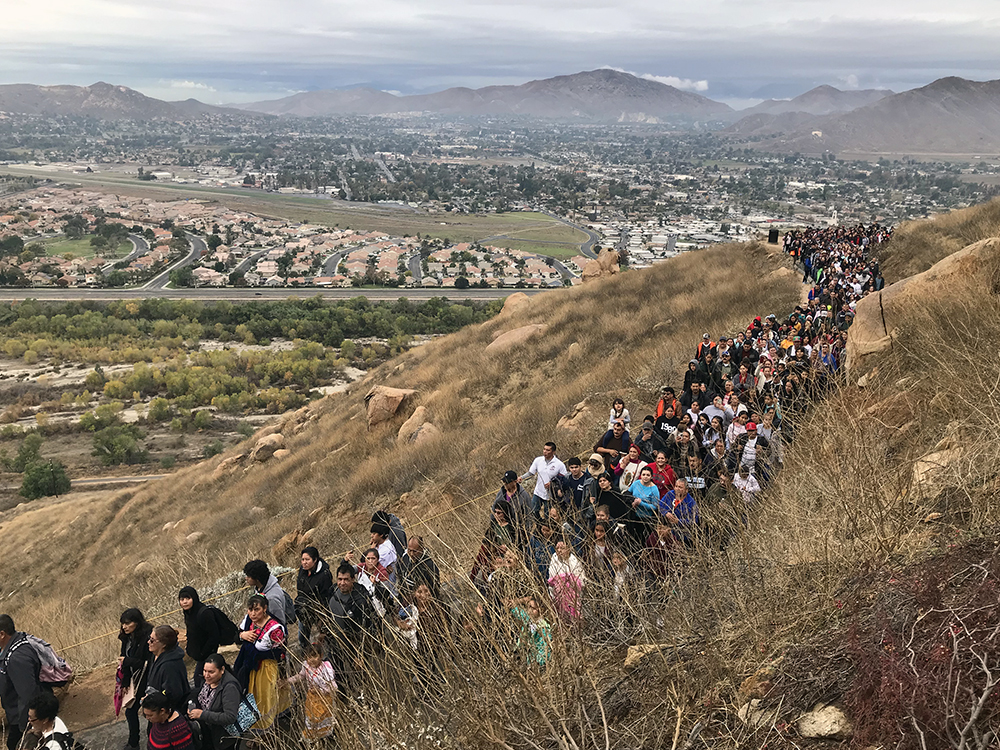
Perhaps ironically, far from our centers of policy influence, there was another call to movement on Saturday, a movement typically involving many thousands of persons by vehicle or on foot (even on their knees) whose lives are often directly impacted by climate change and armed violence, by corrupt practices in institutions large and small, sacred and secular.

On this Saturday was the Feast of Guadalupe, a time in past years for people across Mexico and beyond to practice their devotion to their blessed Mary, but also to share in that devotion energy with the many who gather at the Basilica in Mexico City and the many more who have drunk from this energizing reservoir of faith and commitment in years past.

I have seen this devotion first hand, enough to probe a few of its virtues and shortcomings, enough to see the looks on the faces of pilgrims who could not survive, would not wish to survive, without the sustaining energy that comes from a commitment deeper and more consuming than most of us could hardly imagine beyond the domain of our children and other close family members.

It is sad that this devotional energy, like so much else this year, has moved online due to the pandemic, a digital setting which cannot possibly convey the depth of devotion displayed by people from all walks of life, many of whom likely do not have digital access and wouldn’t accept the substitute if they had.  But there is a lesson still looming here for the rest of us, a lesson about the limitations of our bureaucratized discourse, about our inadvertently patronizing attitudes towards local initiatives and actors, about our tone-deafness towards the very stakeholders we routinely seek to bring into our midst.

When it comes to climate change or other global challenges, the need for urgent action is fully apparent as are some hopeful technologies and other initiatives developed to give us a puncher’s chance to shift course in a sustainable direction, to overcome the “bronze barrier” of our “what’s the use” cynicism that pervades too many persons and sectors, even in our churches and government agencies.  Still our current trajectory remains simply insufficient to the health and healing of the planet or of ourselves, and we should promptly cease defending levels of policy progress or personal dedication that appear unlikely to bend that curve.  

In this time of events running apace of outcomes, it would actually be helpful to hear a few honest expressions of remorse from our leadership, penance for opportunities missed that may not come our way again, expressions of devotion – real devotion – for our planet and its diverse inhabitants. It’s not good politics, I suppose, but If we are to convince the audiences that must be convinced – including the youth in climate vulnerable states, and the small-holder farmers, drivers and shop-keepers walking that long road to Guadalupe — we need to demonstrate our capacity to reach their hearts and not only their “interests,” to “wear” at least some of the devotion which they know full well is essential to getting us over the hump regarding responses to threats that we have merely dabbled in for far too long.

Metaphorically speaking, we’re actually now wearing the right shoes, but its long past time to do important things in them and to do those things without hesitation, without excessive weight from protocols and bureaucracies, without the excuses that stand in the way of learning, doing and being more than we now are. If our incessant policy “paddling” is ever to get us close to safer and saner shores, the craft we paddle must be fueled in greater portion by devotion, that energy which communicates to people everywhere and in all circumstances that their current and future lives, their current and future well-being, are genuinely worth paddling for.

Dragnet: Climate’s Grip on the Security Sector, Dr. Robert Zuber

26 Jul

Poll: Riot gear for police at protests?

Life can only be understood backwards; but it must be lived forwards. Soren Kierkegaard

Ecological healing is all about the healing of relationships.  Charles Eisenstein

History is humankind trying to get a grip.  Kim Stanley Robinson

We must remember that this is not a fight we can win just by fighting.  Charles Eisenstein

We cannot choose the times we live in, but we can choose the stories we tell and live by. Sally Gillespie

When we begin a deeper journey into earth care, sometimes we are struck by the breadth of ruin, even ugliness, that it is our challenge to recover and redeem.  LL. Barkat

Birds start falling. Bees lie dying.  Mary Flanagan

On Friday, as the excellent presidency of Germany nears its end, the Security Council took up the issue of “climate and security,” a thematic relationship which the Council is under more and more pressure to address, especially from its elected members.  The manner in which it was addressed in this session, however, speaks volumes regarding both the policy strength of some delegations and the limitations of the Council in articulating a clear role for itself within our global system of response, one that encourages that all aspects of that system to function at maximum effectiveness.

The UN is, of course, primarily a negotiating platform, but as stated by Germany’s Foreign Minister Maas, some things are not negotiable and “we cannot negotiate with nature.”   But while we cannot negotiate with our climate, we can clearly cause it damage and, by extension, cause grave damage to ourselves and other life forms.  As Belgium made clear, this is no abstract matter but a crisis that both impacts and creates vulnerable people worldwide with “aggravated costs,” as Tunisia and Indonesia both noted, which will likely only increase at least in the near term.

There was broad recognition in this Council debate regarding what Belize referred to as the “indiscriminate consequences” of climate change, impacts (as underscored by Niger and others) that fall largely on regions, states and peoples already vulnerable to conflict and COVID-related threats. Such areas have generally contributed little to the climate crisis yet must live with the heat and the drought, the unpredictable rains and insect plagues that make an often- tenuous relationship to viability ever more so.

There were clear calls to action on Friday, especially from small island states who continue to watch nervously as their sea levels rise while large states continue their out-sized consumption and relentless production of greenhouse gases and other environmental pollutants.  There were also calls for the Council to remain fully seized of the data on climate linkages and impacts, with many supporting the appointment of a special UN envoy on climate and conflict.  But there is still concern in some quarters (including here) that the Council does not fully grasp the role it can play as an enabler of climate action underway in other parts of the UN system, not to mention in communities worldwide, keeping in mind the distinction between what the Council does itself and what actions it encourages in others. In our view, Council enabling – not controlling – effective climate action in diverse settings remains one key to our common survival.

But what of the specific climate-conflict nexus?  There was consensus on this Friday that climate change does not “cause” violence per se, but rather “exposes existing vulnerabilities” to which we have not paid sufficient attention and, as noted by a Niger military official, places the often “tenuous balance” between regional groups under considerable strain.  UN Assistant Secretary General Jenca, representing the Secretariat, underscored the degree to which climate threats expose “deep grievances” which often fester in societies and which can erupt in violence unless they are properly addressed.

While this debate added value in terms of basic nexus contours, it did not directly address (aside from comments on the role of peacekeepers) the impact of climate-related “grievances” on the security sector itself, those tasked with ground-level security functions in communities which, in a growing number of instances, are watching their livelihoods blown away by sandstorms or migrating to waters cool enough to sustain minimal oxygen levels. And where governments are either indifferent or lack a trusted presence, communities may well prefer to defend their interests and manage their difficult affairs on their own, interpreting government security as simply one more coercive element seeking to maintain “order” but not honor promises, adding another level of restriction to an already constrained existence, and this at the point of a gun.

In society after society, we have seen the impact of overly-stretched law enforcement, police which have been weaponized and politicized; police asked to perform security functions in tenuous situations far above their pay grade; police which have been encouraged by political leadership to focus on the coercive end of their mandate and not the conflict prevention and community-responsive elements; police who in many instances are barely required to grasp the letter of the law and even encouraged to ignore both the spirit of the law and abuses of that law committed by other officers.

And across the world those same police are now being sidelined and their reputations scarred by more coercive and unaccountable forces that have no interest in local communities aside from suppressing its dissent and misrepresenting the identity and intent of its protesters. From Cameroon to Portland, we have seen instances of unidentified agents who have increasingly become a tool of regimes seeking to maintain a repressive grip or impose one anew, forces asked to parachute into situations which may be antagonistic already but which their own coercive responses merely inflame.

Grievances at community level are deep now, as deep as I have ever seen them.  Many people are angry, afraid, abused, finding themselves isolated in circumstances worse than anything previously conjured up in their nightmares.  Those grievances in some instances apply as well to the security sector, to law enforcement tasked with maintaining “order” in situations where government officials have clearly not done their jobs, officials who are neither “getting a grip” on current threats nor interested in helping the rest of us to do so. In such a scenario, only authoritarians can possibly claim victory.  The rest of us are left with a series of bad choices, including to arm ourselves to the teeth or hurl projectiles at “enemies” about whom we know little and care even less.

As St. Vincent and the Grenadines said Friday in the Security Council, “action is all that counts now.”  But what is the action envisioned for often anti-democratic governments, edgy citizens and an over-stretched security sector?  What “counts” now?   One pathway is suggested by UN Police which is committed in principle to “the reform, restructuring and rebuilding of host-state police” and which measures this in more “representative, responsive and accountable policing that protect and serve the people.”

In this angry, authoritarian age these principles almost seem old school.  But as we seek to “live forward” in treacherous times, it is important to reaffirm understandings shared from at least a segment of our past – that the “fight” we now seem so intent on waging cannot be resolved through fighting alone. It will be hard enough to restore some measure of trust in a security sector and its leaders that too often manufacture enemies in the public domain, that bury basic tenets of racial representation and accountability, and that allow under-trained, over-militarized forces to clutch state-of-the-art weapons they are much too willing to use.  But we are compelled to try.

The climate healing that is so urgent now is directly related to equally-urgent healing in our communities, a healing premised on restoring the quality of our relationships to each other, but also to protecting the biodiversity struggling to survive, and to mitigating all of the social and personal “ugliness” which we have yet to “recover and redeem.”  But we cannot do so, we may never do so, so long as these fissures exist between a public at its wits end and a security sector that cannot be certain, especially now, who or what it is protecting, whose interests it is actually serving.

We need to restore faith in each other and we need to do so without delay.  For while we hurl tear gas and insults across artificial barriers, while we brandish heavy weapons that merely reinforce the resolve of other weapons-bearers, the social stresses inflamed by our sick climate continue to mount. Birds are falling; bees are dying; fish are abandoning their traditional habitats; islands are drowning; crops are failing.

At this painful time, when the stories we write and tell are much too dystopian and too little hopeful, we would do well to restore an UNPOL version of policing which many in the security sector thankfully still affirm: inclusive, accountable, responsive. But the bar of our collective inaction is too high, at least short term; and as Council members noted in passing and as confirmed at last week’s High Level Political Forum, frustrations and vulnerabilities stemming from our habitual climate negligence are likely to get worse.

This is the conflict-climate nexus that the Council needs to address:  a degraded climate leading to food insecurity, displacement and inequality, but also to a legitimate and largely unaddressed impatience for dignity and change that now seems destined to pit diversely distraught communities against a security sector increasingly equipped for militarized responses and egged on by an aggressive breed of authoritarian leadership.

If we are ever to recover what we have ruined in our world and in ourselves, this is the time. If ever there was a “fight” that cannot be resolved through fighting,  this is the one.


Island Get-Away: Heeding the Call of the Climate-Vulnerable, Dr. Robert Zuber

29 Sep

thumbnail_Screen Shot 2019-09-28 at 8.18.20 PM

Delays and laziness are the two great gulfs in which multitudes of souls are drowned and perish. John Fox

You cannot prove your worth by bylines and busyness.  Katelyn S. Irons

Nathan thought people needed to wash dishes by hand sometimes. Prepare their own meals more often. And take walks.  Eileen Wilks

We cannot put off living until we are ready….Life is fired at us point-blank. Jose Ortega Y Gasset

If you want to save some money at Christmas, you can say Santa Claus died in a wildfire. Chuck Nice

This year’s high-level week at the UN has come and gone.  Barriers designed to separate those invited and not-invited to this grand political party are coming down as I write and most of the dignitaries (and their entourages) have had their say and boarded planes for home. The time will soon come for the diplomats and other stakeholders who walk the UN’s halls daily to translate some of the promises made into concrete policies, as well as to attempt to soften some of the bravado of heads of state who came to the UN to air their grievances and/or to use their platform to, in some instances, defend the indefensible (as with Brazil) or attempt to undermine the value of multilateralism from multilateralism’s most cherished podium (as with the US).

It was a frenetic scene from early Monday’s opening of the Climate Summit through Friday’s high-level event focused on some of the growing, existential threats posed to small-island states from climate change.  Indeed, some of the most significant take-away messages from this UN week were from those very same events.  The widely-reported, emotional statement uttered to dignitaries by Greta Thunberg (“how dare you”) at the Climate Summit underscored the absurdity of middle-age diplomats of privilege putting “hope” in a teenager who should be home and in school, a teenager who is asking only that leaders listen and respond to the science of climate change and not their own polling numbers.  For her part, Greta might well have been one of the only persons in that Summit (not living within walking distance of the UN) whose mode of transport did not contribute to the problem that the dignitaries had ostensibly gathered to address.  Indeed, the vast environmental “footprint” associated with this event (a fact not lost on some skeptics) should have led less to “hope” in the singular determination of a teenager and more to shame regarding the behavior of political leadership who, in too many instances, still lacks the fortitude to practice what they preach.

Friday’s event focused on the growing climate urgency felt by small-island states couched within a mid-term review of the SAMOA Pathway.  This review highlighted the plight of states staring “point blank” at rising sea levels and ever-angrier storms, and gave rise to frustrations with the limited ability of UN leadership to evoke practical climate commitments from the heads of several large-emissions states. But the event also underscored the degree to which the UN remains highly valuable as a platform to appeal for and garner support for island states which have contributed little to the climate problem but which, in too many instances, suffer from its most severe impacts.  In some ways, this event represented the best (as Sweden’s Foreign Minister referred to the UN) of this “global public good” – passionate, honest, helpful and thoughtful –offering hope to small islanders that big-power interests would not be allowed to deflect responses to the now-existential fears that the economies and cultures of their small-island homes could soon be added to our rapidly-growing list of global extinctions.

There were many important messages emanating from this event that highlighted the urgency of the times and the “lazy delays” that have often characterized our common commitments.  Ireland’s President Michael Higgins spoke well of the dangers of “recurrence” of our collective challenges which he believes can only be prevented through a new ecological-social “compact.”  A native speaker from Hawaii was more graphic, noting that there are more plastic objects in the ocean “than stars in the Milky Way” and highlighting the greed that makes us the only species that “forces disharmony” with the natural order.  Climate problems for one, he noted, soon become “problems for all,” underscoring the hope of UN SG Gutterres that if we can find the courage to solve climate change at its most difficult point, we can solve it at other points more readily.

And in a remarkable SAMOA event statement, Barbados’ Prime Minster wondered aloud how long her taxpayers would continue to authorize trips to New York to continue to say and hear the same things over and over, statements with political value perhaps but also with limited practical impact, statements which merely provide cover for the “arrogance” of too-many leaders and other stakeholders who apparently believe that we are already doing enough to stave off our own extinction when we clearly are not.

Back in the General Assembly, Palestinian President Abbas might well have put the matter before us most succinctly:  “Be careful. Be careful,” he warned, “you must not deprive the people of hope.” The following day, also in the GA, the Prime Minister of Lesotho highlighted the role of the UN in saving people from the “follies” of their leaders, surely including the folly of those who tout “patriotism” and “nationalism” as some “magic-bullet” antidote to the limitations of the multilateral order, an “order” that can clearly still attract a crowd but which its own leadership acknowledges has not yet lived up to its lofty billing. We should be so very grateful for the confidence that people continue to place in these hallways despite evidence that the UN’s signature, high-level segments still care too much about themselves and not enough about the yearnings of global constituents.

In a Lower Manhattan park this week, removed from the traffic jams and crowds of people with credentials trying to push their way into UN conference rooms, a small group of people led by Green Map’s director toured a small and now-threatened area once dominated by drug culture but now an oasis of hopeful possibilities – sculptures and a turtle pond, chickens, recreation areas and gardens full of native plants. The tour highlighted the sustainable development goals and was accompanied by park rangers who know just how far this strip of land has come, how much love and attention it has received from current and former neighbors, how much would be lost if the city’s plans to denude the park ostensibly to make it more “climate resilient” would take effect.

It is an emotional and intellectual challenge, for us and others, to balance the “bylines and busyness” so very much valued in the crowded halls of the UN with the millions of local actions (and actors) struggling to overcome impediments imposed by some of the very same global leaders who should be opening pathways to well-being instead.  These actors, the ones perhaps more likely perhaps to “wash their own dishes and prepare their own meals,” the ones who must find walking destinations to restore and refresh in local contexts, are also the ones who need the promises made by leaders during this high-level week to translate — somehow, someway — into fresh motivation and inspiration for local, climate-related progress.

Greta and her youthful colleagues have laid out before us a science-informed path where practical hope in a healthier and more sustainable future is still feasible.   With all the power and influence at their disposal, global leaders can do better than defending their political and “national” interests and (in some instances) casting dispersions on young actors who have taken into their hands responsibilities for climate changes which too many leaders have neglected for too long and which now threaten virtually every island and coastal community on this fragile planet.

Simply put, we need to see more urgent leading from leaders well in advance of the next UN high-level party in 12 months time.

Youth Group: Passing the Torch on Climate Health, Dr. Robert Zuber

22 Sep

strike

You’re learning that you do not inhabit a solid, reliable social structure – that the older people around you are worried, moody, goofy human beings who themselves were little kids only a few days ago.  Kurt Vonnegut

One cannot, without absurdity, indefinitely sacrifice each generation to the following one; human history would then be only an endless succession of negations which would never return to the positive.  Simone de Beauvoir

The last generation’s worst fears become the next one’s B-grade entertainment. Barbara Kingsolver

Respect the young and chastise your elders. It’s about time the world was set aright.  Vera Nazarian

A mistake, committed for a few generations, becomes a tradition.  Nitya Prakash

This past week, the UN Security Council endured a dismal and discouraging session punctuated by an sobering briefing by ASG Ursula Mueller followed by a veritable cat fight among Council members ostensibly committed to easing suffering and reducing levels of threat enduring by the people of Idlib, Syria.  This erstwhile “deconfliction zone” has been the subject of all-too-routine bombing raids by Syria and its allies despite a provisional cease fire, bombing conducted ostensibly to root out terrorist elements and their foreign fighter allies (what Syria referred to as “monsters”) who allegedly have been holed up in schools, hospitals and other civilian infrastructure.

This principled (though not always practiced) concern for protecting civilians and upholding international law by (most) Council members has often run afoul of the concerns of a few to fully prosecute the terror war until all terrorist elements, including foreign military and intelligence capabilities, have been defeated.   In this instance, the disagreements spilled over in a spectacle of competing resolutions on Idlib, one submitted by the “humanitarian penholders” Belgium, Germany and Kuwait, and the other seemingly cobbled together at the last minute by China and Russia and focused more on the necessity of continued, robust counter-terror operations.

Needless to say, neither resolution passed.  Another opportunity to forge a consensus that would spare the people of Idlib from yet another round of violence and displacement was lost.

My own response to this policy carnage was to urge Council members to “burn the tape” of this meeting lest the people of Idlib see for themselves how their urgent interests have been set aside by a body that at times makes more trouble than it resolves – both inside and outside the UN.  Conflicts fester, sometimes for generations, and some of the core lenses that contribute to conflict in our time – especially threats from climate change – have yet to achieve supportive consensus in that body. There is now a “tradition of inaction,” that belies the dignity that still applies within the Council chamber, including the failures to fulfill its own resolutions, hold permanent members to account for acting above the law, and reassure the rest of the international community that Council members are prepared to pull their weight in resolving crises that have sometimes gone on too long and which directly affect prospects for future generations.

Those specific representatives of future generations who have sat with me over the years in the Council chamber have taken note of the political culture which the Council perpetuates and they are by no means reassured.  The clock is ticking while more and more pundits are proclaiming that it might now be “too late” to save ourselves from ourselves. For these young people it is not too late.  It cannot be.

Thankfully reassuring to them has been the recent explosion of climate-related protests, many thousands of people worldwide taking to the streets to “strike” for action and justice, action based on an increasingly firm scientific consensus and justice based on the reality that many who will suffer the most from climate impacts had the least to do with creating the problem in the first place.  Indeed we are now witnessing the scenario of the wealthy trying to buy their way out of the path of severe climate impacts while millions struggle to eke out a living on the margins of rising oceans and expanding deserts.

Inspired by Greta Thunberg and others, there is action on a large (not yet large enough) scale to mitigate climate impacts and redress related imbalances. We do have global policy frameworks to limit emissions and care for climate refugees, though these frameworks are voluntary in nature and thus easily put aside when they allegedly “compromise” the national interest.   We also have a bevy of technologies that have come (and are coming) on line that can promise some relief from excess emissions and other manifestations of our still-excessive environmental footprints. We see every day more corporate and financial interests recognizing that sustainable business requires sometimes dramatic changes in how they “take care of their business.”

And we have seemingly come to grips with the fact that climate mitigation and adaptation can and must be localized, that the challenges people face must be fashioned to context in the form of concrete actions grounded in what we are now missing in too many of these contexts — an abiding commitment to the surroundings that house our ambitions.  In too many instances, we have lost connection with the places we call home, the rhythms of life that we too often take for granted or neglect altogether, the places that demand our immediate and specific attention and get it less and less.   We are a culture full of people who know more about the abstracted feeds on our phones than the habitats and watersheds that surround us daily, the farms and gardens that sustain our bodies and souls in ways that Instagram could never do, the threats to biodiversity (including to essential pollinators) that have sometimes-severe local impacts and that caring and attentive people have the means to address locally.

In pointing this out, I recognize that it is relatively easy for me to examine personal choices and help mitigate climate impacts.   I am not raising children and thus am not bombarded by the desires of children stoked by endless commercial interventions.   I do not need to own a car, or even ride in one, whereas the lives of many others are almost entirely dependent on such vehicles. Indeed, I can walk to markets of all kinds, including places that will gratefully take my copious collection of weekly compost. I can bus or train to work, or even walk if the frustrations of mass transit become too much.

And I can indulge my own amnesia, including with regard to the economic predation characteristic of the most “successful” parts of the city I live in.  I can deceive myself that there is some virtue in growing and producing nothing on my own.  There are few in my life now to remind me of the skepticism and frustration of my earlier years, the energy wasted on investments and behaviors that were sketchy at best and certainly not sustainable in any sense that we now understand that term.

As amnesia is overcome, it becomes a bit easier to accept the skepticism and self-protectiveness of the younger people who allow us to get close to them.  It is easier to forgive the occasional over-indulgence in “first-world problems” and entitlements, the frustration that comes from a life spent in school that, in some ways, produces outcomes just as disappointing as anything the Security Council can muster.  It was interesting that, at Friday’s climate rally in Battery Park, while I was one of the older people present and wearing my “UN costume” of jacket and tie, I was not scolded once, not from the audience and not from the podium.   It was a testiment to the kindness and focus of those strikers that I was able to “escape” so easily.

Indeed, the energy in that park was hopeful, even electric, and the voices of Greta and others were strong, clear and resolute.  Ready or not, it is their turn now, their turn on the playing field, their turn to see if they can overcome their own habituated responses and generational prejudices to effect rescue in a world that is good for them, but also good for those many whom will follow; thereby helping to ensure that their fears and skepticism can be repurposed into actions that will offer more than “B list entertainment” to subsequent generations.

In the shadow of New York’s financial district, Greta reiterated a warning to those who have been made uncomfortable by what they might well interpret as the “bad news” associated with the recent surge in climate activism.  “This is just the beginning.” If we are to preserve our own lives and the “chains of being” on which our lives depend; if we are to eliminate this major contributor to the violence, food insecurity and displacement that now characterize too many global settings; if we are to boldly and urgently mitigate where we can and adapt where we must; then our responsibility is laid out before us, including doing more to ensure that the mistakes of generations past don’t become the “traditions” tying the now-eager and determined hands of the young.

The many voices worldwide insisting on a healthier planet “fit for children” believe, as do we, that this is simply not too much to ask.

Melancholy Moment:  Restoring an Unmanageable World, Dr. Robert Zuber

18 Aug


Melancholy

I felt that I breathed an atmosphere of sorrow.  Edgar Allan Poe

He had the appearance of one who has searched for the leak in life’s gas-pipe with a lighted candle.  P.G. Wodehouse

As the current answers don’t do, one has to grope for a new one, and the process of discarding the old, when one is by no means certain what to put in their place, is a sad one.  Virginia Woolf

Noble deeds and hot baths are the best cures for depression.  Dodie Smith

Learn why the world wags and what wags it. That is the only thing which the mind can never exhaust, never alienate, never be tortured by, never fear or distrust, and never dream of regretting.  T.H. White

Here in the northern hemisphere, we are confronting the end of another summer.  The heat and humidity persist but the days shorten, the trees and bushes have lost much of their vitality, and the time sadly wanes in which we might grab just a bit of rest and outdoor recreation, time to be taken up all-too-soon with fall preparations and duties focused on our families and institutions.

Even for me, for whom this current period represents the best time of my life, I now also breathe a bit of an “atmosphere of sadness.”  Like some who feel pangs of melancholy at dusk, I grieve that we might not have what it takes to address current threats from cold and darkness: the shifting climate that impedes any residual semblance of normalcy, the people falling further and further behind; the stresses that seem to come out of nowhere and linger far too long; and of course the search for better “answers” in policy and practice as our current stable of solutions seem too-often akin to searching for “the leak in life’s gas pipe with a lighted candle.”

How the world “wags” now is a mixed blessing at best.  It will take many noble deeds from many sustainable sources, many public displays of service and discernment, many acts of courage and discomfort, if we are to get through this precarious time and heal the emotions that we neither confess nor control, feelings of gloom that dampen enthusiasm for even those activities and relationships that were once reliably joyful.

At breakfast this week with my friend and colleague Wendy Brawer, we discussed a range of sustainability issues and concerns which have been our obsession for many years at Green Map – from pollinators and parklands to bicycles and food security.   When I asked her about issues that have not gotten sufficient treatment, she mentioned “climate grief,” the sense of sadness that comes from knowing that our current trajectory is not at all sustainable and largely absent clear markers regarding how best to bend that arc and what our role in that bending could be.

I experience a bit of that grief despite the policy-privileged position that I find myself in every day – near the center of discussions about which we have some modest impact on strategies for a more peaceful and sustainable world.   Being near the center is accompanied by its own melancholy, of course, wrapped up in the policy compromises that prevent people from having the basic security and prosperity which should by now be our common inheritance. But “having a say,” being one of the “somebodies” that can do something about what collectively ails us, creates its own positive energy.

We at Global Action always have plenty to do, plenty to share (some helpful) on issues which these weeks range from international law to ocean governance, from the dispute over Kashmir to state-sponsored violence in Cameroon.  And yet there is also that nagging sense that we are not doing enough, nor with sufficient wisdom and nobility, to ensure that this time of metaphorical dusk will not descend into a colder, darker time.  As one commentator noted, with respect to climate change, we seem now to be like a passenger in a car speeding towards a cliff that we don’t acknowledge and without a clear strategy for diverting our course.  This metaphor could equally apply to our refugees and our weapons, our biodiversity and our fresh water supply.

For those raising children, for those who are still children themselves, this race-car scenario doensn’t offer much in the way of comfort nor much in the way of a path to transform some of the current melancholia into sustainable action.

Of course, climate grief is tied to other sources of emotional discomfort, from the ofen-bewildering and regularly escalating complexity of our “modern” lives to the self-protective and sometimes vicious manner in which we, formally and informally, engage the rest of the planet.  We defend within our circles what at times we would do better to renounce, and this current iteration of defensiveness seems less about the other and more about coping with the spoiled fruits of our own melancholia, our own fear of personal fraudulence and social impotence.  We know that something is seriously wrong; we know that we are literally being besieged (largely through our hand-held devices) by those desperate to persuade or distract us; but mostly all we seem to know to do in response is to aggressively defend and protect what is closest, to hope that, somehow, the looming and severe storms will magically pass over our self-made havens without us getting thoroughly drenched.

This epoch of high stress and higher anxiety that we are living through inclines us to medicate but not mediate; to demand from others what we neglect to offer ourselves; to cling to policies and practices that have long-lost their flavor in part because we refuse to adjust our speed to the cliff looming just over the horizon and in part because we no longer completely trust the authors of policy to take account of needs and aspirations of more than themselves and their “interests.”

There is simply too-little health in us.

But there remains another path, of simpler living and clearer thinking, of services gratefully offered and received, of governance at all levels compelled to help us release from their bottles only the genies that can inspire our better selves. We haven’t had such inspiration in what seems like quite some time.  This current wave of xenophobia and climate-obscuring narcissism is not entirely a creature of our present but has deep and complex roots.  Save for too-brief periods and circumstances, we have long been encouraged primarily to pursue the interests of self – and then to “shoot” in one form or another anyone who seems to threaten our various domiciles and dominions.

That other inspiration — to the service of others and to policies that might actually save us from ourselves — is not a matter of moral virtue but of common survival.   We know this somewhere deep in the recesses of our being, in the places that we collectively allow to generate more anxiety and fear than determination and empathy.  It is time to own up to and shed light on our legitimate melancholy but also to the still-potent change capacities and aspirations to which those feelings remain tied, and to do so before the often-beautiful light of dusk turns into a deeper and more foreboding darkness.

These are tough times.  They need not be the end of times.