
Tag Archives: human rights

An Updated Agenda for Rights and Security, Dr Robert Zuber

17 Sep

Editor’s Note: Over the summer, I was asked by NGO colleagues to pen a contribution on this 75th anniversary of the Universal Declaration of Human Rights, one which links two of the UN’s three pillars – that of peace and security and that of human rights. The project seems to have, for now at least, gone “radio silent,” so I decided to post it here so it could be read and scrutinized as desired. Thanks to Jess Gilbert this is now more readable than the initial version. It is also considerably longer than usual . If you decide to give it a read you have my steadfast admiration.

While the UN’s human rights pillar remains in some ways the most unstable of the three – with challenges related to a rapidly expanding mandate with rapporteurs to match, limited enforcement options and sometimes severe push-back on women’s and other erstwhile “indivisible” rights, all referenced in more detail below – tenets of a  still- uneasy security-rights policy relationship which is my task to examine are “not news” to most of the diplomats and NGOs populating UN conference rooms.

Indeed, most all recognize the immense value of the (non-binding) Universal Declaration over many years in promoting the economic, social and cultural rights “indispensable” for dignity and the “free development of personality.” Moreover, the Universal Declaration also explicitly recognizes the importance of maintaining “a social and international order” in which the rights and freedoms it sets forth can be fully realized. And, perhaps most germane to my assignment, the Declaration Preamble makes plain that to ignore the protection of these rights is in essence to invite “rebellion against tyranny and oppression,” a clear sign that even 75 years ago, the human rights – security nexus had direct policy relevance.   

Thankfully, my “not news” task” was energized  a bit by the release of “A New Agenda for Peace” (https://www.un.org/sites/un2.un.org/files/our-common-agenda-policy-brief-new-agenda-for-peace-en.pdf), the ninth policy brief shared by SG Antonio Guterres under the broader rubric of “Our Common Agenda,” an agenda which in several key respects is a worthy successor to the Universal Declaration.

Many in our sector at least to some extent have already scrutinized this New Agenda and I won’t diminish their contributions through my own replication. I do agree with a former-diplomat friend that the Agenda is a “polite” offering, highlighting the dire straits we now find ourselves in (a strength of this SG) while outlining policy priorities which the UN for the most part is already addressing, albeit with uneven energy and success.

This SG has been increasingly vocal about the threats which many constituents still refuse to fully acknowledge. His is not quite a “chicken-little” approach to global threats, but such threats certainly loom large and have been growing in impact for some time. Still the body over which he presides has long been characterized by issuing clarion calls on a range of issues and concerns while diplomatic responses extend too-infrequently  beyond convening opportunities for performative statement making. For instance, this past July’s High Level Political Forum, ably presided over by Bulgarian Ambassador Stoeva, was a beehive of events and reflections on our current, common plight, and on our insufficient responses to sustainable development promises made in 2015 which span the UN’s agenda across its three policy pillars. But still a familiar pattern persisted of shedding more light than heat on our current malaise, more in the way of highlighting our seemingly declining options across these three policy pillars than concrete measures to help honor promises made 8 years ago to resolutely and tangibly deliver the SDG goods. 

For those of you who have not yet had time or interest in doing so, the New Agenda for Peace is worth a read. Some of the proposals have clear and urgent merit including on the need both to ban autonomous weapons (p.27) and to negotiate and adopt tenets of responsible governance over potentially “weaponized” AI and related ICT before those often-“lawless” horses (p.26) finally and forever flee the barn. Thankfully, the New Agenda does not skirt the issue of our grotesque military spending (p.4) which sucks trillions of US dollars out of the global system on an annual basis leaving the UN’s human rights mechanisms overly dependent on what is in essence volunteer labor and, over and over, leaving conflict-affected populations begging for the assistance we have given them reason to believe would be forthcoming.

Also welcome, the New Agenda urges states, yet again, to “look beyond narrow security interests” and embrace multilateral solutions to challenges associated with our “more fragmented geopolitical landscape.” (p.3) Indeed, as this Agenda makes clear, we may well have reached the limits of our capacity to heal the deep scars of war and armed conflict without putting an end to armed conflict altogether. We may have also approached the limits of our ability as currently organized to rebuild damaged infrastructure, revitalize economies and the agriculture damaged by bombs and warming temperatures, restore public trust or ensure that the discrimination, arbitrary detention, child recruitment, online harassment, sexual violence and other abuses now virtually synonymous with conflict in both cause and effect do not thereby lay the foundation for a return to the violence which virtually none on this planet can any longer endure. 

Gratefully, the core of the New Agenda for Peace lies in a commitment to prevention (p.11), easier said than done to be sure, but perhaps our only remaining opportunity  as a species to reset our financial architecture, revise our dangerous habits of consumption and suspicion, and heal our social relations; to create enough breathing room in our societies and their governance structures to ensure that biodiversity can be restored, climate risks can be mitigated and solidarity and other indicators of personal and collective responsibility can be ratcheted up. These and other global obligations would help ensure that barriers to the “universal” rights compliance advocated by the SG (such as the elimination of patriarchal structures as explicitly noted on page 7) can be duly removed, thus helping to ensure that policy promises made are more likely to be kept. 

All who spend time in and around the UN recognize that such “breathing room” is in fact is a high aspiration given the low levels of trust which are manifest in many UN policy spaces and the core values attached therein to sovereign interests which keep the UN largely confined to norm-creation. This norm-creation mode, as important as it can be, generally comes attached to little stomach for holding states accountable to commitments which in too-many instances they have scant intent on fulfilling while pushing off accountability for failures away from themselves and on to other states and entities.  It is commonplace to note this, but worth doing so in this context – among the words you will almost never hear in UN conference rooms are apologies for policy misadventures nor clear acknowledgement of national deficiencies in implementing UN norms prior to engaging in the more common practice of trying to “pin the tail on other donkeys.” 

Indeed, the UN often finds itself hamstrung insofar as it must walk a series of lines which recognize that, at the end of the day, even Charter-offending states are going to have the UN they want. They pay the bills. They set the agendas. Their sovereign interests remain paramount no matter how much they might claim otherwise. In the name of preserving universal membership, states permit discouraging violations of core UN Charter principles often with functional impunity. They often tend to talk a better game than play one given how easy it is to “spin” national performance on the assumption that few if any of the major policy players want their UNHQ representatives to make diplomatic trouble or shut off options for dialogue by “exposing” flaws in their own or others’ national narratives.  The value of diplomats lies, in part, as a function of their considerable ability to keep the policy windows open but this skill is regularly discharged despite the stale air which is too often allowed to settle into deliberative and negotiation spaces.

From my own vantage point in regards to reports such as the New Agenda I often find myself hoping to see an examination of the structural impediments facing what is actually an intensely political UN policy space, from resolutions divorced from viable implementation to “consensus” which too often constitutes a de-facto veto and results in language which, again, is more adept at identifying problems than addressing them with the urgency that the times require. The “lip service” (p.11) which the New Agenda identifies has a wider UN application than merely on prevention, though prevention remains a relatively easy matter to “service” in UN spaces. Regrettably, the prevention agenda can easily become a vehicle by which officials are encouraged and enabled to paint more pleasing national portraits of human rights compliance, development assistance, good governance and arms transfer restraint than the available data could ever support.

What I continue to yearn for, virtually always in vain, is a formal accounting of the gaps and limitations of a state-centric, multilateral system wherein the states make pretty much all the rules, including on levels of engagement on key policy relationships which many in our own NGO sector believe must remain more actively seized, such as those linking the human rights and security pillars. The SG does note the “failure to deliver” (p.2) in his New Agenda, but also refers to the UN as “vital” for harmonizing the actions of states to “attain common goals” (p.30).  Unpacking these challenging-to-reconcile claims could well lead to a stronger, more effective system on both security and human rights. We need to remain seized of what the UN is doing with regard to its security-rights nexus, but also what more is needed to succeed, what skills and human capacities are still lacking, how amenable we are to filling gaps (including at local level) rather than allowing them to fester?

Thankfully, in large measure due to the relentless scrutiny and mandate expansion of the Human Rights Council and its Human Rights Committee our understanding of the human rights/peace and security “nexus” is clearly finding expression in multiple diplomatic settings.  No longer is it necessary to explain how discrimination under law and in access to services, prison conditions which enable the practice of torture or other coercive means of extracting “confessions” (a focus of our good partner FIACAT), arbitrary arrests and disappearances and much more contribute to instability within and between states and thereby foment conflict.  And it certainly no unique insight to point to the numerous instances where armed conflict – from Ukraine to Yemen and from Myanmar to Burkina Faso – creates veritable engines of abuse, complicating peace processes and opening doors to conflict recidivism with xenophobia, hate speech and sexual violence to match, abuses which were likely among the causes of the conflict in its first instance.

However, those of us who still choose to hang out in multilateral conference rooms know the gaps that continue to separate acknowledgment of right violations and threats to peace and security across the human spectrum. Indeed, not every agent and agency of global policy is on board with the notion that human rights should be a central theme both informing and defining peace and security deliberations.

The Security Council (our primary UN cover) is one place where consensus on this relationship has been elusive given recent claims bu at least a couple of members (permanent and elected) that a focus on human rights disturbs what is maintained to be a traditional “division of labor” in the UN; that because the UN has a human rights mechanism – albeit overworked and improperly funded – such matters should essentially be left to their devices. Moreover, there is also a concern among a few members past and present that too much human rights scrutiny can easily become a sovereignty-threatening club that some states use to batter the actions and reputations of other states.

These concerns are not entirely without merit; however, they tend to overlook what we know about the place of human rights abuse in triggering conflict as well as the rights-related consequences of violence unresolved. This view also fails to acknowledge the differing levels of authority with which these diverse entities operate. The Security Council’s permanent members are well aware of the privileges of their membership – not only the vetoes which they occasionally threaten and cast, but the additional  ways in which they can manipulate policy outcomes, protect their allies and overstate with impunity the significance of resolutions which are claimed to be “binding” in the main but which were often negotiated and tabled with a clear (if cynical)  understanding of the client state interests to be protected. Without question and for good or ill, the Council’s vested authority is unmatched across the UN system (including by the International Court of Justice), a system which provides Charter-based options for coercive responses to many (not all) threats to the peace which are simply not options for other agencies and pillars.

Of course, anyone who is still engaged with this piece will likely know all this already.  But perhaps the following implications of this authority imbalance will pique interest. Those in the Council (often from among the 10 elected members) who wish to see the Council’s Programme of Work expanded to more regularly embrace contemporary themes and conflict triggers (such as climate change or as it is now known around the UN, “global boiling”) and areas of overlap (such as human rights enablers and consequences of armed conflict) thankfully have various means to do so including hosting Arria Formula meetings and taking advantage of modest presidential prerogatives when their month to occupy that seat comes around.

But these options remain insufficient to a full vetting of the rights-security nexus.  We have long advocated for a Security Council that is more representative, but also which is more in sync with the goals and expectations of the UN system on the whole.  A case can be made, and we would wish to make it, that the Council should embrace more of an enabling (in the positive sense) role relative to the system of which it is a part. Yes, there is a Human Rights Council. Yes, there are talented rapporteurs galore and human rights review procedures applicable to member states. But human rights performance seems a bit too optional and subject to sovereign interests, especially given that such performance is, if the New Agenda is to be believed, central to any sustainable peace.  At the very least, the Security Council could use its authority to encourage greater political and financial attention to a human rights system which strives for universal application across a “full spectrum” of rights obligations now ranging from ending torture to ensuring the right to a healthy environment.  The Council does not necessarily need to add direct discussions about these rights obligations to its already complex and often-frustrated agenda, but it can and should do more to indicate that the successful work of human rights and other UN mechanisms has a direct bearing on the success of its own peace and security agenda. 

It seems obvious perhaps, but bears repeating: none of us engaged at any level in international policy, neither the Security Council nor any of the rest of us, should ever divert our gaze from the painful reminders of just how many people remain under threat in this world and how much further we need to travel in order to make a world that is more equal, more inclusive, more respectful of each other and our surroundings, certainly even more mindful of our own, privileged lifestyle  “contributions” to a world we say, over and over, is actually not the world we want.  As difficult as it might be to contemplate, we in policy spaces are not always the “good ones.” Indeed, when states and other stakeholders refuse to own up to their own foibles and limitations, especially in areas of rights and security, their/our critiques of others, regardless of their conceptual legitimacy, are more likely to ring hollow.

One area of ownership in these times is related to elements of  the “human rights backlash” which we continue to experience in many countries, in many communities and their institutions, even in multilateral settings, as evidenced by an unwillingness to address the core funding needs of the human rights “pillar,” member state inattentiveness to legitimate requests for investigations by special rapporteurs and others, even attempts by a shocking number of state officials to link the activities of human rights advocates (and even of professional journalists) to those of the “terrorists.”

Clearly, the world we inhabit needs a full reset beyond truces, beyond grudging or even self-interested suspensions of hostilities. Such may well be helpful preconditions for the pursuit of security which simply cannot be obtained at the point of a gun. But the security that so many in this world seek remains too-often elusive despite these often-unstable agreements, including people whose farmlands have dried out or flooded, people forced into poverty, displacement and despair by armed violence and abusive forms of governance, people made vulnerable to the lies and allures of armed groups and traffickers, people who find that they can no longer trust their neighbors or inspire trust from them, people betrayed by officials whose hearts have long-since hardened to their pleas for help. These are just some of the people in our fragmented world whose rights deficits are tied in part to our weapons and power-related addictions but more to our failures as people to soften our hearts and raise our voices to the challenges it is still within our capacity to meet.

The Universal Declaration does not, as many readers know well, dwell on weapons or other security concerns.  But it does define the tenets of a sustainable human dignity, the rights that give people the best chance to pursue lives in keeping with their aspirations beyond their mere survival.  It reminds us, as does the New Agenda more explicitly (p.3) that “war is a choice;” indeed is a series of choices by states and communities to invest in the carnage of ever more sophisticated weaponry and the coercive humiliation which flows from the deployment of such weaponry rather than in ensuring a sustainable future for all our people. Those many rights activists and policy advocates who put their own lives on the line to protect the rights of others know how much of our current security policy and architecture threatens to lead us down paths of ruin.  If the New Agenda is truly to be “new,” it must inspire commitment to find the inner resources needed to pursue more sustainable outer actions that, as with the Universal Declaration, keep dignity at the very top of our conflict prevention and human rights menu.

Sudan: Between Coups, Resistance and Repression, by Moshibudi Motimele

20 Mar

Editor’s Note: We were pleased to be part of a recent seminar on Sudan organized by our good colleague, Hussein Solomon of South Africa. Sudan is one of the places which is experiencing a multitude of challenges emanating from the October coup and climate-related threats to agriculture and water; from refugees coming from Tigray and unresolved justice for victims of violence in Darfur; and much more. We and others have been reminding the international community that, alongside the gravity of events in Ukraine, other sites of conflict, injustice and deprivation must remain in global focus, from Afghanistan to El Salvador, from Yemen to Sudan. We are most grateful for this summary of proceedings by Moshibudi Motimele in support of our ongoing accompaniment of Sudan.

On the 15th March 2022, the Politics and Governance Department at the University of the Free State hosted a virtual seminar titled, ‘Sudan: Between Coups, Resistance and Repression’. The panel of speakers included Eiman Seifeldin, a human rights and women and children’s rights activist and Environmental Sciences lecturer; Mutassim Ali, a lawyer and former director of the African Refugee Development Centre; Dr. Sheldon Gellar, an Africa Democracy and Development Consultant Researcher and Dr. Robert Zuber, Director of the UN-based Global Action to Prevent War and Armed Conflict. The purpose of the webinar was to keep attention on the plight of the Sudanese people, particularly after the latest military coup of October 25, 2021, which has resulted in worsening socio-economic conditions and human rights abuses in the country.

Origins of Current Conflict

The roots of the current conflict were identified as the political and cultural dominance of one ethnicity, continued military rule, genocide, economic instability, and widespread civilian strife. Since Sudanese independence in 1956, the country has been marked by much contestation between those who support the imposition of Islamic law  and military leadership and those who are fighting for civil rule and a more secular state. The first Prime Minister of independent Sudan, Ismail al-Azhari, was removed by a military coup de tat in 1969. Subsequently military coups have occurred consistently in Sudan including in 1971, 1989 and most recently on the 25 October 2021.

Eiman Seifeldin highlighted the fact that the continuous military coups have been characterized by high levels of sexual violence and the use of rape as a weapon to subdue both Sudanese men and women. This has resulted in a large part of the people’s revolution being led and supported by women who find that their bodies continue to be used as sites of violence and repression. Seifeldin almost made reference to the March 14th rape of an 18-year-old student in Khartoum by officers of the military force which is just the most recent incident in the systematic use of sexual violence as a method of suppressing participation in protests.

In particular, the 2019 Revolution was identified as being a key moment in Sudan’s history where revolts were organized by grassroots groups, social organisations and the general public, not the military or political parties as had been the case previously. Responding to dissatisfaction with the continued torture and brutal imprisonment of civilians alongside widespread economic challenges such as extreme hunger, government corruption and unemployment, the Sudanese people were able to end the almost 30-year rule of former President Omar al-Bashir. This resulted in the birth of the transitional period through the signing in of a Constitutional hybrid government with civil groups and military groups.

Crisis of National Identity

According to Mutassim Ali, the root cause of Sudanese suffering is a crisis of national identity that has persisted since independence. The lack of racial and cultural homogeneity within Sudan has meant that the imposition of Arab cultural identity and Islamic law results in continuous protests and revolt that have generated genocides and human rights abuses. He identifies more than 35 attempted coups and insurgencies in areas such as Darfur, South Sudan and the Nuba mountains with very short-lived moments of quasi-democracy in between. Therefore, for Sudanese civilians, violence and instability has marked their daily lives.

It is also important to bear in mind that throughout these epochs of violence and suffering, civilian groups have exhausted all tools to resist the government peacefully. Therefore, the use of more violent strategies should be read within the context of increasing desperation to end military rule which does not hesitate to mete out violence against suspected dissenters and innocent civilians. The revolt that began in December 2018 can be seen as the end point of an accumulative revolution that united many factions of the Sudanese people who have been involved in a more fragmented longer trajectory of resistance against the government. Although this revolution achieved success through the removal of al-Bashir, the cost of activism in Sudan is deadly with many losing lives to all the de facto regimes.

In addition, the subsequent military regimes that have ruled over Sudan, for many represent a continuation of the Bashir time of rule as many of the military leaders guilty of current crimes were part of Bashir’s government. They insist to remain a part of the current regime, at all costs, because they fear the accountability that they will be forced to take for human rights abuses if they are ousted from government. This has an impact on the legitimacy possible for current power-sharing deals with many civilians rightly refusing to accept any form of military rule particularly by those complicit in long histories of violation and repression.

External factors constraining the impact of Revolution

Dr Sheldon Gellar questioned why it is that the revolution had lasted so long when 80% of the population is united against military rule. The predominant external factors that he identified were the political and financial support that Sudanese military leaders receive from particularly Egypt, the United Arab Emirates and Saudi Arabia. In exchange for access to and control of gold mines as well as the protection of human trafficking routes, these foreign governments and transnational actors are willing to turn a blind eye to internal brutality and strife.  Not forgetting as well all the Sudanese mercenaries that continue to be deployed in Yemen and Libya. He notes that the Bashir government was a recipient of up to seven billion dollars from Sunni Arab states including Qatar and Turkey through their shared connection to the Muslim Brotherhood. None of these states, then, have openly condemned the coups and military rule. Instead, they all make statements in which they highlight the fact that they support dialogue, a dialogue which is based on capitulation.

Russia, through the Wagner Group, has been complicit in assisting the Sudanese government in shutting down resistance to the tyrannous regime. This has included the use of Russian planes to kill people. Furthermore, through the Wagner Group, Russia has been responsible for much instability in the region including in Mali and the Central African Republic. At the root of Russian declarations of support is the consideration of Russian interests and strategic relationships, not a concern for the Sudanese people. On the other spectrum, China can be seen to have supported the military government politically by abstaining to condemn them publicly. The same can be said for the African Union, South Africa and Chad who have been seen to subtly support the military regimes by refusing condemnation. This is extremely unfortunate considering the West’s failure to deliver on its promises to protect the Sudanese people from Jihadists and to deliver basic services. However, there is hope to be taken from the continent as well. Burkina Faso, which has an extremely poor economy, has managed to successfully remove a dictator peacefully. As with civilian groups in Sudan, organisation has predominantly been non-violent.

In the West, though many states have openly criticized military rule in Sudan, this criticism has not been followed through with the imposition of real sanctions. The threat of sanctions is often made and international and American aid is reduced but this does not have much impact. Mostly, because Saudi Arabia and the United Arab Emirates have millions of dollars to give to cover this shortfall and don’t require any socio-political guarantees with regards to civilians and human rights in exchange. In essence, there are no actual consequences for continued military coups in Sudan. The orchestrators of these coups lose nothing and are not held accountable.

Concluding remarks – “Justice is not the sacrifice at the alter of stability”

All of the speakers agreed that the crisis in Sudan has occupied less and less of the international imagination and global media attention in recent times despite conditions worsening consistently. The current conflict in Ukraine and its monopolization of global indignation and concern has left very little space for recognition and intervention into urgent crisis in Sudan, and other countries in the region. For the millions of Sudanese civilians, the goal is a just and democratic system of governance where open contestation is permitted. The international community, however, has seemed to priorities stability which has continuously meant acknowledging perpetrators of extreme violence as legitimate sharers of government. Civilian groups in Sudan are clear, they will not acknowledge any agreement that allows military leadership to remain in power as legitimate. Furthermore, a transitional government cannot be successful without peace. The military leadership in Sudan has been equally clear, it has no intention in allowing the transition process to end in democratic elections and the legitimation of a democratic government. This lack of security and trust has created an extremely fragile state of affairs in Sudan which has dire consequences for not only the Sudanese people but the entire Sahelian area which includes Mali, Niger, Central African Republic, Burkina Faso and Chad.

The international community has largely failed the Sudanese people on multiple fronts. They have failed to: renew and effectively implement economic sanctions, successfully bring many military generals to account in the International Criminal Court (ICC) including those who remain in governance today, effectively implement the arms embargo which continues to be breached without consequence and to assist with the operationalization of the 2005 Comprehensive Peace Agreement (CPA). Therefore, in essence there is no international community that is in solidarity with Sudan in a substantive matter. The West’s prime material concerns with power, wealth and hedonism has meant that it is not willing to make the necessary sacrifices to force Sudanese militants to relinquish power.

As the June 3rd deadline of UNITAMS draws closer, it’s clear that the future of a possibly democratic Sudan remains in the hands of the Sudanese people who continue to display an unwavering commitment to secular civilian rule. The solutions and proposals that can adequately deal with the complexities of the crisis in Sudan can only emerge from those who live the reality of that crisis daily. Fundamentally there needs to be a respect for one another regardless of ethnic and religious affiliation as well as the political will to build a real movement towards democracy.

Roaring 20s: The Voices we Need Now, Dr. Robert Zuber

10 Oct

Next year’s words await another voice.  T.S. Eliot

The loudest words are the ones we live.  Mia Sheridan

If you can roar, roar for others.  M.L. Shanahan

She was a voice with a body as afterthought, a wry smile that sailed through heavy traffic. Don DeLillo

Speech is the voice of the heart.  Anna Quindlen

Their comfort isn’t worth your silence.  Rudy Francisco

Don’t let a loud few determine the nature of the sound. It makes for poor harmony and diminishes the song.  Vera Nazarian

Two things happened at the UN this week, both potentially quite positive and both related to each other at least in my mind, though perhaps only to my mind.  First off, amidst all the appropriate hand-wringing about the decline of both biodiversity and human agricultural health, amidst the gloom in some quarters (including ours) that the upcoming COP 26 meeting in Glasgow will not result in firm commitments to the changes we are running out of time to make, the Human Rights Council passed a resolution affirming that “access to a clean, healthy and sustainable environment is a human right.”  With leadership from Costa Rica and other states, this resolution will soon be passed on to the UN General Assembly for final consideration, hopefully in time to create even more pressure on the Glasgow delegations to negotiate urgently and act boldly while action is still a remedial option.

And in New York, a group of 61 countries with Denmark and Costa Rica (again) in the lead, urged through the Third Committee of the UN General Assembly to end what was deemed the “silence” of civil society, referencing groups that through their lived experiences, diverse range of expertise and feet on the ground, “enrich and improve the relevance and outcomes of our work.” This statement called both for UNHQ access for NGOs and a stronger online component to allow those far from New York to keep abreast of what the UN is doing and not doing to address global needs.   The statement also highlighted that while this silencing of NGO voices impedes engagements between delegations and diverse civil society backgrounds and expertise, it also sends a signal to abusive regimes that civil society involvement is no more than a marginal enterprise, and that attacks on human rights and environmental advocates, indigenous leadership, media professional and more can more easily be conducted absent UN rights scrutiny.  This is especially jarring with respect to civil society leaders who choose to cooperate with the UN in implementing its own human rights and environmental priorities.

Those of you paying attention so far might well have ascertained the linkage that forms the basis of this post.   But if not, please allow me to lay it out as best I can.

As welcome as the Human Rights Council resolution is in placing clean, healthy and sustainable environment squarely within the domain of the UN’s human rights pillar, questions of implementation stalk this resolution as they do most that emanate from this Council or the General Assembly to which it is tethered.  Questions go beyond how we can possibly guarantee such a right to other fundamental questions of how we should best pursue this fresh obligation.  Whose job is it to promote the kind of environment we increasingly do not now have, to enable the benefits of a healthy, sustainable environment to the communities most in need, those who are most threatened by eco-predators, whose fields are most rapidly losing their productivity as floods and drought ravage and pollinators have long since fled the scene?

In our own work and through wonderful partners such as Green Map, we have long advocated a localized approach to mitigate the impacts of environmental deterioration and climate change and have done our small part to develop and disseminate tools that can help recover both a sense of place and the full, healthy recovery of those places, recovery led by those who know their spaces and its diverse inhabitants better than any outsider or algorithm possibly could, leaders with homegrown ideas about how to address threats, including from mining interestes and other eco-predators, which are less likely to make circumstances for themselves and their families even more challenging.  

In this tech-charged and overly bureaucratized world we are fashioning for ourselves, it is relatively easy to romanticize local leadership.  We have certainly done so, though many of our previous travels and connections have led us to the conclusion that this is not a wholly inappropriate exercise.  People in these diverse settings may not always “know” what we know, but they certainly “know” differently, sometimes better, and what they know can be essential elements in both local environmental restoration and in building capacity to cope with shocks to come, shocks generally not of their own making but certainly the cause of their own suffering.  It is this ability to convince local others that restoration is still possible and then to grow the number of hands and minds devoted to that restoration which ultimately gives me hope, indeed as much hope as welcome resolutions emanating from Geneva and New York, some of which have mostly gathered dust after the initial energy generated by their passage has worn off.

We know that there are many such people of commitment and energy, many caretakers of locally-led organizations that offer tangible hope to people who may well feel let down or under-served by people like me, people like me who so badly want to get back inside the UN that we may have forgotten what we are there to do. We can forget what privilege requires of us as we return to a setting where our own voices have always had an outsized volume, a “roar” which is too often about our organizational mandates and not often enough about enabling those who seek and deserve the opportunity to roar for themselves, not only to speak at our conferences and zoom meetings but to have that speech be meaningful, actionable, influential.  We reference here voices that aren’t always required to be polite or driven by protocol, that are able to speak their accumulated truth firm in the knowledge that such is more than a mere exercise to gain status or funding, more than a one-off which moves an audience out of their comfort zones for a fleeting moment but which does not often enough result in real partnership based on the flow of ideas that better connect the norm-builders in our global centers with the people who, from their more local vantage point, don’t always experience those norms as amounting to enough.  

Given the time left for us, and despite my profound gratitude for those seeking to enable our UNHQ return, I don’t know for sure that I will ever again set foot inside the UN.  Our 20 months of remote online coverage has convinced me (and a few of our junior colleauges as well) that the UN has become akin to alien space, well branded, utterly state-centric, attracted to money and organizational heft like bees to honey, stubbornly holding on to antiquated fire codes while the world burns around it.  We have long fought thse trends as we have reisisted what we have seen as the “voice over” disease, the tendency to roar over the aspirations of others, the tendency also to forget that as our speech is the voice of our hearts, so too is it the voice of the hearts of millions of others. These are the millions whose own path to progress remains akin to navigating heavy traffic, overcoming one obstacle after another, one burnt field or frightened child after another, one crisis that they are late to solve before another crosses their path. But these are also some of the voices of persistence, the persistent convinction that sustainable progress is possible, that lands laid low can regain their bounty, that damaged biological chains can recover their predictability, and that the guns which have stood as an almost insurmountable barrier to any sustainable relief can finally go silent.

In a policy world of voices muted or unheeded, ours has mostly had a volume disproportionate to the size of our lungs and the strength of our vocal chords.  Given this, we have tried our darndest to let our lives drive our voice, to embed our values in our policy and organizational choices and less in our speeches. But we also recognize that the world has changed so much over 20 years. There are now so many voices in the queue waiting to roar, waiting for a chance to be heard, waiting to be taken with full seriousness.  Perhaps more than any time in our professional lives, “next year’s words await another voice,” another voice which can convince and contextualize, which can cajole and correct, which can sing an energetic tune demanding the more harmonious relations which have largely eluded us during our own tenure.  With whatever time we have left, and for the sake of a planet in multiple forms of distress, we will continue to do what we can to find and encourage those next voices.

Union Station:  A Labor Day Reflection, Dr. Robert Zuber

1 Sep

If suddenly the whole workers of the whole world disappear then the whole world will stop!  Mehmet Murat ildan

And there are so much easier ways to destroy a woman. You don’t have to rape her or kill her; you don’t even have to beat her. You can just marry her. You don’t even have to do that. You can just let her work in your office for thirty-five dollars a week.  Marilyn French

What our generation failed to learn was the nobility of work. An honest day’s labor. The worthiness of the man in the white socks who would pull out a picture of his grandkids from his wallet. For us, the factory would never do. And turning away from our birthright – our grandfather in the white socks – is the thing that ruined us.  Charlie LeDuff

Butter was plastered on to the roll with no regard for the hard labor of the cowKate Atkinson

I was in a large international airport recently with a bit of time on my hands to watch a British Airways flight park at the gate and then be literally surrounded by service workers helping people off the plane, refueling and re-servicing the aircraft, downloading luggage and then cargo, wandering around the perimeter looking for cracks in the hull or worn tires or some other problem that would require immediate attention before the plane could fly again.  Close to where I was standing, people were selling coffee, newspapers and duty free items.  Flight attendants in colorful uniforms chatted with gate agents while waiting their turn to manage an outgoing flight.  TSA agents were on break from dealing with long lines of passengers anxiously (and in some instances angrily) waiting to be screened before take off.  In the distance, men and women were working in the receding but still-hot sun to repair a run-down runway that can stand up to the demands of heavier planes and more frequent landings.

It has been quite some time since I could register as a “fan” of flying.  Planes are cramped.  Service is uneven.  Screening lines can be interminable.  Transportation options to and from the airports I am most inclined to use are stuck in some bygone era.   We all know the drill and we mostly all know that flying should be less of an option given its contribution to climate change.

But this is Labor Day weekend and the airport scene has given rise to a couple of positive thoughts.  First, that part of why flying is an occasionally miserable experience is because it has become a more accessible one.  While they might not ever qualify for “elite status,” more people can find the means – and the fares – to visit some of the places they have perhaps long dreamed of; they have been able to turn a bit of hard-earned and sometimes even hard-fought income into a bit of family pampering.  Flying may not be romantic anymore, nor is it eco-friendly in any sense, but planes are now routinely filled with people making trips of a lifetime alongside fellow travelers making something more akin to trips of the week.

Beyond that, my airport scene was a reminder of just how many competent people are required to make the travel experience safe and relatively convenient.  From the chefs and mechanics to the pilots and gate agents, that so many planes filled with so many people get to their destinations more or less on time and in one piece is something of a miracle.  That most of these airport magicians work for wages which would shock many of us; that most are given absolutely no thought by the rest of us until and unless our baggage is missing or our coffee is cold; that most are considered marginal to this complex process when, in fact, the process would utterly break down without them; this is part of the modern mind-set with respect to labor, the trend to grant respect as a function of income and title rather than of competency and collaboration.

For in an age of gross and growing economic inequalities, in a time when more people have college degrees (with loans and expectations to match) than viable career options, we are strangely inclined to “root for riches,” to long for those times when we can “rub shoulders” with the wealthy and famous, the people who have “made it,” in too-many cases by putting their own interests – and those of their investment partners – well ahead of the well-being of their fellow workers.

I have no metric at hand to calculate the degree to which this current “gilded age” is more or less corrupt and mean-spirited than previous iterations.  But it has surely set a high bar for celebrity worship and stoked an often-petty competition for economic and educational opportunity at local levels.   Somehow, despite the testimony of our own senses, we have managed to misplace the basic insight that our celebrities and economic elites will be nowhere to be found when a tire punctures on the highway or our children need to overcome reading deficiencies; when our groceries need to be bagged and carried to our vehicles, or when our blood pressure starts soaring to dangerous levels.   Moreover, we seem remarkably content to let our commerce and consumption flow through our ubiquitous “devices,” ensuring that “we” get what “we” want without worrying about having to put a human face on any part of that transaction, including on the labor needed to produce our purchase in the first instance.  Indeed the only “face” associated with what is often highly complex and very human consumption is the fake smile on the ubiquitous brown boxes now waiting outside our doors; perhaps also adorning the bill that we will pay when and if we are able.

One of our favorite UN agencies is the International Labor Organization, an entity that actually pre-dates the UN and which has long advocated for labor standards that are rights-based, increasingly applicable to workers of all backgrounds (including migrants), dedicated to eliminating all forms of forced labor and economic slavery, and which allow for the bargaining that can help to ensure a livable wage for all, including and especially the toil of “all” who, among their other miracles, make today’s obscene riches and middle class conveniences possible.  The institutional memory of the ILO can call up many instances of abuses directed towards workers, as well as boardroom and state decisions to enhance shareholder value and consumer access at the expense of those who toil in fields and warehouses, with sometimes grave implications for their families and communities as well.

I have often walked or driven down major streets in parts of my still-affluent country — New Jersey or Oklahoma, Florida or North Carolina — and paid close attention to the small businesses and chain stores that occupy storefronts or populate small shopping malls.   And while I’ve had my share of jobs in such places, I cannot imagine what it must be like to work behind those counters and cash registers day after day, year after year, trying to keep a business or even a simple livelihood afloat while also preserving the often-fragile security for their families.

And, perhaps ironically, I who sit daily and help navigate policy in a powerful place have greater need for some of these people than they will ever have for me.   I need the socks they are selling to replace the ones with holes in them; I need the pizza they are selling when I forget to eat lunch; I need their skills to service our balky copy machine; I need the dish soap and paper towels that keep my semblance of an apartment reasonably clean; I need others to respond when I have interns to credential or taxes to prepare; I even need their baseball opinions while I’m cashing out my beer purchases.

Our lives are punctuated by an ever-increasing tapestry of skills and capacities that we barely recognize and often denigrate, the people whose labor should (but often doesn’t) confer the dignity that my own work confers routinely; and this despite the fact that it is sometimes unclear what we do, practically speaking, for anyone else. Indeed, if we add value beyond the confines of our UN bubble, it is shining a supportive lens on the marginal and forgotten, not as a category of need but of promise, the promise of skills, energy and passion that can contribute more to making the world we say we want and are in serious danger of losing.

The other day in the paper, a couple of CEOs were quoted in ways that appeared to reverse what has been a generation of economic orthodoxy — that the role of business leadership was primarily to serve the interests of the investment class.  As our friends at Georgia Tech’s Scheller School remind us regularly, the “servant leadership” we (and they) speak of often seems to be catching on in some of our previously “tone deaf” board rooms.  Perhaps we are finally coming to recognize that the “status” of labor is not intrinsic to the task but is a function of our ability to honor both the hard work that sustains our lives and the positive identities that accrue when work is duly respected and fairly compensated. Perhaps we are coming to recognize that a social and economic system capable of weathering the current storms that threaten will require much more from us – including more “horizontal” care and respect – than our current stew amply seasoned with overly-branded leadership and bloated salaries to match.

Perhaps a bit like the rest of us, people at or near the top of our current economic food chain like to think that they have “earned” their lofty place in the world.  But an honest review of any one of our increasingly complex institutions and social structures makes clear that we are where we are – no matter who we are — because other people helped place us there. I cannot do what I am so fortunate to do in this world without the contributions of countless (often under-compensated and under-appreciated) people – in my neighborhood of course but also in places like El Salvador where too many toil under conditions over which they have little control and from which they receive insufficient benefit.

In this condition of dependency, I am not at all an isolated case; but hopefully becoming a more mindful and grateful one.

Cold Play:   Eliminating Barriers to a World Fit for Children, Dr. Robert Zuber

4 Aug

Children on Swing

War is what happens when language fails.  Margaret Atwood

There is no flag large enough to cover the shame of killing innocent people.  Howard Zinn

Something is significantly wrong with a creature that sacrifices its children’s lives to settle its differences. Suzanne Collins

We were eighteen and had begun to love life and the world; and we had to shoot it to pieces.  Erich Maria Remarque

Not one would mind, neither bird nor tree, if mankind perished utterly. Sara Teasdale

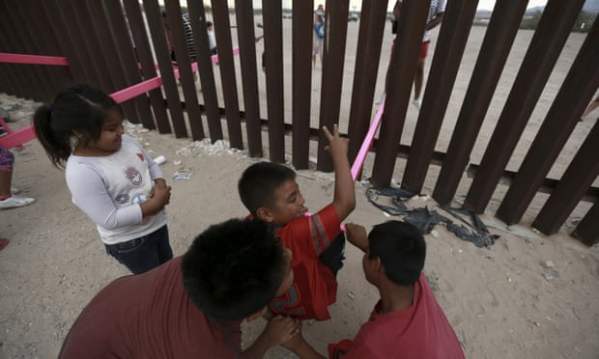
The picture at the head of this piece is one I hesitated to use.  Most all of you have already seen images of this extraordinary sight – children (and some adults) on both sides of the US-Mexican border riding a “see saw” projecting through a heavy-metal fence designed by policy to keep them separate.

But the events of yesterday, the carnage associated with shooters in Dayton and El Paso whose hatred and access to weapons had literally colonized their consciousness, brought me back to this hopeful but bittersweet image, an image that reinforces the indomitable spirit of children around the world who find the means to connect and play amidst the psychic and physical rubble courtesy of we “well-meaning” adults.  Virginia San Fratello and Ronald Rael deserve major honor for developing this simple piece of playground equipment that unlocked spaces of hope we’d probably forgotten we had.

This was also, in some ways at least, an important week for child-attentive policies at the UN.   Under the leadership of current president Poland, the Security Council held a 9 hour debate on “children and armed conflict” this past Friday covering virtually every aspect of the distressing encounters of children with situations of armed violence including sexual abuse, children locked away in adult facilities, and forced recruitment into the service of some armed groups and national militias.  Special Representative Gamba and UNICEF Chief Fore led a procession of 80 state and civil society briefers weighing in on an issue that weighs heavily on the consciousness of many – our limited ability (despite numerous resolutions and debates) to protect children from the worst consequences of our conflict-prevention failures.

A day earlier, Canada had hosted an important side event during which it launched its Implementation Guidance for the Vancouver Principles.  The “principles” are proving increasingly relevant both in identifying and addressing recruitment and other abuses perpetrated against children in conflict zones.  They are also proving their value in recruiting “eyes and ears on the ground” — peacekeepers, gender specialists, child protection advisors and others — to ensure both that abuses can be prevented wherever possible and that children freed from conscriptive bondage have accesses to the services they need to successfully walk that long road to healing from stigma and trauma.

Perhaps surprising to some, despite the near-unanimous views expressed by states that a “world fit for children” is a world where children and armed violence do not mix, success in providing protection and rehabilitation services for abused, abducted, incarcerated and recruited children is lagging in several instances.   We do have more child-protection advisors assigned to peacekeeping missions.  We do have a growing list of implementable normative frameworks — including the Vancouver Principles and the Safe Schools Declaration — designed to monitor and address conflict-related threats to children.  We are becoming more skilled at reintegration of child soldiers. And yet, the UN-identified “six grave violations” against children in armed conflict are still being committed, often with impunity, and increasingly (as noted in the SC debate) by state actors. Schools are still being targeted by bombing raids or used for military purposes. Hospitals and other medical facilities are also under frequent attack in confict zones.  Children continue to be conscripted into armed groups via abductions or propaganda, and then forced to endure numerous violations of their basic rights.  Children continue to seek opportunities for playful communion across militarized borders with peers facing indefinite separation from loved ones should they somehow find a way to squeeze through the intimidating metal fence.

In addition such children are so often denied access to things that might not rise immediately to the level of “gravity,” but which are essential to growth and wholeness — things like food security, safe places to play,  nurturing communities, schools equipped to prepare children for the world they will live in and not the world their teachers have lived in.  And perhaps also, communicating those too-hard-to-find assurances that the adults now “in charge” are doing everything possible to ensure that there is a viable, liveable planet for today’s (and tomorrow’s) children to inherit.

Among the takeaways for us from our diverse news feeds and this UN week of child-focused meetings is the sense that there truly is something seriously and collectively wrong with us.  To sacrifice the well-being of children in the ways we continue to do in the name of “settling differences” (that too-often remain unsettled) represents a moral sleight-of-hand that leaves philosophers and psychologists, not to mention child policy and protection advocates, fighting back tears of anger and disbelief.

In addition, and for reasons that literally defy our policy experiences and genetic predispositions, children facing violence or forced conscription, stigma, or trauma somehow escape consciousness when it comes to negotiating and implementing the agreements that seek to “bring peace” to communities, nations and regions.  This in itself constitutes a remarkable example of the ever-shrinking limits of our human concern.  We who fuss endlessly over our own children, who demand the “best” for them even if we have to bend the law to get it, endorse policy agreements and their negotiators that (in the name of unity and peace) literally put our children’s generations at risk; as though we are somehow doing our own children a favor by betting — through peace talks or parenting — that they can somehow escape the metaphorical (and perhaps literal) flood that is set to engulf their peers and those who follow.

While I am not the world’s foremost fan of the institution, there is (for me) a moving part of the marriage ceremony practiced in some Christian communities that goes like this:  Those whom God has joined let no one put asunder.   As one trying to maintain some semblance of faith amidst all of the idolatry and meanness of our collective present, these words seem particularly relevant to the children playing through a steel fence along the US southern border, or the 2 year old whose life ended abruptly yesterday in an El Paso shopping mall.  Whether we like to admit it or not, we are hard wired for connection, for communication, for play.  We have been “joined” to each other by our sometimes-glorious, sometimes sordid history, by the proddings of divinity, by the existential crises that we share (and must now resolve) in common.  And yet, despite all of this connective tissue, we are literally running out of time to demonstrate that we can sustain the innate and inclusive dispositions that can guarantee a future for our children that is more about riding see-saws and less about dodging bombs and bullets.

Those who would continue to disconnect us through ideology or economics, through social snobbery or overt racialism, must quickly be called to account for these actions.   We continue to laud our own technical and policy cleverness, but are actually making the case for our own collective demise and, what is worse, for the demise of those children who fervently wish that the physical and metaphorical barriers in their homes, schools and playgrounds could once and for all be removed.

If we truly seek to preserve and enhance the potential for exploration, wonder and play of children, we adults need to stop “playing” ourselves and commit fervently to freeing from bondage the enthusiasm and hopefulness of our young, sentiments now held hostage by our too-frequent short-sightedness and self-delusion.

Summer Sale: The UN Shares its High Level Merchandise, Dr. Robert Zuber

14 Jul

Law

Sharing your knowledge and experience without trying to sell yourself sends a greater message of engagement and authenticity.  Create Wealth Communities

The garden suggests there might be a place where we can meet nature halfway. Michael Pollan

Don’t burn your bridges until you build better ones.  Matshona Dhliwayo

The weeds keep multiplying in our garden, which is our mind ruled by fear.  Sylvia Browne

On a week that witnessed more bombing of civilian targets in Syria and Yemen, migration-related callousness in the Americas, and an early start to what promises to be a formidable hurricane season, the UN community gathered in large numbers to assess progress (or its lack) on fulfilling our collective obligations to the 17 sustainable development goals (SDGs).

The High Level Political Forum (HLPF), convened under the auspices of the UN’s Economic and Social Council (ECOSOC) is (for now at least) the place where development progress is assessed at global levels (this year with a focus on goals on children, climate change, peaceful and inclusive societies, partnerships and ending inequalities) but also at national level through a process of Voluntary National Reviews.   In the plenary sessions this week (and next) governments have largely proffered narratives that highlighted actions (allegedly or actually) designed to make their societies – and those others to which they contribute — more equitable, just and resilient to climate impacts.  In some instances having young people deliver those highlights added a dimension of urgency to the proceedings as these are the people who will benefit – or suffer – depending on our collective fidelity to our development promises.

The plenary sessions have been both supplemented and often even inspired by a full schedule of “side events,” most often taking the form of collaborations between (mostly larger) civil society organizations and government missions.  In these settings the deliberations were more focused and sometimes even more thoughtful, often referencing the release of reports from groups seeking both to influence the larger conversation and (at least as important to many groups) put them in position to win new or renewed funding from member states.

Some of these reports added good value, including the annual Spotlight Report assembled annually by the Global Policy Forum, a report by WaterAid that examines deficits in global sanitation (including neglect of sanitation workers), and a report authored by Kavitha Suthanthiraraj, our former international coordinator now with Save the Children Australia, looking at the underinvestment in ending violence against children in the Pacific region.  A fourth report launched this week by the UN Office on Drugs and Crime examined statistics on homicide.  While not officially a side event to the HLPF, this was one of a number of discussions held elsewhere at the UN this week (including a Peacebuilding Commission event on Chad and a Security Council review of communications with peacekeeping stakeholders) that are contributing in their own way to the general pursuit of peaceful and inclusive societies.

The blurring of important development content and salesmanship is something we’ve grown accustomed to in UN headquarters.  NGOs and UN Secretariat offices are constantly on the prowl for funds and not without cause.  Taking care of people can be expensive business and, as with the SDGs as a whole, it is important that promises to constituents made are promises kept.

On the other hand, it is also important that we don’t lose sight of the differences between selling and discerning, the ways in which we accommodate donors (especially government donors) in side events by engaging in a version of what speakers most often do in plenary – sharing the attractive parts of our stories while overlooking the warts and gaps that might create a less-enthusiastic environment for states looking to build their own brands with “bricks” supplied by the groups they choose to fund.

Unsurprisingly, it is precisely the warts and gaps we don’t acknowledge that stand in the way of fulfilling our sustainable development promises.  During the HLPF, but really year round, if you raise a policy issue with a secretariat official or civil society representative, what you will get back most often is a recitation of “what we’re doing about it,” which is fair enough at one level.   But selling and branding aside, what we really need to know is what they’re NOT doing, what they are unable to do, the gaps and deficits that require more than funding, but also require the skills and ideas, the presence and voices of persons worldwide who don’t have a say, who can’t afford to be present in sessions like the HLPF, who must accommodate policy decisions made in places like New York by people who often could often not find their communities on a map, let alone understand their specific circumstances.

As the first week of the HLPF draws to a close, these are our other, albeit-modest insights about the current process and prospects for ensuring sustainable development.

First, we want to acknowledge an insight by Barbara Adams of Global Policy Forum (GPF) at their fine event on “voluntary national reviews,” that what we need to know from states in their voluntary reviews is not only what they are pledged to do more of, but what they must stop doing altogether.   Barbara rightly took issue with the language of “acceleration,” not because we don’t need to move faster on our SDG commitments (we do) but because such acceleration implies that more activity is, in and of itself, the only path to progress.

It isn’t.  As we noted in that same session, if individuals are having problems in their lives, part of the solution is doing things differently, perhaps shifting energy to making life more fruitful for others.  But part of problem solving is putting a stop to destructive patterns, to pull the weeds as it were that impede more healthy growth.  And whether it is ending an addiction to fossil fuels, cutting back on weapons manufacturing, refusing to pawn off our  toxic waste on cash-strapped countries, or transitioning away from unsustainable agriculture, some of what we definitely need to hear from states and other stakeholders are the things they are prepared to stop doing, and stop doing now.

Second, there is a tendency at this HLPF to couple poverty reduction, the promotion of social protection floors, etc. with efforts to end inequalities.   As we also noted at the GPF side event, as critically important as poverty reduction measures are, you can’t build a bridge (including to greater equality) from only one end of a divide.  Such structures will inevitably collapse somewhere near the middle.  The point here is that if we are truly committed to ending inequalities, a high bar to be sure, we must be willing to talk more openly about wealth and its concentrations that increasingly make more and more of us subject to the whims of the super wealthy, virtually ensuring that the circumstances of those living in poverty will improve at a snail’s pace relative to the wealth accumulation of those at the highest ends of the current, vast, economic divide.

Finally, we have noted an uncritical attraction from many HLPF participants to the notion of “partnership,” based in part on the quite-right notion that our pursuit of the SDGs, including those such as hunger and climate on which our performance is far from satisfactory, requires us to do more together.  As Switzerland noted this week during one HLPF plenary session,  we need to “decentralize” efforts on all the SDGs but especially on Goal 16, allowing communities to take more of the lead on implementation. But how do we give pay more than lip service to the many voices seeking to contribute to SDG fulfillment but without the resources to get any sustained attention from delegations, let alone from some of the large NGOs whose gatekeeping around the UN has become legendary?  And do “partnerships” mean anything more than the powerful stroking the interests of others in power?  Can we find a way to affirm the basic equality which we insist upon in the “partners” that support and enrich our personal lives?

We must.   Beyond the rhetoric of this HLPF, beyond all the good reports and welcome efforts on development system reform,  we are still largely in “selling mode,” telling the part of the truth about our current efforts that will win the support of those with support to provide but in a manner that is as likely to discourage global constitutents as inspire them.  They know the ways in which conditions are threatened.   They need practical confirmation on a more regular basis that we know this as well.

Some of the HLPF side events have, indeed, offered inspiration.  In addition to the GPF event on “voluntary national reviews” and other events mentioned here, there was an event this week on “Human Rights and the 2030 Development Agenda,” an event noteworthy for both its important cross-cutting perspectives and its commitment to truth-telling.  In addition to a fine address by the president of ECOSOC Inga Rhonda King, a key intervention took the form of reflections on presentations by Craig Mokhiber, director of the New York office of UN Human Rights.  Mokhiber has earned the reputation as a “straight-shooter,” and he didn’t disappoint at this event, urging us to get beyond our limited “technocratic sauce” and embrace this current (and perhaps final) generational opportunity to “get development right.”

Mokhiber and his colleagues have much to contend with within their own spheres as threats to human rights multiply from the bombing of civilian targets to attacks on journalists and the shrinking of civil society space.  But he was still able to recognize and articulate what he called the “development scars” from a misguided paradign which for too long turned a blind eye to elite-only decisionmaking, corrupt governance, grossly unequal access to justice and widespread rights abuses, virtually ensuring that the resulting development will be anything but sustainable. Such “scars” threaten again and again to undermine both trust and skills at community level and an honest and sustained policy enthusiasm at multilateral level.

If there is a preferred outcome to this HLPF, it is that we can turn a blind eye no longer, neither to the many threats remaining to sustainable development nor to the ways in which the half-truths of our development discourse undermine both trust and progress.  In this critical moment for sustainable development progress, we must recover the “engagement and authenticity” that comes from sharing with each other and across sectors the best of our knowledge and expertise more than from selling ourselves.

Turning the Page:  Recovering the UN’s Relevant Responses, Dr. Robert Zuber

28 Apr

UN Stamp

If we don’t all row, the boat won’t go. Unknown

If everyone helps to hold up the sky, then one person does not become tired. Askhari Johnson Hodari

Laugh as long as you breathe, love as long as you live. Nujeen Mustafa

Many times a day, I realize how much my outer and inner life is built upon the labors of people, both living and dead, and how earnestly I must exert myself in order to give in return as much as I have received and am still receiving.  Albert Einstein

In the hot and stormy future we have already made inevitable through our past emissions, an unshakable belief in the equal rights of all people and a capacity for deep compassion will be the only things standing between civilization and barbarism.  Naomi Klein

While contemplating the content for this post, I took a walk in a nearby Manhattan park in what has been a particularly lovely season for flowers and blossoms.   While strolling and admiring I came across a Parks Department worker and thanked her for making all of this wonder possible.

She looked a bit stunned, as though this simple recognition was akin to a message from Mars.  But I remember well a time when my jogs through this very park were exercises in reckless risk taking, when park benches and pathways screamed out for repair, when “security” was largely based on “street smarts,” when flowers bloomed in defiance of neglect rather than as the result of loving care.

Part of the “care” of this park now is a function of a largely-unfortunate gentrification. We didn’t “deserve” a functioning green space, apparently, until the neighborhood became “safe” enough to absorb copious quantities of downtown money.  But even so, the park is now a place where flowers are planted and benches painted, where playgrounds are truly playful for children rather than being the dangers they once were for their parents, where teenagers play ball near a pond with turtles, egrets and feral cats, and folks trying to get in better shape are encouraged to jog around the now-even pavement meandering around the park’s edges.

And I contributed to virtually none of these improvements, as I tend to contribute too-little to so many of the things I use and (too often) take for granted.

This is intended less as a “confession” and more as a punctuation to what was an exhausting and instructive week of UN business.   From indigenous people straining to protect biodiversity and achieve formal UN recognition to some policy-challenging conversations on identifying and addressing what the UN Office of Drugs and Crime called “chilling” threats from nuclear terrorism and the increasingly convergent interests of terrorists and organized crime, it was difficult for us to keep track of (let alone contribute to) these multiple challenges or identify threads of what might constitute an effective response.

Fortunately, there were other UN events this week where the positive potential was easier to spot.

One of these was in the Security Council where Germany (April president) reinforced a discussion on the security and humanitarian issues affecting Syria by scheduling a poignant briefing from Nujeen Mustafa, a remarkable young woman with a disability who, from her wheelchair, schooled Council members on the many persons much too “invisible” in times of peace who become even less visible in times of conflict.  She reminded all in the Chamber that the figures quantifying humanitarian need have human faces, and that some of these faces already experience grave difficulties in this world which armed conflict merely intensifies.

And in the General Assembly, President María Fernanda Espinosa Garcés convened the first International Day for Multilateralism and Diplomacy for Peace.  While some delegations rightly lamented that such a day would even be necessary, and some used the opportunity to settle political scores, most understood that ours is a system that needs to be fixed rather than cast aside.  The president herself understands that a future for the UN lies in its ability to help build “a fairer world in practice, beyond our UN rhetoric,” a world that reaches persons living with poverty, with disabilities, with grave discouragement. And, as noted by the Finnish Foreign Minister, a world pointing to a future that does not belong only to “the rulers and the strong.”

In preparation for this post, I looked through my grandfather’s collection of UN stamps from 1951, the first year that UN stamps were issued.  The themes were revealing:  stamps highlighting the work of UNICEF and the ILO, stamps honoring the commitment of the UN to human rights.   And there were two others from 1951 of direct relevance to this post – one touting the UN’s commitment to capacity support and the other (at the top of this post) implying that the doors of the UN are open to all peoples of the world, and that it is the “common” people – and not only their diplomats and bureaucrats – who must be able to find something akin to an attentive and respectful haven in this place.

Taken together, this combination of hopefulness and tangible support is a legacy that is worth preserving, a legacy that certainly demands more of each of us, more thoughtfulness, more tangible contributions, more honesty, even more compassion.  It requires many more of us to commit to “hold up the sky” and row the boat, but also a willingness to burden-share, to refuse to “hog the oars” or avoid getting near the boat in the first place.

I recognize every day the degree to which our own little project has become a bit of a dinosaur, wedded to obsolete technology and pushing values that are important at one level but haven’t always served the global interest well as they should have. I also recognize that there is significant interest now in many corners of the globe to simply turn the page, to move on from rowing and holding, to dismiss the institutional arrangements of the past that have led to undeniable progress but also to exclusion and broken promises; arrangements that have allowed existential risks to become near-certainties, and that have extended cooperation with one hand while hording power and resources with the other.

Our fervent wish is for people to read the page before they turn it.

Read the page about the many issues – from sexual violence in armed conflict and nuclear terrorism to climate change and pandemics – for which the UN remains an indispensable point of policy reference.  Read the page about the people like Nujeen Mustafa whose “invisibility” is steadily giving way to recognition and respect.   Read the page about the many delegations reminded of their responsibility to both contribute more to the world they want and offer more tangible encouragement for the contributions of others.  Read the page about those who have dedicated their lives to protect human rights for those who labor and those who protest, for those who are mere bystanders to conflict and those whose vulnerabilities have compromised their very agency.   Read the page where coordinated pressure from UN agencies and member states has created conditions for the dramatic reduction of numerous human scourges, from torture and malaria to state corruption and the recruitment of child soldiers.

This page certainly contains its share of hypocrisy and protocol substituting for genuine gratitude and compassion, but it also contains evidence of a willingness to grow and change, to give a good-faith attempt to resolve its lapses of effectiveness and address the legitimate skepticism of some of its global public. We routinely spend 10 hour weekdays inside the UN, and there are days when we shake our heads so often that our necks become strained.  But we know that this place retains some capacity for self-reflection, occasionally even humor. Together we can fix this place, making it more effective but also more human, insisting that its constituent parts contribute more to the global commons and uphold more fully the values that gave rise to its existence 74 years ago.

At the General Assembly this past week, the Irish Ambassador spoke of the “problems without passports” for which the UN is uniquely if not yet fully equipped to address.  Hers is the section of the page we need to be sure to bookmark.

Panic Attack:  Countering the UN’s Anxious Moments, Dr. Robert Zuber

30 Sep

Worrying doesn’t empty tomorrow of its sorrow, it empties today of its strength. Corrie Ten Boom

The more the panic grows, the more uplifting the image of the one who refuses to bow to the terror. Ernst Junger

Anxiety is like a rocking chair. It gives you something to do, but it doesn’t get you very far.  Jodi Picoult

Anxiety is the dizziness of freedom.  Søren Kierkegaard

The UN’s annual high-level week is over, and it is frankly difficult to capture the energy of UN Headquarters with so many global leaders – political, economic and moral – gathering to share their visions for the world while navigating what many millions hope is a path to greater peace and understanding.

Wandering the halls this week, it was clear that few issues of global consequence have escaped the attention of this leadership.   From pandemics to migrants and from climate change to nuclear disarmament, it would be difficult to conclude that the UN and its member states are ducking key responsibilities, nor are diplomats willfully placing the well-being of future generations in jeopardy through abject incompetence or benign negligence.  The week’s opening gambit, a celebration of the life of Nelson Mandela complete with state commitments to a “political declaration” which his life inspired, was followed by other (albeit largely voluntary) commitments from national leaders, including on the reform of peacekeeping operations, the political integration and empowerment of youth, on Global Compacts for Migrants and Refugees, and (facilitated by Kazakhstan) the adoption of a Code of Conduct for the complete elimination of terrorism by the year 2045.

It would be easy to pick apart most if not all of these commitment events as more show than substance, more defending pre-existing positions than a serious exploration of their limitations, more signatures on the paper than serious commitments to up our urgency and amend our working methods.  But what could be interpreted as the limitations of this week would better be understood as a herculean struggle by states to overcome the anxiety – even panic – of these times, anxiety defined by so many policy “loose ends”, so many unfulfilled promises, threats to the global order to which some leaders have become overly complacent while many others find sleep elusive on most nights.

We did not need the High Level week to remind us of the roots of some of our current, pervasive anxiety – the climate threats that seem to have exceeded our collective capacity to respond; the weapons of more and less mass destruction that continue to flood conflict zones despite our high-minded resolutions and treaties; the equity gaps that this generation of policymakers has yet to address; the holes yet to be plugged in our 2030 Development Agenda responsibilities – anxieties that could exhaust even the most hopeful and energized of persons.

At the UN on Tuesday, It was apparently easy to join in the laughter at the outlandish claims made repeatedly by the US president.  And yet it is likely that much of that laughter was nervous more than mocking.  As the US president made the simultaneous case for the US’s own “hard sovereignty” coupled with the right to take unilateral action against the sovereign rights of others, there was a clear sense in the room of yet another dagger plunged into what remains of our “rules based order,” what remains of respect for a rule of law that even its erstwhile state guarantors in the Security Council too-often disregard with impunity.   As French president Macron noted in an address that seemed designed to counter what president Trump had been expected to say, we must do more to preserve the rules-based foundations needed to counter the struggles that lie before us.  But part of that requires self-assessment, to recognize that states and their peoples have threatened withdrawal from this “order” because it has too-often failed to fulfill its promises. We must acknowledge the self-interested application of this order’s privileges that have increased what Macron referred to as the “humiliating inequalities” we have repeatedly pledged to reduce.  As more than one speaker this week noted, in many key aspects we have brought this current situation on ourselves. Too often, we have been insufficiently vigilant and attentive stewards of the global commons entrusted to us.

Some of the rules-based anxiety this week was filtered through the various human rights events that dotted this week’s UN calendar, repeating what many have long recognized – that the commitment to human rights in many corners of the world is under serious assault.  Speaker after event speaker lamented the violence, intimidation and impunity for abuses that characterizes so much of our current landscape.  Often using terrorism and “illegal” migration as foils, states are increasingly justifying attacks on journalists, civil society organizations and others challenging the chillingly-punitive narratives emanating from more and more national capitals. Calls to “maintain our commitment to cooperation” as articulated by our current High Commissioner for Human Rights, Michelle Bachelet, and to better ensure respect for the rights that are “inconsistent with human misery,” as noted by Senegal’s Foreign Minister, represent important messages that seem more and more to pass through our ears without pausing in our brains.

In fairness, the High Level event this week marking the 70th Anniversary of the Universal Declaration of Human Rights was brimming with insight, much of it courtesy of the Secretary-General and an extraordinary, young female advocate from Somalia. But even more wisdom came from a group of three elderly women, Louise Arbour, Mary Robinson and the aforementioned Michelle Bachelet, all of whom have occupied the High Commissioner’s seat, and all of whom were willing to speak truth about the “urgency and anger” that must energize our collective commitments to address rights-related threats – including on climate and migration – which we must get right if we are to avoid the “scorn of future generations.”

Mary and Louise, especially, are part of a quite small group of leaders in my long tenure at the UN whose respect from our office has never once wavered.   They have well-earned authority to name the present anxiety without “bowing to the terror” of these difficult times: this while also acknowledging the limitations of the system of which they have been an integral part – the doors to peace not opened, the unfair and self-serving application of our erstwhile “universal values,” our overly tepid defenses of human dignity, our increasing acquiescence (as also noted by the Republic of Korea’s Foreign Minister) to narratives that deliberately skew the truth about government intent, that allow leaders (as noted by France’s MFA) to get away with claiming they are “managing” journalists and civil society when such actors are actually being “muscled.”

These women and their podium colleagues grasp the times we are living through. In an age of high anxiety, temptations multiply to pull back, to cash in our trust in others, to micro-manage our own brand, to see threats around every corner, to preoccupy ourselves with those who are allegedly trying to “get us,” or hurt us, or “offend” us.  In an age of high anxiety, it is always someone else’s fault.  There is always someone or something trying to take advantage of us, prey on our vulnerability, or “ruin” what we have come to believe is our entitlement.  From our hyper-personal and increasingly isolated fortresses, we shine the mirror of anxiety and mistrust in every direction where it suits our psychic interests – everywhere it seems but towards ourselves.

The 70th Anniversary of the Universal Declaration, noted Mary Robinson, is not nearly as happy an event as it could have been.   Our “dignity deficit” remains intact, and we have allowed anxiety-driven isolation and polarization to spread like a virus, localizing trust and substituting small-screen grievances for bigger-picture human concerns.  If the UN is to make good on its recent promises, if the frenetic activity of this past week is to result in policies that benefit more than the people who crafted them, then we must all pledge to assess and refine as needed the caliber of our stewardship of the norms, rules and structures entrusted to us.  Only then can we credibly challenge the modern tendencies, as described by Mexico’s outgoing president Nieto this week, of states and people who would either “sow discord or sit on the sidelines.”

Moving Day:  Protecting the Rights of Indigenous Migrants, Dr. Robert Zuber

12 Aug

We’ve got to think now, in real terms, for that seventh generation . . . We’ve got to get back to spiritual law if we are to survive. Oren Lyons

The purpose of any ceremony is to build stronger relationship or bridge the distance between our cosmos and us.  Shawn Wilson

Something happens to Aboriginal people who work in hierarchies, whether bureaucracy or academic… You get to the top and find it bereft, bereft of passion, bereft of intuition, of emotion.  Amanda Sinclair

From a human rights standpoint, this was a less than stellar week for the UN.  We welcome a new High Commissioner for Human Rights, former Chile president Michelle Bachelet, someone of considerable gravitas and well known throughout the UN community.  The departure of her predecessor Prince Zeid was a blow to many of us who have witnessed the suppression of many outspoken voices, the domestication of what should otherwise be a forceful and candid human rights concern, the politicizing of rights guarantees for citizens that should no longer be subject to debate.  The human rights community faces new threats, opportunities and discouragements, and we hope that Ms. Bachelet will be successful both in resisting large-state pressures and in insisting on the importance of the human rights pillar for any sustainable successes the UN is likely to achieve on the peace and development fronts.

Among the current disappointments this week has to be news reports on Saudi Arabia, both for a spat with Canada over rights guarantees for Saudi women and for the horror of a bus full of children bombed by Saudi jets with military hardware supplied by more than one UN Security Council member.   Last week’s tepid Council meeting on Yemen –with its welcome announcement of upcoming political negotiations – nevertheless kept the door ajar for fresh recrimination and violence for which the bus bombing will likely remain as a particularly galling symbol of our conflict resolution failures.

Less disappointing from a rights standpoint was an event this week on “Indigenous Peoples’ Migration and Movement” (on the occasion of the International Day of the World’s Indigenous Peoples).  With the signing of the Global Compact on Migration scheduled for December in Morocco, this event had considerable relevance not only as a “test” of the ability of the Compact to address challenges relevant to indigenous peoples, but also as a reminder of state practices that undermine the rights of indigenous peoples to move themselves – but also their cultural ceremonies and languages – back and forth across state lines.

The event itself was rightly described as a bit “tired” by a couple of the participants we spoke with who stayed for the entire event.  Nevertheless some good insight was conveyed both applicable to the Global Compact and consistent with discussions held at the Permanent Forum on Indigenous Issues.  The always thoughtful Miriam Wallet Aboubakrine, current Chair of the Permanent Forum, highlighted the non-binding nature of state and multi-lateral commitments to indigenous peoples and urged states to do more to combat host-state “fear” while “enhancing the skills” of indigenous migrants such that their migratory pathways can be safer and also more productive for themselves and those back home relying on their success.

Part of the reason why the event seemed flat at points is related to the difficulty in getting the full richness of indigenous cultures on policy display.  The discourse, especially from the indigenous activists in the room, tends to focus — at times obsess — on North American indigenous concerns.   There was certainly some effort to paint a broader picture, including from a representative from Thailand who cited the “traditional symbiotic relationships” that people in his region have with forests that were amply supplying local needs long before they were largely appropriated by state and corporate interests.  He also criticized government policy advocating state forms of education for indigenous children, bureaucracies that neglect indigenous languages, cultural expressions and often-passionate relationships with the natural order.

But much of the anguish was from sources geographically more proximate to New York. Indeed, perhaps the most compelling testimony of the afternoon came from Ms. Amy Juan whoseTohono O’odham community occupies the border regions between Arizona and Mexico.   Ms. Juan, a self-described activist without “academic credentials,” spoke eloquently about the struggles of indigenous communities living in the frontiers between sovereign, modern states.  Juan referenced the “restrictions on freedom of movement” that have intensified in this age of border walls and unwelcoming rhetoric emanating from our political leadership.   She even described pressures her community experienced from the US Border Patrol to refrain from providing water to persons traversing the harsh US desert “illegally.”  Juan noted that, beyond solidarity and humanitarian concerns, a “right to water” must take precedence over national politics and host-country inhibitions.

Beyond the sometimes compelling testimony there were two key takeaways for the Global Action folks in the room.  The first was related to the issue of the day – the impact of climate change on indigenous migration patterns.   As more than one speaker noted, but which was most clearly articulated by the representative from the International Organization on Migration, indigenous communities uniquely “attached to the land” have the most to lose from negative climate impacts, but are also under considerable pressure to abandon their ancestral lands once those lands can no longer sustain families and livelihoods.  Our current, collective efforts on behalf of climate health may still be enough to save our species, and we will know we have done our best work when communities – including indigenous ones – are no longer driven from lands made unproductive from drought, flooding and the violence that so often follows.

The other takeaway is more spiritual, if you will, more about continuing to bring together the extraordinary diversity and what Panama referred to as “dynamism” of indigenous communities to forge a new policy path and ensure that international agreements such as the Global Compact and 2030 Development Agenda take full account of diverse indigenous needs and circumstances.  Indeed, speakers were calling for a revitalized “brotherhood/sisterhood” to more effectively link indigenous communities on the move, one which prioritizes the need of women and children indigenous migrants, but one which more broadly commits to alleviating what the El Salvador Ambassador described as the “toxic” dissolution of identity experienced by so many indigenous migrants, persons struggling (often unsuccessfully) to avoid what Ecuador described as the “double discrimination” of being both “foreign and indigenous.”

I have been blessed over the years to have interactions with many indigenous communities from Canada to the Philippines and from Guatemala to the Western United States. I have seen first-hand the commercially-appropriated cultural symbols, the “reservations” characterized by lands largely unfit for agriculture or other sustainable livelihoods, the schools that make children fit only to abandon the cultures of their birth, the suspicion communicated from so many sources beyond the borders of ancestral lands. I have also been extremely fortunate to be connected to the late Terry Whitcomb, a family tie who spent much of her extraordinary life exploring – mostly through art and architecture — the often treacherous interplay in what is now California between indigenous communities and the Catholic friars who sometimes assisted, sometimes encouraged, sometimes humiliated, sometimes subjugated them.

As our climate continues its decline and our distance from fulfilling our sustainable development goals remains daunting, we can afford no more delays in ensuring the rights, dignity and freedom of movement of our indigenous migrants. Indeed so many indigenous persons can still claim that the “heavy handed treatment” they too often receive — born of fear, anxiety and ignorance—serves only to rob indigenous migrants of security and confidence,and the rest of us of their many life-affirming contributions.


A Wobbling Stool: Stabilizing the UN’s Human Rights Obligations, Dr. Robert Zuber

6 May

Handcuffs

The purpose of torture is not getting information. It’s spreading fear. Eduardo Galeano

Wherever men and women are persecuted because of their race, religion, or political views, that place must — at that moment — become the center of the universe.  Elie Wiesel

We are just two people. Not that much separates us. Not nearly as much as I’d thought. Kathryn Stockett,

Human rights are praised more than ever – and violated as much as ever. Anna Lindh

The UN witnessed a few positive milestones this week, including the presentation of “vision statements” by candidates to become the next president of the General Assembly.  In this rare instance the candidates (from Honduras and Ecuador respectively) were both women, thereby guaranteeing that this often fiscally-challenged and programmatically-burdensome office – a point reinforced earlier this month by current president Lajčák – will transition to female leadership  for one of the few times in the UN’s history.

For its part, the Security Council under Poland’s presidency went on mission to Myanmar and Bangladesh to survey first-hand the human wreckage from abuses we collectively did not do enough to prevent.  Such missions serve as a “reality check” for this Council that is increasingly (and appropriately) under pressure from the general membership to up its game – to invest more in conflict prevention, leave politics at the chamber doorways, and work more collaboratively with the UN agencies tasked with bring core “triggers” of conflict – including rights abuses – to heel.  The Council is not as hostile to human rights as is sometimes claimed, and attention to context in places like Cox’s Bazar and the Lake Chad Basin reinforces for members that development, rights and security deficits represent urgent, interlinked and comprehensive responsibilities.

But the past week also brought difficult issues to consider and lessons that we still need to learn, poignant reminders of how many people remain under threat in this world and how much further we need to travel in order to make a world that is more equal, more inclusive, more respectful of each other and our surroundings, even more mindful of our own “contributions” to a world we say, over and over, is actually not the world we want.

Institutional dimensions of this threat were evident on Wednesday in a small UN conference room filled mostly with NGOs. At that meeting, two officials of the Office of the High Commissioner for Human Rights (OHCHR) — ASG Gilmour and NY office director Mokhiber – led a somber discussion on what they referred to as a “human rights backlash,” citing in this regard resistance to human rights by some Security Council members, an unwillingness to address the core funding needs of the human rights “pillar,” member state inattentiveness to requests for investigations by special rapporteurs, and attempts by a shocking number of states to link the activities of human rights advocates (and even in some cases of UN officials) to those of the “terrorists.”

Also expressed was the concern with “double standards” on human rights, including the proclivity of many states to scream about some abuses while remaining utterly silent about others, a cocktail of righteous indignation and willful indifference too-often characteristic of UN culture within and beyond the Security Council. A version of this, of course, could apply to much of the NGO community as well, defending our positions in the rooms where “our” issues are under consideration but withholding the contributions we could be making to policy interlinkages and even at times acting as though three-legged analysis and advocacy is an interesting fad rather than a core dimension of our Charter-based responsibility.  As stressed by OHCHR at this meeting, the human rights community needs some sort of “firewall” to protect it from unwarranted state influence. We NGOs need to invest more in building that wall and otherwise commit to protecting the integrity of each other’s (and the UN’s) advocacy space.

But that firewall is still very much a work in progress as was clear during this week’s World Press Freedom Day, a sobering affair given the recent bombing of journalists in Kabul alongside a spate of other threats to journalists around the world – threats to the integrity of their work but also to their physical safety.

This was not at all a happy event.  Speaker after speaker reminded the audience of the shrinking safe space for journalistic activity, and of the extent to which threats to the press are often mirrored by (or are a precursor for) the erosion of other rights and civil liberties.   Journalists who have lost their lives while pursuing important stories were rightly honored and special mention was made of the often-courageous role of “fixers,” those with knowledge of the local “terrain” who provide guidance and safety for outside journalists, but often with significant personal and family risk.  And there were stark reminders, including from a CBC journalist, that “lies and propaganda” are most likely to fill the gap left when journalists are jailed or otherwise intimidated. As Austria’s Ambassador Kickert chimed in, “power intoxicates” and “un-harassed” journalists are essential if we are to finally curb corruption and other rights abuses as well as fulfill our responsibilities to the implementation of the Sustainable Development Goals.

Finally of note regarding the complexities of our current human rights responsibilities, there was the event on Thursday sponsored by Japan on rights abuses in North Korea (DPRK),  an event that focused on the often heart-rendering pain of persons who have lived through the abduction of family members by DPRK agents.  The sorrow and uncertainty of “disappearances” is something we address through our affiliation with Paris-based FIACAT and it is no small matter to much of the human rights community.

Against the backdrop of high-level discussions on a possible de-nuclearization of the Korean peninsula, the event also served as a rightful reminder that human rights cannot become a “bargaining chip” to a peace agreement, “freezing” past and current abuses in place without an insistence on accountability.  And it is not unreasonable, as has been the case with other peace negotiations, to demand a full accounting and release of those previously disappeared and perhaps imprisoned.  But the sometimes agonizing choices associated with this peace-rights linkage went largely unaddressed under an avalanche of anti-DPRK rhetoric that often sounded more professional and less ideological than it actually was. Where, we wonder, does the abductions issue in all of its heartbreak fit on the scale of human rights concerns to be taken up in the context of peace negotiations? As noted this day by OHCHR’s Mokhiber, while human rights accountability must not be sacrificed to any peace agreement, we must remind ourselves of the centrality of armed conflict to contemporary rights abuses, abuses that a confrontation involving modern nuclear weapons would likely multiply beyond our imagination.

As I am writing this, the Carillion bells of the Riverside Church are pealing yet again, a weekly beckoning to me of the road I have yet to travel – that we all have yet to travel – in order to build a world able to resolve our current conflicts, ensure tolerance and respect among peoples, and offer sustainable options for our children.  Such a world is possible only if we are resolved to tightening the screws on our now-wobbling human rights leg, but are also committed to a fully inclusive agenda that moves closer to “the center of the universe” the safety, health and equity that we have yet to sufficiently and comprehensively promote.  And it means being more thoughtful and interactive as we resolve the sometimes agonizing choices and challenges that call us to consider the policy “forest” and not only the individual trees.

Above all, we must never become content with the mere praise of human rights while so many rights in so many contexts — in prisons and newsrooms, in trafficking rings and First Nations communities – remain so dangerously elusive.