Tag Archives: Security Council

10,000 Steps: The Security Council searches out a health regimen, Dr. Robert Zuber

21 Sep

Are we being good ancestors?  Jonas Salk

The lawn-cutter might just as well not have been there at all; the gardener will be there a lifetime.  Ray Bradbury

Carve your name on hearts, not tombstones. Shannon Alder

It’s the greatest legacy you could ever leave your children or your loved ones: The history of how you felt. Simon Van Booy

The songs of our ancestors are also the songs of our children. Philip Carr-Gomm

This light of history is pitiless; it has a strange and divine quality that, luminous as it is, and precisely because it is luminous, often casts a shadow just where we saw a radiance. Victor Hugo

The marks humans leave are too often scars. John Green

The planting of a tree is a gift which you can make to posterity at almost no cost and with almost no trouble. George Orwell

They realize the no money, no church service, no eulogy, no funeral procession no matter how elaborate, can remove the legacy of a mean spirit. Abraham Verghese

What you create today might not go viral. It might not even be noticed. But years from now, it may be the seed someone else needed to survive. Lawrence Nault

Lead in a way worth rememberingFarshad Asl

The real currency of life isn’t money—it’s meaning. And meaning compounds.  Narendra Tomar

On Thursday, the Security Council under the presidency of the Republic of Korea, held its 10,000th meeting in the Council chamber. The theme for this meeting was the situation in the Occupied Territories, a fitting item given how long it has been on the Council agenda, and how little sustainable policy success it has enjoyed over that history.

This 10,000th event itself was highlighted by several delegations including elected members Korea, Guyana and Pakistan, part of the contingent of 10 elected members frustrated by a US veto of a resolution it deemed “slanderous” on the situation in Gaza backed by all E10 members and 4 of the 5 permanent members.  Such frustration emanating from the E10 continues to build as resolutions from the Council are blocked by veto, unimplemented due to a lack of political will, or watered down by policy disagreement to such a degree that their implementation potency remains in serious doubt. 

As one of a handful of groups which have prioritized Council monitoring, we have watched these sessions for over a generation, muffling our share of gasps as the Council failed again and again to embrace,  what Denmark called this week the “decency to act,” or when the Council acts in a manner already compromised and virtually certain to inadequately addressing global threats with the determination and foresight required.

The Council Chamber, of course, is not always given to policy inadequacy, nor is it the only forum in which Council activity occurs. Even the best resolutions require careful and often protracted coordination from penholders and other diplomats assigned to the Council.  Moreover, the Council has mandated subsidiary organs – including sanctions regimes and more thematic considerations such as Children and Armed Conflict – which rightly consume Council attention though largely via the efforts of elected members.

But the Chamber remains the place where peace and security crises and potential resolutions have some transparency, and what is shown to the world which still bothers to care is not always hopeful.  Such was in good measure the case on Thursday as the will of a single permanent member defiantly nullified the desire of Council colleagues for a cease fire, humanitarian access and hostage release for Gaza.  But it was also a rare moment of emotional transparency for many Council members used to more often than not showing off their policy chops mostly by repeating, sometimes word for word, the briefings carefully provided by SRSGs and other Secretariat officials. 

This time there was no briefing to copy, nothing to help convince colleagues and viewers that they know what they were talking about.  But they all knew – about the carnage that they failed to either prevent or end, about the numerous violations of international law which continue with impunity, about the sullied reputation of a Council which cannot or will not uphold its core Charter principles, a Council that will not do what is needed to preserve its own reputation but, much more important, to bring an end to the traumas inflicted on children from Gaza to Sudan, children multiply displaced and deliberately starved, children who may survive the immediate carnage but who will bear scars for life and who will surely will be future candidates for resistance to a world which now abandons them in multiple ways.

Amidst all the pomp and circumstance surrounding the Council, the endless honoring of diplomats and governments, the predictable reading of statements often written by officials not actually present in the Chamber, it is the lack of growth and maturity that is so puzzling, so frustrating, so indicative in these dark times of a failure to heed a “heal thyself” dictum.  As much as we acknowledge the potential still present in Council spaces and the efforts of diplomats, we must also share the concern of a body increasingly in its own way and, more to the point too often in the way of positive change for constituents as well.  Whether we like to admit it or not, when a resolution is passed there are perhaps millions of global constituents who want to believe – need to believe – that something materially is about to change for the better in their circumstances, their communities.  When this does not follow, it is not clear that any amount of calling attention to vetoes and other “constraints” highlighted by Pakistan and others on Thursday will appease these constituents.  How could it possibly?

Most delegations including Pakistan clearly understand this.  Indeed, among the moving statements on Thursday, Algeria seemed to capture the moment best (and arouse the ire of Israel most directly).  The Ambassador didn’t pretend to have answers that the Council given its current limitations would be willing to accept.  Instead, in an all-too-rare moment, he simply asked for forgiveness, forgiveness for not being able to defend Gazan doctors, journalists, aid workers, entire extended families. Forgiveness for the famine which spreads as we write and which the Council has done little to stop.

As moving as this was for us and surely for some others, we must remind ourselves that forgiveness is part of a two-step process, the latter of which is amendment of life — that determination to pay attention to patterns of inadequacy and dysfunction followed by the resolve to break those patterns.  At this moment  it is unclear whether this Council can overcome its current constraints or whether the Ambassadors gathered around the oval would even be authorized to jettison the limitations which undermine both the Council’s legacy and a meaningful chance at a peaceful and prosperous life for the children of the world.

There are ongoing, some would say “endless” efforts within the UN to “reform” the Council mostly focused on the veto and the Council member “makeup,” searching over and over for consensus on how to make the Council more representative of the modern world. But this protracted process runs the danger of largely reinforcing the Council’s current culture, configurations and state interests. The “culture” of the Council, the culture which must be healed so that is can better effect the healing of others, remains largely off the radar. Perhaps this concern would be considered an “insult” to states. However, to fail to heal the culture of this divided and acrimonious Council could well be seen — and we would wish to do so — as an insult to global constituents bearing burdens which none should bear alone.

There is a belief among some medical authorities that walking 10,000 steps is key to preserving and restoring human health.  It is unclear at this moment that 10,000 meetings have resulted in a healthier Council, one which is committed to “carving its name on hearts and not tombstones,” one which understands the abiding need to touch the lives of people with pressing needs which transcend national interests, one which grants honor and attention to others which it seems endlessly to demand for itself, one which incarnates the understanding that we are merely caretakers in the transition from what we inherited to what we bequeath to others.

The Council, needless to say, is not required to listen to me or any other NGO voice, and it is not clear that it is equipped to do much more than patronize those who do speak out, even if requested by the Council to do so. But I’m pretty confident about at least one thing; if the Council fails to grow into its responsibilities, to fix what needs to be fixed and heal what needs to be healed, it will have lost for good the attention and trust of states and constituents long before its next 10,000 meeting milestone.

Accountability, Compromise and the Future of the UN: A Reflection by Tazia Marie Mohammad.

14 Aug

Editor’s Note:  This reflection is courtesy of one of the more insightful interns/associates we have had at Global Action in my 23+ years.  Tazia did what we want all of our colleagues to do – throw themselves into many areas of UN policy and practice and then assess the current relevance of the UN as convener and problem-solver on an increasingly volatile planet. This task was made easier during July’s High-Level Political Forum when so many UN issues and concerns come to the fore.  But the HLPF also magnified opportunities for frustration, especially for younger people worried about their future and the capacities of existing global institutions to shape a more compassionate, just and sustainable world.

The day after my internship with Global Action ended, I took a 6:00 AM connecting flight from JFK to Tokyo-Haneda. Since then, I have been working as an English tutor in multiple prefectures across Japan, a welcome respite from the bustle and grit of life in New York City. The curriculum I work with, more content-based than instructional, focuses on multicultural communication and attainment of the UN Sustainable Development Goals—noticeably reminiscent of the Japanese mission’s own interventions on the General Assembly floor.

It feels a bit hypocritical to be getting these kids excited about our grand plans to change the world only days after walking out of a circle that blatantly disregards them. America, the country I effectively represent to my students, has rejected the SDGs and withdrawn from the Financing for Development conference—a culmination of decades of unwillingness to commit to its climate promises. Simultaneously, it funds the killings of over 60,000 Palestinian men, women, and children, while strong-arming sovereign bystanders into complicity in the Security Council and beyond.

The UN, over its near-eighty-year tenure, seems to have refashioned itself in America’s image: swift and adept at bullying the weak, but slow and inefficient at aiding those in need. This has long since graduated from mere unfairness: with 2030 just around the corner, only 17% of the SDGs are on track, and each state’s unwillingness to shape up digs us deeper into a grave that seems less escapable each day. If we cannot face ourselves and implement a hard narrative reset, we may well not survive.

Perhaps the greatest hindrance to SDG attainment is the UN’s inability to hold member states accountable. In the Security Council, this dearth of responsibility can be attributed to an irreconcilable truth: every resolution, stance, and condemnation issued is overshadowed by each nation’s own military exploits and casual brutality. Every law-breaker seemingly feels emboldened by the tacit understanding that they will face no substantial punishments for violating international laws, for the states responsible for upholding these laws are often the most infamous violators themselves. This is evident in Israel and America’s noncompliance with the Geneva Convention despite near-universal condemnations, and in Russia’s stubborn continuation of its invasion in Ukraine despite its pariah status in Europe. Until more rigid and autonomous frameworks for unlawful intervention are implemented, the UN cannot in good faith claim to protect the sovereignty of its members or the safety of their citizens.

This accountability crisis also stems from the Western hegemony’s open use of reality-bending narration as a shroud for its own failings. Iran, for instance, engages in a more rigorous nuclear reporting process than any other UN member, yet its compliant status with the IAEA was revoked immediately preceding Israel’s unprovoked terror attacks on its IAEA-protected nuclear plants on June 13th. Iran, which has never been recorded to possess nuclear arms, was declared a volatile adversary seemingly overnight to justify Israel’s warfare. Statements by nearly every Security Council member focused more on urging that Iran—a known non-nuclear entity—must never obtain nuclear weapons than on addressing any details relevant to the matter at hand. This air of favoritism is accentuated by the fact that Israel itself is estimated to possess 90 nuclear warheads yet refuses to sign any non-proliferation treaty or register its arsenal with the IAEA.

One must also look to Palestine, where the plight of Israeli hostages—prolonged solely by Israel’s ceasefire violations and rejection of negotiations with Hamas—is measured at equal, if not greater weight, than the deaths of over sixty thousand Palestinians. Moreover, Israel’s core arguments about the hostages are never challenged despite the obvious question: how can one protect Hamas’s prisoners while simultaneously bombing them? Even factual realities are pushed aside to make room for Israel’s excuses: some member states still push the debunked claim that Palestine’s aid blockages are caused by Hamas’s banditry and not Israel’s denial of humanitarian entry. This utter obedience to the flawed, dehumanizing logic of uncompromisingly self-interested tyrants degrades the credibility of the United Nations, and if there is to be a future for international cooperation, such atrocities cannot continue.

At the same time, efforts at achieving SDG 13 and other climate goals are undercut by the naivete of many member states, who support climate efforts only if they are cost-effective, complementary to their development ideas, and inoffensive to corporate sponsors. To illustrate this, I recall a panel I attended during the early days of the High-Level Political Forum on AI integration into bureaucratic institutions. While charismatic and well-spoken, the presenter painted a future in which AI technology is so ubiquitous that it will become inseparable from our logistical frameworks—a beautiful idea, but without any word on where the energy for such technology would come from, or how environmental implications might be reconciled. When I pressed him on this point, the answer I received was certainly optimistic: “AI will solve for AI.” Though it would be lovely to see this clever catchphrase prove true, it is irresponsible for any diplomat or lawmaker to operate with this notion in mind. The “do no harm” principle dictates that it is the innovator’s responsibility to prove her creation isn’t harmful, and there is no alternative that makes it viable to create and then market problems in hopes of fixing them later.

Yet, it seems the consensus for most wealthy and middle-income nations is to have your cake and eat it too. Climate conversations throughout the HLPF were lathered with appeals for understanding: while states want to try their best for our planet, they refuse to hinder their own economic development. This unwillingness to accept the inherent limitations of sustainability on growth sets us on a dangerous path: climate protection will always require sacrifice, and member states must compromise on growth expectations if they hope to meaningfully contribute to SDG 13 or any of the other goals.

It is easy to be swept up by the pomp and circumstance of the UN Headquarters: diplomats are ushered from their limousines by entourages at every hour, and there is constant pressure to cave to the status quo of self-aggrandizing optimism and verbose inertia. However, we cannot forget the main purpose of its existence: to protect and care for our fellow human beings. Integrity can no longer remain an afterthought on the General Assembly floor; we must be diligent in our moral convictions, and honest in our efforts at carving out a better world. Only then can we look our children in the eye and tell them sincerely that the SDGs are worth being excited about.

Kicking the Can: A Plea for More Tangible Urgency, Dr. Robert Zuber

27 Jul

From this instant on, vow to stop disappointing yourself. ― Epictetus

Only put off until tomorrow what you are willing to die having left undone. Pablo Picasso

A year from now you may wish you had started today. Karen Lamb

Some of us keep missing the breakthrough because we don’t want to cross the bridges of growth that look like weakness, solitude, loneliness, and delay. Andrena Sawyer

If you choose not to deal with an issue, then you give up your right of control over the issue
and it will select the path of least resistance.
 Susan Del Gatto

That glorious vision of doing good is so often the sanguine mirage of so many good minds. Charles Dickens

We tremble with the violence of the conflict within us — of the definite with the indefinite — of the substance with the shadow. Edgar Allan Poe

You may think twice about beginning to build your ark once it has already started raining. Max Brooks

The comfort zone is a region where great dreams go to get murdered, buried and forgotten.  Michael Bassey Johnson

The truth which has been spoken too late is more damaging than a lie. Amit Kalantri

The High-Level Political Forum has concluded for yet another year.  Under the leadership of Ambassador Bob Rae of Canada, Ministers, other diplomats and NGOs convened at UN Headquarters to assess both global and national efforts to fulfill a multitude of promises made in 2015 on sustainable development and good governance, including getting the 2030 Development Agenda back on some reasonable facsimile of a right track.

The HLPF consists of plenary sessions, side events (often the most interesting aspects) and what are known as Voluntary National Reviews where governments present efforts and outcomes on sustainable development priorities and receive input on how they can expand/improve such efforts.  One major culmination of all these efforts is the adoption of a Ministerial Declaration which will be presented in the General Assembly in September at the opening of its 80th session in the hope of achieving some sort of consensus adoption by those a bit higher up the political food chain than most of those who attended the HLPF.

The Declaration (https://docs.un.org/en/E/HLPF/2025/L.1) is a difficult read in at least two senses.  The 21-page, single-spaced document is a litany of issues which the global community acknowledges require urgent attention, especially in the five key focus areas of this HLPF – ensuring health lives, promoting gender equality, decent work for all, sustainable use of oceans and marine resources, and revitalizing global partnerships with a special focus on finance for development.  Moreover, side events attempted to incarnate some of the urgency suggested by these priorities, through topics such as access to housing and workforce empowerment, localizing social development and how AI is reshaping government operations.

he HLPF represented some of what is best about the UN, even amidst its current financial limitations, as issue after issue which weighs heavily on both our global agenda and on future prospects for younger staff and interns are given significant attention. There is perhaps no place on earth where so many global problems –problems which cannot be managed by any one country alone – are put on the table for consideration by diplomats and other stakeholders.  In this “see no evil” moment in our collective history, the willingness to acknowledge and specify the gravity of these times is most welcome.

But acknowledgment has its own caveats which our younger colleagues are often quick to point out. Negotiators at the UN are rarely key decisionmakers in their own governments, nor are they responsible for implementing the resolutions they pass – the “promises” which they make but have by professional design little or no role in honoring. 

Moreover, there is a growing disconnect between the loftiness of our aspirations and the current malaise (at best) of our human condition, our propensity to tell only the truth which suits our purposes, to accept cruelty and abusive governance as signposts of a corrupted reality we have not done enough to challenge, to cheer on technological advances without asking ourselves if human beings now seemingly resigned to a “race to the bottom” can do any better than exploiting such technology for private gain. If we collectively fail the test of a fairer and more compassionate humanity, and even the recent “Mandela Day” events suggested that we might well be on our way to doing so, is there any chance that we can rescue technological advance from being a shiny new toy to increase our already draconian levels of inequality?  Some young people are dubious.  I am compelled to join that sentiment.

But there is a second, related theme in the Declaration which comes up over the over at the UN and certainly at this HLPF – the virtual obsession by the UN and its member states with large conference events on topics from climate change and finance for development to ocean health and the status of the Least Developed States.  You often hear at the UN statements such as “the upcoming conference on (name a topic) provides an important opportunity” to push forward on commitments which, in the main, were made at previous major conferences and which largely remain as un-ripened fruit on the vine.

Why do we need conference after conference, pact after pact, outcome document after outcome document as though the major, often carbon-sucking events from which all this emanates will ever justify the expense of energy and money they require?  And why do we need so many of these events when the UN exists on a daily basis to promote those sorts of collaborations?  And dare we ask: Has the Paris agreement actually resulted in lowered global emissions?  Do we really need more climate-focused COPs (now on number 30) hosted by governments often hostile to significant aspects of climate activism, whose policies in more than a few instances promote deforestation and fossil fuel use which has gotten us into this mess from which we are now struggling to extricate ourselves?

Why is it considered to be some incarnation of multilateral heresy – mild or severe — to raise these conerns?

And while we’re at it, what of the failures of the Security Council on peace and security and its blatantly obvious impacts on our ability to meet our sustainable development obligations?  Peace and security were not a major focus on this HLPF but in the Council chamber where we spend much time implications for sustainable development were disturbingly and stubbornly clear. How do conflicts in Gaza and Ukraine impact our sustainability scorecard?  What about Sudan and Myanmar which have largely fallen off the diplomatic radar?  What of the tensions in South Sudan, Libya and elsewhere which threaten to unravel some very hard-won political and protection gains?  And why did the HLPF and the Council, as in years past, choose to keep each other at arm’s length?

The point here is really not to bash the UN so much as to call attention to some of its structural and procedural flaws as it enters a period of profound budgetary uncertainties in a world which stands in desperate need of sanity and healing.  Why do we continue to hold large international meetings with little regard for whether the outcomes actually justify the event? Why does the president of ECOSOC leave office upon the conclusion of the HLPF rather than continuing to use the office to push harder for outcomes and consequences that truly matter?  Why, given all that we know about the state of the world and its current trajectories, do we continue to kick the proverbial can down the road, pointing longingly towards the next major event which is as unlikely to break policy impasses as were previous ones?  Why do we act as though what we have been doing is good enough when the indicators of sustainability continue to point, often decisively, in the wrong direction?

For the sake of us all, especially for the young and those yet to come, this serial policy procrastination must end.  We need more truth-telling, more honest discernment, a greater capacity for compassion for those who have been waiting far too long for relief, a resolve to stop confounding constituents and, if we are able, to stop disappointing ourselves as well.

We are called now, more perhaps than in the past, to cross bridges of growth which have long beckoned, bridges for ourselves which can enable more tangible outcomes for our institutions and constituencies. The HLPF and its Declaration are heavy on sound analysis of our dire straits but short on breakthroughs.  We need breakthroughs and we need them soon.


Behind the Curtains: Reflections on the Security Council’s Tensions and Contradictions, by Yewon (Hannah) Lim

14 Oct

Editor’s Note: Yewon came to us via the Republic of Korea and Columbia University and she proved herself to be quite an adept commentator on UN events, both in the High-Level Political Forum and in the Security Council. This is the last of the reflections from our summer 2024 cohort and I am particularly pleased to share it with our readers. I am continually impressed by the diverse and talented younger folks who literally fall into our lap. We are so very grateful to have shared with Yewon and the others this small portion of our common journey.

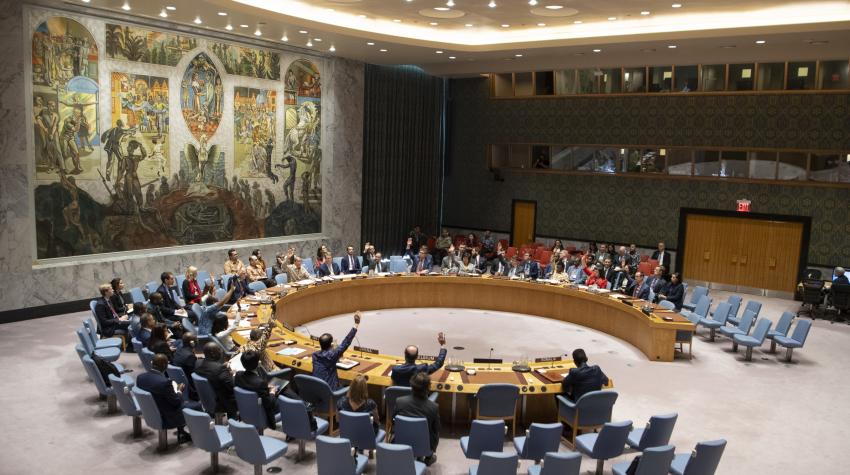
The Security Council (SC) Chamber is adorned with dark turquoise patterned wallpaper that stretches across the two sides of the room, and at the back of the room, behind the nearly perfect circular meeting table, hangs thick, lengthy curtains that flow gracefully from the ceiling to the floor. Between the curtains, a large mural is painted on the white marble wall. All of this creates a space that appears rich and sophisticated, with just a touch of frivolity. As a stranger to this room, the atmosphere seems at first, quiet, calm, undisturbed, almost subtly serene, and still. Yet, what is discussed in this space is often the opposite–intense, stifling, restrictive, cold, and at times, hostile. As I reflect back on my relatively brief time here at the United Nations (UN) this summer, including time at the High-Level Political Forum, there are several observations and personal reflections I want to share specifically concerning the Security Council.

The UN SC meetings occur most weekdays at 10am. For general debates, the meeting continues at 3pm until all states who wish to speak have spoken. As the meeting bell rings announcing the start of the meeting, state members finish taking their seats around the table. I open my laptop laid out in front of me and insert the interpretation earpiece on one of my lobes as the President calls the meeting to order. The President gives the floor to the briefers, and then each of the representatives takes turns deliver their speeches. Heated debates, amicable conversations, and pragmatic outcomes were some of the elements I expected from the meetings. However, it was, in fact, very political, formal, bureaucratic, and curiously unwelcoming and distant. This was especially so because state members would mostly read from pre-written scripts.

One of the meetings I attended which was truly intense, political, and even hostile was the discussion on the situation in the Middle East concerning the Israeli-Palestinian conflict. The bombardment of hospitals and schools, military raids, the number of dead women and children, food insecurity, health systems on the brink of collapse, all of these and more were repeatedly mentioned, representatives mostly condemning the acts that led to such devastations, and then calling for a ceasefire. Each of these meetings invited representatives from the State of Palestine and Israel. There were a few instances when the Ambassador  from Palestine would point fingers at the Israel representative, passionately urging state members sitting in the room to uphold the UN Charter and international humanitarian law by acting instead of sitting around simply discussing what to do about this heinous war which has occurred ever since October 7th 2023 attacks by Hamas.

In response, the Israeli representative would use phrases like “child rapists” to describe the Palestinians and argue against the points the Palestinian Ambassador had previously stated. The atmosphere was hostile, intense, far from respectful and void of understanding, as might have been anticipated given that the two states have been at odds for decades. Their deep-seated hostility is historical, passionate, and complex, which is why such discussions were not easy. Indeed, it was obvious that there were no practical outcomes after these heated conversations. All that was addressed was what the situation in Gaza was like and the statistics that supported what each of the member states said throughout the meetings. The death of civilians continues to rise whilst these individuals sit in their suits and ties on the comfortable chairs in the Security Council chamber.

The hostile dynamic between  Israel and Palestine was not the only one. Such political hostility was clear between the United States and Russia, mostly over Ukraine but over Gaza also. The Russia representative would put the US in the spotlight, accusing it of being perpetrators of the longstanding policies of the West that continuously excluded the interests of Russia and other non-Western countries. He painted the US as a serial violator of fundamental agreements and highlighted US reluctance in multilateral engagements. They mentioned  widespread US corruption in one of the meetings, using the example of the Pentagon’s inspector general of the US army who did not report weapons violations, which he asserted was only the tip of the corruption iceberg. On the other hand, the US representative accused Russia of fabricating lies and constantly distorting narratives, mentioning that it is “… unfortunate we all had to sit here and listen to that…”. The members would further elaborate on their respective failure to uphold multilateralism and the UN Charter, highlighting that Russia is hypocritical as they utilize the SC as a platform to broadcast disinformation. As the US and Russian representatives delivered their statements, the other Ambassadors were often on their phones, a clear sign of their political dissatisfaction with each other.

As part of an often-small audience listening to their statements, I was often  shocked and bewildered at the irony of the meetings. The UN was founded on the values of multilateralism and cooperation, peace and security, integrity and accountability, and so on. Few of the meetings represented these values. Instead, they displayed the opposite, pushing for more of a political agenda instead of a peaceful and dignified one. I wanted to have a conversation with each of these representatives and learn more about their personal stances, instead of what their statements represented. What were their names – instead of “the representative of the Republic of Korea”? Do they truly care about the issues they talk about every day, or do they only pretend to care? Are they likewise frustrated about these meetings which are often long on statements and short on progress? I had no way of knowing. After each of these sessions such as the conversation on the situation in the Middle East, I would leave the chamber disappointed and discouraged. I realized the most I could do is write about my observations and experiences during my time here at the UN.

Despite all this, my time at the UN was a profitable one for an evolving  student such as myself, not yet sufficiently exposed to present real-time ongoing global issues and conflict. If learning about the world and the issues our society faces is a priority, sitting inside the walls of a classroom is one way to go, but the opportunity to watch and listen in on Council members was quite another. I learned more about the world, exponentially more in fact, outside of the classroom in these meetings. It was a great space for me to hear first-hand about the current situations in states that are struggling with international peace and security. It was much more tangible and concrete than reading about it from literature, news articles, or textbooks, as important as they can be. I realized the significance of being present in an environment that existed for the purpose of making the world a better place. If there is one difference between myself at the beginning of my internship and now, it is that I am much more educated, informed, and interested in global politics, international relations, and issues relating to peace and security. The frustrations were not simply frustrations but also a catalyst, sparking my passion to change the world, directing my attention to pursuing a career in organizations that actively tackle global issues, specifically in areas that are directly impacted by war, because I believe it is a scourge that needs to be addressed right now. As is often noted in the Council chamber, the fate of so many of the world’s peoples, especially women and children (who often have little or no say in resolving the violence) continue to hang by a perilous thread.  

Clearly, in order to tackle global conflict, the UN  must fix the problems that lie within the institution, and this includes the Security Council. States must step up to the task and rub the dust off their eyes which conceals the reality of these meetings. Such meetings are too often impractical, redundant, ineffective, and unproductive. How can the SC members encourage multilateralism and cooperation when they fail to maintain an amicable relationship between themselves? Of course, there are several Council members  which maintain good terms with others. Yet, I am left to wonder  how many of these are actually grounded in politics, not sincerity, which is a realistic concern seeing that the UN is a fundamentally political organization. However, this too must evolve. Despite apparent differences, states must find it within themselves to eagerly come together each morning to the SC, full of compassion, integrity, and the willingness to listen actively to contrasting views. Members must better cooperate through lively, results-oriented  conversations, instead of reading from their politicized pre-written scripts. .

A Moment of Truth: Reflections on the UN System from the Inside, by Himadri Ratnayake  

4 Aug

View of the Security Council chamber from the left side of the room, with a round table for delegations and a mural of a pheonix on the wall.

Editor’s Note: A student at Columbia University of Sri Lankan heritage, Himadri has concluded her summer internship with us, adding much value to our work and making the most of the opportunities which the UN presented. Her task here was to reflect on how being at the UN differed from (or confirmed) learning about the UN in a classroom setting, how her assessments of the UN were influenced by expectations of the UN generated in other contexts. We were really happy to have her with us especially during July’s High-Level Political Forum.

We have six years…six years left to go. In 2030, I will be 30. In 2040, I will be 40. In 2050, I will be 50 and so on. Only six years to make comprehensive progress on the 2030 Sustainable Development Goals, with only 17% of the goals and targets now on track. . While it may seem like there is a lot of time left, there is also still a lot of work to do to fully address all the goals and their targets, to honor the promises we have made to global constituents.    

As a 24-year-old graduate student studying international affairs with an emphasis on Economic and Political Development, International Organizations/UN Studies and International Conflict Resolution, I have been able to understand some of the behind-the-scenes of what takes place within UN spaces. When you are in school, there is only so much you can take away from articles, resolutions and the knowledge of a professor. Having now been at the UN, I have been able to apply what I have learned and understand more of the system and processes that occur within that sphere. Overall, it has been an absolute privilege to have been able to attend meetings covering a span of topics: the conflicts in Gaza, Yemen, Ukraine, etc., food insecurity, children impacted by climate change and war, oceans, decolonization, etc. I have acquired an abundance of knowledge just by attending such meetings and side events, learning about various climate and terrorist threats, UN agency mandates and rules of procedure, preferred UN terminology, and so on. There were some topics that I had never truly known about until I attended a meeting, and that only goes to show the range of conversations which are taking place at the UN, especially during July’s High-Level Political Forum.   

Throughout my time here, I have had multiple opportunities to engage in meetings held within the Security Council, ECOSOC and the General Assembly as well as “side events” in many other conference rooms. Upon my first time sitting in on a Security Council meeting, I felt excited to be able to witness discussions in a manner that is  often closed to the outside world. There is a level of seriousness and intensity in the room that one can’t necessarily experience on UNTV or in a classroom. The briefings initially held at the beginning of meetings by various officials from UN agencies ranging from the OHCHR to the IOM and so on, offer incredible insight regarding statistics and stories of urgent situations taking place on the ground.  

Initially, during the first few meetings, all the country’s statements appeared to be full of hope and promise, offering a great chance of making progress toward resolving situations on the UN agenda. However, upon attending several meetings and listening to multiple country statements back-to-back, I noticed the repetition of information and beliefs expressed by the country representatives. The statements would usually start the same, often including the same statistics that would already have been mentioned in an opening briefing. The words “let me make three points” were frequently mentioned as well. I bring up the structure of these speeches because it shows how much repetition we witness, not only in structure but in content as well.  

While I still retain so much hope in the UN, and still wish to join the Foreign Service soon along with involving myself in humanitarian field work, I cannot help but wonder how much progress and change we are truly creating in terms of resolving many existing global threats. This is also the case for emerging crises; everyone but the people at the very top of governance seem so highly limited in terms of decision-making access and impact. Even those residing at or near  the top experience their own limitations.  

 In addition to what I have previously noted, I have also observed other unfortunate occurrences in the meetings I attended. There are Member State representatives who walk out of the Council chamber when certain countries are preparing to speak, Member States who change the narrative (facts being turned into fiction and vice versa) and those who do not seem passionate or even interested in their own or other country’s speeches. I have also noticed the lack of attention given to those that are speaking or participating in the meetings. There have been countless times where it is evident that people were on their phones, ostensibly on social media, scrolling endlessly and even occasionally forgetting to turn their volume off. During my short tenure in the Council, I have heard bag pipes playing, some hip-hop music, etc. amidst deliberations on critical matters pertaining to peace and security. This may not seem like a big deal to some, but when discussing matters of war, the effects of it on civilians, etc. what does the lack of careful listening tell us?  

These past couple of months have brought great insight into processes which had mostly been closed off to me and others in my cohort. On the outside, the UN often represents a symbol of peace, hope, strength and unity. It also serves as a promise to current and future generations, that there will not be another world war and that peace can eventually prevail. However, it seems that presently there are more wars (regional conflicts) occurring now than perhaps ever before. My question is thus, what are we doing exactly to help resolve these situations?  

One of my favorite adornments in the Council chamber is the “Untitled (Mural for Peace)” by Norwegian artist Per Krohg. It sits as a perfect backdrop to the purpose of the Council, and further emphasizes the importance for peace and security in our world today. What a powerful message and image this is, where the phoenix is rising above the ashes of a conflict-ridden society. That is the future I wish to see, not a continuation of what is currently happening. If anything, we are now driving the phoenix back down into the ashes. The Damask wall tapestry further embodies faith with the growing wheat representing “hope and the heart of charity.” While such beliefs still persist, it is imperative that we fulfill these symbolic aspirations and apply them to the world.  

On the inside, the Council meetings usually start in the same manner. The three dings go off, and the agenda is usually announced and adopted for the session. In some meetings, the level of intensity is relatively tame while in others there is finger-pointing and hostility that permeates the air. As a student, I see the hypocrisy within certain country statements, and while I understand the justification behind them should we not be looking for more sustainable solutions than reflect minimum concessions to peace? There are certainly hopeful solutions that representatives present to their colleagues, but not everyone is committed to following what seems to be the obvious answer to the issues presented in such meetings.  

As I am entering my second year of my master’s program with this new outlook on the UN, I am hoping to discover what my place will be in that place post-graduation. I do not want to wait until 2050, when I am 50 years old, for change to take place in our world today. Not more discouraging  change, which we surely don’t need, but good change. We need more good change, we need more progress on sustainability, and we need it quickly.   

One final thought:  Throughout my time  at the UN, many discussions that took place in the context of smaller events, especially during the High-Level Political Forum (HLPF), mentioned the need to involve the youth by incorporating them in conversations and even decisions. These conversations include the evolving climate crisis, peacebuilding priorities, multiple human rights issues, etc. The problem is that prominent figures in the room may listen to youth  but there is little to no progress which can be measured as a result of these interactions. Involving younger generations in actual development processes, whether it be policymaking or other discussions at multiple levels of policy and practice, is necessary if we wish to fulfill our SDG commitments.   

As a member of the “younger generations,” there is so much I wish to do in terms of solving these global challenges that only seem to be growing. But it seems unlikely that I can make any impact or real change at my current stage. The more UN meetings I attended, the more I observed the age range of people leading discussions, and they were mostly (with all due respect) from the older generations. There were even some events where one could easily notice the lack of bodies of any age in the room, perhaps because not many people were aware of the event, perhaps they were too busy with other matters, or (I fear) perhaps some people in the system (or attending the HLPF) may be losing hope in an organization that has demonstrated limited capabilities to resolve many security and development concerns.  

With that being said, I hope my reflection offers some helpful insight into a youth’s developing perspective on the UN. My passion for international affairs and this journey into diplomacy stems from my time in Model United Nations (MUN). In learning about various world issues at an even younger age and then being privileged to travel the world, I acquired this hope that the UN could be the answer to solving these pressing challenges. Over time, as my knowledge and experiences have grown, I realized that it is not only the UN but also and primarily world governments who are the keys to forging positive change. They are the primary policymakers and the ones who hold the power in decision-making when it comes to war, the climate crisis, peacebuilding priorities, etc. Thank you to FIACAT and all who made my UN sojourn possible. By 2030, I hope more significant progress on all of the SDGs will be possible. .  

The UN Security Council and Climate Change:  Struggling  to Connect the Dots, Dr. Robert Zuber

6 Jul

Editor’s Note: This piece was written in response to an invite from a university in Kenya, a zoom presentation which never materialized due to communications issues related in part to the unrest which had exploded in Nairobi in late June. So….here it is for you to read if you so choose. I hope its worth your time.

I want to begin this presentation to all of you with a sober look at where we are vis a vis the climate crisis.  Put simply, we have collectively failed to address climate risks and, in the case of the wealthier countries, have failed to meet our obligations to climate victims.  The burdens of climate change are felt by all including displaced women and an increasing number of women farmers, but they are not responsible for the growing climate-related carnage.  These people, like most of you, are suffering from a crisis they did not cause.   

Here at the UN, we continue to pass resolutions with levels of enthusiasm  for implementation which tend to drop as soon as those resolutions are adopted. On climate, the threat is felt acutely in small island states and in the Sahel, but not quite as much in most middle income and wealthy states, precisely the states responsible for the bulk of global emissions. Even when the rhetoric is sufficiently urgent, Council climate action continues to fall well short of what is needed.  Young people have in some instances filled the leadership gap created by older persons on addressing climate risks; and yet for many young people the preparations they are taking in their lives, their studies, family matters and more  are likely confronting a future of extreme heat, equally extreme weather events, growing threats of  food insecurity and I would add life insecurity as well.  You in this university audience didn’t do this to the planet, and you don’t deserve the consequences  either.

It is commonplace to note this, but how we assess in life is largely a function of what we expect, and it is the expectation of many young people that we aging folks from the west in our relatively comfortable contexts should have done more, could have done more to stem the increasingly inevitable climate tide.  What were we thinking?  Were we thinking at all? 

And if we were thinking at all, what were we thinking about?  About gender-balancing our climate action? About helping to unleash the diversity of youthful  talents across the world that can break through some of the policy bubbles and stale air which exist in the diplomatic world?  Were we metaphorically thinking about “sharing the ball” with youth and others which is the only way human civilization can possible win this game of climate ruin?

There is  at least a growing sense within the international policy community that climate change is, at least, a conflict multiplier that the climate is evolving much quicker than we have the ability to address, including its impacts on international peace and security.  But there is also a growing sense, and I agree with it,  that we have mis-positioned our climate action, focusing much too much on the activities of officials and diplomats making (and often failing to make) climate policy largely through resolutions without “teeth” or through large international events which burn more carbon than make change, rather than on communities seeking pathways to more resilience and abundance.

From our base in New York, we have identified and assisted programs around the world which are attempting to promote inclusive, gender sensitive local lenses on sustainability.  My favorite of these is Green Map (greenmap.org), a set of tools including culture-specific iconography to help local communities identify environmental assets and liabilities,  to use mapping to reintroduce people to the resources and habitats which are worth protecting and which make their communities special.   Our slogan – think global, map local – is symbolic of a deep belief that we will never fulfill our climate or sustainability goals without pragmatic engagement by local leaders in all global regions, including many more women and youth participants.

While affirming local action in all we do, I often sit in a very different place, in the UN Security Council, which has an uneven relationship with the climate issue.  It could even be said that the Council also has an uneven relationship with its own Women, Peace and Security agenda, an agenda 24 years old with a host of gendered gaps and discriminations still largely unaddressed.  On climate the pattern is similar: recognition by some Council members, especially elected members, that climate is a major contributor to conditions which make conflict more likely.  On the other hand some members simply don’t see the linkage, or  think that climate issues should be handled by the UN agencies tasked specifically with climate or other environmental matters.  The concern here, made most forcefully at the moment by Russia, is that there is a division of labor in the UN and that these divisions should be respected.

But while mandates may have similar force, the mechanisms of enforcement do not.  Russia and other Council members know full well that while Council resolutions are often ignored, the Council at least has Charter-mandated coercive tools at its disposal that other UN agencies do not.  And if the Council cannot make states uphold their promises on issues such as gender and climate, then the hands of the full UN are surely tied in terms of enforcing any agreements whatsoever – including climate agreements. 

Some Council members are fighting back, more and more, recognizing that we have set forces in motion that promise more violence, more misery, more displacement and that we must robustly address those forces. These states recognize that the Council can fulfill an important enabling role vis a vis the UNs climate priorities without usurping the authority of the agencies tasked with responding to this crisis.

One example of this “fight back” occurred during its Council presidency of the United Arab Emirates in June 2023, as that delegation tried to rally Council colleagues to take climate risks and their implications for peace and security with the urgency they deserve.  It should also be noted that the UAE at that time was also prepping the Council as well for its COP 28 presidency which ultimately turned out pretty much like all the other COP events – burning more fossil fuel than changing the course of climate threats and making promises of change that are generally  not kept.  But this meeting was at least asking the right questions about the Council’s role in ensuring more diverse climate action and remaining seized of the many ways in which climate change makes conflict more likely.

This quote from the UAE’s Concept Note set a proper tone:

Climate change is the defining challenge of our time. Its interconnected consequences – intensified extreme weather, rising sea levels, food and water insecurity, biodiversity loss and heightened health risks – jeopardize human life, livelihoods and ecosystems and have an adverse impact on national, regional and global stability.

And, as also noted in the Concept Note, climate change has implications for the entire peace continuum including those who are unjustly excluded from participation in peace processes:

The gendered impact of climate change has significant implications for international peace and security. Women and girls are disproportionately affected by the adverse effects of climate change, including food insecurity, displacement and increased rates of conflict-related sexual violence. Moreover, women are often excluded from decision-making processes related to climate change mitigation and adaptation. Evidence shows that, by leveraging the role of women as agents of change, gender-sensitive work on climate change and peace and security can serve to advance both stability and gender equality.

This is good policy language from the UAE but of course it is only language.   Little or nothing changed as the result of this meeting.  Little or nothing changes as the result of most Council meetings as much as the global community, sometimes desperately, needs to see evidence of change. Is there a missing ingredient here beyond politics?

I think there is.  As we discuss often here in NY, there is a human dimension to this crisis which we ignore at our own peril.

Whether the Council or other international institutions embrace their responsibility to address climate risks in a timely manner or not, the changes to our world are coming quickly, more quickly than we had originally anticipated, and we seem unable as a species to respond in kind.  We are in many ways, and more than we generally acknowledge, creatures of habit, and those habits make it difficult indeed to shift our course, even when we want to do so, even when are survival depends on us doing so.

Those of us in the west and beyond know of threats to agriculture from multiple climate related impacts including increased drought and flooding, but we (especially in the west) continue to eat and otherwise consume largely as we always have.  We know of threats to biodiversity but we continue to cut down forests, destroy habitats, and plant non-native and fertilizer-intensive plants in our gardens.  We know about  increasing prospects of climate-related disasters including massive storms and pandemics, but we continue along as though we possess some immunity from those impacts.  We know of threats to our ocean environments, but our collective addiction to plastics waste remains largely unchallenged. 

The climate-conflict nexus is in part about the effectiveness of our global policy and in part about we as members of local communities, the sustainable examples we set, the people and actions we inspire, the habits we are prepared to change.  We know something is very wrong.  We feel the heat.  We experience the growing frustration, anger and suspicion at community and national levels. But can we adapt?  Can we learn new skills, can be more mindful and compassionate towards the created order, can we break out of unsustainable habits?  Can we take the data urgently provided by scientists and turn them into sustainable amendments of both policy and life? The jury is clearly out on this.

As we contemplate our resistance to change, I want to end with a couple of quotes from a recent report from UNICEF on climate impacts affecting future generations, which likely directly  applies to you. The report notes that,  “Environmental degradation, including the climate crisis, is a form of structural violence against young people and can cause social collapse in communities and families. Poverty, economic and social inequalities, food insecurity and forced displacement aggravate the risk that children will experience violence, abuse and exploitation.”

There is also a quotation in the report from a young interviewee:  “The environment is our life.” Adults [should] stop making decisions for the future they won’t experience.”  

Taken together, this is quite an indictment of our collective failure to meet this urgent moment. Yes, we should stop making decisions for people and start making decisions with them, with the people who will have to live with the threats we have left for them, threats of gendered and racial discrimination, threats from abusive governments, threats from an overheated world which can no longer preserve biodiversity or support healthy agriculture. And yes we old folks and our institutions of choice (including the Security Council) have reinforced, inadvertently or willfully, strubborn conditions of structural violence which make it harder than it ever should be for young people across the world to chart a more sustainable course for their lives.

A world of increasing climate threats, including threats of armed conflict,  is a world we are running out of time to prevent, and it is the country I call home along with other large consuming states which need to make changes on emissions and consumption quickly and permanently.  We the people of largely undeserved privilege  owe it to the rest of the global community  to somehow reverse our current, unsustainable course, reminding ourselves frequently that the clock on such reversal is loudly ticking.

An Updated Agenda for Rights and Security, Dr Robert Zuber

17 Sep

Editor’s Note: Over the summer, I was asked by NGO colleagues to pen a contribution on this 75th anniversary of the Universal Declaration of Human Rights, one which links two of the UN’s three pillars – that of peace and security and that of human rights. The project seems to have, for now at least, gone “radio silent,” so I decided to post it here so it could be read and scrutinized as desired. Thanks to Jess Gilbert this is now more readable than the initial version. It is also considerably longer than usual . If you decide to give it a read you have my steadfast admiration.

While the UN’s human rights pillar remains in some ways the most unstable of the three – with challenges related to a rapidly expanding mandate with rapporteurs to match, limited enforcement options and sometimes severe push-back on women’s and other erstwhile “indivisible” rights, all referenced in more detail below – tenets of a  still- uneasy security-rights policy relationship which is my task to examine are “not news” to most of the diplomats and NGOs populating UN conference rooms.

Indeed, most all recognize the immense value of the (non-binding) Universal Declaration over many years in promoting the economic, social and cultural rights “indispensable” for dignity and the “free development of personality.” Moreover, the Universal Declaration also explicitly recognizes the importance of maintaining “a social and international order” in which the rights and freedoms it sets forth can be fully realized. And, perhaps most germane to my assignment, the Declaration Preamble makes plain that to ignore the protection of these rights is in essence to invite “rebellion against tyranny and oppression,” a clear sign that even 75 years ago, the human rights – security nexus had direct policy relevance.   

Thankfully, my “not news” task” was energized  a bit by the release of “A New Agenda for Peace” (https://www.un.org/sites/un2.un.org/files/our-common-agenda-policy-brief-new-agenda-for-peace-en.pdf), the ninth policy brief shared by SG Antonio Guterres under the broader rubric of “Our Common Agenda,” an agenda which in several key respects is a worthy successor to the Universal Declaration.

Many in our sector at least to some extent have already scrutinized this New Agenda and I won’t diminish their contributions through my own replication. I do agree with a former-diplomat friend that the Agenda is a “polite” offering, highlighting the dire straits we now find ourselves in (a strength of this SG) while outlining policy priorities which the UN for the most part is already addressing, albeit with uneven energy and success.

This SG has been increasingly vocal about the threats which many constituents still refuse to fully acknowledge. His is not quite a “chicken-little” approach to global threats, but such threats certainly loom large and have been growing in impact for some time. Still the body over which he presides has long been characterized by issuing clarion calls on a range of issues and concerns while diplomatic responses extend too-infrequently  beyond convening opportunities for performative statement making. For instance, this past July’s High Level Political Forum, ably presided over by Bulgarian Ambassador Stoeva, was a beehive of events and reflections on our current, common plight, and on our insufficient responses to sustainable development promises made in 2015 which span the UN’s agenda across its three policy pillars. But still a familiar pattern persisted of shedding more light than heat on our current malaise, more in the way of highlighting our seemingly declining options across these three policy pillars than concrete measures to help honor promises made 8 years ago to resolutely and tangibly deliver the SDG goods. 

For those of you who have not yet had time or interest in doing so, the New Agenda for Peace is worth a read. Some of the proposals have clear and urgent merit including on the need both to ban autonomous weapons (p.27) and to negotiate and adopt tenets of responsible governance over potentially “weaponized” AI and related ICT before those often-“lawless” horses (p.26) finally and forever flee the barn. Thankfully, the New Agenda does not skirt the issue of our grotesque military spending (p.4) which sucks trillions of US dollars out of the global system on an annual basis leaving the UN’s human rights mechanisms overly dependent on what is in essence volunteer labor and, over and over, leaving conflict-affected populations begging for the assistance we have given them reason to believe would be forthcoming.

Also welcome, the New Agenda urges states, yet again, to “look beyond narrow security interests” and embrace multilateral solutions to challenges associated with our “more fragmented geopolitical landscape.” (p.3) Indeed, as this Agenda makes clear, we may well have reached the limits of our capacity to heal the deep scars of war and armed conflict without putting an end to armed conflict altogether. We may have also approached the limits of our ability as currently organized to rebuild damaged infrastructure, revitalize economies and the agriculture damaged by bombs and warming temperatures, restore public trust or ensure that the discrimination, arbitrary detention, child recruitment, online harassment, sexual violence and other abuses now virtually synonymous with conflict in both cause and effect do not thereby lay the foundation for a return to the violence which virtually none on this planet can any longer endure. 

Gratefully, the core of the New Agenda for Peace lies in a commitment to prevention (p.11), easier said than done to be sure, but perhaps our only remaining opportunity  as a species to reset our financial architecture, revise our dangerous habits of consumption and suspicion, and heal our social relations; to create enough breathing room in our societies and their governance structures to ensure that biodiversity can be restored, climate risks can be mitigated and solidarity and other indicators of personal and collective responsibility can be ratcheted up. These and other global obligations would help ensure that barriers to the “universal” rights compliance advocated by the SG (such as the elimination of patriarchal structures as explicitly noted on page 7) can be duly removed, thus helping to ensure that policy promises made are more likely to be kept. 

All who spend time in and around the UN recognize that such “breathing room” is in fact is a high aspiration given the low levels of trust which are manifest in many UN policy spaces and the core values attached therein to sovereign interests which keep the UN largely confined to norm-creation. This norm-creation mode, as important as it can be, generally comes attached to little stomach for holding states accountable to commitments which in too-many instances they have scant intent on fulfilling while pushing off accountability for failures away from themselves and on to other states and entities.  It is commonplace to note this, but worth doing so in this context – among the words you will almost never hear in UN conference rooms are apologies for policy misadventures nor clear acknowledgement of national deficiencies in implementing UN norms prior to engaging in the more common practice of trying to “pin the tail on other donkeys.” 

Indeed, the UN often finds itself hamstrung insofar as it must walk a series of lines which recognize that, at the end of the day, even Charter-offending states are going to have the UN they want. They pay the bills. They set the agendas. Their sovereign interests remain paramount no matter how much they might claim otherwise. In the name of preserving universal membership, states permit discouraging violations of core UN Charter principles often with functional impunity. They often tend to talk a better game than play one given how easy it is to “spin” national performance on the assumption that few if any of the major policy players want their UNHQ representatives to make diplomatic trouble or shut off options for dialogue by “exposing” flaws in their own or others’ national narratives.  The value of diplomats lies, in part, as a function of their considerable ability to keep the policy windows open but this skill is regularly discharged despite the stale air which is too often allowed to settle into deliberative and negotiation spaces.

From my own vantage point in regards to reports such as the New Agenda I often find myself hoping to see an examination of the structural impediments facing what is actually an intensely political UN policy space, from resolutions divorced from viable implementation to “consensus” which too often constitutes a de-facto veto and results in language which, again, is more adept at identifying problems than addressing them with the urgency that the times require. The “lip service” (p.11) which the New Agenda identifies has a wider UN application than merely on prevention, though prevention remains a relatively easy matter to “service” in UN spaces. Regrettably, the prevention agenda can easily become a vehicle by which officials are encouraged and enabled to paint more pleasing national portraits of human rights compliance, development assistance, good governance and arms transfer restraint than the available data could ever support.

What I continue to yearn for, virtually always in vain, is a formal accounting of the gaps and limitations of a state-centric, multilateral system wherein the states make pretty much all the rules, including on levels of engagement on key policy relationships which many in our own NGO sector believe must remain more actively seized, such as those linking the human rights and security pillars. The SG does note the “failure to deliver” (p.2) in his New Agenda, but also refers to the UN as “vital” for harmonizing the actions of states to “attain common goals” (p.30).  Unpacking these challenging-to-reconcile claims could well lead to a stronger, more effective system on both security and human rights. We need to remain seized of what the UN is doing with regard to its security-rights nexus, but also what more is needed to succeed, what skills and human capacities are still lacking, how amenable we are to filling gaps (including at local level) rather than allowing them to fester?

Thankfully, in large measure due to the relentless scrutiny and mandate expansion of the Human Rights Council and its Human Rights Committee our understanding of the human rights/peace and security “nexus” is clearly finding expression in multiple diplomatic settings.  No longer is it necessary to explain how discrimination under law and in access to services, prison conditions which enable the practice of torture or other coercive means of extracting “confessions” (a focus of our good partner FIACAT), arbitrary arrests and disappearances and much more contribute to instability within and between states and thereby foment conflict.  And it certainly no unique insight to point to the numerous instances where armed conflict – from Ukraine to Yemen and from Myanmar to Burkina Faso – creates veritable engines of abuse, complicating peace processes and opening doors to conflict recidivism with xenophobia, hate speech and sexual violence to match, abuses which were likely among the causes of the conflict in its first instance.

However, those of us who still choose to hang out in multilateral conference rooms know the gaps that continue to separate acknowledgment of right violations and threats to peace and security across the human spectrum. Indeed, not every agent and agency of global policy is on board with the notion that human rights should be a central theme both informing and defining peace and security deliberations.

The Security Council (our primary UN cover) is one place where consensus on this relationship has been elusive given recent claims bu at least a couple of members (permanent and elected) that a focus on human rights disturbs what is maintained to be a traditional “division of labor” in the UN; that because the UN has a human rights mechanism – albeit overworked and improperly funded – such matters should essentially be left to their devices. Moreover, there is also a concern among a few members past and present that too much human rights scrutiny can easily become a sovereignty-threatening club that some states use to batter the actions and reputations of other states.

These concerns are not entirely without merit; however, they tend to overlook what we know about the place of human rights abuse in triggering conflict as well as the rights-related consequences of violence unresolved. This view also fails to acknowledge the differing levels of authority with which these diverse entities operate. The Security Council’s permanent members are well aware of the privileges of their membership – not only the vetoes which they occasionally threaten and cast, but the additional  ways in which they can manipulate policy outcomes, protect their allies and overstate with impunity the significance of resolutions which are claimed to be “binding” in the main but which were often negotiated and tabled with a clear (if cynical)  understanding of the client state interests to be protected. Without question and for good or ill, the Council’s vested authority is unmatched across the UN system (including by the International Court of Justice), a system which provides Charter-based options for coercive responses to many (not all) threats to the peace which are simply not options for other agencies and pillars.

Of course, anyone who is still engaged with this piece will likely know all this already.  But perhaps the following implications of this authority imbalance will pique interest. Those in the Council (often from among the 10 elected members) who wish to see the Council’s Programme of Work expanded to more regularly embrace contemporary themes and conflict triggers (such as climate change or as it is now known around the UN, “global boiling”) and areas of overlap (such as human rights enablers and consequences of armed conflict) thankfully have various means to do so including hosting Arria Formula meetings and taking advantage of modest presidential prerogatives when their month to occupy that seat comes around.

But these options remain insufficient to a full vetting of the rights-security nexus.  We have long advocated for a Security Council that is more representative, but also which is more in sync with the goals and expectations of the UN system on the whole.  A case can be made, and we would wish to make it, that the Council should embrace more of an enabling (in the positive sense) role relative to the system of which it is a part. Yes, there is a Human Rights Council. Yes, there are talented rapporteurs galore and human rights review procedures applicable to member states. But human rights performance seems a bit too optional and subject to sovereign interests, especially given that such performance is, if the New Agenda is to be believed, central to any sustainable peace.  At the very least, the Security Council could use its authority to encourage greater political and financial attention to a human rights system which strives for universal application across a “full spectrum” of rights obligations now ranging from ending torture to ensuring the right to a healthy environment.  The Council does not necessarily need to add direct discussions about these rights obligations to its already complex and often-frustrated agenda, but it can and should do more to indicate that the successful work of human rights and other UN mechanisms has a direct bearing on the success of its own peace and security agenda. 

It seems obvious perhaps, but bears repeating: none of us engaged at any level in international policy, neither the Security Council nor any of the rest of us, should ever divert our gaze from the painful reminders of just how many people remain under threat in this world and how much further we need to travel in order to make a world that is more equal, more inclusive, more respectful of each other and our surroundings, certainly even more mindful of our own, privileged lifestyle  “contributions” to a world we say, over and over, is actually not the world we want.  As difficult as it might be to contemplate, we in policy spaces are not always the “good ones.” Indeed, when states and other stakeholders refuse to own up to their own foibles and limitations, especially in areas of rights and security, their/our critiques of others, regardless of their conceptual legitimacy, are more likely to ring hollow.

One area of ownership in these times is related to elements of  the “human rights backlash” which we continue to experience in many countries, in many communities and their institutions, even in multilateral settings, as evidenced by an unwillingness to address the core funding needs of the human rights “pillar,” member state inattentiveness to legitimate requests for investigations by special rapporteurs and others, even attempts by a shocking number of state officials to link the activities of human rights advocates (and even of professional journalists) to those of the “terrorists.”

Clearly, the world we inhabit needs a full reset beyond truces, beyond grudging or even self-interested suspensions of hostilities. Such may well be helpful preconditions for the pursuit of security which simply cannot be obtained at the point of a gun. But the security that so many in this world seek remains too-often elusive despite these often-unstable agreements, including people whose farmlands have dried out or flooded, people forced into poverty, displacement and despair by armed violence and abusive forms of governance, people made vulnerable to the lies and allures of armed groups and traffickers, people who find that they can no longer trust their neighbors or inspire trust from them, people betrayed by officials whose hearts have long-since hardened to their pleas for help. These are just some of the people in our fragmented world whose rights deficits are tied in part to our weapons and power-related addictions but more to our failures as people to soften our hearts and raise our voices to the challenges it is still within our capacity to meet.

The Universal Declaration does not, as many readers know well, dwell on weapons or other security concerns.  But it does define the tenets of a sustainable human dignity, the rights that give people the best chance to pursue lives in keeping with their aspirations beyond their mere survival.  It reminds us, as does the New Agenda more explicitly (p.3) that “war is a choice;” indeed is a series of choices by states and communities to invest in the carnage of ever more sophisticated weaponry and the coercive humiliation which flows from the deployment of such weaponry rather than in ensuring a sustainable future for all our people. Those many rights activists and policy advocates who put their own lives on the line to protect the rights of others know how much of our current security policy and architecture threatens to lead us down paths of ruin.  If the New Agenda is truly to be “new,” it must inspire commitment to find the inner resources needed to pursue more sustainable outer actions that, as with the Universal Declaration, keep dignity at the very top of our conflict prevention and human rights menu.

Trust Busters: Interrogating the “Blossoms” of Distrust, Dr. Robert Zuber

7 May

You may be deceived if you trust too much, but you will live in torment if you don’t trust enough. Frank Crane

Trust dies but mistrust blossoms. Sophocles

When trust improves, the mood improves. Fernando Flores

How can people trust the harvest, unless they see it sown? Mary Renault

As you enter positions of trust and power, dream a little before you think. Toni Morrison

Trust, even when your heart begs you not to. Alysha Speer

To borrow against the trust someone has placed in you costs nothing at first. You get away with it, you take a little more and a little more until there is no more to draw on. Jeanette Winterson

Trust starts with truth and ends with truth.  Santosh Kalwar

This past week, under the Swiss presidency, the Security Council held a general debate on the topic, “Futureproofing trust for sustaining peace.”  This “debate,” chaired by the Swiss Minister of Foreign Affairs, gave delegations the chance to both assign blame for the current, largely dismal, state of multilateral affairs, but also to be more thoughtful than is often encouraged about how trust-building is a more essential element in the success of such affairs than has often been recognized.

Amidst the cold winds blowing through the UN since the height of the pandemic, specifically with regard to NGO and civil society access, we have noticed more and more delegations taking up – in rhetoric if not always  in practice – the normative elements that we and others have been promoting for some time.  More and more it is recognized that the comfort we share within our UN bubbles is often not shared by constituencies at large; that our predispositions to craft language (especially on peace and security) watered down by a misreading of “consensus” and then foisted on a needy world with little or no interest in how such language is to be implemented does not appear to others to be quite the breakthrough that we imagine it to be in the realtive conform of UN conference rooms.  Indeed, there are, and likely shall remain, trust deficits which will inevitably occur in situations where the norm-makers have little or no responsibility to ensure that norms crafted can actually breathe hope and life into the communities ostensibly served, communities who generally have little or no say in their crafting.

As we know from our own training and investigations, and as this week’s Council debate reinforced, trust is no simple matter.  Indeed, like “love” and many other of our cherished normative categories, trust is far easier to invoke than to either define or maintain.  Indeed, in a world which seems at times to be spinning out of control, the tendency in policy is to focus too much on the criterion govering our own trust issues rather than on criterion for cultivating and enabling trust in others.  Moreover, in the context of multilateral relations, it is too easy to forget that the priority of trust-building has a history, one in part of colonial powers and other large states which has “borrowed against trust,” over and over again, throwing their weight around, imposing values that they do not always practice themselves, telling only the part of the truth which serves national interests, crafting agreements with abundant loopholes which preserve options for some and limit them for many others, insisting on ending impunity for smaller, offending states while dodging accountability for themselves, insisting on a “rules-based order” without a thorough vetting of who made those rules and the starkly uneven ways in which they are often enacted.

We should be clear here.  We have sat in UN conference rooms with laptops open and mouths closed for a generation now.  Despite the aforementioned “cold winds” which we experience on a daily basis, we continue to believe that the flaws in this system, flaws which impede the full-flowering of what is still a rather remarkable experiment, can and must be fixed.  Despite the extraordinary diplomatic and learning opportunities occurring routinely within its walls, we have long since moved past honoring the resolutions which are dead on arrival, the endless COPs and other of what Kenya referred to this week as our “ceremonial meetings” which too –often deliver even less than half a loaf, those diplomats who insist that the UN is solely for its member states without reminding the small but attentive audiences that the decisions which hopefully bind are made mostly in national capitals not in UN conference rooms, the often-fruitful discussions which are now more frequently webcast but which are more likely to raise constituent expectations than satisfy them. 

Despite calls by the African Union and several other delegations speaking at the “Futureproofing” event to bring multilateralism closer to the people, gaps of trust remain, gaps which cannot be written off as the fruits of vaccine inequity or the painful Russian aggression against Ukraine.  These are gaps of “good faith” as noted by Mexico this week, of the absence of justice as Ireland insisted, of promises made and then broken as suggested by China, including the promise to break down “the high walls over small spaces” that more and more states seem desperate to maintain.  For its part, Brazil warned of the rapid spread of resentment (and we would add “grievance”) which is toxic to trust-building as is (well-put by the Swiss Minister of Foreign Affairs) our current climate of unpredictability which causes some states to retreat into an unhelpful “nostalgia” and others to dig in their heels and refuse to budge on policy until their own (largely un-named) trust issues are duly addressed.

It is not so difficult for each of us to grasp the complexities of trust; we only have to examine our own relationships, our own mishandling of the truth including the truth about ourselves, the unexamined hurts we carry around in our hearts which impede both the risks of trust but also a clear-eyed examination of the hurts we have inflicted on others.  Trust is no simple matter, neither for institutions like the UN nor in our own domestic contexts.  Whether local or global we continue to “borrow against trust” in ways that only serve to shrink our personal circles and policy worldviews, narrrowing options for both promise keeping and service provision.  

During the Council meeting on “Futureproofing Trust,” The UN High Commissioner for Human Rights, Volker Türk (who doesn’t pull many punches) cited what he called “atrocious ruptures in the social fabric” which make trust in governing institutions a high hill to climb.  Unfortunately, this “high hill” also applies to our personal and domestic contexts as well.  Study after study has chronicled a growing sense of loneliness and isolation amongst many of our populations, people whose primary companions have become cell phones and social media outlets, people who tend to place more trust in apps than in neighbors, people who wouldn’t dream of talking to a stranger but will bare their all in front of a camera to be consumed by thousands of perfect strangers

The “atrocious ruptures” chronicled by the High Commissioner thus have implications both within and beyond multilateral structures, pushing peoples and their representative into harder positions and more well-defended spaces from which stems too-little hope, too-little confidence, too-little trust, too-little courage.  The “torment” which verily comes from living in a world characterized by staggering levels of mistrust now constitutes a metaphorical “superbloom,” one which coveys little beautfy but rather continues to narrow personal and policy options and perspectives. This torment is simply something we must choose to live without.

If we are to scale the peaks on which are very lives likely now depend, we will need to replace the interminable “code red” warnings of our hearts with heart-friendly investments, refusing to be lonely and isolated, refusing to make promises we have no intention of keeping, refusing to pay lip service to the trust that we desperately require at the core of our souls and institutions, the trust that can “improve our collective mood” and bridge divides of truth and action that threaten to turn gaps into the ruptures which we all would do well to fear.

Switzerland opened a door this week in an eminent policy space to reflect on a topic both exceedingly complex and largely neglected.  The takeaway is that we are running short of time to adjust our ways and means such that we might trust with greater courage and improve prospects for maintaining the trust of others. Trust in the end is the glue which can hold together our increaingly unglued societies and their increasingly bewildered citizens. We must continue to make spaces conducive to exploring and examinuing ways to build and share the trust on which our collective future likely hinges.

Preface to a Volume of African Reflections on the Future of Climate and Security Threats, Dr. Robert Zuber

30 Oct

Editor’s Note: While contemplating my next post, I was asked to write a preface for a volume on climate and security in African contexts written by diversely-situated African scholars. Without revealing the name of the book, which is yet to be published, I thought that some of you might be interested in our collective “take” on these pressing security concerns. We’ll advertise the book in this space once it is available to the public.

In the policy spaces which we cover, many of which are at UN Headquarters in New York, we see fresh evidence, if not sufficient implementation, of what we here refer to as the “climate-conflict nexus,” or what the authors of this volume refer to more explicitly and broadly as intersected “insecurity in the age of the Anthropocene.” 

Without minimizing any of the challenges facing African countries, the African authors of this compendium stress both internal issues of governance, terrorism and control of natural resources and of colonial legacies which have transformed but not abated, legacies which are perhaps more subtle but which nevertheless continue to keep an oversized foot securely planted on the neck of so many African aspirations.

Movement within global policy often crawls when running is called for, including on addressing climate threats, and yet there are signs that major institutions and their powerful patrons are beginning to take at least some responsibility for crises which they have enabled more than abated, crises related to (in my own country at least) growing economic inequities, concentrations of consumption and attendant waste for which the term “conspicuous” barely suffices, and levels of military spending which drain global coffers of funds which could be used to build more caring and collaborative societies and fund all of our sustainable development commitments.

The moniker inside the UN Security Council and beyond routinely stresses “African solutions to African problems.”  But this can only happen as the voices of African scholars and policy advocates, of civil society leaders and others living and working on the front lines of conflict and our ever-widening climate emergency, are respected and, above all, heeded. Some of this is happening at the level of international policy. Some demands have taken shape, albeit unevenly, and are now eliciting some positive global responses. There is more talk of a permanent African seat on the UN Security Council.  There are discussions about the importance of predictable funding for African peace operations.  There are reflections, including by UN Human Rights mandate holders, of the human rights dimensions of climate challenges, including the racially-charged implications of climate response which marginalizes those voices – including African voices — which suffer most from and contributed least to our climate emergency. There is even some remorse shed for failures both to ensure fair and adequate distribution of Covid vaccines and to support Africa’s own vaccine production capacities more actively.

But much more is needed to which this volume clearly and resolutely attests.  More self-reflection, sovereign respect and urgent climate action (including climate finance) on the part of major economic and political powers.  More efforts to eliminate corrupt practices and ensure that the abundance of natural resources across Africa yields greater blessings and fewer curses to African peoples.  More on the part of the major arms merchants to end the scourge of widely available, trafficked weapons to groups which terrorize and humiliate, and which impede even African states’ best efforts to roll back climate risks, ensure higher levels of food security, preserve and expand livelihoods, and restore the trust of diverse communities.  More efforts by African governments to ensure that a continent of active and often anxious young people can have confidence in state motives and plot a sustainable future which can be realized on African soil. 

As the authors note from their various contexts, if we are to effectively reverse what Gabon’s Minister of Foreign Affairs referred to recently in the Security Council as our current, “slow death,” this will require more from each of us: including higher levels of people-centered solidarity, more effective, collaborative policy energies, and sustained attention to the essential needs and aspirations of our brothers and sisters across a vast, diverse, multiply challenged and equally abundant continent. The authors of this volume are showing us the dimensions of a a more peaceful, sustainable path.  We need to walk alongside them.

Morbid Symptoms: Shedding Tears of Change, Dr. Robert Zuber

16 Oct

This is the time we have to walk stepping on the storm. Suman Pokhrel

We must rewild the world! David Attenborough

We are greater than, and greater for, the sum of us. Heather McGhee

The real problem of humanity is the following: We have Paleolithic emotions, medieval institutions and godlike technology. Edward O. Wilson

The crisis consists precisely in the fact that the old is dying and the new cannot be born; in this interregnum a great variety of morbid symptoms appear.  Antonio Gramsci

What remains in diseases after the crisis is apt to produce relapses.  Hippocrates

It’s just a hard moment for him, a low point, not some soul-shaking crisis; you know those aren’t sudden or public, they take years, worming inside you like a disease.  Stewart O’Nan

You have shed tears endlessly, and nothing seems to change you because you are relying on somebody else to do the job. Jiddu Krishnamurti

October is a particularly busy month at and around the UN as the six General Assembly committees scramble to put into consensus language operative paragraphs that are, sadly enough, often inoperable.  Year after year, these committees struggle with non-self-governing territories which remain less than fully free, and testimony from human rights rapporteurs which generate support mostly from the states who are already in compliance with those norms. In addition, we are witness to pious declarations of disarmament intent while nuclear weapons are both threatened and modernized and while massive defense expenditures both threaten the fulfillment of the Sustainable Development Goals and find justification in the Russian aggression against Ukraine and other global conflicts where the major arms producers have a compelling interest.

There are many instances in UN conference rooms where the storm seems to be stepping all over us rather than its opposite, where our resolutions (crafted by diplomats with often too-little discretion beyond “instructions from capitol”) with some exceptions seem designed less to offend than to inspire, designed to do what diplomats do best, which is to keep the windows open perhaps in the hopes of better, stronger statements of intent, somewhere down the line.

Sometimes, the problems are running ahead of the resolutions, at times well ahead.  As we dither over language, the “symptoms” which that language highlights continue to “kill us softly.”  The “solutions” which we propose but don’t often enforce are as likely to breed relapse as not, as we manage just enough of the dimensions of our maladies to mostly ensure that our habits (of the heart and of practice) will generate variants on longstanding human disorders, like patients who take enough of the antibiotics to feel better but not to rid their system of what caused their infection in the first instance.

Some of the crises we face at the moment are loud and visible even to the crisis-resistant and at least some of the now-numerous and noisy crisis-deniers which have sprung up in our societies like vegetation enjoying an infrequent rainfall.  Ukraine has taken up much of the crisis-energy of the UN in this recent period, including in the Security Council where serial mind-boggling justifications and righteous indignation have largely obscured the direct threat which the Council continues to pose to the credibility of the UN system as a whole.  Indeed, as the Ukraine conflict lurches towards further escalation rather than resolution; as a cease fire agreement in Yemen has, at least for now, gone by the boards; as armed groups continue to threaten governance and livelihoods across the Sahel; as Haiti continues to struggle mightily with both anarchy and unwanted outside interference; and as violence against Palestinians in the Occupied Territories reaches a new and grisly threshold, the Council’s inability to agree on courses of action and then enforce those agreements is, for many, particularly gauling.

So too on climate change. While the activism of environmentally conscious youth becomes more and more definant, and as the UN prepares for a 27th “COP” event which is likely to again disappoint those looking for more from officials than the massive carbon footprint and tepid results we have grown to expect from these elite gab fests, more than the “Loss and Damage” reparations to which small island states are clearly entitled, the Security Council met this week at the behest of Gabon’s Foreign Minister to consider linkages between climate change impacts and the spread of armed violence by state and non-state actors across his African continent.

One after another, as is so often the case in the Council, members followed the briefers and opening statement by the Gabon Foreign Minister to either reinforce the conflict-related impacts of climate change in Africa and elsewhere, or else to deny that Council has any vested interest in a matter which ostenstibly lies within the jurisdiction of other UN bodies and which they would prefer to remain lodged in those policy agencies.

What we did not hear often in these carefully scripted statemens sent over from various capitols were confessions of how little has changed on climate change on their watch aside from emissions at still-record levels and an Arctic ice cap experiencing fall temperatures more appropriate to Portugal. There were no mea-culpas from the major emitting states. There was no mention by Brazil of the deforestation prioirties that are quickly turning the Amazon into a net carbon emitter rather than the carbon sink we have relied too much on it to perform. The emissions implications of the energy policies of the UK or other major powers were not up for review, nor was the degredation complements of arms production and trade fueling environment-wrecking armed conflicts of varying degrees of “legitimacy.” Indeed, it was Ambassador Kimani of Kenya, who is thankfully using his last months on the Council to set records straight, who reminded all of us of the colonialist double-standards which still threaten African progress on climate and development as a “natural capital superpower.”

Certainly we all need to set records straight as we are able. I came across a reflection recently that the most effective messages and strategies for social change are directed not at middle-aged contemporaries but at the next generations. But these generations don’t need our messaging. They know the “morbid symptoms” which characterize these times and they also know that we erstwhile adults have done little enough to mitigate their impacts. They also know, for all the floods and droughts, for all the fires out of control and species we never new existed on the brink of extinction, that the climate crisis remains akin to a tumor, a tumor the existance of which we can delude oursevels about only so long as the grave threats it poses remain hidden, subtle, not yet sufficiently affecting our own daily movements and priorities.

And let’s be real. There are too many “tumors” in our world now which are poised to become fully symptomatic at precisely the point at which our palliative options face severe limitations. More and more, our youth can barely grasp how it is that such threats are not sufficient to put habits and policies on a fresh course, do not represent morbid crises sufficient to replace the suits and private planes of our bubble-wrapped international events with the metaphorical equivalent of sackcloth and ashes. When will we be prepared to bring our “paleolithic emotions” and “medieval institutions” fully in line with the energy and commitment — our energy and commitment — which these times demand? When will we be ready to truly “re-wild” a life-endangered planet which is slowly slipping from our predatory grasp? When will we shed the tears commensurate with our prior indifference and future devotion?

I’ve been wondering the same.