So how on earth can I bring a child into the world, knowing that such sorrow lies ahead, that it is such a large part of what it means to be human? I’m not sure. That’s my answer: I’m not sure. Anne Lamott
Through the blur, I wondered if I was alone or if other parents felt the same way I did – that everything involving our children was painful in some way. Debra Ginsberg
She has changed in this way that motherhood changes you, so that you forget you ever had time for small things like despising the color pink. Barbara Kingsolver
Mothers are all slightly insane. J. D. Salinger
The best way to keep children at home is to make the home atmosphere pleasant and let the air out of the tires. Dorothy Parker
(24/7) once you sign on to be a mother, that’s the only shift they offer. Jodi Picoult
What fabrications they are, mothers. Scarecrows, wax dolls for us to stick pins into, crude diagrams. Margaret Atwood
Women, who struggle and suffer pain to ensure the continuation of the human race, make much tougher and more courageous soldiers than all those big-mouthed freedom-fighting heroes put together. Anne Frank
Have you any idea how many children it takes to turn off one light in the kitchen? Three. It takes one to say “what light” and two more to say “I didn’t turn it on.” Erma Bombeck
Guilt to motherhood is like grapes to wine. Fay Weldon
Taking care of myself doesn’t mean ‘me first.’ It means ‘me, too.’ L.R. Knost
If they would all sleep all the time she wouldn’t mind being their mother. Kate Atkinson
I spent part of Thursday at the Post Office where I was on a line behind two men with Mother’s Day cards trying desperately to get some commitment from the postal workers that a 78-cent stamp would ensure delivery two days hence.
Such a small and untimely investment wouldn’t ensure any such thing of course and you have to wonder about folks who felt that they had to do SOMETHING for Mother’s Day but didn’t have the resourcefulness to mail on time nor were they apparently inclined to resort to the fancy bouquets, jeweled necklaces and other material indulgences which literally dominate the airwaves during this season.
The quotations above are intended to serve as a partial antidote to the excessive rituals which often punctuate this “holiday,” a day when “remembering” mom is incarnated, not enough in thoughtful questions and familial solidarity but in gifts which often show as much care and recognition as those tardy Mother’s Day card holders in the postal line. Some of the quotations will be familiar. Some offer humor and a bit of insight into the worry and uncertainty experienced by so many mothers I know, the knowledge that we have collectively made a world too dangerous for humans and other life forms, including the life forms better known as human children. We have indulged and normalized behavior that need not be so and that we do not need to be so. We have misused the inheritance of our children – grown and not – inheritance less about trust funds and more about a world which is running out of trust more generically, a world in which we don’t honor promises and then create conditions where promises can barely be met even if we were inclined to do so.
And yet, despite all, so many women, so many mothers in waiting have decided to bring new life into the world anyway.
It is this cloud of global uncertainty affecting motherhood, even influencing the decision to be a mother, in the first instance which I want to briefly explore here.
I have articles on my feed daily outlining some of the internal pressures on mothers – from partners inattentive to child rearing responsibilities and children addicted to screens and their messaging, to struggles with access to health care, child care and formal schooling which might actually prepare children to take on an increasingly challenging world.
At the same time, mothers face a climate increasingly hostile to women’s full and equal (as we say at the UN) participation in civic and political life. The rollback of women’s rights and freedoms, including the disrespect of their professional skills and accomplishments, unimaginable threats to their political franchise and the apparent re-normalization of sexual predation, all this and more has a dramatic impact on mothers hoping to raise respectful sons and empowered daughters. It is painful for some I know to watch as children struggle to adjust to a world which, in several significant aspects, we older folks dared to think we had left behind.
On top of this, as many mothers I know recognize, threats and challenges to children extend much further afield – to rising sea levels and biodiversity losses, to wars of choice and the inevitable displacements and deprivations they cause, to pandemics and other medical emergencies which we don’t seem to have any timely plan to recognize or address, to the pervasiveness of criminality on a massive scale which literally opens spaces for traffickers and corrupt officials as it closes spaces for those seeking to hold criminal elements to account.
You who have indulged these posts over several years have also shared our window into an international order which seems to be fraying at the edges and which the growth of artificial intelligence is most likely to accelerate. From climate change to nuclear weapons, the institutions where we do our work are increasingly unable to ensure that we will not eventually perish at our own foolish hands. “Bombs, blockades and bluster” are terms which represent too much of our current policy discourse and practice, speeches and actions much more likely, it seems, to turn up the heat rather than tone it down.
For mothers, this is yet another dimension of a painfully recognized inability to shield children from the worst of adult follies. Long before these posts were launched, I was part of a UNICEF Committee on the Rights of the Child, committed to “making the world fit for children.” I have worked over the years alongside many women – many mothers – who have contributed much of themselves towards this same end, a goal as essential to the continuation of our human family as it has been elusive. And it has remained very much elusive over the course of my adult life.
And yet, knowing what they know, feeling as they feel, worrying as they might, women choose to have and raise children anyway. They take a stand for lives that they can nurture if not always protect, extending the hope and potential that every child brought into this world embodies, at least in part. As Anne Frank noted above, amidst her own era of war and holocaust, there is courage at the center of this choice, the courage which we should honor this day and all days, the courage which binds so many mothers amidst the joys and travails of motherhood, even those for whom having children remains simply the only natural life path.
We see you and your courage. We see what you have chosen to do, have chosen to embrace, to bring children and the possibility they represent into this world. We have no cards or jewels to offer, but you have our deep respect. Take a bow.
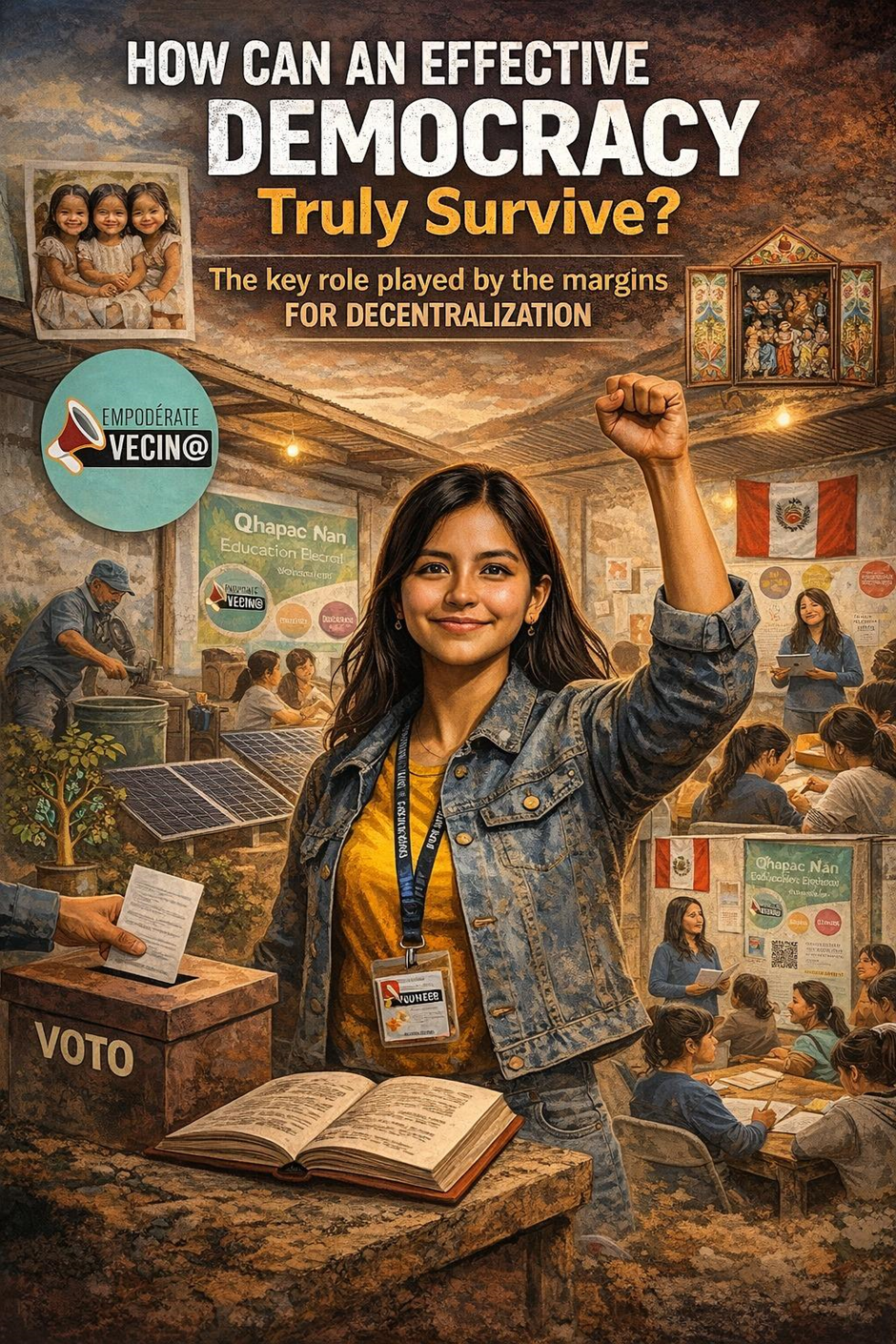
Editor’s Note: The lengthy excursion below is also an excellent introduction to the work of a young Peruvian woman who has become an important colleague for us. Andrea was introduced to us by our longtime friend Dr. Toh Swee-Hin, and we had quickly become enamored of her community activities and her energetic spirit that we wanted to both support that work and draw her more into our international orbit. Andrea recently was issued a visa by the US government and we expect to have her at the UN this summer for the High Level Political Forum and related activities. Hopefully she will make abundant contacts which will help shape her future community work in Peru. We, on the other hand, stand to learn much from her presence here. The text below will help explain why we are so pleased to welcome her.
No one told me that founding a youth organization engaged in community volunteer work on democracy and citizen participation while belonging to a vulnerable population (a young woman, premature seven-month triplet, first-generation university student, and coming from an emerging district) would be highly complex; but no one told me either that I would lead with such passion, even on the most uncertain days.
I GREW UP ON THE PERIPHERY OF DEMOCRACY: I BECAME NATIONAL NEWS WHEN I WAS BORN ALONGSIDE MY SISTERS.
Who could have imagined that the girl whose birth was exposed as a media event in the era before social networks — at a time when digital platforms did not exist to communicate and public visibility depended almost entirely on traditional media — would later be instrumentalized within a phenomenon that drew in a political candidate willing to extract political capital from family vulnerability, would end up leading her community. Yes, a politician came to promise help, posed for the photo as part of his unfulfilled social assistance, and never returned. That is how I was named Andrea, in honor of an authority of the time who promised support to my family in front of cameras and whose name I ended up carrying in its feminine version.
My parents settled in an emerging district — the other face of Lima — where many people build their lives from scratch in search of the opportunities their hometown, 18 hours from the capital, could not offer them: education, healthcare, and stability. They were uprooted from their families at ages 11 and 14 respectively and arrived in a city marked by discrimination, structural racism, and stigmatization. In those years, coming from Ayacucho — a region deeply affected by the internal armed conflict — meant bearing prejudice, suspicion, and exclusion. I am the daughter of those migrants who fled not only from precariousness, but also from the weight of stigmatization and lack of opportunity.
Both arrived while still almost children. They had no formal education or role models along the way, yet guided by their Catholic faith, they leaned on one another and on work to provide their daughters with basic goods and services. I grew up with faith and dignity. Perhaps it was there that I understood how each act shaped who I am. I chose to study Political Science as an act of “rebellion”: to understand power in order to transform it, because politics shapes our lives from birth.
In my veins, in my Indigenous Ayacuchan roots, runs the blood of generations who did not have the privilege of education, of understanding, or of acting to alter that reality. It is a struggle that is not easy to embody, yet it became my life’s passion: to assume collective challenges from the periphery.
I, too, would have liked to be born into a cradle of opportunity, but the cradle of resilience into which I was born shaped me from my very first minute of life. Here I am, here I remain, and I endure, because I firmly believe, as Mujica once said, that my strength lies precisely in having been born where opportunities are scarce but dignity abounds. We do not choose the cradle into which we are born, but we do choose what we do with the life we are given. In the trench of scarcity also lives the courage of struggle and rebellion transformed into love for others. For that reason, politics is an instrument of service, even when the path becomes more arduous for those who remain faithful to their ethical principles. What gives strength is not what is lacking, but what overflows in conviction, because the cause is always to live with meaning.
I ENTERED THE MOST PRESTIGIOUS PUBLIC UNIVERSITY IN MY COUNTRY, ON SCHOLARSHIP, AND SINCE THEN I HAVE WORKED TO TRAIN WITH EXCELLENCE
I have always pursued challenging goals. I understood early on that living means precisely that: moving forward even when uncertainty weighs more than certainty.
I never imagined entering the “Dean of the Americas.” Not because I doubted my abilities — I was always disciplined and deeply committed to my studies in my community’s public school, where I ranked second overall throughout all my school years (first place was achieved by my triplet sister) — but because I often heard that such a path “was not designed for someone like me.” The narrative was familiar: accept reality, resign yourself to economic limitations, study only if my parents could afford a few months of preparatory academy; otherwise, give up the dream.
But I earned admission. I won a national scholarship. I graduated with excellent grades. I participated in an international exchange, also on scholarship. Later, I went through months of unemployment until an opportunity arrived that transformed my trajectory: a paid internship at USAID, an institution that believed in my potential, revitalized my vocation, and allowed me to work alongside highly qualified professionals, engage in technical dialogue, and operate in a language other than my own. It was not that I romanticized the agency. It was that every second of the experience was difficult to describe. I learned enormously and deeply valued having been selected among thousands of applicants. I did not only learn from my office, but from all of them. Absorbing knowledge was, without exaggeration, one of the most enriching professional experiences of my life.
I received significant recognition within the institution, yet everything ended. My stipend was rescinded in February due to the broader context. I carried with me learning, networks, and professional validation. Outside, however, another reality awaited me: that of my country. Months later came the enactment of Law No. 32301, modifying the framework of the Peruvian Agency for International Cooperation (APCI). One of the main criticisms points to its imprecise wording. By generically prohibiting projects that may imply “intervention in internal politics” or actions that “affect public order, citizen security, or national defense,” the regulation could inhibit virtually any form of citizen criticism. The potential impact on independent media and organizations reliant on international cooperation is particularly concerning, especially in fields such as human rights, governance, and the environment. An inevitable tension arises: How can the State validate investigations that may question it?
The Inter-American Commission on Human Rights (IACHR) expressed grave concern regarding these changes, warning that prior authorization requirements and new administrative obligations could create disproportionate obstacles to civic space and freedom of association. All of this unfolds amid a national context marked by organized crime, expanding extortion, and the proximity of general elections in a highly fragmented landscape with more than 36 political parties.
For a political scientist who refuses to normalize complacency toward corruption, navigating this reality is already complex. Doing so from unemployment is even more so. In contemporary Peru, engaging in advocacy or volunteer initiatives related to democracy and citizen participation can paradoxically become a professional risk factor — not due to lack of merit, but because certain institutional environments view such experiences with suspicion. In a climate where the current government maintains a restrictive posture toward various forms of collective action, the tension between ethical coherence and job stability ceases to be theoretical and becomes a daily decision.
FROM RESILIENCE TO COLLECTIVE ACTION: ORGANIZING FROM BELOW TO SUSTAIN DEMOCRACY
I founded Empodérate Vecino(a) in 2022. I did so while working as a junior research assistant at the National Police of Peru and simultaneously directing the research workshop “Ciudad Crítica” at my university. This initiative emerged after researching the territorial governance of the Lima 2019 Pan American Games, particularly in my district. For the first time, high-level sports infrastructure arrived in my community. This transformed not only the urban landscape, but also my understanding of territory, inequality, and citizenship.
I chose to lead the organization through a quiet yet close approach. I wanted to build a space that did not merely appear active, but truly executed; that did not only speak about participation, but practiced it effectively. Since then, Empodérate Vecino(a) has become my principal space and refuge for civic engagement. I deeply believe in self-organization and self-management as forms of democratic resilience. Grassroots movements like ours embody concrete practices of deliberative democracy: inclusion of diverse voices, public reasoning grounded in arguments and evidence, respect, active listening, and the search for shared foundations connecting deliberation with legitimacy.
However, the path is not easy. Structural barriers persist: distrust toward young women’s leadership, cohesion within community-based grassroots organizations, high criminality in historically excluded territories, and the constant fear of raising one’s voice in the face of social injustices. Added to this is the reduction of funding for democratic strengthening, which generates emotional exhaustion among those who sustain initiatives amid scarcity.
Young people who choose to speak up also face demotivation stemming from precarious conditions and, more recently, the threat hanging over their social and professional capital. In many cases, activism — far from being recognized as valuable civic experience — can become a source of vulnerability, stigmatization, or professional risk.
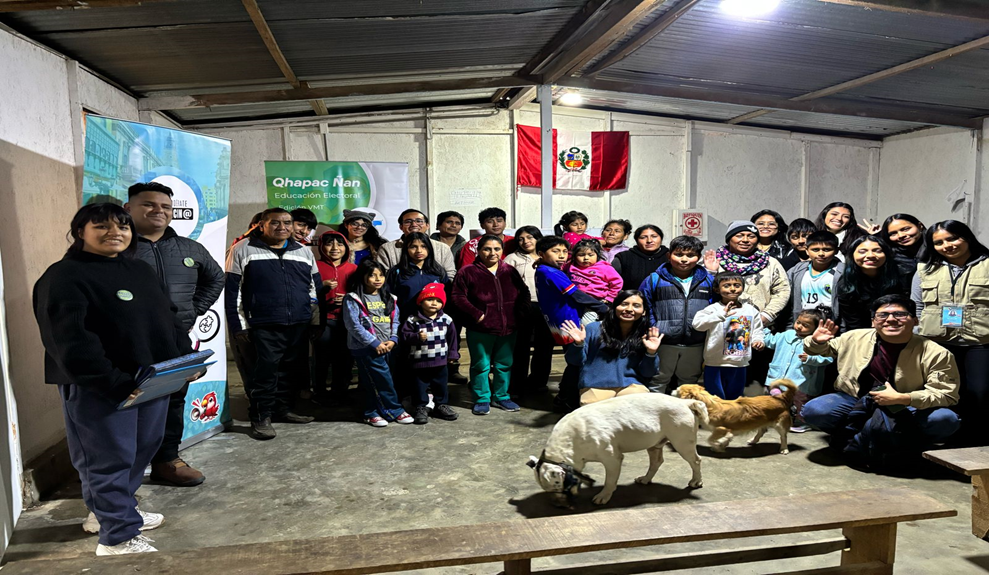
Despite this, the organization has consolidated itself as a space where young people from peripheral neighborhoods learn to lead, participate, and create change through everyday action. Not through rhetoric, but through practice: civic labs, civic games, workshops for young mothers, and creative participation methodologies. After my experience at the development agency within the U.S. Embassy, I decided to apply for international funding. We secured support from Global Changemakers, which allowed us to implement the project “Qhapaq Ñan Cívico.”
This electoral education and empowerment initiative was aimed at internally displaced migrant women from the other side of Lima — my community, emergent yet resilient. Many of them face triple exclusion based on gender, age, and migratory trajectory, along with limited access to safe spaces for participation.
We worked to change that reality through participatory workshops, intergenerational mentorship, and intercultural content. As part of the pedagogical design, I developed a mascot: an animated version of the Andean Cock-of-the-rock, Peru’s national bird. This character accompanies participants along the “civic pathway,” blending humor, warmth, and cultural symbolism.
In this way, the concept of Qhapaq Ñan — a Quechua term associated with the Inca road system — is reimagined as a metaphor of connection: civic pathways that cross territories where institutional democracy often arrives late or incompletely. Because it is precisely there — in the margins — where decentralized democracy must be strengthened: where the State, technology, academic opportunities, and international connection rarely converge.
This initiative is deeply personal. It represents a living expression of the principles that guide my work: that transformative education can build bridges between local realities and global aspirations for justice, sustainability, and inclusive democracy. And because, ultimately, change is driven by ordinary people, by the nobodies, the anonymous, those who rarely appear in the newspapers.
DELIBERATIVE DEMOCRACY FROM THE MARGINS: GRASSROOTS ORGANIZATIONS MATTER MORE THAN EVER
Community-based youth organizations are not born from offices nor under paternalistic, assistentialist logics. They emerge from lived experience, from territorial urgency, and from the need to solve concrete problems where the State arrives late, precariously, or simply does not arrive. However, the ecosystem of social and financial support often privileges models more comfortable for traditional cooperation: initiatives aimed “at” vulnerable populations, but not necessarily built “with” them. Projects designed from above, framed by savior narratives, backed by secured resources and prior institutional validation.
This tension reveals a structural contradiction: while the importance of empowering underrepresented populations is proclaimed, their organizational autonomy, technical capacity, and political leadership are frequently met with distrust. Youth organized within their own territories are not assistentialist projects nor symbolic extensions of traditional activism. Yet they often face a silent delegitimization when they attempt to articulate networks, mobilize communities, or generate advocacy, as they are frequently not taken seriously.
A problematic logic persists within certain social support and funding ecosystems: narratives, representation, and even the “marketing of the cause” are expected to be led by external actors with greater economic capital. Collective action appears to require the mediation of a savior figure — someone with resources, status, or symbolic authority — who designs initiatives from a desk and speaks on behalf of those who experience inequality firsthand.
Grassroots youth organizations face a persistent paradox. They must demonstrate professionalism, impact, and sustainability while operating under conditions of high precariousness, constant self-management, and emotional exhaustion. Added to this is another challenge: the suspicion cast upon youth activism, especially when it addresses democracy, citizen participation, or institutional oversight. Today, in an international landscape where funding for democracy and civic strengthening is shrinking, the pressure is even greater. Defenders of democracy — particularly those who work within and belong to excluded territories — face not only budgetary constraints, but also symbolic and material risks.
In countries such as Peru, this tension acquires complex issues. Advocacy on democracy and electoral education, far from always being recognized as a contribution to democratic development, can become a source of professional vulnerability. For many young people, active engagement in these spaces entails real costs in employability, job stability, and even personal safety. All of this unfolds within a context marked by low electoral trust, party fragmentation, the expansion of organized crime in peripheral territories, the normalization of extortion in public spaces, and the weakening of civic space.
In the face of this panorama, grassroots organizations do not represent a romantic gesture nor a naïve wager. Rather, they constitute living democratic infrastructures: spaces where deliberation is practiced, citizenship is built, and social bonds essential to democratic stability are sustained. Transforming concerns into collective action is not easy — even less so when dealing with agendas that rarely appear “attractive” to funding mechanisms despite their structural urgency.
And yet, I remain convinced: Peru needs more than ever spaces for civic education, electoral literacy, and democratic leadership, particularly as the country moves toward general elections described by many analysts as among the most complex in its history, in a landscape with 38 political parties and a citizenry increasingly disconnected from institutional politics.
CONCLUSION: DEMOCRACY IS DEFENDED WHERE LEAST ATTENTION IS PAID — THE MARGINS.
Democracy is not sustained solely by institutions, norms, or electoral processes. It rests above all on everyday practices, on social bonds, and on people’s capacity to organize, deliberate, and construct collective solutions. A truly living democracy is not merely administered from above: it is built from below. This demands an urgent ethical and political call: to recognize that democracy is also a territorial experience, one that must be lived, contested, and strengthened precisely where it has historically been most fragile — the margins.
It requires rethinking public policy through a territorial lens and listening to those who for decades have been considered social, political, or economic peripheries — not as a symbolic gesture, but as a structural condition for democratic legitimacy. Because citizen participation is not a complement to democracy. It is its invisible infrastructure.
Sometimes it rains. Sometimes exhaustion outweighs optimism. Yet even on those days, I wake up motivated when I see tangible results in Empodérate Vecino(a) — a space that has become my refuge for civic engagement and living proof that another way of practicing citizenship is possible. I continue applying. I continue studying. I continue preparing myself technically and professionally. And I aspire to find work where I can keep reimagining, from within, how the State, public policy, and democracy can better dialogue with people’s lived realities.
This article is not a success story. It is a story still under construction. Because I am still striving for stability, for professional growth, for new opportunities. But I also know I am not alone. There are thousands of us, across different territories, weaving another way of doing politics — grounded in collective purpose.
Democracy will survive if it learns to look where it has never truly looked. If it recognizes that its defense does not occur only in grand national debates, but also in neighborhoods and grassroots organizations that sustain the public sphere through fragility and hope.
Because, ultimately, democracy reinvents itself precisely where it is least observed.
They want us to practice aggression and perfect antagonism. Kamand Kojouri
What do nations care about the cost of war, if by spending a few hundred millions in steel and gunpowder they can gain a thousand millions in diamonds and cocoa? W.E.B. DuBois
We are only just beginning to understand the power of love because we are just beginning to understand the weakness of force and aggression. B.F. Skinner
The greater the gap between self-perception and reality, the more aggression is unleashed on those who point out the discrepancy. Stefan Molyneux
There are no humane methods of warfare, there is no such thing as civilized warfare; all warfare is inhuman, all warfare is barbaric; the first blast of the bugles of war ever sounds for the time being the funeral knell of human progress. James Connolly
Likewise the proud do not have mercy because they despise others and look upon them as evil, taking it for granted that these people deserve to suffer whatever they have to suffer. Thomas Aquinas
The evidence of history is that no advance which can be applied to the killing of other human beings goes unused. Malcolm Potts
Venom doesn’t always declare itself in aggressions; sometimes it’s hidden in the calm of indifference, in the choices we justify, in the harm we cause without raising our voice. Renuka Goria
As of this writing, the presidency of the UN Security Council transitions from the US to Bahrain, a stark shift in appearance more than in fact as Bahrain in the early stages of its Council tenure has proven itself to be a consistent (if not always enthusiastic) ally of US positions, including with regard to the war in Iran.
The US presidency in March got off to an auspicious beginning with Russia and China refusing to initially endorse the US program of work for March (over the JCPOA) and the US beginning its presidency not with a discussion on Iran but with a Melania Trump-led discussion on “Children, technology and education in conflict.”
To some of us, it seemed a bit convenient that the aggression against Iran was held more or less at the same time the US assumed the presidency of the Council. Without plunging into conspiracies, it was apparent that the March presidency gave the US leverage over how meetings on Iran were to be conducted, including the briefers and the designated slots when the US Ambassador or DC Secretaries would deliver their remarks.
What was stunning to me, though not entirely surprising, is how much of March’s Iran-focused discussions were about Iran’s transgressions not those related to the war-of-choice waged by Israel and the US. Evidence of this took the form of Resolution 2817 submitted by Bahrain under the US presidency (https://docs.un.org/en/s/res/2817(2026) and focused on the illegality of attacks by Iran on Jordan and Gulf Coast States.
This is fair enough on its face. Iran has launched attacks on its neighbors and apparently not always with precision. But even a cursory reading of the resolution text calls its exclusions into account, leaving the reader to wonder if Bahrain and some other Council members actually believe that this particular iteration of needless warfare was initiated by Iran itself.
Indeed, there is no mention in the resolution of US or Israeli aggression, no mention of the massive aggression now being perpetrated against Lebanon by Israel, no acknowledgement of the perpetually dubious claims that Iran is on the verge of acquiring a nuclear weapon, no mention of Iran’s right of self-defense, a right which is invoked over and over to justify Israeli abuses against Palestinians, Lebanese and others. Moreover, there is no mention of the US bases which have for some time formed a “ring” around Iran, bases which are threatening enough in peacetime but which are manifestly more threatening once aggression from the administrator of those bases commences.
Some have claimed that not all of these bases were being utilized in the Iran attacks and thus should be exempt from being targeted. Again fair enough to a point. But questioning Iran’s targeting strategy while also (by words or silence) defending the war-of-choice waged by the US and Israel is, for me, a bar far too high, as is the constant reshuffling of the cards hoping to the find the one which can explain with any validity the justification for this particular incarnation of aggressive intent.
I am no fan of Iran’s government as I am not a fan of many others. But the juxtaposition of a Security Council which, on the one hand, denies Iran’s right to self-defense while granting plenary indulgence to Israel to commit whatever crimes it feels the need to commit against both Gazans and the sovereign territories of other states is more than I am able to accept. It is also more than the credibility of the UN can bear. at this pivotal moment in its history. An institution which refuses to uphold its own core principles has endangered and possibly even forfeited more of its authority and credibility than it might currently be able to recognize.
It is not as though the current crop of Council members is unable to muster up indignation at violations of IHL and the UN Charter. During discussions on Ukraine, Council members take Russia to task in a manner markedly at variance with the more “kid gloves” treatment given to Israel and/or the US. I have no issue with such treatment of Russia though much of the rhetoric often seems more political than principled, par for the course in a Chamber where diplomats are conferring positions crafted elsewhere. But the tonal gaps between Ukraine and Gaza (and now Iran) are startling for at least some of us who frequent the Council chamber. That the US ensures such a chasm where Israel is concerned is both apparent and emblematic of the UN’s decline in the eyes of much of the global public.
When the Trump Administration started sending its own people to New York over a year ago, it was clear that the UN was headed into rougher waters. Part of this was of the UN’s making but part of it was the need to respond to threats by the “host country” to restrict payment of dues and diplomatic visas while seeking to reduce the footprint of the UN in multiple contexts, as part of a move to “return the UN to its core mission” which is to stop war and armed conflict.
There was and still is a kernel of truth to this. The UN has engaged in seemingly endless policy meetings and pledging conferences geared towards funding the humanitarian and development consequences of un-prevented and/or unresolved armed conflicts. The US is right to point out this linkage and insist that a more robust conflict prevention capacity would yield financial and credibility benefits across the UN system and, even more, offer relief to millions of long-suffering conflict victims.
The US, however, is wrong for not owning up to its own fingerprints on some of the gravest, conflict-related horrors facing nations and peoples around the globe. This isn’t the place to explore how a national psyche absolves national leaders of self-reflection, let alone responsibility. But this is the place to remind the US (and certainly not only the US) that its vast military expenditures and protective vetoes, its bullying and disinformation campaigns often behind the scenes, its predisposition at times to blatant “wolf in sheep’s clothing” sabotage has not made the world safer or more trustworthy. At times such actions merely reinforce the view that international law is a luxury that the well-armed and well-financed nations of the world need only invoke when it serves their narrow purposes.
Even in this time of often inept and tone-deaf governance, there is much that still emanates from my country which serves a human interest more than a national one and which can still elicit pride in the actions of a range of national stakeholders. But it is also the case that we are living through a time where trust across nations and cultures is low and aggression itself is increasingly normalized – in our foreign policy, in our use of language, in our willingness to see others as competitors to neutralize rather than as partners in positive, cooperative endeavors, even in swaths of our religious life seemingly unaffected by the devotional profundities of Ramadan, Passover and Christian Holy Week. And despite the collaborative rhetoric routinely emanating from UN sources, we have largely allowed the same to fester within our own structures, enabling states to attempt to justify what ought to be unjustifiable, acts of aggression leveled against nations and peoples with little or no accountability or remorse.
Bahrain began its formal presidency on Thursday with events exploring ways of enhancing relations between the UN and both the Gulf Cooperation Council and League of Arab States. Here’s hoping that any fresh collaborative commitments extend to some of the other items on the Council agenda for April including the event on the 27th devoted to “maritime security.” The status of the Strait of Hormuz will no doubt dominate that session regardless of how aggression against and by Iran over the next three weeks evolves. The stake here are clearly high and continuing to rise.
I have been asked by a couple of people to convey some thoughts regarding the recent US decision to, once again, do Israel’s bidding and launch fresh attacks on Iran which, as of this writing, have resulted in the deaths of the Ayatollah, other Iranian leaders, perhaps hundreds of of Iranian school children and other civilians, with more to come, perhaps much more.
The response to this latest war of choice has been interesting; positive responses from the Iranian community on the streets of Los Angeles and from some members of the US Congress, along with endless prevarications from a White House which has long-ago stopped talking forthrightly to US citizens while promoting the view that US aggression constitutes some form of providential redemption and that what Israel wants is more important than what any of what remains of our multilateral frameworks can assimilate.
There has been tepid global response in support of the US-Israeli operation, response which recognizes, as we all probably should, that the Trump Administration has no interest in what any of us thinks about any of this. “Getting behind” the operation seems to be the only viable option even for sovereign governments which have seen for themselves the relentlessness of current US military operations, the single mindedness of this administration in advancing the joint US-Israeli agenda and, of course, the burning desire to keep the Epstein Files out of the headlines.
The relative success with which the US is currently achieving its objectives in Iran while mobilizing the “holy warriors” narrative should remind us that this trend has not run its course. The speed, surprise and violence characteristic of “Epic Fury” will not be limited to Iran which, despite some claims to the contrary, did not attack the US in the first instance.
Many expect Cuba to be next in line for a “righteous” assault. Whether or not, there will most assuredly be a “next.” The righteousness attached to this US will to “project force on a global scale” is rightly questioned, but the ability of the US to “sustain one fight after another” is not completely apparent, regardless of whether that fight has been provoked or merely chosen.
The US goal here is to remind the global community that while international law and multilateral cooperation may be crumbling, the law of force in the form of US-Israeli collaboration is locked and ready, more so than we have seen a military alliance in some time. This alliance is powerful, relentless, amoral, deceptive, abusive and largely non-negotiable.
The US will surely continue to “play act” its concern for Security Council resolutions and other manifestations of multilateralism. But this sustained attack on Iran and the growing number of sycophantic leaders who condemn not the US-Israeli aggression but only the Iranian response leads one to presume that, behind the veil of statecraft, concessions have been made which are only likely to accelerate the “nationalizing” of international law and its incumbent responsibilities.
For us, this is a tragic erosion that we will do all within our very limited powers to reverse. I have certainly had many concerns about the Iranian government in its current incarnation. But in the larger picture, it is aggression and war itself which are the greatest of all current threats to the human race. No amount of deceptive policy bravado or high- tech weaponry changes that equation. Those of us who witness this erosion must commit ourselves anew to shifting the arc of our current, dangerous narrative as best we are able.
One should try to be honest with oneself almost as a daily devotion. Ian Brady
Never try to discourage thinking, for you are sure to succeed. Bertrand Russell
The world was to me a secret which I desired to divine. Mary Shelly
It is an illusion of idealistic children of light to imagine that we can destroy evil merely by avowing ideals. Reinhold Niebuhr
An hour of innocence builds more trust than years of diplomacy. Abhijit Naskar
History does not care about intention. It records outcomes. Leo Croft
When a philosopher happens to read some of his older texts, and most of the time he shakes his head in disapproval, he can be sure that he is on the right path. For this is an infallible sign that his thought has evolved and that he possesses the capacity to learn, to unlearn, to adapt. Giannis Delimitsos
Why do we call all our generous ideas illusions, and the mean ones truths? Edith Wharton
I have been writing and advocating in the peace and security space for many long years, trying to maintain poise and principle amidst updrafts of needless violence and now the crumbling of an international order that, though far from perfect, has helped hold together some semblance of security and dignity amidst the oppression and greed to which too many of us succumb.
Relative to many people I am privileged to know in this world, I have had a relatively drama-free life. But I must acknowledge, albeit with some hesitation, that my engagement with an increasingly unruly world, and even with some of the people and organizations with whom we ostensibly share goals and principles, have taken an increasingly heavy toll.
I have attempted over many years to keep my own counsel in part as a service to those with whom I interact, especially the younger people for whom bursts of cynicism or other careless emotional reactions only serve to push them away from the very work I would wish for them to undertake. And though I’m clearly losing more and more miles off my proverbial fast ball as time progresses, I do my best to maintain a posture of hopefulness and competence amidst the current chaos.
After all, in a world of sometimes grave suffering, my own drama has been, and remains, more self-inflicted than due to any objective influence.
All this said, I’m not going to keep my own counsel here, which means that some of you who still read these posts might wish to close this file and move on to more productive endeavors. For those who remain, which likely includes several folks also struggling with the current weight of bewildering, unwelcome change, perhaps they and others will relate to what is coming below and, if only for a short while, swap out their own masks of rationality and competency for a few additional moments of honesty.
As some of you know, I’ve been re-reading some of my graduate school texts and my earlier writings. In both of these instances, my main take-away has been some iteration of “what were you thinking?” Why did you underline that paragraph while missing the more salient insights down the same page? Why did you allow yourself to think that articles of yours which were for some unknown reason accepted into journals or magazines might actually be breaking some new ground? And why did you not run more confidently with insights that you knew to be true but which lacked the courage to pursue? And, finally, why have you been so slow to unlearn and adapt?
These questions seemed especially pertinent as I re-read “The Children of Light and the Children of Darkness” by Reinhold Niebuhr, a book now 80 + years old which had a stunning impact on me at the time of first reading even if its influence on my subsequent writing and activities would remain uneven.
Niebuhr’s Christian realism (not nationalism) spoke to me as one who took the violence and discrimination of the world seriously but felt that many of the responses to such ills were more sentimental than impactful. By “sentimental” I mean (and Niebuhr mostly meant) the largely unexamined belief that the breakthroughs of history are inevitable; that institutions in which we have spent years such as the UN are grounded in fundamental principles which ensure their survival and even their prosperity; that the hard-won achievements of humanity are assured to persist even absent the hard work, dedication and self-analysis required to weed out the hypocrisies that make most of us unworthy stewards of our most profound ideas and values; that we can confront and nullify threats and evils merely by spouting rhetorical condemnations and avowing abstract ideals.
For Niebuhr, history is creative but not redemptive. This is how I had come to see it also. A space where we can participate in and offer correctives as needed regarding the complexities of the world and ourselves, the successes and inadequacies of our policies, practices and aspirations. To the extent that we can escape our own limitations, our knee-jerk forgiveness of mixed motives and unimplemented ideals, our “rooting interests” which cause pain to those who “root” differently, then history holds possibilities for maximizing dignity, empathy and care.
Possibilities not inevitabilities.
We now find ourselves at a particularly discouraging moment not only because institutions are crumbling and violence and cynicism are wildly on the loose, but because we humans have not proven ourselves up to current challenges. Indeed, this current, oppressive moment seems utterly beyond our remit. Too many people in shoes similar to mine have allowed ourselves to be blinded by a light of virtuous aspiration which is largely self-manufactured. Such light remains possible in our age as it was in others, and yet our sentimental attachments to what is good, but not yet good enough, have resulted in more fog than illumination, more abstracted diagnoses about the status of institutions and fewer concrete diagnoses about the status of ourselves and our promises to others..
For me, this has long been a double discouragement; in the outsized malevolence of riches and power politics, to be sure, but also in our failure to seize the creative opportunities of the present without turning what works for us into what works for all. We know we can do better, but too many people like me who should also know better as we choose to push our chips into the center of an unstable table that we forget we must vigorously maintain if the table itself is to remain functional.
I am blessed with places to go and friends and loved ones in many of them. I am also someone who has tamed his wants such that he infrequently wants for more of anything. But as with other friends and colleagues I know, I am veering too close to a tipping point of emotional insolvency. I have become the person who watches sports instead of movies and documentaries because sports don’t break any of my emotional bubbles. I have become the person who can’t even sing Christmas songs in private without shedding tears. I have become the person who bonds with cats more easily than with many humans, someone whose faith tradition is now in the hands of largely unfathomable forces whose theology offers no truth or comfort, someone who harbors too many secrets even from himself.
I am not alone in any of this even if the peculiar sources of my discouragement are not always in alignment with others. Many rightly wonder, even despair over what might still be salvageable in our world, wonder how we can best save what is left of structures that promised much of value but also promised considerably more than they have delivered. Such persons wonder how to adjust to the dismantling of rights and institutions that we have dedicated our lives to improve but too often have also idealized and even taken for granted.
Niebuhr spent much of his writing highlighting the power of self-interest not only in those promoting the darkness of tyranny and injustice, but in the rest of us as well. Our serial inability to remove the logs in our own eyes such that we can better see the specks in the eyes of others was a cardinal sin of my early years and a deep sadness of my later ones. As I have come to learn, the moment we disregard our own willful blindness, the moment that we replace honest critique of personal motives with behavior now known as “virtue signaling,” we open the door to violence and worse by those content to heap scorn on our self-congratulatory claims of virtue as they seek to consign such virtue to the scrap heap of history.
When you sit in UN conference rooms day after day over many years as we have done, it is easy to point out the cynicism which infects the practices of many nations, especially but not exclusively the large and powerful ones. Nations which come to places like the UN to put their best faces on often abusive policies. Nations which turn their backs on treaties and international law obligations whenever such suits their interests. Nations which create convoluted rationalizations for behaviors which are clearly contrary to the commitments which led them into the UN in the first instance.
But I have also fudged things when it served some need of mine. I have also indulged rationalizations for choices that clearly should have taken a different direction. I have also created invitations to cynicism by not saying what needed to be said, by not betting sufficiently on the value of our own critical lens, by not insisting firmly enough that the institutions we say we care about are ultimately not going to improve in any sustainable way until we improve ourselves as well.
Niebuhr understood well this dilemma of how to confront cynicism in the powerful and malevolent without becoming cynical ourselves. He maintained, rightly I think, that “the children of light must be armed with the wisdom of the children of darkness but remain free from their malice.” This is a high bar, even for folks in my circles of commitment, as we are persons battered in ways that we can only begin to understand, persons in diverse global settings whose emotional bank accounts have suffered from too many withdrawals and too few deposits.
Of course these wounds are all relative in volume and impact, but all offer important lessons. For instance, I have long maintained the view that there is sanity in agency, that the ability to address and resolve (or at least attempt to do so) personal and even global crises is ultimately less taxing on the emotions than feeling trapped in impotence and its oft-accompanying despair. But agency for myself and others is, indeed must be, more than defending values and ideals, more than rhetorical arguments and clarifications, more than sentimental attachments to institutions and their rules which have proven less effective than advertised and which we have ultimately done too little to energize. My own life used to be more practical, more personal, more about enabling the agency of others than about brandishing a second-tier policy lens. For the sake of our still-numerous, still-inspirational global connections and my own, now-teetering emotional health, I need to find that missing piece of agency once again.
May you who have read this to the end find it also.
To handle yourself, use your head; to handle others, use your heart.Eleanor Roosevelt
Our chief want is someone who will inspire us to be what we know we could be. Ralph Waldo Emerson
Keep your fears to yourself but share your courage with others. Robert Louis Stevenson
You will see a great chasm. Jump. It is not as wide as you think. Joseph Campbell
Example is not the main thing in influencing others. It is the only thing.Albert Schweitzer
If your actions inspire others to dream more, learn more, do more and become more, you are a leader. John Quincy Adams
Leadership is not about a title or a designation. It’s about impact, influence, and inspiration.Robin Sharma.
Last week under the presidency of Slovenia, the UN Security Council held a debate on the topic “Leadership for Peace.”
Needless to say I was intrigued though recognizing that these terms connected by “and” are not straightforward; indeed they often cover up more light than they reveal.
Peace is ostensibly what Global Action was created to promote and inspire. Our track record over 20+ years is mixed to be sure. We haven’t sufficiently inspired people to transcend their own anger and grievance, nor governments to honor their political agreements and commitments; nor groups like ours to self-reflect on how endless fundraising compromises integrity and effectiveness. Peace, after all, is something we do as much as something we promote. As Albert Schweitzer intimated above, we have done a better job of advocating for peace than setting a peaceful example, forgetting at times that any success in our chosen realm requires an intentional, thoughtful blending of both.
And what of leadership? For many of the delegations present in the Council chamber, the issues which consumed their interest were related to whom the next Secretary-General might be after Antonio Guterres’ two terms in office. This is not an irrelevant consideration given the current state of the UN and given the complex role that the SG plays in that space; a role as many others have noted, more “secretary” than “general, more implementer of the wishes of the large and powerful states than enforcer of the UN Charter and international law. The current SG has a bit of “chicken little” in him, constantly pointing out the ways in which international law and the basic rights of civilians have been trampled, climate change threats have largely been ignored, and conflicts continue to rage under the umbrella of large power interests and in clear violation of the UN Charter. He has surely been in a tough spot. Nevertheless, pleading for change and constructing a system which can inspire, make and sustain change are not synonymous. The next SG must do some of both but the latter tasks constitute a higher bar.
I am in the process of writing a longer piece on leadership as a contribution to a project which we will help unveil in Kosice, Slovakia in February, a project tentatively entitled the Carpathian Leadership Fellows Program and currently being facilitated by our board members Dr. Robert Thomas. The project will focus on various aspects and incarnations of leadership pertinent to Ukraine and surrounding areas, organized around key questions including, What does leadership entail for post-conflict Ukraine? What does it require for the various stakeholders – teachers, engineers, clergy, architects, police, merchants, artists, farmers, health workers and more – who will be asked to play prominent roles in helping Ukraine and the region recover from damaged and aging infrastructure, from young people whose education and hope for the future have both been compromised, from people internally and externally displaced by violence waiting more and less patiently to return to their communities?
I will briefly share aspects of this project (and this season) which are of particular importance to me – some relevant to the UN and others more directly relevant to the baby in the manger which is our one and only Christmas point of origin.
On leadership, what the UN cannot easily accommodate, indeed most bureaucracies cannot, is leadership’s organic nature. Quotation after quotation at this stage of my investigation highlights this aspect of leadership, organic in the sense that it is intimately related to the active consent of those being led and is entirely related to context and condition, requiring administrative skill but also the inspiration that comes from the heart and connects to the heart. The testimony I have found reflects leadership which inspires us to jump over chasms which seem too daunting; leadership which insists that there is a better part of ourselves yet to be revealed to self and others; leadership which not only knows what needs to be done but also who needs to do it and how to inspire the energy, trust and perseverance to rebuild schools and communities, hospitals and transportation; leadership which makes hope more tangible especially for people whose need to believe again in the hope of a better world, hope which has too long been buried under rubble of various forms and not of their own making.
At the UN, leadership claimed is undermined by several factors including the machinations of the large global powers, the disconnect between policymakers and constituencies, but especially by the promises which we make through that policy, promises which elevate many more expectations than they satisfy, promises unkept which damage the trust needed for our leadership, such as it is, to inspire broader-based action for the more peaceful, just and prosperous world we claim to want, for our children and grandchildren if not for ourselves.
And this leads me back to the Christmas manger and the inspiration of a child. There is a lovely and oft-quoted passage from the Talmud, shared by sages as remarkable as Martin Buber and Abraham Joshua Heschel, that with the birth of each child, “the world begins anew.” Indeed, with each child the hope of the world is restored in measures small and large. Leadership of course should also be about instilling and growing that hope, helping people find a reason to believe that their lives and labors matter beyond fiscal outcomes. In this way, leadership can reinforce what I understand to be a Christmas call to reach beyond the confines of what we imagine ourselves to be, to demonstrate skill and courage in larger measure in whatever contexts and conditions we find ourselves.
For me and for many others, it is the child in the manger, the child of meager circumstance and divine significance, who remains my foundational source of hope especially through what for us has been a long season dark and cold in aspects far beyond climate. For me, this incarnation of hopefulness lies well beyond the province of officialdom and bureaucracy. It points us towards what we often long for but also find elusive, the power and grace to be more than we are now for the people who need our example as they seek to call out more from themselves as well. These bonds of influence and inspiration now seem to be in serious need of repair. The promise and power of Christmas make such repair well within our remit.
Cruelty has a human heart And jealousy a human face, Terror the human form divine, And secrecy the human dress. William Blake
I discovered in myself sweet dreams of oppression. Albert Camus
If God is keeping out of sight, it’s because he’s ashamed of his followers and all the cruelty and ignorance they’re responsible for promoting in his name. Philip Pullman
We can never be gods, after all–but we can become something less than human with frightening ease. N.K. Jemisin
You cannot use cruelty against yourself to justify cruelty to others. Marie Lu
All cruel people describe themselves as paragons of frankness. Tennessee Williams
Cruelty is easy, cheap and rampant. Brene Brown
It seems to me that liberal and humane people, of whom there are many among us, would, if they were asked to rank the vices, put cruelty first, intuitively they would choose cruelty as the worst thing we do. Judith Shklar
Those of you who have endured many years of these annual messages know of my personal fondness for the image of the Jewish man or woman sitting on the end of a remote cliff, staring into the vastness of space, wondering if there is any relief for the suffering borne of an enveloping cruelty part personal and part embedded in the institutions of the day, sadly including that embedded in religious institutions.
It is hard for some of us to imagine that moment of being seemingly rebuffed by such a vastness and then having to return to domiciles and communities under oppressive occupation complete with religious leaders who have turned their backs on the needy and dispossessed, people longing for relief who will accept even its faintest hope, a veritable whiff of a world that is kinder and more just than the one which defines most all of their daily business.
We moderns who like to imagine the superior manner in which we conduct our earthly affairs are more than occasionally guilty of scoffing at the cruelty of those earlier times and the misery they inflicted, scoffing as though we have somehow graduated from the lusts of degrading and subjugating other human beings, graduated from muck to which too many of our ancestors were consigned and about which they felt they could do little. Look at how far we’ve come. Look at our “mixed blessing” achievements and successes. Look at our evermore fancy gadgets and the clever economic predations they enable. Look at our decision making which consistently magnifies current interest to the detriment of future interest. Look at the overly confident, divisive, self-satisfied proclamations that our modernity privileges some of us to spout.
Maybe this isn’t the Advent to look too closely at ourselves. Or maybe it is precisely the moment to do so.
For the sojourn at the edge of the cliff is not only about the longing for a redeemer. It is also about the discomfort – at times severe – during those all-too-rare moments when there is nothing but vastness and quiet to distract us from ourselves, to remind us of our relative impotence, the many things we have done and especially left undone, the potential once identified and then summarily squandered, the love and care we failed to provide in sufficient measure or rebuffed as others tried to provide for us.
And the cruelty. Always the cruelty, perhaps the most shocking feature of our current, collective incarnation, cruelty disturbingly linked to those long-ago days of occupation and crucifixion, those days which relegated sickness to the demonic and branded as unclean anyone who broke any of the complex regulations brandished by religious elites, regulations which such elites often felt entitled to ignore themselves, regulations sold as revelations of a God who ostensibly prioritized honor and deference over compassion and reconciliation.
As many of “God’s people” try to sell in our own time. Psychologists such as Erich Fromm had long identified the “death wish” that can consume people defined by grievance, some of whom are people of faith, a wish that manifests itself in decisions which are short-sighted and anger-fueled, decisions neither in our best interest nor in the interest of generations to come who may well face formidable trouble coping with the massive damage we now eagerly inflict with full impunity.
Let’s be honest with ourselves. Cruelty has always been our species companion, the demon that literally consumes much of our life energy and conspires to make a mockery of our values once we stop identifying and wrestling with its threats and allures. There are certainly many moments when kindness, compassion, fairness and other, deeper and more “horizontal” virtues seem to have pride of place, when we seem to “have it in us” to rise to a higher, more attentive and more responsive standard.
But then we too often allow ourselves to get complacent, or self-satisfied, or we give in to multiple impulses which should have been thoroughly examined and then placed under wraps. In all of this we tend to neglect the uncomfortable spaces which remind us of uncomfortable truths. And at such times, cruelty is poised to make a comeback, returning to a stage complete with autonomous weapons and violent rhetoric, with ethnic cleansing and partisan hatred, with all of the self-serving justifications one could possibly invoke including willful, decontextualized misinterpretations of religious texts which are at times astounding in their arrogance.
It is a truism of sorts to insist that we are responsible both for what we do and what we enable, that which our own actions inadvertently grant permission for others to do. A bit like children in a kindergarten class, we defend our own behavior by pointing fingers at those who not only behave contrary to our own interests but who we might feel get away with it, serving personal preferences petty and more profound with what appears to be full impunity. In a similar vein, we trend towards laser focus on behavior we find offensive in others and then too often try to attribute the offense to an entire class of human beings defined by race or ethnicity or gender or religion, all while doing what we can to ensure that the laser never turns back on us.
Amidst all of these manifestations of self-deception is a pervasive cruelty. While recognizing the degree to which social media skews judgments on this matter – providing compelling visuals on incidents individual and collective which would have remained hidden in previous times – it is nevertheless the case that our human compassion has taken a serious hit. At levels both official and community, a generic indifference serves to endorse and justify the most obvious instances of cruelty, those which have dented our rational and moral capacities – rapes in El-Fasher and Goma, target practice and food insecurity against Palestinian children in Gaza, brown-skinned people brutalized by aggrieved and poorly trained ICE agents in US cities, religious bias, domestic violence, racial discrimination and killing largely without remorse, without accountability, without any sense of the implications of such brutality for a world which must sooner or later be passed on to children in whatever shape we leave it. And beyond active cruelty, we move with lightning speed from individual instances of abuse to more categorical denunciations of “other” humans which ultimately encourage more abuse than they identify.
I certainly do not believe that cruelty constitutions our entire genetic and social footprint, not by any means, but from my UN policy vantage point it seems to occupy more of our current frame than most of us would have deemed possible, certainly more than our civilizations can likely survive over the long term.
Returning to the lonely figure at the edge of a cliff, it is also important to acknowledge the degree to which making time and space for self-reflection is also to make time and space which can be filled by anxiety, by self-doubt, by disappointment. The space of Advent is a moment for reminding me of how far I’ve come but how very much is left undone, the self-honesty and amendment of life which remains an insufficient portion of my seasonal preparation, the vestiges my own “sweet dreams of oppression” which have led over the years to trespasses which are to be forgiven only in the same measure that I forgive the trespasses of others.
Collectively, our demons are now well out of the places where they had been at least partially confined, tricking us into renewing cycles of distrust and outright violence that compromise our politics, our faith and possibly our future. It remains alarming at how quickly we can sacrifice our compassion and dignity at the altar of anger and grievance. It is equally discouraging (if numerous films are any indication) how easily we can become addicted to dystopian worldviews that, beyond entertainment, reinforce the belief that the world is in its essence a harsh, violent, deceitful and fearful place in which values such as cooperation, discernment, kindness and compassion are naïve if not outright dangerous.
It may be, as Judith Shklar maintains, that cruelty is the behavior which represents the very worst of ourselves. But what we fail to recognize as often is how this “worst thing we do” lurks just below the surface of civility, just out of sight and reach until it bursts forth like a plague of long-dormant insects which we then choose to feed and otherwise encourage until the outburst has run its course, leaving in its wake a veritable wasteland of disinformation, intolerance and cynicism. This cycle is compounded by the widespread and insufficiently countered belief that cruelty is an inevitable manifestation of our genetic makeup. Cruelty may represent a pervasive factor in human history, but “inevitable” it is not.
The reason I particularly honor Advent, year after year, is that it represents yet another opportunity for people of much faith and little faith to confront and overcome what Dostoyevsky termed the “artful” cruelty which dominates far too much of our current human landscape. In our words, in our actions and reactions, we very much have it in us to set a tone that can serve to counter the worst of current influences and thereby ensure places where children can live and thrive when we have finally left this world to their loving care. But this “tone” requires more of us, replacing grievance with thanksgiving, swapping out indifference with caring, renouncing in words and deeds what Fromm worried was “our craving for evil,” pledging to take more risks and give in less to cynicism and fearfulness.
If the opportunities of Advent seem more dauting this year it is because the “syndrome of decay” which we have over-indulged like Thanksgiving leftovers has been allowed to consume larger and larger swaths of our human condition. But we can roll it back. We can recover our shattered faith, our lagging courage, our indifferent stewardship of a world which will eventually no longer be ours to pillage. For me, Advent represents the latest, best opportunity to restore our collective dignity, prepare to better incarnate my understanding of the divine promise, and “save what’s left” of our ailing planet. This year, let’s agree to honor that potential.
In lieu of another piece from me at this time, we decided to post this back and forth between myself and Neema Kihwelo a young woman of Tanzanian origin and formerly a student at Columbia University. Neema is not in New York at this juncture but has been helping us fill a gap with respect to our concerns with human rights and peace and security issues – the widening development inequalities and debt burdens which exacerbate tensions which can (and do) lead to violence in various forms. Neema has shared expertise which we would otherwise only sporadically have access to, expertise which helps to “round out” our core policy concerns and more directly links progress on sustainable development to progress on peacebuilding.
In the Security Council this past week, the US representative shared his disdain for the Sustainable Development Goals believing them to be a needless distraction from the “real work of peace.” Contrary to this view, we affirm that such Development which includes a fairer system of international finance, urgent debt relief, counter-corruption measures and greater international solidarity and trust are actually indispensable to any peace which can ultimately be sustained.
Neema started off the conversation with her review of the important UN event below.
Towards a Risk-Informed Approach to Development Financing Resilience Today for a Sustainable Tomorrow Second Committee Side Event, UN General Assembly
UNDRR and UNDP opened with a strong call for country-led transformation moving from project-by-project interventions to a “systems finance” model. They stressed integrating risk analysis and financing into core government policy across all sectors, anchored in three pillars: scaling risk-informed investments, strengthening national systems, and promoting cross-sector action.
Panel 1: Financing Gaps, Local Capacity, and Innovation
Key Highlights:
● Global disaster risk financing needs are estimated at USD 2.3 trillion annually, yet only 25% is currently mobilized, signaling an urgent need for more effective resource allocation as ODA continues to decline.
● Panelists identified a risk appetite mismatch between capital holders and the credit profiles of vulnerable nations, with perceived or actual credit risks obstructing private and institutional investment in resilience.
● The UNCDF and partners showcased practical de-risking innovations such as climate insurance programs in the Pacific and Africa, financial inclusion facilities for African small banks and SMEs, and mobile-based insurance payouts that provide citizens rapid compensation after climate shocks.
● Subnational governments face fragmented and misaligned financing options. As highlighted by Paul Smoke, private financing remains scarce, concessional funds unevenly distributed, and infrastructure transfers often bypass local resilience priorities.
● The panel called for expanding incentive-based and intermediary finance, such as municipal development banks and blended finance partnerships, to empower local governments, improve creditworthiness, and attract sustainable private investment.
● Strengthening loan repayment systems, targeted bond frameworks, and aligning financial instruments with measurable resilience outcomes were seen as central to enabling locally owned, durable disaster risk investments.
Critical Reflections: While Panel 1 presented innovative tools and strong technical solutions, the discussion revealed persistent structural obstacles. Many pilot initiatives depend on external actors and lack domestic ownership or policy mainstreaming. Subnational entities where vulnerability is greatest still face limited capacity to absorb, implement, and sustain risk-informed investments. National reforms to integrate resilience into public budgets remain incomplete, and incentive frameworks for private investment are not yet delivering at scale. The price of inaction, however, is rising without deeper collaboration, governance reform, and equitable access to finance; innovation risks outpacing inclusion.
Panel 2: Tailored Solutions for Vulnerable and Local Contexts – Financing strategies, concessional mechanisms and partnership
Rwanda: Rwanda presented a strong example of national ownership in risk-informed development. A roadmap for universal early warning coverage by 2027 is being implemented through coordination across ministries and financing from the Rwanda Green Fund and National Risk Reduction Fund. Its partnership with the World Bank’s contingent credit line mechanisms represents a shift from reactive to proactive financing, anchoring resilience in domestic resource mobilization and job creation within green sectors.
Portugal – “Safe Village, Safe People” Programme: Portugal’s model of community-led wildfire risk reduction demonstrated how local partnerships can operationalize systemic resilience. The program combines structural safety measures with behavioral change, conducting local drills, appointing Local Safety Officers, mapping safe zones, and training volunteers in vulnerable rural areas. Recognized by the EU, World Bank, and G20 as a leading example, this initiative highlights how risk preparedness can be localized effectively to address vulnerable demographics such as older and isolated populations.
Private Sector & Digital Finance – Global Policy House: Michelle Chivunga (Global Policy House) emphasized digital transformation as a driver of resilience finance. She urged governments to invest in data ecosystems, digital literacy, and energy sustainability for data centers to support AI-readiness and analytics for disaster response. Highlighting alternative capital sources such as digital assets, tokenized resources, and cryptocurrency, she framed private-sector innovation as essential for inclusive growth. Her remarks underscored the need for citizens to be co-architects, not beneficiaries, ensuring that digital transitions are participatory, ethical, and community-led.
Comparative Insights and Overarching Gaps
● Financial Innovation: The event showcased diverse instruments, contingency funds, DRF strategies, Cat DDOs, and risk pooling but large-scale blended mechanisms involving private and digital finance remain nascent. Sustained pilots, harmonized regulation, and stronger domestic financial ecosystems are crucial for scaling impact.
● Data, Digital, and Equity Challenges: While digital readiness was frequently mentioned, data ethics, infrastructure, and harmonization gaps persist, particularly across low-capacity and rural contexts.
● Decentralized Capacity: Subnational entities require tailored tools and credit enhancements to invest in risk management autonomously, supported by practical governance and fiscal reforms.
● Participatory Shift: Rwanda and Portugal reframed local actors as partners in design and delivery. Similarly, Chivunga’s proposal linked digital and financial inclusion directly to SDG progress, envisioning resilience as both an economic and social justice outcome.
Zuber Response
Hello Neema,
I’m sitting in a UN cafe waiting for 6th Committee to start and thinking about your good reflections on the Thursday event. You are more on top of all this than I am, and I appreciate it very much.
One part of your assessment struck me particularly: “National reforms to integrate resilience into public budgets remain incomplete, and incentive frameworks for private investment are not yet delivering at scale. The price of inaction, however, is rising without deeper collaboration, governance reform, and equitable access to finance; innovation risks outpacing inclusion.”
The UN has been pushing states to adopt more robust early warning mechanisms for the SIDS and other small developing states. And there is plenty of discussion on the importance of blended finance and domestic resource mobilization. But amidst all of the positive interventions, something doesn’t add up and I can’t put my finger on it.
Clearly one issue relates to the gaps, sometimes enormous, between pledged funds and delivered funds. It is so easy to promise, but delivery runs into obstacles including funding already promised for other purposes (ie. peacekeeping, specialized agencies), the proliferation of earmarked funds rather than general operating funds which can be mobilized quickly to meet crises, the relative lack of anti-corruption policing as well as measures to ensure that natural resources remain in domestic hands and can thus contribute to domestic budget priorities.
All of this is important, and all of this seems insufficient to building a more peaceful world. What is missing?
Pinning some of this resource inadequacy on “colonial legacies” is true, in my view, but doesn’t illuminate the path forward aside from demanding a reset to ensure that domestic resources remain under domestic control and that colonial puppeteers cut the manipulative chords for good.
But governments don’t always have the best interests of constituents at heart, and in some instances the “theft” of resources has occurred with the active support of governments which have also in some instances enabled the “illicit flows” that we spend so much time talking about here and which the wealthier nations and investment banks have enabled as well in their own way.
I don’t know, Neema. Seems at times like we have too many culprits and not enough solutions. We humans and our motives are a mixed bag for sure.
All best,
Bob
Neema Response
I hope you are well and have had a good start to the week. I completely agree with your sentiments, and I guess this is what I have always found challenging about policy work versus the realities of implementation. The moderator at the end of panel one captured it perfectly when she said that solutions exist, but financing remains a challenge. That struck me, because again it raises the question of what a real resolution forward looks like.
I agree with you that humans are a complicated bunch. While colonial legacies have undeniably shaped today’s inequities, they can’t fully explain the persistent dysfunction in how we mobilize and govern resources. What has been needed for a while now is a genuine overhaul of governance systems at both global and domestic levels. The protests we’re seeing across the Global South, from Nepal, Madagascar to Kenya and beyond, reflect deep frustration with governments that feel disconnected from citizens’ realities and with global systems that still appear extractive rather than empowering.
Blended finance continues to be celebrated as a silver bullet for unlocking private capital, but in practice it often reproduces the same hierarchies it claims to fix. Risk perceptions make finance prohibitively expensive for small or climate-vulnerable states, while accountability mechanisms remain weak. Without tackling the systemic biases about who defines risk, who controls resources, and who truly benefits, even the most innovative mechanisms risk becoming old tools repackaged.
Maybe what is missing is the connective tissue between global ambitions and local realities. That means putting greater focus on institutional intermediation and trust infrastructure. National systems need the capacity and credibility to absorb and direct funds effectively, while international institutions must learn to share rather than centralize risk and decision-making.
Dear All, The recent decision by president Trump to resume nuclear testing is reckless at several levels, including its inaccurate and dangerous assumption that others (aside from the DPRK) are testing their own weapons. Our colleague Jacqueline Cabasso follows nuclear weapons issues more closely than I do and offers this reflection. Please follow these developments as they evolve and respond as you are able.
Donald Trump’s Truth Social announcement, “Because of other countries’ testing programs, I have instructed the Department of War to start testing our Nuclear Weapons on an equal basis. That process will begin immediately,” has raised alarms. But it’s hard to know what to make of it. The announcement is full of mistruths. Russia and China are not conducting explosive nuclear tests, so the U.S. has no basis to respond in kind. They are conducting missile tests, but so is the U.S. The Department of Defense (Department of War) is responsible for missile tests, but it is the Department of Energy that is responsible for preparation for explosive nuclear testing. It’s not clear to me that Trump understands any of this, or that his “announcement’ changes the status quo regarding explosive nuclear testing. I note also that Russia has previously said it would resume nuclear explosive testing if the U.S. conducts a test. Of course we must remain vigilant, but I caution against overreacting. I think we should try to use this as a teachable moment.
Since then, Hegseth has said that the DOD would work with DOE to conduct nuclear explosive tests, and DT, when asked about what kinds of nuclear tests he was referring to said, “We’ll see.” So I’m pretty sure that DT and Hegseth don’t know what they’re talking about, and we have no clarity about what DT’s tweet means. I will say that Project 2025 calls for a return to explosive nuclear testing. But I’m not ready to offer a definitive interpretation. – Jackie
The lawn-cutter might just as well not have been there at all; the gardener will be there a lifetime. Ray Bradbury
Carve your name on hearts, not tombstones. Shannon Alder
It’s the greatest legacy you could ever leave your children or your loved ones: The history of how you felt. Simon Van Booy
The songs of our ancestors are also the songs of our children. Philip Carr-Gomm
This light of history is pitiless; it has a strange and divine quality that, luminous as it is, and precisely because it is luminous, often casts a shadow just where we saw a radiance. Victor Hugo
The marks humans leave are too often scars. John Green
The planting of a tree is a gift which you can make to posterity at almost no cost and with almost no trouble. George Orwell
They realize the no money, no church service, no eulogy, no funeral procession no matter how elaborate, can remove the legacy of a mean spirit. Abraham Verghese
What you create today might not go viral. It might not even be noticed. But years from now, it may be the seed someone else needed to survive. Lawrence Nault
Lead in a way worth remembering. Farshad Asl
The real currency of life isn’t money—it’s meaning. And meaning compounds. Narendra Tomar
On Thursday, the Security Council under the presidency of the Republic of Korea, held its 10,000th meeting in the Council chamber. The theme for this meeting was the situation in the Occupied Territories, a fitting item given how long it has been on the Council agenda, and how little sustainable policy success it has enjoyed over that history.
This 10,000th event itself was highlighted by several delegations including elected members Korea, Guyana and Pakistan, part of the contingent of 10 elected members frustrated by a US veto of a resolution it deemed “slanderous” on the situation in Gaza backed by all E10 members and 4 of the 5 permanent members. Such frustration emanating from the E10 continues to build as resolutions from the Council are blocked by veto, unimplemented due to a lack of political will, or watered down by policy disagreement to such a degree that their implementation potency remains in serious doubt.
As one of a handful of groups which have prioritized Council monitoring, we have watched these sessions for over a generation, muffling our share of gasps as the Council failed again and again to embrace, what Denmark called this week the “decency to act,” or when the Council acts in a manner already compromised and virtually certain to inadequately addressing global threats with the determination and foresight required.
The Council Chamber, of course, is not always given to policy inadequacy, nor is it the only forum in which Council activity occurs. Even the best resolutions require careful and often protracted coordination from penholders and other diplomats assigned to the Council. Moreover, the Council has mandated subsidiary organs – including sanctions regimes and more thematic considerations such as Children and Armed Conflict – which rightly consume Council attention though largely via the efforts of elected members.
But the Chamber remains the place where peace and security crises and potential resolutions have some transparency, and what is shown to the world which still bothers to care is not always hopeful. Such was in good measure the case on Thursday as the will of a single permanent member defiantly nullified the desire of Council colleagues for a cease fire, humanitarian access and hostage release for Gaza. But it was also a rare moment of emotional transparency for many Council members used to more often than not showing off their policy chops mostly by repeating, sometimes word for word, the briefings carefully provided by SRSGs and other Secretariat officials.
This time there was no briefing to copy, nothing to help convince colleagues and viewers that they know what they were talking about. But they all knew – about the carnage that they failed to either prevent or end, about the numerous violations of international law which continue with impunity, about the sullied reputation of a Council which cannot or will not uphold its core Charter principles, a Council that will not do what is needed to preserve its own reputation but, much more important, to bring an end to the traumas inflicted on children from Gaza to Sudan, children multiply displaced and deliberately starved, children who may survive the immediate carnage but who will bear scars for life and who will surely will be future candidates for resistance to a world which now abandons them in multiple ways.
Amidst all the pomp and circumstance surrounding the Council, the endless honoring of diplomats and governments, the predictable reading of statements often written by officials not actually present in the Chamber, it is the lack of growth and maturity that is so puzzling, so frustrating, so indicative in these dark times of a failure to heed a “heal thyself” dictum. As much as we acknowledge the potential still present in Council spaces and the efforts of diplomats, we must also share the concern of a body increasingly in its own way and, more to the point too often in the way of positive change for constituents as well. Whether we like to admit it or not, when a resolution is passed there are perhaps millions of global constituents who want to believe – need to believe – that something materially is about to change for the better in their circumstances, their communities. When this does not follow, it is not clear that any amount of calling attention to vetoes and other “constraints” highlighted by Pakistan and others on Thursday will appease these constituents. How could it possibly?
Most delegations including Pakistan clearly understand this. Indeed, among the moving statements on Thursday, Algeria seemed to capture the moment best (and arouse the ire of Israel most directly). The Ambassador didn’t pretend to have answers that the Council given its current limitations would be willing to accept. Instead, in an all-too-rare moment, he simply asked for forgiveness, forgiveness for not being able to defend Gazan doctors, journalists, aid workers, entire extended families. Forgiveness for the famine which spreads as we write and which the Council has done little to stop.
As moving as this was for us and surely for some others, we must remind ourselves that forgiveness is part of a two-step process, the latter of which is amendment of life — that determination to pay attention to patterns of inadequacy and dysfunction followed by the resolve to break those patterns. At this moment it is unclear whether this Council can overcome its current constraints or whether the Ambassadors gathered around the oval would even be authorized to jettison the limitations which undermine both the Council’s legacy and a meaningful chance at a peaceful and prosperous life for the children of the world.
There are ongoing, some would say “endless” efforts within the UN to “reform” the Council mostly focused on the veto and the Council member “makeup,” searching over and over for consensus on how to make the Council more representative of the modern world. But this protracted process runs the danger of largely reinforcing the Council’s current culture, configurations and state interests. The “culture” of the Council, the culture which must be healed so that is can better effect the healing of others, remains largely off the radar. Perhaps this concern would be considered an “insult” to states. However, to fail to heal the culture of this divided and acrimonious Council could well be seen — and we would wish to do so — as an insult to global constituents bearing burdens which none should bear alone.
There is a belief among some medical authorities that walking 10,000 steps is key to preserving and restoring human health. It is unclear at this moment that 10,000 meetings have resulted in a healthier Council, one which is committed to “carving its name on hearts and not tombstones,” one which understands the abiding need to touch the lives of people with pressing needs which transcend national interests, one which grants honor and attention to others which it seems endlessly to demand for itself, one which incarnates the understanding that we are merely caretakers in the transition from what we inherited to what we bequeath to others.
The Council, needless to say, is not required to listen to me or any other NGO voice, and it is not clear that it is equipped to do much more than patronize those who do speak out, even if requested by the Council to do so. But I’m pretty confident about at least one thing; if the Council fails to grow into its responsibilities, to fix what needs to be fixed and heal what needs to be healed, it will have lost for good the attention and trust of states and constituents long before its next 10,000 meeting milestone.