
Archive | Uncategorized RSS feed for this section

The Monsters We Indulge: A Post-Electoral Reflection, Dr. Robert Zuber

10 Nov

We were born to work together like feet, hands and eyes, like the two rows of teeth, upper and lower. To obstruct each other is unnatural. Marcus Aurelius

Let faith be the bridge you build to overcome evil and welcome good.  Maya Angelou

If only there were evil people somewhere insidiously committing evil deeds, and it were necessary only to separate them from the rest of us and destroy them. But the line dividing good and evil cuts through the heart of every human being. Aleksandr Solzhenitsyn

We are all mistaken sometimes; sometimes we do wrong things, things that have bad consequences. But it does not mean we are evil, or that we cannot be trusted ever afterward. Alison Croggon

The evils against which we contend are the fruits of illusions similar to our own. Reinhold Niebuhr

Do not accept an evil you can change.  E. Lockhart

Sometimes, the wicked will tell us things just to confuse us–to haunt our thoughts long after we’ve faced them.   Sarah J. Maas

Evil begins when you begin to treat people as things.  Terry Pratchett

And your defect is a propensity to hate everybody. And yours, he replied with a smile, is willfully to misunderstand them.  Jane Austen

I hope that real love and truth are stronger in the end than any evil or misfortune in the world. Charles Dickens

Judging others makes us blind, whereas love is illuminating. Dietrich Bonhoeffer

May the forces of evil become confused on the way to your house. George Carlin

I’ve been getting a number of messages from various parts of the globe inquiring about how I was reacting to the recent US election results.  I’m sure many of you have similar stories to tell and I’m also sure that your reactions to the messages have been similarly diverse – bewilderment, outrage, fatigue, perhaps even a measure of relief in some instances.

I won’t dwell on this too much now because, for me at least, such reactions at this early stage would largely lack perspective.  The election is over.  Unless somehow the House of Representatives flips, and perhaps even if does, we are two months from the likely start of mass deportations, a reoriented economy in the form of tariffs and fresh tax breaks for the already wealthy, new challenges to women’s rights and a federal bureaucracy where the litmus test for all applicants is loyalty to a president not a founding document.

The Democrats were anything but perfect in this election cycle, are anything but perfect in any and all aspects of governance.  But it is interesting nevertheless that so many voters– including droves of Hispanic men and white women – chose to support a candidate so manifestly opposed to what might otherwise appear to be their interests. Or perhaps people in my orbit have merely failed to grasp what those interests are, how they might have been balanced for others in ways similar to how we seek to balance our own.

How to explain all of what is happening now in our world?  The short answer is, I cannot.  Many have honed in on anger around commodity prices and immigration in whatever form those are understood and, in the case of prices at least, are probably pointing fingers in the wrong directions.  But point they have – we pretty much all did – and with an outsized consciousness of the “obvious” flaws of our adversaries with little sense of how the “garbage” some of us ascribed to others might motivate hatred in return with a fervor that at least some folks have managed to sustain.

Whatever else one could say about this election season there was certainly no shortage of hateful rhetoric, no end to the recriminations leveled by many people — including in my own orbit –against folks we know only by the conspiracies and dubious theology they espouse or perhaps by their fervent rejection of the “expertise” we in our policy bubbles inflict on people we don’t know, don’t want to know, don’t care about, and don’t pay attention to. 

This has been a condition of our society for some time, the singular dismissal of the other, our growing comfort level with stereotyping devoid of real evidence, giving in to the arrogance of defining our ingroups by the best of them and our outgroups by the worst.  We increasingly live in bubbles of our own choosing, at times even our own creation, but we forget that the reality as seen from a bubble is only a caricature of reality, only a small and insular piece of a broader truth which literally defies any and all facile understandings. 

Whether we are able to sit with this or not, ours is an age of growing economic disparities, of manifestations of faiths which have little or nothing to do with their founders, of privilege magically transformed  into merit, of rights in urgent retreat, of threats ignored or addressed in a manner guaranteed to magnify misery beyond what could ever be rationalized. There is much beauty still in the world and in ourselves but we’ve concealed so much of that behind curtains we’ve forgotten we’ve woven and hung.

None of this is news, of course, we flawed humans giving in to impulses incompletely understood, we who deign to make decisions for others whose realities are willfully sealed off from our own, we who parrot and even impose values that we fail to live by ourselves.  This in itself is not newsworthy.  The wrinkle for me in this last political cycle was the persistent and generally uncritical recourse to “evil” in describing political and religious “others” and their intent. 

Evil, needless to say, is a loaded word, loaded with perverse meaning, with hostile intent, with self-righteous venom.  And this is true whether we are describing evil actions or indulging in more essentialist determinations of evil as “of the devil,” the evil that cannot be healed, cannot be redeemed, cannot be transformed into something more closely approximating “civilized” let alone Godly behavior.  This is the “evil” that ostensibly transcends individual acts towards an ontology which designates some as redeemed and others beyond redemption, the erstwhile “children of light” casting the “children of darkness” as destined for places beyond grace, beyond options, beyond reconciliation, beyond compassion.  

I don’t entirely know what is gained from such designations, that “evil” which transcends the specific violations which we who hurl invectives have largely not done enough to prevent or transform.  Moreover, such designations fail to honor the testimony of philosophers, literary authors, sages, psychologists and others, testimony which makes clear that the lines which separate good and evil in we humans are often thin, indeed.  We forget that we must within our religious traditions constantly elevate the status of forgiveness not out of piety but out of necessity.  For if it is not available to others neither will it likely be available to ourselves. And needless to say, given the metaphorical wolves we all struggle to keep at bay, forgiveness is needed at some point by each and every one of us..

And let’s be honest.  To move as we now do in my country, as we did so often during the political campaign just past, move towards the positing of those we oppose as devils incarnate is to set in motion something we remain unlikely to control. We need to remind ourselves and be reminded by others that the essentialist “evil” we are too quick to ascribe is evil allegedly baked into the genetic makeup of our adversaries which cannot be negotiated so much as exterminated.  We have seen this ugly (and in my view unjustified) conclusion incarnate at times in our own political and religious history – “God” or circumstance justifying mass carnage against others treated more as “things” than as humans deserving of dignity (as is now happening in Gaza and other zones of global aggression).

We are no stranger to this ugliness but the stakes are surely higher now, stakes which our current dispositions might well predict our collective ruin just as surely as climate change or nuclear weapons.

One of the things that we have repeatedly warned diplomats about over many years is their readiness to embrace “condemnation” as a response to the evils against which they ostensibly contend. In psychological terms, the more an individual or government is “condemned” the less impact condemnation actually has.  To oppose is noteworthy, even heroic, when circumstances call for it. To condemn is largely an indulgence, an act which creates artificial distance and shortcuts the courage and mindfulness necessary to call out policy and practice which diminishes all of our better selves. It is simply too easy for we humans to transition from abusive acts which we believe warrant robust rejection to broader ascriptions of evil which deny all of the relevant connections between what we condemn in others and what needs fixing in our more immediate contexts.

Long ago, Socrates proclaimed the relative equivalence between evil and ignorance. We have, in this political season, demonstrated willful ignorance of our political adversaries. Sadly enough we have also demonstrated willful ignorance of ourselves, specifically the ties that continue to bind us, like it or not, to even the most vocal of those adversaries. These next years will likely be much as the prior years have been, a test of our basic humanity, of our willingness to confront and transition away from our own illusions with the same fervor that we attack or otherwise seek to diminish the illusions of others.

I think we can manage to do this, albeit with fingers and toes crossed and, for me at least, eyes scanning the heavens for guidance.

An Electoral Primer for our Deeper Selves, Dr. Robert Zuber

27 Oct

Always forgive your enemies nothing annoys them so much.  Oscar Wilde

I suppose I’ll have to add the force of gravity to my list of enemies.  Lemony Snicket

Prodigious birth of love it is to me, That I must love a loathed enemy.  William Shakespeare

The Bible tells us to love our neighbors, and also to love our enemies; probably because generally they are the same people.   G.K. Chesterton

I have never made but one prayer to God, a very short one: Oh Lord, make my enemies ridiculous. And God granted it.   Voltaire

Let’s have a toast. To the incompetence of our enemies.  Holly Black

If we could read the secret history of our enemies, we should find in each man’s life sorrow and suffering enough to disarm all hostility.  Henry Wadsworth Longfellow

Dear All,

This post is going to be on the “short but sweet end.”  There are many lessons to be learned from this electoral season , including how far we all have fallen down the shaft of greed, indifference, grievance, enmity and ignorance.  With so much political rhetoric seeking to tear us down and exploit divisions beyond what any evidence would suggest, it is time for us to hold our society and our responsibilities to it in a better light, beginning with the thoughtful casting of ballots over the next week or so.

However, you come down on the political spectrum, and this here is not my business, there are at least two core duties which I feel are my business and which we all need to keep in mind.

The first is to reject the notion that our country is so dysfunctional, so ridden with corruption, fear and hatred, that only a singular politician (or group thereof) can save us.  That this is a claim made largely by a rapidly aging former president is certainly to be noted, but it is also a notion which is now baked into our political infrastructure of many stripes, a virtual credo of our unresponsive bureaucracies and elected officials who act as though they’ve been issued an American Express card with such privileges that the metal in which these cards of privilege are made of  has yet to be invented. 

We have messes to clean up to be sure, but we have also allowed the fog of personal and political grievance to seep into our private domains, allowing for the indulgence of more fear, more hostility, more indifference to pain and violence than is good for any of us.  And rather than welcoming and sharing the sun that burns off the fog, too many of our churches have magnified the grievance, have given succor to some of our worst instincts, those which Jesus and indeed all the world’s great religious figures came to highlight and then to offer another path.  I can only speak for my own tradition here, but I am constantly at practical odds with a growing number of “Christians” who have blinded themselves to the complexities of our collective souls, who have as well meandered so far from the teachings of Jesus that they now actually find such teachings quaint or naïve, apparently not what the God of Leviticus had in mind for “His” most ardent followers.

And this leads me to the second point, which in many ways merely flows from the first.  In this political campaign, we have found precious little counterpoint to the more strategic, competent indulgence of enemies and expanding enemies lists which are ridiculous at one level but also  an increasingly dangerous component of the social fabric we are now weaving. People we only know well enough to hate.  People we fear as though the world were little  more at present than a minefield full of the sorts of “horrible” folks not like us who increasingly populate our movie screens and social media feeds.  Indeed, more and more of us seem convinced that the world offers little but scary people and scary movies, a world where your best options are to tend to your own business and vote for people who claim to be “tough enough” to keep the monsters at bay.

But as we know, fear and its co-pilot anxiety are the raw materials for societies whose best features are increasingly closeted.  Not a shining city on a hill but a dark dungeon filled with potential enemies  we don’t know, don’t want to know, and don’t have a shred of sympathy for.  Not a model for the world but a country caught up in the muck of competition among political adversaries who have become acceptable, even desirable, depending on political proclivities. Not a beacon of freedom and opportunity for all but only for some, only for those who can buy their way to political influence without ever having to put themselves in front of a voting public, perhaps also for those who look like the “nice” folks we are, not the folks who invoke anger and discrimination in our often-unexamined selves.

Let us not delude ourselves: These legacies are likely going to be with us regardless of the electoral outcome in just a few days.  We are likely in too deep to just walk away from electoral outcomes as though this one was just like the others.  But we must cast our vote, we must encourage others to do likewise, and then we must all do our next part to clean up the messes our votes have failed to address, including  enmity at the  ready to deliver a package we surely don’t want and likely don’t even remember ordering.

I have heard people I generally respect talking about leaving the country in case their candidate is not elected. That is a choice I will not be making.  This is the country of my birth, the country that many of my relatives fought and died alongside so many others to preserve.  It is also the country that other countries in this world need to be better and do better, to at least project the value of equality, maturity, fairness and generosity even if these and others of their ilk are now more elusive and in shorter supply than we might wish.

 We have work to do before election day.  We have more work to do afterwards.  Please stay the course.

Behind the Curtains: Reflections on the Security Council’s Tensions and Contradictions, by Yewon (Hannah) Lim

14 Oct

Editor’s Note: Yewon came to us via the Republic of Korea and Columbia University and she proved herself to be quite an adept commentator on UN events, both in the High-Level Political Forum and in the Security Council. This is the last of the reflections from our summer 2024 cohort and I am particularly pleased to share it with our readers. I am continually impressed by the diverse and talented younger folks who literally fall into our lap. We are so very grateful to have shared with Yewon and the others this small portion of our common journey.

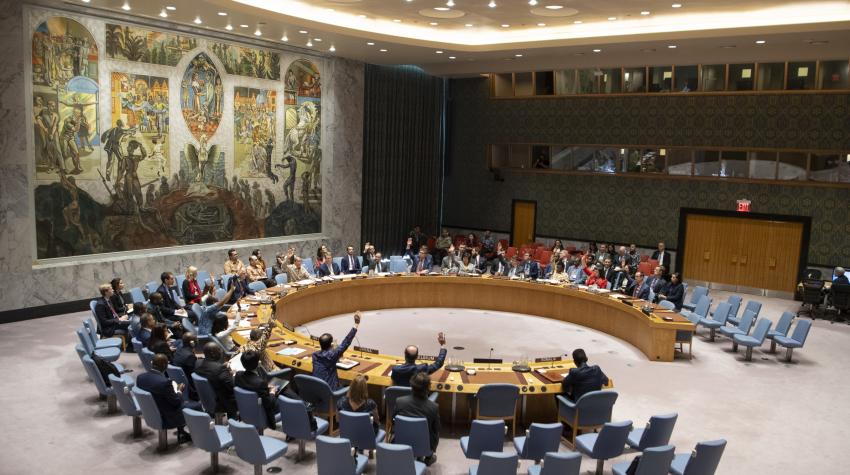
The Security Council (SC) Chamber is adorned with dark turquoise patterned wallpaper that stretches across the two sides of the room, and at the back of the room, behind the nearly perfect circular meeting table, hangs thick, lengthy curtains that flow gracefully from the ceiling to the floor. Between the curtains, a large mural is painted on the white marble wall. All of this creates a space that appears rich and sophisticated, with just a touch of frivolity. As a stranger to this room, the atmosphere seems at first, quiet, calm, undisturbed, almost subtly serene, and still. Yet, what is discussed in this space is often the opposite–intense, stifling, restrictive, cold, and at times, hostile. As I reflect back on my relatively brief time here at the United Nations (UN) this summer, including time at the High-Level Political Forum, there are several observations and personal reflections I want to share specifically concerning the Security Council.

The UN SC meetings occur most weekdays at 10am. For general debates, the meeting continues at 3pm until all states who wish to speak have spoken. As the meeting bell rings announcing the start of the meeting, state members finish taking their seats around the table. I open my laptop laid out in front of me and insert the interpretation earpiece on one of my lobes as the President calls the meeting to order. The President gives the floor to the briefers, and then each of the representatives takes turns deliver their speeches. Heated debates, amicable conversations, and pragmatic outcomes were some of the elements I expected from the meetings. However, it was, in fact, very political, formal, bureaucratic, and curiously unwelcoming and distant. This was especially so because state members would mostly read from pre-written scripts.

One of the meetings I attended which was truly intense, political, and even hostile was the discussion on the situation in the Middle East concerning the Israeli-Palestinian conflict. The bombardment of hospitals and schools, military raids, the number of dead women and children, food insecurity, health systems on the brink of collapse, all of these and more were repeatedly mentioned, representatives mostly condemning the acts that led to such devastations, and then calling for a ceasefire. Each of these meetings invited representatives from the State of Palestine and Israel. There were a few instances when the Ambassador  from Palestine would point fingers at the Israel representative, passionately urging state members sitting in the room to uphold the UN Charter and international humanitarian law by acting instead of sitting around simply discussing what to do about this heinous war which has occurred ever since October 7th 2023 attacks by Hamas.

In response, the Israeli representative would use phrases like “child rapists” to describe the Palestinians and argue against the points the Palestinian Ambassador had previously stated. The atmosphere was hostile, intense, far from respectful and void of understanding, as might have been anticipated given that the two states have been at odds for decades. Their deep-seated hostility is historical, passionate, and complex, which is why such discussions were not easy. Indeed, it was obvious that there were no practical outcomes after these heated conversations. All that was addressed was what the situation in Gaza was like and the statistics that supported what each of the member states said throughout the meetings. The death of civilians continues to rise whilst these individuals sit in their suits and ties on the comfortable chairs in the Security Council chamber.

The hostile dynamic between  Israel and Palestine was not the only one. Such political hostility was clear between the United States and Russia, mostly over Ukraine but over Gaza also. The Russia representative would put the US in the spotlight, accusing it of being perpetrators of the longstanding policies of the West that continuously excluded the interests of Russia and other non-Western countries. He painted the US as a serial violator of fundamental agreements and highlighted US reluctance in multilateral engagements. They mentioned  widespread US corruption in one of the meetings, using the example of the Pentagon’s inspector general of the US army who did not report weapons violations, which he asserted was only the tip of the corruption iceberg. On the other hand, the US representative accused Russia of fabricating lies and constantly distorting narratives, mentioning that it is “… unfortunate we all had to sit here and listen to that…”. The members would further elaborate on their respective failure to uphold multilateralism and the UN Charter, highlighting that Russia is hypocritical as they utilize the SC as a platform to broadcast disinformation. As the US and Russian representatives delivered their statements, the other Ambassadors were often on their phones, a clear sign of their political dissatisfaction with each other.

As part of an often-small audience listening to their statements, I was often  shocked and bewildered at the irony of the meetings. The UN was founded on the values of multilateralism and cooperation, peace and security, integrity and accountability, and so on. Few of the meetings represented these values. Instead, they displayed the opposite, pushing for more of a political agenda instead of a peaceful and dignified one. I wanted to have a conversation with each of these representatives and learn more about their personal stances, instead of what their statements represented. What were their names – instead of “the representative of the Republic of Korea”? Do they truly care about the issues they talk about every day, or do they only pretend to care? Are they likewise frustrated about these meetings which are often long on statements and short on progress? I had no way of knowing. After each of these sessions such as the conversation on the situation in the Middle East, I would leave the chamber disappointed and discouraged. I realized the most I could do is write about my observations and experiences during my time here at the UN.

Despite all this, my time at the UN was a profitable one for an evolving  student such as myself, not yet sufficiently exposed to present real-time ongoing global issues and conflict. If learning about the world and the issues our society faces is a priority, sitting inside the walls of a classroom is one way to go, but the opportunity to watch and listen in on Council members was quite another. I learned more about the world, exponentially more in fact, outside of the classroom in these meetings. It was a great space for me to hear first-hand about the current situations in states that are struggling with international peace and security. It was much more tangible and concrete than reading about it from literature, news articles, or textbooks, as important as they can be. I realized the significance of being present in an environment that existed for the purpose of making the world a better place. If there is one difference between myself at the beginning of my internship and now, it is that I am much more educated, informed, and interested in global politics, international relations, and issues relating to peace and security. The frustrations were not simply frustrations but also a catalyst, sparking my passion to change the world, directing my attention to pursuing a career in organizations that actively tackle global issues, specifically in areas that are directly impacted by war, because I believe it is a scourge that needs to be addressed right now. As is often noted in the Council chamber, the fate of so many of the world’s peoples, especially women and children (who often have little or no say in resolving the violence) continue to hang by a perilous thread.  

Clearly, in order to tackle global conflict, the UN  must fix the problems that lie within the institution, and this includes the Security Council. States must step up to the task and rub the dust off their eyes which conceals the reality of these meetings. Such meetings are too often impractical, redundant, ineffective, and unproductive. How can the SC members encourage multilateralism and cooperation when they fail to maintain an amicable relationship between themselves? Of course, there are several Council members  which maintain good terms with others. Yet, I am left to wonder  how many of these are actually grounded in politics, not sincerity, which is a realistic concern seeing that the UN is a fundamentally political organization. However, this too must evolve. Despite apparent differences, states must find it within themselves to eagerly come together each morning to the SC, full of compassion, integrity, and the willingness to listen actively to contrasting views. Members must better cooperate through lively, results-oriented  conversations, instead of reading from their politicized pre-written scripts. .

Two Faced: Healing the Ruins of a Broken Year, Dr. Robert Zuber

6 Oct

Let Ruin End Here.  Danez Smith

God hath given you one face, and you make yourself another. Shakespeare

The most common form of despair is not being who you are. Soren Kierkegaard

I have sometimes been wildly, despairingly, acutely miserable, racked with sorrow; but through it all I still know quite certainly that just to be alive is a grand thing.  Agatha Christie

It is a characteristic of wisdom not to do desperate things. Henry David Thoreau

I come into the peace of wild things who do not tax their lives with forethought of grief. I come into the presence of still water. And I feel above me the day-blind stars waiting with their light. For a time, I rest in the grace of the world and am free.  Wendell Berry              

Tricks and treachery are the practice of fools, that don’t have brains enough to be honest. Benjamin Franklin

When one with honeyed words but evil mind persuades the mob, great woes befall the state. Euripides

A year ago this week, as images of horrific violence by Hamas started a year-long recalibration of international relations, indeed of international law itself, people caught up in the wilfull malevolence of violence born of violence and begetting violence which continues to occur on a scale that we have not seen for some many years.

My response in the aftermath of the Hamas attack was to pen a (not particularly well received) piece entitled “Weighing in on Weighing in,” in which I tried to describe the short term, soon to become long term, impacts of old wounds revisited and new wounds inflicted, a Jewish people which had not –could not – assimilate one more of the many abuses perpetuated on them over centuries; and here faced off by another people, long occupied with serial miseries and indignities inflicted at the hands of an Israeli government which early on made it clear that any modicum of restraint – this October – was simply not in the cards.

The reasoning for that earlier piece was my early recognition that wounds had been ripped open in ways that left people little flexibility – perhaps even control – over their more and less intense emotional reactions.  Almost immediately after the attackas opinions hardened to an almost unprecedented degree, friendships frayed, organizational partnerships cooled.  “Who you stand with,” became the litmus test of continued conviviality, as though such “standing” often required something more than clicks on a social media page, or perhaps some street and campus“outrage” generated by high levels of anxiety about the state of the world alongside (as would be the case for me as well) an incomplete understanding of what might just be the most complex geo-political interactions on planet earth.

This hardening of opinions was often swift and unforgiving with implications far beyond individual friendships and organizational dynamics.  The UN also became entwined in it as well as US vetoes kept the Security Council (though not the General Assembly or the International Court of Justice) from issuing resolutions which at least promised some tangible respite from the horrific violence inflicted in reaction to October 7.  A few Council members refused to condemn the Hamas attacks or pay sufficient attention to hostage release.  On the other hand, the Council’s responsibilities to uphold their own resolutions and international law were reduced to mostly handwringing regarding the staggering number of UN personnel, humanitarian workers, journalists and health workers killed by Israeli bombs. But as Council members slowly sought to challenge IDF operations, the more Israel made clear that it will do what it needs to do, while claiming (not entirely without evidence) that any of the other countries around the Council oval would behave just as Israel was behaving if something similar to the Hamas attacks were to happen to them.  On several occasions, Israel’s diplomats even resorted to calling the UN and its Ambassadors “terrorists” for not recognizing and supporting the erstwhile righteousness of Israel’s cause. Even in these diplomatic halls, categorical opinions proved (and still prove, one year on) highly resistant to reconciliation.  Numerous calls for a cease fire and the restoration of respect for international law have been stubbornly rebuked, as were prior resolutions over many years calling for an end to occupation, terrorism, settlement expansion and settler-related violence.  Thankfully in UN forums outside the Security Council, clearer calls were made for an end to what can only be described as collective punishment, the destruction of entire neighborhoods, their infrastructure and inhabitants, justified by intelligence confirming wanted Hamas (and now Hezbollah in Lebanon) elements therein.

I have had something of a front-row seat to the diplomatic dimension of this multiplicity of carnage which has been characterized by reckless military incursions with little regard for civilian life, feckless resolutions with little or no enactment, the desperate measures taken by Gazans to find some basic nourishment and reasonably potable water only to find instead a sniper’s bullet, the “collateral damage” of child after child relegated to a life without limbs let alone any modicum of inner peace, the weapons gushing from multiple fronts into a widening conflict zone which only threatens to widen further, the hardening of “theocratic posturing” by those politicians and insurgents whose theology is anything but beyond reproach, the resurrection of “like it or leave it” governance reminiscent of the US during the Vietnam War, the dramatic rise in anti-Semitism and Islamophobia which seemingly fails every distinction suggested between the dubious actions of governments and insurgents on the one hand, and the deeper traditions struggling (and deserving) to maintain their full dignity and respect on the other.  There has also been a failure, including by some prominent western media outlets, to properly account for the millions across the Middle East and beyond, including in Israel itself, who refuse to swallow the bait, who see in the current carnage a path to ruin which will only grow in intensity and sorrow, which will only catch more and more innocents in its snares.

As with so many other examples nowadays, this is a horrific mess of our own making, a failure to uphold our own creeds while endlessly and obliviously pointing fingers at others all the while claiming some perverted notion of “divine sanction.”  This failure has left so many on the edge of despair and pushed so many others over the edge.  I have an easy life relatively speaking, as there are no bombs exploding outside my apartment window. There are no children in my back room suffering from health-related traumas while wondering if they will survive the next aerial assault.  I am not spending my days preparing funerals of hostages, journalists, children, aid workers, these and more killed during a year-long cycle of violence which has been two-parts predictable and three-parts contemptable. 

And yet throughout this horror and the emotional “dodge ball” that we have all been required to play, I have worried deeply and daily about our capacity to turn back from this newest of brinks, to become “who we are” with the caveat that we are now demonstrating only a portion of that capacity, certainly the portion that revels in destruction and righteous hate, certainly the portion that is willing to swap out our God-given face for a more grotesque version of our own making, certainly the portion that prefers tricks and treachery to honest engagement, including being honest with ourselves.  The Middle East is not the only global venue for horrific violence and abuse, for displacement and collective punishment.  It is not the only place on earth where authoritarians pursue authoritarian goals – including the goal of keeping themselves out of jail once they no longer enjoy unchecked power with which to insulate themselves from accountability. Israel has often reminded UN diplomats over years of occupation critique that Israel is the sole functioning, “moral” democracy in the region without completing the sentence – that democracy is more than voting and that morality transcends – often considerably – ascriptions of national or ethnic interests.

In trying to make sense of this past year and my own generally inept contributions to a peace which passes understanding (to quote my prayer book), a few images and memories have reverberated. I recall several of my Jewish friends who I feel may have been pushed into taking a harder Zionist line than otherwise might have been the case had the violence on October 7 not been immediately followed by more intense, anti-Semitic recrimination on October 8, rekindling fears of discrimination lurking below every human surface.  In addition, my social media feeds over the year have been filled with images from the Auschwitz Memorial archives (@AuschwitzMuseum), images of so many children and their families led to a collective slaughter once more in their collective history for no reason other than being Jewish. At the same time, I have kept a lengthy file from over 20 years of covering the major UN bodies which include multiple files chronicling abuses by an occupying power against an occupied people, abuses which are now being committed on a much larger scale, albeit a scale consistent with a past characterized by episodic bombings, settler violence, home demolitions and more. These allegedly “Godly” policy excesses are accompanied by an almost complete disregard of UN resolutions and other efforts to keep alive a “two-state solution” which is currently, at the very most, on life support.

One wonders if ending the occupation would have prevented an October 7, would have done more to end the toxicity of hatred now directed against Jews and Arabs. I cannot say.  This option is not given to us now. What is given is more saber-rattling by regional states, more bombs falling in civilian areas, more journalists and aid workers under direct attack, more acts of terror and retribution, and certainly more children facing lives without limbs, schools and hope, children who bear no responsibility for the carnage we continue to witness no matter how many officials claim otherwise, no matter how many snipers blithly use the children of Gaza as target practice.

The quotations above, especially from Wendell Berry and Agatha Christie, are there not for your benefit but for mine, this person of privilege and relative access who has not been able to move the pile of violent intent a single millimeter over many years of trying, who has no defensible solution for the acrimony  which has swept over friendships and partnerships like a dense fog, a person who can only incompletely process the profound moral backsliding which people across the world, including in my own country, have succeeded in recent times to normalize.

In some ways I seem to have been broken by all of this seemingly intentional reverting to a dark place from which we thought we might finally have escaped. But if this ruin is to end, and if I and others are to contribute something positive to its ending, then I must – we must reject the darkness, the hatred, the creeping dystopia. Much better is to renew as best we can our full embrace of that “grand thing” which is life itself.  For a time, those of us who have been granted this blessing must learn to “rest in the grace of the world,” if only long enough to be able to return to the practice of discernment, the practice of healing, the practice of peace.  There is, in the end, a way to convert our own blessings into pathways of healing and reconciliation for those who have so long been “racked with sorrow.” May we find and choose that path.

More Intern Reflections on UN Policies and Processes, by Antonio Persi

3 Oct

Editor’s note. While it wasn’t for as long a time as we had hoped, we were pleased to have Antonio Persi with us for at least part of the summer. He missed the High-Level Political Forum in July but was able to attend a number of General Assembly and Security Council meetings and other UN events. As he transitions to the University of Chicago to study Anthropology and Public Policy, I asked him to jot down some of his UN Impressions especially related to how the system engages and includes young people. Excerpts from what he shared with us appear below.

Upon my arrival, I quickly discovered that the UN was riddled with disputes. At surface level this is not alarming, as disagreements and the explication of varying beliefs serve as the basis of representative governments, but as time went on (in both the Security Council and General Assembly) I was alarmed by the longevity and quantity of these quarrels and how these examples of conflict and vocal dissent did not seem to be leading diplomats to any real resolutions. Bickering only seemed to further limit options on already gridlocked attempts at unified international responses to pressing issues. On the other hand, while the atmosphere at 42nd and First Avenue was not always “inviting,” I enjoyed the absence of sugar coatings and was captivated by the shocking reality of where the world stands today.


Achieving a stable Security Council that truly and equally represents the civilians its resolutions seek to affect is a difficult and perhaps unrealistic task for the current Council–a group that already struggles with too many divergent opinions. But this does not excuse the stagnant nature of the UNSC, a chamber which largely reflects the global status quo following World War II. In a particular meeting regarding African Representation on the council the GAPW team sat through remarks delivered by virtually every member state in the United Nations, diplomats who mostly stated and restated that a change must be made, and that Africa “deserves better” which is surely true. The President of Sierra Leone actually saw fit to fly to the United Nations to commence this eight-hour long session of the UNSC which highlighted the Councils–and perhaps the United Nation’s–stubbornness to adopt a more representative process. While never explicitly mentioned, the meeting also seemed to be a clear attempt to remove the right of permanent Council members’ ability to veto a resolution, but I am just as confused as anyone on how this is going to happen. P5 members of the UNSC have vetoed the inclusion of new permanent members time and time again, deadlocking the changes that most states say they desire. Besides getting nowhere, what these day long disputes do is waste precious time and resource needed by countries to resolve more critical issues: the UNSC meeting on African Representation was meant to conclude before 1 PM but went on until about 5 pm, which meant that UNSC discussions scheduled for that afternoon regarding conflict in the Middle East ended up being discussed in more private settings with no transparency or official dialogue observed.

The need for a younger perspective within the United Nations has never been greater. The truth is that the United Nations–and society at large–has fallen victim to the notion that power and influence can and should come with seniority. I won’t negate the importance of longer-term education and experience, but perhaps that very education is the issue at hand. It is–with some variance–the education that shaped our nation’s diplomats and political leaders of today, an education that so often leads to policy gridlock and teaches one how to achieve solutions in the context of international dynamics that are no longer relevant to today. The negative consequences of this can be seen beyond the UN’s lack of perceived authority. In some of our most “objective” areas of understanding, recent discoveries show how scientific technology, and the taught knowledge it relies upon, discriminates and works against minority groups, their communities and interests.


Through interpreting the selective wording in diplomatic speeches and watching the interactions between national representatives when off the clock, it is clear that the neutrality of these chambers is compromised. Diversifying councils, envoys and conferences will continue to be the most effective way to mitigate the effects of this complex network of international alliances. Unfortunately, the word diversity feels almost intrinsically tied to race and other key factors of identity: but as we share our definitions of diversity, we often forget the inclusion of age. Different generations are naturally going to think in different ways, each is facing their own respective world and future that looks so vastly different than the other. I would argue that the world my generation is facing looks more like a pressure cooker than ever before; because of this I feel that we have shown resilience, determination and integrity like never before. In my professional experience I have seen issues like representation handled better through councils of high school students than by diplomats at the United Nation.


This drive to see change and our “blank-slate” naivety is why we as a generation stand out. Advocacy efforts have skyrocketed in my generation proving that we want to be heard, and we are ready to face the complex challenges of today. We just need somebody to truly listen. This act of listening is not satisfied by holding “youth” events in UN chambers at 5 pm on a Friday during which tired interns are talked at for hours on end with no room to include their own opinion.


If our objectivity is stripped from us upon birth (or perhaps upon conception) and we accumulate bias through time and lived experience, then how could reaching objective conclusions on critical issues be as simple as hiring the most experienced candidate? We must look to younger individuals whose formative years are not yet in the past. For it is their lack of exposure to biased “qualifications” coupled with their determination to reach ethical and just outcomes that will ensure that their contributions to the system can be thoughtful and representative of people who see little appeal in the efforts of the officials tasked with governing them. As important as youth involvement will be in revitalizing the efficiency and effectiveness of institutions such as the United Nations I fear that few hopeful peacemakers will want to involve themselves in a system in which life-saving aid is leveraged in the name of hegemony and true representation feels like a utopian dream

Recovering the Disposable:  A Labor Day Reflection, Dr. Robert Zuber

2 Sep

Nothing will work unless you do.  Maya Angelou

The only effective answer to organized greed is organized labor.  Thomas Donahue

The first step in the evolution of ethics is a sense of solidarity with other human beings.  Albert Schweitzer

We are in this together, this accumulation of scars, this world of objects, this physical and temporary heaven that so often takes on the countenance of hell. What matters is kindness; what matters is solidarity. Olivia Laing

People are not crucified for helping poor people. People are crucified for joining them.  Shane Claiborne

If liberty means anything at all, it means the right to tell people what they do not want to hear. In times of universal deceit, telling the truth will be a revolutionary act.  George Orwell

We stand with the demonized so that the demonizing will stop. We situate ourselves right next to the disposable so that the day will come when we stop throwing people away.  Gregory Boyle

Solidarity involves commitment, and work, as well as the recognition that even if we do not have the same feelings, or the same lives, or the same bodies, we do live on common ground.  Sara Ahmed

Be regular and orderly in your life, so that you may be violent and original in your work. Gustave Flaubert

Without labor nothing prospers.  Sophocles

Yes, we have come to another Labor Day, the end of summer for all in this hemisphere, the end of innocence for some, the end of fans stuck on “high” and waking by the light of the dawn rather than the drones of an alarm, the end of consuming farm-fresh fruits at a volume that would give fruit bats indigestion. 

With due regard for the degree to which I now have to borrow energy from holidays to find enough inspiration to post, there is actually much of value to share from this weekend.   This is the time when we recognize the panoply of skills and occupations which make this world prosper to the extent that it can be said to do so.  Within a single building or neighborhood, the various ways in which people piece together lives and livelihoods are inspirational, if not always recognized as such.  People engage in their “work,” honored and not, fairly compensated and not, enjoyable and not, empowering and not, in an effort to take care of what is most important to them and navigate our increasingly complex and technology-driven societies. 

And while we tend to pay little attention to those who pick up our trash, care for our elderly, harvest our fruits and vegetables, run the credit cards for our “happy meals,” or perform many other tasks that the rest of us would wish not to do without, were we to sit with this inattentiveness for a bit we would have to admit that our consumer-driven and competitive cultures currently require vast amounts of this labor, labor which we might have dabbled in during a more youthful incarnation but which most who bother to read these posts would not see as containing any element of aspiration.  That we need so much of what too many of us tend to disregard if not outright disrespect (and this would include vital minerals mined by children under horrific conditions) is a discontinuity more akin to a profound moral failure than some clever incarnation of unearned privilege.

And of course, threats to those “hanging on” with jobs that don’t compensate sufficiently and demand a great deal physically and mentally continue to grow.  The growth spurt of artificial intelligence which (like much “advanced” technology) no one I know was asking for, threatens labor in many fields and contexts, but certainly those “hanging on” the most.  AI promises to kick to the curb those who have barely managed to stay on the sidewalk with not even a “thank you for your service.”  Indeed, one of the reasons that I have long advocated for “universal basic income” (UBI) is that it would provide just enough “order and regularity” such that people could choose to care for gardens and relatives, to join religious or political movements, to create art and meaning for others, to increase rather than reduce the amount of “intentionality” in the world, to provide real alternatives to the desperate pursuing of dead-end jobs that fail to provide basic security for families and in the age of AI are set to evaporate like raindrops in a desert. 

UBI would allow people to cultivate and practice skills which they possess but have not had opportunity to incarnate. Indeed, part of the honoring of Labor Day is directed towards the dazzling array of skills by which I am continually surrounded, skills I admire but don’t have, skills I need from others and cannot generate within myself. Indeed, as someone whose skills set is quite narrow and limited, confined now to writing pithy things when the mood hits and providing advice for policymakers who pretty much have no intention of heeding it, I am continually astounded by what people are able to do in this world – the cabinets and clothes they make, the repairs that keep old cars and houses functional, the ability to maintain water resources and other civilian infrastructure. the vegetables and fruits they know how to plant and harvest – these and much more are skills which I do not possess but can certainly respect and even revere. These are among the skills that keep our world from plunging into utter discouragement.  These are among the innumerable and necessary responses to tasks for which my name will never appear on any call list.

But in the end, honoring is a relatively easy bar to achieve if it does not produce more than sentiment or what is now commonly known as “virtue signaling.”  For as we honor labor there is the obligation to solidarity with the laborer, the people who endure the grind which keeps this leaky ship of ours afloat.  Solidarity takes real effort, occasionally even real sacrifice.  It involves telling the truth about the ways in which so much labor strips away the dignity we insist upon for ourselves.  It involves concrete actions in political and economic realms to ensure that those who work in fields and factories have at least basic access to health care and educational opportunities for themselves and their families. And it involves counter-balancing false narratives, including setting straight what has become the “universal deceit” about “job stealing,” criminally-minded immigrants who seek only to sow violence and discord amongst our erstwhile law-abiding citizenry.

On this Labor Day, more and more of us are facing a crisis of disposability as more and more technical, financial and political power concentrates in the hands of those with large ambitions couched in “solutions” which are largely self-referencing.  This crisis applies to me, to my neighbors, to many millions of workers all global regions. We are all at risk of having our skills and values denigrated outright or at a miminum restricted to smaller and smaller circles of interest. Indeed, as I write this, the “common ground” of labor which we would do well to acknowledge and support appears to be collapsing under our feet.  Let us pledge before the next Labor Day to restore at least some of its firmness. 

A Moment of Truth: Reflections on the UN System from the Inside, by Himadri Ratnayake  

4 Aug

View of the Security Council chamber from the left side of the room, with a round table for delegations and a mural of a pheonix on the wall.

Editor’s Note: A student at Columbia University of Sri Lankan heritage, Himadri has concluded her summer internship with us, adding much value to our work and making the most of the opportunities which the UN presented. Her task here was to reflect on how being at the UN differed from (or confirmed) learning about the UN in a classroom setting, how her assessments of the UN were influenced by expectations of the UN generated in other contexts. We were really happy to have her with us especially during July’s High-Level Political Forum.

We have six years…six years left to go. In 2030, I will be 30. In 2040, I will be 40. In 2050, I will be 50 and so on. Only six years to make comprehensive progress on the 2030 Sustainable Development Goals, with only 17% of the goals and targets now on track. . While it may seem like there is a lot of time left, there is also still a lot of work to do to fully address all the goals and their targets, to honor the promises we have made to global constituents.    

As a 24-year-old graduate student studying international affairs with an emphasis on Economic and Political Development, International Organizations/UN Studies and International Conflict Resolution, I have been able to understand some of the behind-the-scenes of what takes place within UN spaces. When you are in school, there is only so much you can take away from articles, resolutions and the knowledge of a professor. Having now been at the UN, I have been able to apply what I have learned and understand more of the system and processes that occur within that sphere. Overall, it has been an absolute privilege to have been able to attend meetings covering a span of topics: the conflicts in Gaza, Yemen, Ukraine, etc., food insecurity, children impacted by climate change and war, oceans, decolonization, etc. I have acquired an abundance of knowledge just by attending such meetings and side events, learning about various climate and terrorist threats, UN agency mandates and rules of procedure, preferred UN terminology, and so on. There were some topics that I had never truly known about until I attended a meeting, and that only goes to show the range of conversations which are taking place at the UN, especially during July’s High-Level Political Forum.   

Throughout my time here, I have had multiple opportunities to engage in meetings held within the Security Council, ECOSOC and the General Assembly as well as “side events” in many other conference rooms. Upon my first time sitting in on a Security Council meeting, I felt excited to be able to witness discussions in a manner that is  often closed to the outside world. There is a level of seriousness and intensity in the room that one can’t necessarily experience on UNTV or in a classroom. The briefings initially held at the beginning of meetings by various officials from UN agencies ranging from the OHCHR to the IOM and so on, offer incredible insight regarding statistics and stories of urgent situations taking place on the ground.  

Initially, during the first few meetings, all the country’s statements appeared to be full of hope and promise, offering a great chance of making progress toward resolving situations on the UN agenda. However, upon attending several meetings and listening to multiple country statements back-to-back, I noticed the repetition of information and beliefs expressed by the country representatives. The statements would usually start the same, often including the same statistics that would already have been mentioned in an opening briefing. The words “let me make three points” were frequently mentioned as well. I bring up the structure of these speeches because it shows how much repetition we witness, not only in structure but in content as well.  

While I still retain so much hope in the UN, and still wish to join the Foreign Service soon along with involving myself in humanitarian field work, I cannot help but wonder how much progress and change we are truly creating in terms of resolving many existing global threats. This is also the case for emerging crises; everyone but the people at the very top of governance seem so highly limited in terms of decision-making access and impact. Even those residing at or near  the top experience their own limitations.  

 In addition to what I have previously noted, I have also observed other unfortunate occurrences in the meetings I attended. There are Member State representatives who walk out of the Council chamber when certain countries are preparing to speak, Member States who change the narrative (facts being turned into fiction and vice versa) and those who do not seem passionate or even interested in their own or other country’s speeches. I have also noticed the lack of attention given to those that are speaking or participating in the meetings. There have been countless times where it is evident that people were on their phones, ostensibly on social media, scrolling endlessly and even occasionally forgetting to turn their volume off. During my short tenure in the Council, I have heard bag pipes playing, some hip-hop music, etc. amidst deliberations on critical matters pertaining to peace and security. This may not seem like a big deal to some, but when discussing matters of war, the effects of it on civilians, etc. what does the lack of careful listening tell us?  

These past couple of months have brought great insight into processes which had mostly been closed off to me and others in my cohort. On the outside, the UN often represents a symbol of peace, hope, strength and unity. It also serves as a promise to current and future generations, that there will not be another world war and that peace can eventually prevail. However, it seems that presently there are more wars (regional conflicts) occurring now than perhaps ever before. My question is thus, what are we doing exactly to help resolve these situations?  

One of my favorite adornments in the Council chamber is the “Untitled (Mural for Peace)” by Norwegian artist Per Krohg. It sits as a perfect backdrop to the purpose of the Council, and further emphasizes the importance for peace and security in our world today. What a powerful message and image this is, where the phoenix is rising above the ashes of a conflict-ridden society. That is the future I wish to see, not a continuation of what is currently happening. If anything, we are now driving the phoenix back down into the ashes. The Damask wall tapestry further embodies faith with the growing wheat representing “hope and the heart of charity.” While such beliefs still persist, it is imperative that we fulfill these symbolic aspirations and apply them to the world.  

On the inside, the Council meetings usually start in the same manner. The three dings go off, and the agenda is usually announced and adopted for the session. In some meetings, the level of intensity is relatively tame while in others there is finger-pointing and hostility that permeates the air. As a student, I see the hypocrisy within certain country statements, and while I understand the justification behind them should we not be looking for more sustainable solutions than reflect minimum concessions to peace? There are certainly hopeful solutions that representatives present to their colleagues, but not everyone is committed to following what seems to be the obvious answer to the issues presented in such meetings.  

As I am entering my second year of my master’s program with this new outlook on the UN, I am hoping to discover what my place will be in that place post-graduation. I do not want to wait until 2050, when I am 50 years old, for change to take place in our world today. Not more discouraging  change, which we surely don’t need, but good change. We need more good change, we need more progress on sustainability, and we need it quickly.   

One final thought:  Throughout my time  at the UN, many discussions that took place in the context of smaller events, especially during the High-Level Political Forum (HLPF), mentioned the need to involve the youth by incorporating them in conversations and even decisions. These conversations include the evolving climate crisis, peacebuilding priorities, multiple human rights issues, etc. The problem is that prominent figures in the room may listen to youth  but there is little to no progress which can be measured as a result of these interactions. Involving younger generations in actual development processes, whether it be policymaking or other discussions at multiple levels of policy and practice, is necessary if we wish to fulfill our SDG commitments.   

As a member of the “younger generations,” there is so much I wish to do in terms of solving these global challenges that only seem to be growing. But it seems unlikely that I can make any impact or real change at my current stage. The more UN meetings I attended, the more I observed the age range of people leading discussions, and they were mostly (with all due respect) from the older generations. There were even some events where one could easily notice the lack of bodies of any age in the room, perhaps because not many people were aware of the event, perhaps they were too busy with other matters, or (I fear) perhaps some people in the system (or attending the HLPF) may be losing hope in an organization that has demonstrated limited capabilities to resolve many security and development concerns.  

With that being said, I hope my reflection offers some helpful insight into a youth’s developing perspective on the UN. My passion for international affairs and this journey into diplomacy stems from my time in Model United Nations (MUN). In learning about various world issues at an even younger age and then being privileged to travel the world, I acquired this hope that the UN could be the answer to solving these pressing challenges. Over time, as my knowledge and experiences have grown, I realized that it is not only the UN but also and primarily world governments who are the keys to forging positive change. They are the primary policymakers and the ones who hold the power in decision-making when it comes to war, the climate crisis, peacebuilding priorities, etc. Thank you to FIACAT and all who made my UN sojourn possible. By 2030, I hope more significant progress on all of the SDGs will be possible. .  

A Time for Care and Reflection:  A Tribute to Saul Mendlovitz, Dr. Robert Zuber

21 Jul

At the end of the recent High Level Political Forum on Sustainable Development held at the UN, the president of the Economic and Social Council convened what for us was certainly  one of the most inspirational events of the entire two-week sequence, a session devoted to caregiving and its gendered impacts. 

Featuring the newly minted Foreign Minister of Mexico and featuring other presenters from within and outside the UN system, the session made plain both the almost-universal need we humans have for caregiving and the degree to which that responsibility falls on women – women whose labors are often unrecognized, often uncompensated, often inadequately shared with their male partners, often keeping them from developing other talents or joining together to pursue the “power” for which the Foreign Minister advocated  in this session.

Needless to say, most of us do not take sufficient time to reflect on our pathways, contexts and conditions as human beings.  We certainly do not, as a professor from Buenos Aires chimed in during this UN session, spend sufficient energy in taking down the “patriarchal scaffolding” which inhibits women who choose to be caregivers from achieving both compensation for their families and the dignity and respect their caregiving is surely due.  As bombs continue to rain down on communities, as fields lay fallow due to climate change impacts, and as more and more families face grave uncertainties as they take to hostile byways in search of secure places for their children, the need for caregiving is both profound and acute.  It cannot be, must not be, the informal, unpaid and unacknowledged province of women alone.

This is background for what is intended to be a tribute to the recently deceased Saul Mendlovitz, one of three co-founders (with Jonathan Dean and Randall Forsberg) of Global Action to Prevent War and Armed Conflict back in 1999.  Saul took his leave of GAPW some years ago, and the project has certainly (for better and worse) evolved in his absence, but his legacy, to some significant degree, is embedded in this project as it was in the World Order Models which preceded it and to which I also made contributions.

Beyond his role in Global Action, Saul was a professor at Rutgers Law School and, as his scholarly interests over the years shifted to incorporate a more literary lens, his stature as teacher only grew further.  He was a passionate speaker, conveying urgency and more than occasional wit, which drew a number of students to his lectures who had no institutionally coerced reason for being present.

In some ways, Saul’s vision for Global Action was a continuation of his work with the World Order Models Project.  His community was a solid, talented group of World Order scholars with all their strengths and limitations.  At the same time, the target audience for both the Global Action “Program Statement” and the project for a “UN Emergency Peace Service” a standing, rapid-response service to prevent mass atrocities, was the United Nations itself, an entity often referenced but less often engaged with sufficient depth.  Proposals often emanated from GAPW towards a system which was ill-equipped to absorb them due in large measure to what I and others came to believe was an over-reliance on our ideas and an under-reliance on both the often-frustrating politics of implementation and the growing testimonies emanating from communities under siege, people who increasingly demanded a hearing and generally dared to hope for significantly more than that. 

As we say often at the UN, policy proposals have life when states adopt them not when NGOs (or academics) introduce them.  And, in a system where words are far more plentiful than decision-making authority, what comes “out of our heads” is certainly less impactful  than our willingness to swim in the soup of UN politics while endeavoring as best we can to preserve our policy independence.

Especially in the early years of Global Action, Saul was integral to preserving that culture of independence.  While his circle of fundraising contacts was relatively small, it was larger than those of the rest of us and he unabashedly and routinely asked for money from those who found his personal vision compelling. There was never enough to manage even a spartan life in New York City but there was surely enough to eschew the sort of arrangements which would require us to support policies which we felt were more likely to result in broken promises than in prospects for concrete caregiving for those facing the end of their capacity and resilience.  

From the note which Saul’s daughters sent to some and circulated to others following his death, it was clear that his life and priorities had a profound affect on his family.  His vision forged over 99 years of life resonated with them as it did with others. Indeed, for all the limitations inherent in academic worldviews, Saul communicated clearly that there is a need for global values and policy rigor to complement policy negotiation and ensure successful outcomes for people.  It is important that we do all we can to prevent violence and indignities of all kinds at a macro level such that the burdens of care at family and community levels can be sustainably reduced.  Otherwise, we are left mostly to heal physical and psychological wounds which, if we in the policy world were honest with ourselves, probably never needed to happen in the first instance.

Also noteworthy in Saul’s daughters’ communication is the news that, as his life was coming to an end, Saul swapped out his preoccupations with world order and the ruminations of the New York Times for a more contemplative, introspective engagement consistent with living through (rather than denying) one of the two most profound transitions in human experience.  As a man who, in his younger years, often seemed to prefer professional ambition over a concern for caregiving (though he certainly did some of that), who frequently indulged in competition with far-flung colleagues to the exclusion of solidarity with those in his more immediate professional circle, it was reassuring to think of Saul engaging in that urgent, poignant, honest, self-directed exploration as his earthly life over nearly a century was nearing its end.

I and any number of others would surely have wished to know what he discovered in those meditative moments.  It would have been a fitting last lesson for Saul to have left for those of us still struggling to discern and to care.

A Generation of Engagements on Peacekeeping Operations, Dr. Robert Zuber

14 Jul

Editor’s Note: Deep thanks to Professor Peter Hoffman for organizing the New School’s “UN summer study” course and for, once again, allowing us to share ideas on a topic close to our hearts with such a diverse group of younger people.  As I remind such audiences on a regular basis “it is your turn now” to direct this leaky ship, to practice the skills and values that can move forward the confused and volatile species we have become. I especially honored this group for exploring options through this course to do exactly that. 

I want to begin today by pointing out that the UN has changed significantly regarding the presence of NGOs since we started down the road of UN engagements, indeed even since the end of COVID.  Some delegations, even those who appreciate our work and our “fairness” have championed a system where states are more firmly and fully in charge while  the rest of us have to scramble to have voices and proposals heard, a condition which was rarely an issue pre-Covid as a range of our publications and co-hosted UN events over 20 years would attest. It’s been a tough slog in some ways being at the UN since the onset of Covid, even as lots of our NGO colleagues, like ourselves, lost much of what we once had during those pandemic months. Many left the system. For better or worse, we have yet to do so.

We’ve tried as best we know to make our modest contributions over 20 years while preserving our independence and taking the UN’s full policy ecosystem into account rather than branding around specific activities for which we could get funded.  We’ve also kept a low profile understanding that change occurs at the UN when states own a proposal, not when NGOs make a proposal.  That said, we have been deeply involved previously in  monitoring of Arms Trade Treaty negotiations, in the promotion of  gender lenses on disarmament and atrocity crime prevention, in efforts to create broader support for the creation of the Peacebuilding Commission, in identifying hopeful projects opening space for more diverse civil society involvement in UN conference rooms,  and much more. Perhaps our most visible contribution was through the promotion of what we called a “UN Emergency Peace Service,” supported by the late Sir Brian Urquhart and other UN luminaries, which was envisioned as a standing, rapid-response capacity which could serve as both a deterrent to and an effective, prompt response to outbreaks of atrocity-level violence.

To that end, we held conferences and consultations on every inhabited continent and penned  numerous publications including “Standing for Change in Peacekeeping Operations.” The news in all of this  is that the project did not survive into the present.  This was OK as the actual point of UNEPS was to help move the international community and regional organizations to assess key aspects of peacekeeping in the transition to more effective, protection-oriented commitments.  The point was not to draw attention to ourselves or to promote our work as being somehow more “fundable” or valuable than other initiatives of its kind. We were clear from the beginning that if a UNEPS-style service was ever to see the light of day, it would not be us who would liberate the idea in all its complexity from its  conceptual shadows.

Our Concerns

Between the creation and current transition of our UNEPS proposal, and happily so, DPKO (now DPPA) officials and experts  have largely addressed our collective concerns.  They have fixed many force generation and peacekeeper training challenges, addressed abuses alleged to have been committed by peacekeepers, helped streamline to some extent reimbursements for troop and police contributing countries, added layers of protection and medical access for peacekeepers, embraced revised mandates related to elections, protection of civilians and climate change impacts, initiated  substantial efforts to diversity peace operations especially by gender, eliminated some if not all deployment “caveats” which limit mission performance,  minimized the environmental footprint of large operations such as MONUSCO in DR Congo, and taken with renewed seriousness the importance of ensuring that peacekeeping deployments are closely tied to viable political processes.  All of this is good and important work and we are grateful for it.

Moreover, while peacekeeping’s relationship to human rights abuses and the prevention of atrocity crimes remains to some extent a work in progress, the decision to prevent the direct military engagement of peacekeepers with terrorists was, at least in our view, a wise one.  Ultimately the point of peacekeeping is to allow for transitions which lead to political settlement while enhancing the ability (and the will) of national and regional forces to maintain their own protection functions and address their own security threats, including from terror and other armed groups.

This last contribution is not without controversy as more and more countries seem to be deciding on security-related alternatives to UN peacekeeping, some of that via enhanced domestic capacities which may not quite be ready for prime time, but some of that through agreements with the Russian entity formerly known as the Wagner Group and other external players. What these entities  seem to have in common is a willingness to suspend human rights concerns in the name of countering national security threats from terrorists and other armed groups, a suspension which UN peacekeepers may not indulge and which we would not wish for them to indulge.   

Especially since the transition between peacekeeping as primarily guarantors of truce/peace agreements to a more robust mandate for protecting civilians, threats to peacekeepers have grown dramatically.  Increasingly we send peacekeepers into highly volatile environments with daunting protection needs and threats and challenges emanating literally from all directions.  Efforts to engage communities, especially now by women peacekeepers constitute an important dimension of the work, but high levels of peacekeeper casualties on an annual basis speak to training deficits among troop contributors but more to challenges related to discerning friend from adversary  in multiply uncertain and often hostile contexts.

At the end of the day, while peacekeeping is not a substitute for viable political processes, it is also not a substitute for failures regarding our primary commitment to conflict prevention.  I grew up in a family of multiply deployed military personnel.  I heard all their stories, some of them quite gruesome, some of which you all could probably replicate from your own cultural and national contexts.  As arms flow in all directions, as climate change and resource extraction fuel local tensions and food insecurity, as the scales of inequality continue to be tipped in favor of people like me (for absolutely no reason), prospects for conflict prevention often appear dim. But it is effective conflict prevention which holds the greatest promise for effective civilian protection, for children spared trauma and recruitment, for women spared sexual violence while trying to conmfort children they cannot feed, for men spared participation in the armed violence which accomplishes little beyond shortened or ruined lives.

Prevention isn’t sexy, but it should be noted that much of the international community has, from our vantage point at least, become exhausted from trying to protect, trying to deliver, trying to restore and reconcile once armed violence has been given license.  We humans have some significant blind spots that we refuse to examine, one of which is related to our propensity for metaphorically deciding to close barn doors only  after all the horses have escaped.  If your generation is to avoid mass trauma, if you are to have the funds you need to promote justice and healing rather than cleaning up after what seems like endless messes of criminality and violence, if you are to be able to raise children without armed guards and gas masks, then we need to collectively show more maturity and courage, to commit to readjusting the established order of things when that order is unable to deliver, to privilege prevention rather than endless reconstruction of the rubble of armed violence, to make a better and stronger case for a world less inclined to disruption and violence hosting people more inclined to relinquish destructive habits and otherwise encourage their better selves. 

We can do this together.  We can do this separately.  But we must do it.  And, to belabor an otherwise obvious point, time is decidedly not on our side.

The UN Security Council and Climate Change:  Struggling  to Connect the Dots, Dr. Robert Zuber

6 Jul

Editor’s Note: This piece was written in response to an invite from a university in Kenya, a zoom presentation which never materialized due to communications issues related in part to the unrest which had exploded in Nairobi in late June. So….here it is for you to read if you so choose. I hope its worth your time.

I want to begin this presentation to all of you with a sober look at where we are vis a vis the climate crisis.  Put simply, we have collectively failed to address climate risks and, in the case of the wealthier countries, have failed to meet our obligations to climate victims.  The burdens of climate change are felt by all including displaced women and an increasing number of women farmers, but they are not responsible for the growing climate-related carnage.  These people, like most of you, are suffering from a crisis they did not cause.   

Here at the UN, we continue to pass resolutions with levels of enthusiasm  for implementation which tend to drop as soon as those resolutions are adopted. On climate, the threat is felt acutely in small island states and in the Sahel, but not quite as much in most middle income and wealthy states, precisely the states responsible for the bulk of global emissions. Even when the rhetoric is sufficiently urgent, Council climate action continues to fall well short of what is needed.  Young people have in some instances filled the leadership gap created by older persons on addressing climate risks; and yet for many young people the preparations they are taking in their lives, their studies, family matters and more  are likely confronting a future of extreme heat, equally extreme weather events, growing threats of  food insecurity and I would add life insecurity as well.  You in this university audience didn’t do this to the planet, and you don’t deserve the consequences  either.

It is commonplace to note this, but how we assess in life is largely a function of what we expect, and it is the expectation of many young people that we aging folks from the west in our relatively comfortable contexts should have done more, could have done more to stem the increasingly inevitable climate tide.  What were we thinking?  Were we thinking at all? 

And if we were thinking at all, what were we thinking about?  About gender-balancing our climate action? About helping to unleash the diversity of youthful  talents across the world that can break through some of the policy bubbles and stale air which exist in the diplomatic world?  Were we metaphorically thinking about “sharing the ball” with youth and others which is the only way human civilization can possible win this game of climate ruin?

There is  at least a growing sense within the international policy community that climate change is, at least, a conflict multiplier that the climate is evolving much quicker than we have the ability to address, including its impacts on international peace and security.  But there is also a growing sense, and I agree with it,  that we have mis-positioned our climate action, focusing much too much on the activities of officials and diplomats making (and often failing to make) climate policy largely through resolutions without “teeth” or through large international events which burn more carbon than make change, rather than on communities seeking pathways to more resilience and abundance.

From our base in New York, we have identified and assisted programs around the world which are attempting to promote inclusive, gender sensitive local lenses on sustainability.  My favorite of these is Green Map (greenmap.org), a set of tools including culture-specific iconography to help local communities identify environmental assets and liabilities,  to use mapping to reintroduce people to the resources and habitats which are worth protecting and which make their communities special.   Our slogan – think global, map local – is symbolic of a deep belief that we will never fulfill our climate or sustainability goals without pragmatic engagement by local leaders in all global regions, including many more women and youth participants.

While affirming local action in all we do, I often sit in a very different place, in the UN Security Council, which has an uneven relationship with the climate issue.  It could even be said that the Council also has an uneven relationship with its own Women, Peace and Security agenda, an agenda 24 years old with a host of gendered gaps and discriminations still largely unaddressed.  On climate the pattern is similar: recognition by some Council members, especially elected members, that climate is a major contributor to conditions which make conflict more likely.  On the other hand some members simply don’t see the linkage, or  think that climate issues should be handled by the UN agencies tasked specifically with climate or other environmental matters.  The concern here, made most forcefully at the moment by Russia, is that there is a division of labor in the UN and that these divisions should be respected.

But while mandates may have similar force, the mechanisms of enforcement do not.  Russia and other Council members know full well that while Council resolutions are often ignored, the Council at least has Charter-mandated coercive tools at its disposal that other UN agencies do not.  And if the Council cannot make states uphold their promises on issues such as gender and climate, then the hands of the full UN are surely tied in terms of enforcing any agreements whatsoever – including climate agreements. 

Some Council members are fighting back, more and more, recognizing that we have set forces in motion that promise more violence, more misery, more displacement and that we must robustly address those forces. These states recognize that the Council can fulfill an important enabling role vis a vis the UNs climate priorities without usurping the authority of the agencies tasked with responding to this crisis.

One example of this “fight back” occurred during its Council presidency of the United Arab Emirates in June 2023, as that delegation tried to rally Council colleagues to take climate risks and their implications for peace and security with the urgency they deserve.  It should also be noted that the UAE at that time was also prepping the Council as well for its COP 28 presidency which ultimately turned out pretty much like all the other COP events – burning more fossil fuel than changing the course of climate threats and making promises of change that are generally  not kept.  But this meeting was at least asking the right questions about the Council’s role in ensuring more diverse climate action and remaining seized of the many ways in which climate change makes conflict more likely.

This quote from the UAE’s Concept Note set a proper tone:

Climate change is the defining challenge of our time. Its interconnected consequences – intensified extreme weather, rising sea levels, food and water insecurity, biodiversity loss and heightened health risks – jeopardize human life, livelihoods and ecosystems and have an adverse impact on national, regional and global stability.

And, as also noted in the Concept Note, climate change has implications for the entire peace continuum including those who are unjustly excluded from participation in peace processes:

The gendered impact of climate change has significant implications for international peace and security. Women and girls are disproportionately affected by the adverse effects of climate change, including food insecurity, displacement and increased rates of conflict-related sexual violence. Moreover, women are often excluded from decision-making processes related to climate change mitigation and adaptation. Evidence shows that, by leveraging the role of women as agents of change, gender-sensitive work on climate change and peace and security can serve to advance both stability and gender equality.

This is good policy language from the UAE but of course it is only language.   Little or nothing changed as the result of this meeting.  Little or nothing changes as the result of most Council meetings as much as the global community, sometimes desperately, needs to see evidence of change. Is there a missing ingredient here beyond politics?

I think there is.  As we discuss often here in NY, there is a human dimension to this crisis which we ignore at our own peril.

Whether the Council or other international institutions embrace their responsibility to address climate risks in a timely manner or not, the changes to our world are coming quickly, more quickly than we had originally anticipated, and we seem unable as a species to respond in kind.  We are in many ways, and more than we generally acknowledge, creatures of habit, and those habits make it difficult indeed to shift our course, even when we want to do so, even when are survival depends on us doing so.

Those of us in the west and beyond know of threats to agriculture from multiple climate related impacts including increased drought and flooding, but we (especially in the west) continue to eat and otherwise consume largely as we always have.  We know of threats to biodiversity but we continue to cut down forests, destroy habitats, and plant non-native and fertilizer-intensive plants in our gardens.  We know about  increasing prospects of climate-related disasters including massive storms and pandemics, but we continue along as though we possess some immunity from those impacts.  We know of threats to our ocean environments, but our collective addiction to plastics waste remains largely unchallenged. 

The climate-conflict nexus is in part about the effectiveness of our global policy and in part about we as members of local communities, the sustainable examples we set, the people and actions we inspire, the habits we are prepared to change.  We know something is very wrong.  We feel the heat.  We experience the growing frustration, anger and suspicion at community and national levels. But can we adapt?  Can we learn new skills, can be more mindful and compassionate towards the created order, can we break out of unsustainable habits?  Can we take the data urgently provided by scientists and turn them into sustainable amendments of both policy and life? The jury is clearly out on this.

As we contemplate our resistance to change, I want to end with a couple of quotes from a recent report from UNICEF on climate impacts affecting future generations, which likely directly  applies to you. The report notes that,  “Environmental degradation, including the climate crisis, is a form of structural violence against young people and can cause social collapse in communities and families. Poverty, economic and social inequalities, food insecurity and forced displacement aggravate the risk that children will experience violence, abuse and exploitation.”

There is also a quotation in the report from a young interviewee:  “The environment is our life.” Adults [should] stop making decisions for the future they won’t experience.”  

Taken together, this is quite an indictment of our collective failure to meet this urgent moment. Yes, we should stop making decisions for people and start making decisions with them, with the people who will have to live with the threats we have left for them, threats of gendered and racial discrimination, threats from abusive governments, threats from an overheated world which can no longer preserve biodiversity or support healthy agriculture. And yes we old folks and our institutions of choice (including the Security Council) have reinforced, inadvertently or willfully, strubborn conditions of structural violence which make it harder than it ever should be for young people across the world to chart a more sustainable course for their lives.

A world of increasing climate threats, including threats of armed conflict,  is a world we are running out of time to prevent, and it is the country I call home along with other large consuming states which need to make changes on emissions and consumption quickly and permanently.  We the people of largely undeserved privilege  owe it to the rest of the global community  to somehow reverse our current, unsustainable course, reminding ourselves frequently that the clock on such reversal is loudly ticking.