
Editor’s Note: The lengthy excursion below is also an excellent introduction to the work of a young Peruvian woman who has become an important colleague for us. Andrea was introduced to us by our longtime friend Dr. Toh Swee-Hin, and we had quickly become enamored of her community activities and her energetic spirit that we wanted to both support that work and draw her more into our international orbit. Andrea recently was issued a visa by the US government and we expect to have her at the UN this summer for the High Level Political Forum and related activities. Hopefully she will make abundant contacts which will help shape her future community work in Peru. We, on the other hand, stand to learn much from her presence here. The text below will help explain why we are so pleased to welcome her.
No one told me that founding a youth organization engaged in community volunteer work on democracy and citizen participation while belonging to a vulnerable population (a young woman, premature seven-month triplet, first-generation university student, and coming from an emerging district) would be highly complex; but no one told me either that I would lead with such passion, even on the most uncertain days.
I GREW UP ON THE PERIPHERY OF DEMOCRACY: I BECAME NATIONAL NEWS WHEN I WAS BORN ALONGSIDE MY SISTERS.
Who could have imagined that the girl whose birth was exposed as a media event in the era before social networks — at a time when digital platforms did not exist to communicate and public visibility depended almost entirely on traditional media — would later be instrumentalized within a phenomenon that drew in a political candidate willing to extract political capital from family vulnerability, would end up leading her community. Yes, a politician came to promise help, posed for the photo as part of his unfulfilled social assistance, and never returned. That is how I was named Andrea, in honor of an authority of the time who promised support to my family in front of cameras and whose name I ended up carrying in its feminine version.
My parents settled in an emerging district — the other face of Lima — where many people build their lives from scratch in search of the opportunities their hometown, 18 hours from the capital, could not offer them: education, healthcare, and stability. They were uprooted from their families at ages 11 and 14 respectively and arrived in a city marked by discrimination, structural racism, and stigmatization. In those years, coming from Ayacucho — a region deeply affected by the internal armed conflict — meant bearing prejudice, suspicion, and exclusion. I am the daughter of those migrants who fled not only from precariousness, but also from the weight of stigmatization and lack of opportunity.
Both arrived while still almost children. They had no formal education or role models along the way, yet guided by their Catholic faith, they leaned on one another and on work to provide their daughters with basic goods and services. I grew up with faith and dignity. Perhaps it was there that I understood how each act shaped who I am. I chose to study Political Science as an act of “rebellion”: to understand power in order to transform it, because politics shapes our lives from birth.
In my veins, in my Indigenous Ayacuchan roots, runs the blood of generations who did not have the privilege of education, of understanding, or of acting to alter that reality. It is a struggle that is not easy to embody, yet it became my life’s passion: to assume collective challenges from the periphery.
I, too, would have liked to be born into a cradle of opportunity, but the cradle of resilience into which I was born shaped me from my very first minute of life. Here I am, here I remain, and I endure, because I firmly believe, as Mujica once said, that my strength lies precisely in having been born where opportunities are scarce but dignity abounds. We do not choose the cradle into which we are born, but we do choose what we do with the life we are given. In the trench of scarcity also lives the courage of struggle and rebellion transformed into love for others. For that reason, politics is an instrument of service, even when the path becomes more arduous for those who remain faithful to their ethical principles. What gives strength is not what is lacking, but what overflows in conviction, because the cause is always to live with meaning.
I ENTERED THE MOST PRESTIGIOUS PUBLIC UNIVERSITY IN MY COUNTRY, ON SCHOLARSHIP, AND SINCE THEN I HAVE WORKED TO TRAIN WITH EXCELLENCE
I have always pursued challenging goals. I understood early on that living means precisely that: moving forward even when uncertainty weighs more than certainty.
I never imagined entering the “Dean of the Americas.” Not because I doubted my abilities — I was always disciplined and deeply committed to my studies in my community’s public school, where I ranked second overall throughout all my school years (first place was achieved by my triplet sister) — but because I often heard that such a path “was not designed for someone like me.” The narrative was familiar: accept reality, resign yourself to economic limitations, study only if my parents could afford a few months of preparatory academy; otherwise, give up the dream.
But I earned admission. I won a national scholarship. I graduated with excellent grades. I participated in an international exchange, also on scholarship. Later, I went through months of unemployment until an opportunity arrived that transformed my trajectory: a paid internship at USAID, an institution that believed in my potential, revitalized my vocation, and allowed me to work alongside highly qualified professionals, engage in technical dialogue, and operate in a language other than my own. It was not that I romanticized the agency. It was that every second of the experience was difficult to describe. I learned enormously and deeply valued having been selected among thousands of applicants. I did not only learn from my office, but from all of them. Absorbing knowledge was, without exaggeration, one of the most enriching professional experiences of my life.
I received significant recognition within the institution, yet everything ended. My stipend was rescinded in February due to the broader context. I carried with me learning, networks, and professional validation. Outside, however, another reality awaited me: that of my country. Months later came the enactment of Law No. 32301, modifying the framework of the Peruvian Agency for International Cooperation (APCI). One of the main criticisms points to its imprecise wording. By generically prohibiting projects that may imply “intervention in internal politics” or actions that “affect public order, citizen security, or national defense,” the regulation could inhibit virtually any form of citizen criticism. The potential impact on independent media and organizations reliant on international cooperation is particularly concerning, especially in fields such as human rights, governance, and the environment. An inevitable tension arises: How can the State validate investigations that may question it?
The Inter-American Commission on Human Rights (IACHR) expressed grave concern regarding these changes, warning that prior authorization requirements and new administrative obligations could create disproportionate obstacles to civic space and freedom of association. All of this unfolds amid a national context marked by organized crime, expanding extortion, and the proximity of general elections in a highly fragmented landscape with more than 36 political parties.
For a political scientist who refuses to normalize complacency toward corruption, navigating this reality is already complex. Doing so from unemployment is even more so. In contemporary Peru, engaging in advocacy or volunteer initiatives related to democracy and citizen participation can paradoxically become a professional risk factor — not due to lack of merit, but because certain institutional environments view such experiences with suspicion. In a climate where the current government maintains a restrictive posture toward various forms of collective action, the tension between ethical coherence and job stability ceases to be theoretical and becomes a daily decision.
FROM RESILIENCE TO COLLECTIVE ACTION: ORGANIZING FROM BELOW TO SUSTAIN DEMOCRACY
I founded Empodérate Vecino(a) in 2022. I did so while working as a junior research assistant at the National Police of Peru and simultaneously directing the research workshop “Ciudad Crítica” at my university. This initiative emerged after researching the territorial governance of the Lima 2019 Pan American Games, particularly in my district. For the first time, high-level sports infrastructure arrived in my community. This transformed not only the urban landscape, but also my understanding of territory, inequality, and citizenship.
I chose to lead the organization through a quiet yet close approach. I wanted to build a space that did not merely appear active, but truly executed; that did not only speak about participation, but practiced it effectively. Since then, Empodérate Vecino(a) has become my principal space and refuge for civic engagement. I deeply believe in self-organization and self-management as forms of democratic resilience. Grassroots movements like ours embody concrete practices of deliberative democracy: inclusion of diverse voices, public reasoning grounded in arguments and evidence, respect, active listening, and the search for shared foundations connecting deliberation with legitimacy.
However, the path is not easy. Structural barriers persist: distrust toward young women’s leadership, cohesion within community-based grassroots organizations, high criminality in historically excluded territories, and the constant fear of raising one’s voice in the face of social injustices. Added to this is the reduction of funding for democratic strengthening, which generates emotional exhaustion among those who sustain initiatives amid scarcity.
Young people who choose to speak up also face demotivation stemming from precarious conditions and, more recently, the threat hanging over their social and professional capital. In many cases, activism — far from being recognized as valuable civic experience — can become a source of vulnerability, stigmatization, or professional risk.
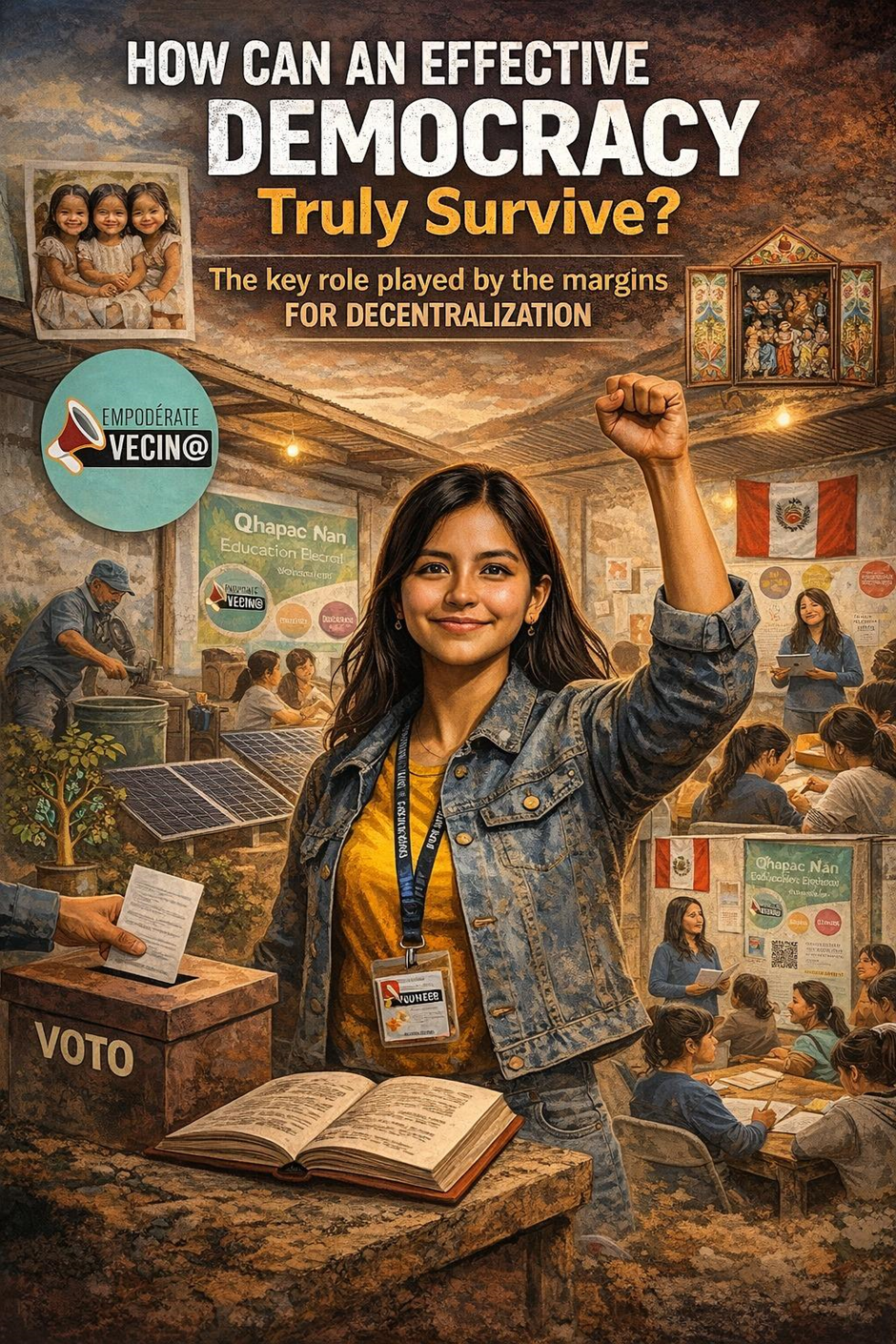
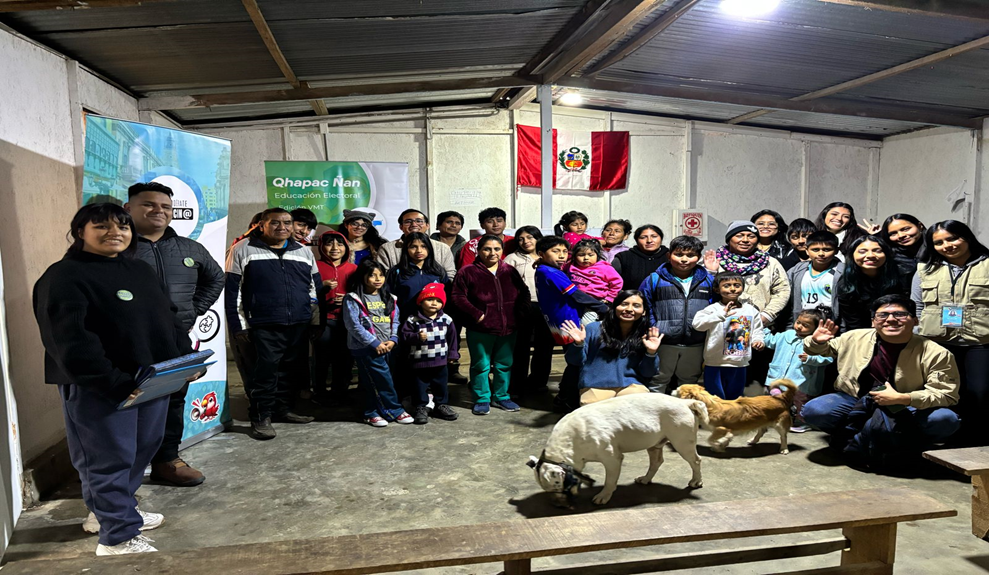
Despite this, the organization has consolidated itself as a space where young people from peripheral neighborhoods learn to lead, participate, and create change through everyday action. Not through rhetoric, but through practice: civic labs, civic games, workshops for young mothers, and creative participation methodologies. After my experience at the development agency within the U.S. Embassy, I decided to apply for international funding. We secured support from Global Changemakers, which allowed us to implement the project “Qhapaq Ñan Cívico.”
This electoral education and empowerment initiative was aimed at internally displaced migrant women from the other side of Lima — my community, emergent yet resilient. Many of them face triple exclusion based on gender, age, and migratory trajectory, along with limited access to safe spaces for participation.
We worked to change that reality through participatory workshops, intergenerational mentorship, and intercultural content. As part of the pedagogical design, I developed a mascot: an animated version of the Andean Cock-of-the-rock, Peru’s national bird. This character accompanies participants along the “civic pathway,” blending humor, warmth, and cultural symbolism.
In this way, the concept of Qhapaq Ñan — a Quechua term associated with the Inca road system — is reimagined as a metaphor of connection: civic pathways that cross territories where institutional democracy often arrives late or incompletely. Because it is precisely there — in the margins — where decentralized democracy must be strengthened: where the State, technology, academic opportunities, and international connection rarely converge.
This initiative is deeply personal. It represents a living expression of the principles that guide my work: that transformative education can build bridges between local realities and global aspirations for justice, sustainability, and inclusive democracy. And because, ultimately, change is driven by ordinary people, by the nobodies, the anonymous, those who rarely appear in the newspapers.
DELIBERATIVE DEMOCRACY FROM THE MARGINS: GRASSROOTS ORGANIZATIONS MATTER MORE THAN EVER
Community-based youth organizations are not born from offices nor under paternalistic, assistentialist logics. They emerge from lived experience, from territorial urgency, and from the need to solve concrete problems where the State arrives late, precariously, or simply does not arrive. However, the ecosystem of social and financial support often privileges models more comfortable for traditional cooperation: initiatives aimed “at” vulnerable populations, but not necessarily built “with” them. Projects designed from above, framed by savior narratives, backed by secured resources and prior institutional validation.
This tension reveals a structural contradiction: while the importance of empowering underrepresented populations is proclaimed, their organizational autonomy, technical capacity, and political leadership are frequently met with distrust. Youth organized within their own territories are not assistentialist projects nor symbolic extensions of traditional activism. Yet they often face a silent delegitimization when they attempt to articulate networks, mobilize communities, or generate advocacy, as they are frequently not taken seriously.
A problematic logic persists within certain social support and funding ecosystems: narratives, representation, and even the “marketing of the cause” are expected to be led by external actors with greater economic capital. Collective action appears to require the mediation of a savior figure — someone with resources, status, or symbolic authority — who designs initiatives from a desk and speaks on behalf of those who experience inequality firsthand.
Grassroots youth organizations face a persistent paradox. They must demonstrate professionalism, impact, and sustainability while operating under conditions of high precariousness, constant self-management, and emotional exhaustion. Added to this is another challenge: the suspicion cast upon youth activism, especially when it addresses democracy, citizen participation, or institutional oversight. Today, in an international landscape where funding for democracy and civic strengthening is shrinking, the pressure is even greater. Defenders of democracy — particularly those who work within and belong to excluded territories — face not only budgetary constraints, but also symbolic and material risks.
In countries such as Peru, this tension acquires complex issues. Advocacy on democracy and electoral education, far from always being recognized as a contribution to democratic development, can become a source of professional vulnerability. For many young people, active engagement in these spaces entails real costs in employability, job stability, and even personal safety. All of this unfolds within a context marked by low electoral trust, party fragmentation, the expansion of organized crime in peripheral territories, the normalization of extortion in public spaces, and the weakening of civic space.
In the face of this panorama, grassroots organizations do not represent a romantic gesture nor a naïve wager. Rather, they constitute living democratic infrastructures: spaces where deliberation is practiced, citizenship is built, and social bonds essential to democratic stability are sustained. Transforming concerns into collective action is not easy — even less so when dealing with agendas that rarely appear “attractive” to funding mechanisms despite their structural urgency.
And yet, I remain convinced: Peru needs more than ever spaces for civic education, electoral literacy, and democratic leadership, particularly as the country moves toward general elections described by many analysts as among the most complex in its history, in a landscape with 38 political parties and a citizenry increasingly disconnected from institutional politics.
CONCLUSION: DEMOCRACY IS DEFENDED WHERE LEAST ATTENTION IS PAID — THE MARGINS.
Democracy is not sustained solely by institutions, norms, or electoral processes. It rests above all on everyday practices, on social bonds, and on people’s capacity to organize, deliberate, and construct collective solutions. A truly living democracy is not merely administered from above: it is built from below. This demands an urgent ethical and political call: to recognize that democracy is also a territorial experience, one that must be lived, contested, and strengthened precisely where it has historically been most fragile — the margins.
It requires rethinking public policy through a territorial lens and listening to those who for decades have been considered social, political, or economic peripheries — not as a symbolic gesture, but as a structural condition for democratic legitimacy. Because citizen participation is not a complement to democracy. It is its invisible infrastructure.
Sometimes it rains. Sometimes exhaustion outweighs optimism. Yet even on those days, I wake up motivated when I see tangible results in Empodérate Vecino(a) — a space that has become my refuge for civic engagement and living proof that another way of practicing citizenship is possible. I continue applying. I continue studying. I continue preparing myself technically and professionally. And I aspire to find work where I can keep reimagining, from within, how the State, public policy, and democracy can better dialogue with people’s lived realities.
This article is not a success story. It is a story still under construction. Because I am still striving for stability, for professional growth, for new opportunities. But I also know I am not alone. There are thousands of us, across different territories, weaving another way of doing politics — grounded in collective purpose.
Democracy will survive if it learns to look where it has never truly looked. If it recognizes that its defense does not occur only in grand national debates, but also in neighborhoods and grassroots organizations that sustain the public sphere through fragility and hope.
Because, ultimately, democracy reinvents itself precisely where it is least observed.
.


 gapwblog